"My Future Is Not Here": Youth Perceptions and Migration Intentions in The Gambia
Abstract
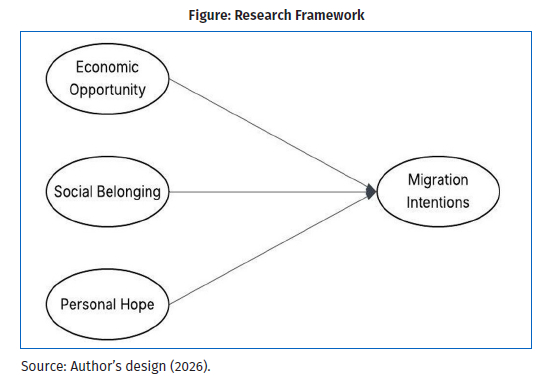
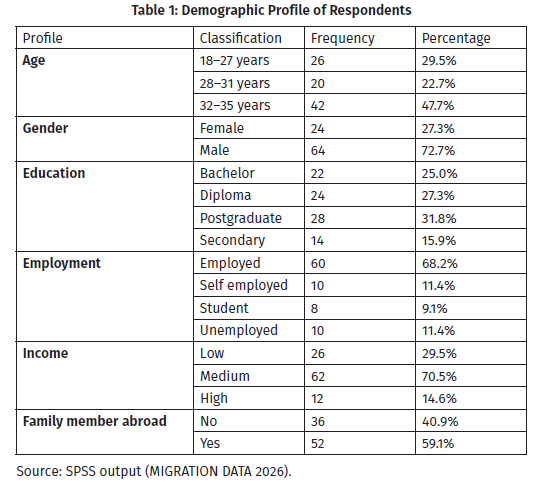
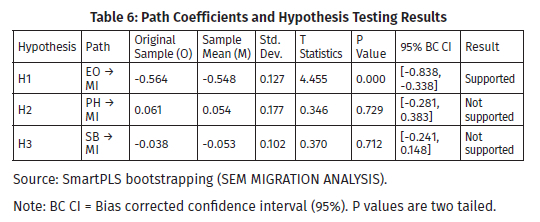
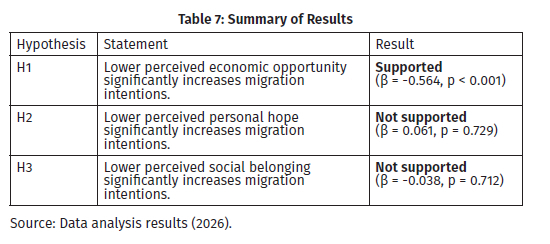
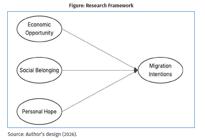
This study examines the relationship between youth perceptions and migration intentions in The Gambia, where irregular migration to Europe remains persistently high. The objective was to determine whether perceived economic opportunity, social belonging, and personal hope influence young Gambians' intentions to leave permanently. A quantitative cross-sectional design was used, with a structured questionnaire administered to 88 young Gambians aged 18-35 years. Data were analyzed using the Statistical Package for the Social Sciences (SPSS) software for descriptive statistics and the Smart Partial Least Squares (SmartPLS) statistical software program for structural equation modeling. The findings show that perceived economic opportunity has a strong, negative, and significant effect on migration intentions. Young Gambians who believe decent work and fair income are unavailable at home are substantially more likely to intend to migrate. In contrast, neither perceived social belonging nor perceived personal hope shows a significant relationship with migration intentions. These results demonstrate that economic perceptions are the dominant driver of migration intentions among Gambian youth, while social and psychological factors play a minor role. The findings are useful, because they shift policy toward improving young people's perceptions of local economic opportunity through visible job creation, entrepreneurship support, and credible success stories, rather than interventions centered on hope or social cohesion alone.
Perceived economic opportunity; social belonging; personal hope; push factors
 Thumbnail