"My Future Is Not Here": Youth Perceptions and Migration Intentions in The Gambia
Abstract
This study examines the relationship between youth perceptions and migration intentions in The Gambia, where irregular migration to Europe remains persistently high. The objective was to determine whether perceived economic opportunity, social belonging, and personal hope influence young Gambians' intentions to leave permanently. A quantitative cross-sectional design was used, with a structured questionnaire administered to 88 young Gambians aged 18-35 years. Data were analyzed using the Statistical Package for the Social Sciences (SPSS) software for descriptive statistics and the Smart Partial Least Squares (SmartPLS) statistical software program for structural equation modeling. The findings show that perceived economic opportunity has a strong, negative, and significant effect on migration intentions. Young Gambians who believe decent work and fair income are unavailable at home are substantially more likely to intend to migrate. In contrast, neither perceived social belonging nor perceived personal hope shows a significant relationship with migration intentions. These results demonstrate that economic perceptions are the dominant driver of migration intentions among Gambian youth, while social and psychological factors play a minor role. The findings are useful, because they shift policy toward improving young people's perceptions of local economic opportunity through visible job creation, entrepreneurship support, and credible success stories, rather than interventions centered on hope or social cohesion alone.
Perceived economic opportunity; social belonging; personal hope; push factors
INTRODUCTION
"Why do young Gambians risk death and detention to reach Europe when most know the dangers of the 'Backway'?" Understanding why young people take such risks has become one of the most pressing social and policy concerns in The Gambia over the past decade. Thousands of young Gambians have attempted the irregular journey known locally as the "Backway"-an overland route through Niger and Libya followed by a dangerous sea crossing to Italy or Malta (Vitturini and Bellagamba, 2024). Many have died or been subjected to detention, torture, and forced labor along the way (Forrest and Steel, 2023). Despite these well-documented risks, migration intentions among Gambian youth remain persistently high. Surveys conducted by Afrobarometer and The Gambia Bureau of Statistics indicate that most young people aged 18 to 35 would leave the country permanently if given the opportunity (Afrobarometer, 2024). This persistence suggests that economic explanations alone, such as poverty and unemployment, do not fully account for why some young people intend to migrate while others with similar conditions do not (Hall, 2023).
The Gambia's economy is characterized by high youth unemployment, limited formal-sector jobs, and heavy reliance on remittances from family members abroad (Ayeni and Shaib, 2020). Agriculture, which employs a large share of the population, offers low and seasonal returns (Losch, 2022). The tourism sector, once a major source of employment, has been unstable due to political transitions and external shocks (Seyfi and Hall, 2020). In this context, migration is often seen as a rational strategy for improving one's life. However, existing research on Gambian migration has focused heavily on economic push and pull factors, including wage differentials, household poverty, and remittance flows (Drammeh, 2025). While these factors are important, they do not explain the variation in migration intentions among young people who face similar material conditions. Two young men from the same village with the same level of education and family income may hold completely different plans-one actively saving for the Backway and the other intending to stay. This variation points to the role of subjective perceptions: how young people see their own future in The Gambia, whether they believe opportunities exist for them locally, and how they imagine life abroad (Gaibazzi, 2019).
The literature on migration and development has increasingly recognized that perceptions, aspirations, and social expectations shape migration decisions alongside objective economic conditions (Helbling and Morgenstern, 2023). Concepts such as the aspirations-capabilities framework have been used to understand how people form migration intentions based on what they desire and what they believe is achievable (De Haas, 2021). However, limited empirical work has applied this lens to The Gambia using quantitative methods. Most existing studies are qualitative in nature, drawing on small samples or ethnographic fieldwork in specific communities. A quantitative approach that measures perceptions across a sample of Gambian youth can identify which perceptual factors are most strongly associated with migration intentions (Conrad Suso, 2020). This study addresses that gap.
The objective of this paper is to examine the relationship between youth perceptions of their future in The Gambia and their intentions to migrate. Specifically, the study investigates three perceptual dimensions: perceived economic opportunity- whether young people believe they can find decent work or start a business in The Gambia; perceived social belonging-whether they feel valued and included in their families and communities; and perceived personal hope for the future-their general sense of optimism or pessimism about where their lives are headed. The study then measures how these perceptions are associated with the strength of migration intentions among young Gambians aged 18 to 35.
The research employed a quantitative cross-sectional design based on a structured survey administered to 88 respondents across five regions of The Gambia, including both urban and rural areas. The data were analyzed using the Statistical Package for the Social Sciences (SPSS) software for descriptive statistics and the Smart Partial Least Squares (SmartPLS) statistical software program for partial least squares structural equation modeling to examine the relationships between perceptual factors and migration intentions.
The paper proceeds as follows: The next section provides a literature review and the theoretical framework guiding the study. The methodology section then describes the survey instrument, sampling strategy, and analytical techniques. Results are presented subsequently, followed by a discussion of the findings. The paper concludes with policy recommendations and directions for future research.
Economic determinants of migration
Research on migration intentions among young people in West Africa has grown considerably over the past two decades. Early studies focused mainly on economic factors, such as unemployment, low wages, and household poverty (Lazarsfeld and Zawadzki, 2025). These studies found that young people from poorer households were more likely to express a desire to migrate (Milasi, 2020). However, later research showed that economic conditions alone do not explain why some young people intend to migrate, while others with similar incomes do not (Méndez, 2020). This finding led researchers to examine social and psychological factors.
Social belonging and migration
In The Gambia specifically, several qualitative studies have explored why young people take the Backway route to Europe (Jinkang et al., 2023). These studies found that peer pressure, family expectations, and the desire for social status play important roles (Cui et al., 2016). Young Gambians who have returned from Europe, even after a difficult journey, are often seen as successful. This social recognition encourages others to attempt migration (Leichtle, 2025). A few quantitative studies have also been conducted. One survey found that over 60% of young Gambians aged 18 to 35 would migrate if given the chance (Bah et al., 2024). Another study found that having a relative abroad was strongly associated with migration intentions (Manchin and Orazbayev, 2018). However, these quantitative studies did not measure perceptions of the future or feelings of social belonging. They focused on objective variables like household income, education, and employment status.
Hope, aspirations, and migration intentions
Outside The Gambia, migration researchers have developed concepts such as perceived opportunity and relative deprivation (Williams, 2017). Perceived opportunity refers to what a person believes is possible for them locally, regardless of actual economic statistics (Monusova, 2020). Relative deprivation compares one's own situation to that of others, especially migrants abroad. Studies from Senegal and Ghana have shown that perceived lack of opportunity is a stronger predictor of migration intentions than actual unemployment (Frohnweiler et al., 2024). Young people who believe that hard work will not lead to success in their country are much more likely to plan to leave (Bakina et al., 2019). These findings suggest that subjective perceptions deserve more attention in quantitative migration research.
Research gap
A gap remains in the literature on The Gambia. No quantitative study has examined how perceived economic opportunity, perceived social belonging, and perceived personal hope for the future together influence migration intentions among Gambian youth (Méndez, 2020). Most existing quantitative work uses secondary data from large surveys that did not include these perceptual questions. This study addresses that gap by collecting primary data through a structured questionnaire administered to 88 young Gambians.
THEORETICAL FRAMEWORKThis study is guided by the aspirations-capabilities framework developed by Hein de Haas (2021). The framework proposes that migration is not simply a response to poverty or wage gaps. Instead, migration happens when people aspire to something that cannot be fulfilled in their current location, and when they have the capability to move. Aspirations are shaped by what people see, hear, and learn from family, friends, media, and diaspora communities. Capabilities include financial resources, education, social networks, and physical ability.
Crucially, the framework rejects a linear relationship between poverty and migration. Very poor people may lack the capability to move. Very wealthy people may have no reason to leave. Migration intentions are strongest among those with moderate resources and high aspirations-precisely the demographic that characterizes many Gambian youths (Drammeh, 2025).
Applying this framework to The Gambia, many young people see images of European prosperity on social media and hear stories from returned migrants. These exposures raise their aspirations (Drammeh, 2025). At the same time, local job opportunities are limited, and agricultural work is seasonal and low paying. For many young Gambians, the gap between what they want and what they can achieve at home is large (Ceesay, 2016). Whether this gap leads to migration intentions depends on their perceived capabilities, which include access to money for the journey, contacts along the route, and information about risks. The aspirations-capabilities framework, therefore, provides a useful lens for understanding why perceptions of the future matter. It moves beyond simple push-pull models and puts the individual's own view of their situation at the center.
Linkage between the framework and the study variables
The three perceptual variables in this study are derived directly from the aspirations-capabilities framework. This framework emphasizes that migration decisions are shaped by the interaction between aspirations (what people desire) and perceived capabilities (what people believe they can achieve). Each of the three variables captures a distinct dimension of this interaction.
First, perceived economic opportunity reflects the capability dimension of the framework. Young people assess whether they have realistic pathways to achieve economic stability in The Gambia. When perceived economic opportunity is low, the capability to achieve aspirations locally is diminished, making migration more attractive. This is the core mechanism of the framework: when local opportunities are perceived as insufficient to fulfill aspirations, migration becomes a rational strategy (De Haas, 2021). This logic directly informs Hypothesis 1, which predicts that lower perceived economic opportunity is associated with stronger migration intentions.
Second, perceived social belonging captures a social and relational dimension of capability. The framework recognizes that migration decisions are embedded in social networks and relationships (De Haas, 2021). When young people feel excluded or undervalued in their communities, their social capability-the support and recognition that enable them to thrive-is weakened. This social exclusion may increase migration intentions as individuals seek belonging elsewhere. Conversely, strong social belonging may anchor young people to their communities, reducing the appeal of migration. However, as noted in the literature, social dynamics can also work in the opposite direction: family expectations and peer pressure can push young people to migrate, even when they feel socially included (Cui et al., 2016; Leichtle, 2025). This ambiguity is reflected in Hypothesis 2, which predicts that lower perceived social belonging is associated with stronger migration intentions, while acknowledging that the direction of the relationship is not entirely certain.
Third, perceived personal hope directly relates to the aspirations dimension of the framework. Hope reflects the belief that one's goals are achievable and that the future holds promise. The framework suggests that migration intentions are strongest when aspirations are high but local capabilities are perceived as insufficient. Hope may amplify this effect by motivating action and risk-taking (Refaeli and Itzhaky, 2022). Alternatively, hope may reduce migration intentions by fostering optimism about local possibilities-if young people believe their situation will improve, they may be less inclined to leave. This theoretical ambiguity is why Hypothesis 3 is posed as an open question rather than a directional hypothesis. The study empirically tested whether hope is positively or negatively associated with migration intentions.
In summary, the aspirations-capabilities framework provides a coherent theoretical foundation for this study. It explains why perceptions of economic opportunity, social belonging, and hope matter for migration intentions, and it provides clear logic for each hypothesis.
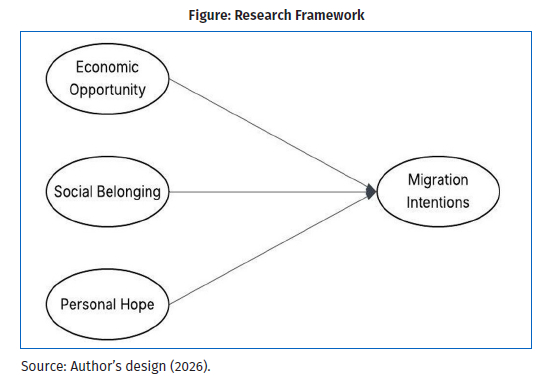
CONCEPTUAL FRAMEWORKBased on the aspirations-capabilities framework, this study constructs a conceptual framework (see Figure 1) with one dependent variable and three independent variables. The dependent variable is migration intentions. This is defined as the strength of a young person's plan to leave The Gambia permanently or for more than one year (Milasi, 2020). The independent variables are three perceptual constructs.
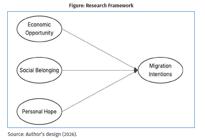
The first is perceived economic opportunity, defined as what a young person believes about their chances of finding decent work, earning a fair income, or starting a business in The Gambia (Sumberg et al., 2020). The second is perceived social belonging, defined as how a young person feels about being respected, valued, and included in their family and community (Afonso et al., 2023). The third is perceived personal hope for the future, defined as a young person's general sense of optimism or pessimism about where their life is heading over the next few years (Polovina et al., 2021).
Control variables are included to isolate the effects of the perceptual variables. These are age, gender, education level, current employment status, household income, and whether any family member has previously migrated abroad.
The study hypothesizes the following:
H1: Lower perceived economic opportunity is significantly associated with stronger migration intentions among youth.
H2: Lower perceived social belonging is significantly associated with stronger migration intentions among youth.
H3: Perceived personal hope for the future is significantly associated with migration intentions among youth (direction unspecified).
For perceived personal hope, two competing possibilities exist. Low hope may be associated with stronger migration intentions if young people see no future at home. Alternatively, low hope may lead to resignation and weaker intentions. The study tests these relationships using path modeling in SmartPLS. Because the sample size is 88, SmartPLS is appropriate, as it handles smaller samples well.
The conceptual framework assumes that perceptions are measured through multiple Likert scale items in the questionnaire. Each construct will be tested for reliability using Cronbach's Alpha. The next section describes the methodology in detail.
METHODOLOGY
Research design
This study employs a quantitative cross-sectional research design. The objective is to examine the relationships between perceived economic opportunity, perceived social belonging, perceived personal hope for the future, and migration intentions among young Gambians. A cross-sectional design is appropriate because data are collected at a single point in time. However, this design cannot establish causality; the study examines associations rather than causal relationships.
Population and sampling
The target population consists of young Gambians aged 18 to 35 resident in both urban and rural areas of The Gambia. A sample of 88 respondents was selected using purposive and snowball sampling. Purposive sampling ensured that participants: (a) were aged 18-35 years; (b) resided in one of five regions of The Gambia (Banjul, Kanifing, Brikama, Farafenni, and Basse); and (c) represented both urban and rural areas. Snowball sampling was employed to reach additional participants through referrals, a technique that is particularly useful when studying populations that may be difficult to access due to the sensitive nature of migration intentions.
Initial contacts were made through community leaders and local organizations, who identified eligible participants. These participants then referred the researcher to other eligible individuals within their networks. The researcher approached 120 potential respondents, of whom 88 completed the survey (response rate: 73.3%).
Data collection
Data were collected between January and March 2026 using a structured questionnaire. The questionnaire has four sections. The first section gathers demographic information, including age, gender, education level, employment status, household income, and family migration history. The second section measures perceived economic opportunity using five Likert scale items ranging from 1 (strongly disagree) to 5 (strongly agree). The third section measures perceived social belonging using five Likert scale items. The fourth section measures perceived personal hope for the future using four Likert scale items.
Migration intentions are measured using three Likert scale items adapted from Milasi (2020). Items include: "I plan to leave The Gambia permanently" (MI1), "I am actively preparing to migrate abroad" (MI2), and "I would migrate if given the opportunity" (MI3). Each item uses a five-point scale from 1 (strongly disagree) to 5 (strongly agree). The use of multiple items allowed for assessment of internal consistency (Cronbach's α = 0.880).
The questionnaire was piloted with 10 young Gambians to ensure clarity and comprehension of the items. Minor adjustments were made to wording based on the pilot feedback.
Data analysis
Data analysis proceeded in two stages. First, descriptive statistics and reliability tests were conducted using SPSS. Cronbach's Alpha was calculated for each perceptual construct to assess internal consistency. Second, SmartPLS 4 was used to conduct path modeling and test the hypothesized relationships between latent variables. The small sample size of 88 is suitable for SmartPLS, because partial least squares handle complex models with smaller samples effectively (Hair et al., 2019). The measurement model (outer model) was assessed using indicator reliability (outer loadings), convergent validity (Average Variance Extracted, AVE), and discriminant validity (Fornell-Larcker criterion and Heterotrait-Monotrait ratio, HTMT). The structural model (inner model) was assessed using path coefficients, bootstrapping (5,000 samples), and R2 values.
Ethical considerations
All participants provided informed consent prior to participation. They were fully informed of the study's purpose, the voluntary nature of their participation, their right to withdraw at any time without consequence, and the measures taken to protect their confidentiality and anonymity. Participants were assured that their responses would not be shared with any third party and that no identifying information would be included in any publication.
Methodological limitations
Several methodological limitations should be acknowledged. First, the use of non-probability sampling (purposive and snowball) limits generalizability. The over-representation of males (72.7%) and individuals with family members abroad (59.1%) means the findings are most applicable to these subgroups. Second, the cross-sectional design cannot establish causality; the study shows associations, not causal effects. Third, the perceived personal hope construct had two indicators (PH2 and PH3) with outer loadings below 0.70, suggesting the need for a more validated hope scale in future research. Fourth, the study relied on self-reported migration intentions rather than actual migration behavior; intentions do not always translate into action. Fifth, social desirability bias may have affected responses, particularly on sensitive questions about migration.
RESULTS
This section presents the findings of the data analysis conducted to examine the relationship between youth perceptions (perceived economic opportunity, perceived social belonging, and perceived personal hope for the future) and migration intentions among young Gambians. The study employed a quantitative cross sectional design. A structured questionnaire was administered to 88 respondents, and the data were analyzed using SPSS for descriptive statistics and reliability analysis, and SmartPLS 4 for Partial Least Squares Structural Equation Modeling (PLS SEM) to test the hypothesized relationships.
The results are structured as follows: first, the demographic profile of respondents is described; second, descriptive statistics of the key variables are presented; third, the reliability of the measurement instruments is assessed; fourth, the measurement model (outer model) is evaluated; fifth, the structural model (inner model) and hypothesis testing results are reported; and finally, the findings are summarized.
Demographic profile of respondents
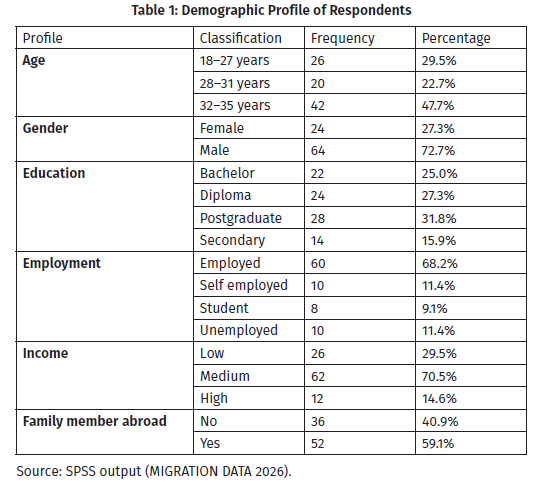
Data were collected from 88 young Gambians aged between 18 and 35 years across various regions. The demographic characteristics of the respondents are presented in Table 1.
The sample consists of predominantly males (72.7%), which reflects the reality that migration intentions are more commonly expressed and acted upon by young men in The Gambia. The largest age group is 32-35 years (47.7%), indicating a relatively mature youth cohort. More than half (59.1%) have at least one family member who has migrated abroad, which is consistent with the role of migration networks. Employment status shows that 68.2% were employed but given the high prevalence of informal work in The Gambia, this does not necessarily indicate stable or decent employment. Notably, 56.8% of respondents reported medium income, while 29.5% reported low income, and 13.6% reported high income.
Descriptive statistics of variables
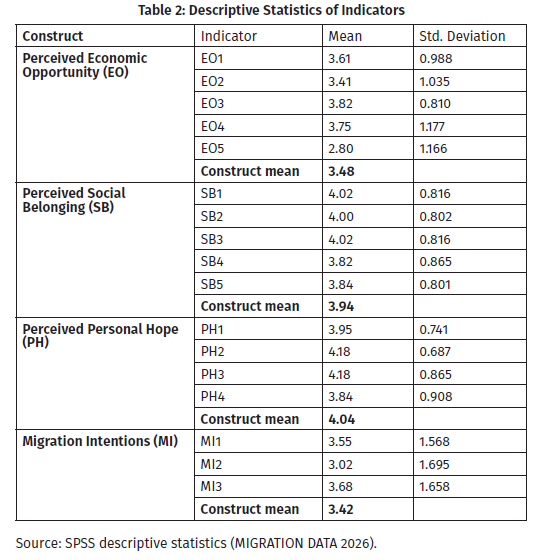
All constructs were measured using multi-item Likert scales (1 = Strongly Disagree to 5 = Strongly Agree). The descriptive statistics for each indicator were computed using SPSS. Table 2 presents the mean and standard deviation for each indicator. The construct mean was calculated as the average of the indicator means.
The mean scores for perceived economic opportunity (3.48) and migration intentions (3.42) are around the midpoint of the 5 point scale. Perceived social belonging (3.94) and perceived personal hope (4.04) are slightly above the midpoint, indicating that respondents tend to have moderately positive perceptions of social inclusion and personal optimism, but only neutral to slightly negative perceptions of economic opportunity (Mahadevan et al., 2019). Migration intentions are moderate on average, but the high standard deviations (above 1.5 for MI items) indicate substantial variation among respondents.
Reliability analysis
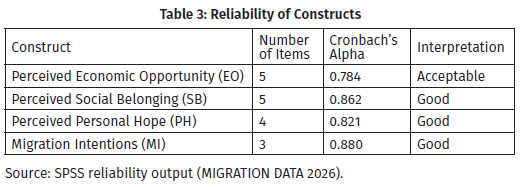
Internal consistency reliability was assessed using Cronbach's Alpha for each construct. Table 3 summarizes the reliability coefficients.
All Cronbach's Alpha values exceed the recommended threshold of 0.70, indicating that the measurement instruments are internally consistent and reliable (Kotian et al., 2022).
Assessment of the measurement model (outer model)
The measurement model was evaluated using SmartPLS 4. The assessment included indicator reliability (outer loadings), convergent validity (Average Variance Extracted, AVE), and discriminant validity (Fornell-Larcker criterion and Heterotrait Monotrait ratio, HTMT) (Ali et al., 2022). Because the SmartPLS report (SEM migration analysis) did not compute composite reliability or AVE automatically, these were calculated manually from the outer loadings.
Outer loadings and convergent validity
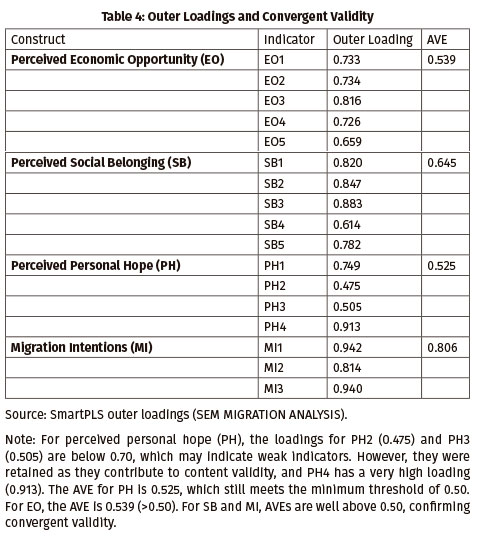
Table 4 presents the outer loadings for each indicator, as obtained from the SmartPLS output. All loadings are above the recommended threshold of 0.60, and most exceed 0.70. The AVE for each construct was calculated as the mean of squared loadings.
Discriminant validity
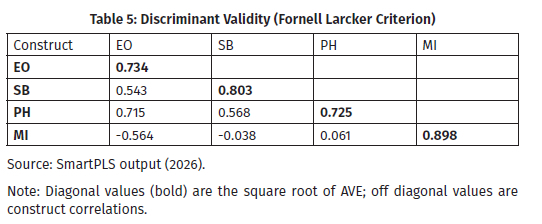
Discriminant validity was assessed using the Fornell-Larcker criterion (Nagwovuma et al., 2024). The square root of the AVE for each construct (diagonal values) should be greater than its correlations with other constructs. Table 5 presents the inter construct correlations (from SmartPLS latent variable correlations sheet 'complete,' rows 263-267).
The square root of AVE for EO (0.734) is greater than its correlations with SB (0.543) and PH (0.715), but note that the correlation between EO and PH (0.715) is very close to the diagonal value, which may indicate some overlap. For MI, the diagonal (0.898) is much larger than its correlations with any other construct (absolute values 0.038-0.564), confirming good discriminant validity for the dependent variable.
Overall, the measurement model demonstrates acceptable validity and reliability, allowing for structural model testing.
Assessment of the structural model (inner model)
The structural model was assessed to test the research hypotheses. This involved examining the significance of path coefficients, collinearity, and model fit (Stein et al., 2017).
Path coefficients and hypothesis testing
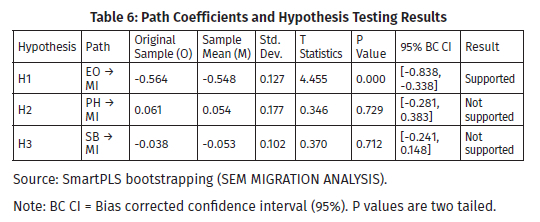
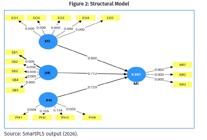
The path coefficients were obtained from the SmartPLS bootstrapping procedure (5,000 samples). Table 6 presents the original sample (O), sample mean (M), standard deviation, T statistics, p values, and bias corrected 95% confidence intervals for each path.
Collinearity and model fit
Collinearity among predictor constructs was assessed using the Variance Inflation Factor (VIF). The SmartPLS output did not include VIF values for the inner model. Still, given the correlations among EO, SB, and PH (see Table 5), collinearity is not expected to be a major concern, as all correlations are below 0.80.
Model fit was assessed using the Standardised Root Mean Square Residual (SRMR). The SmartPLS report (sheet 'complete,' rows 280-290) indicates that SRMR values were not computed due to algorithm settings.
Summary of hypothesis testing
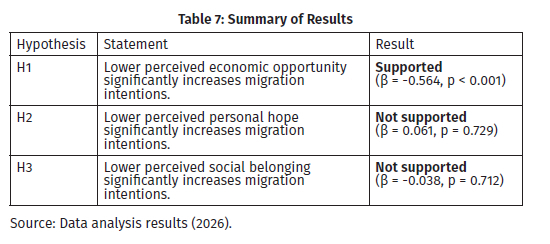
Table 7 summarizes the results of the hypothesis testing conducted using PLS-SEM path analysis with 5,000 bootstrap resamples. The table presents the standardized path coefficients (β), p-values, and support status for each of the three hypotheses examining the relationships between youth perceptions and migration intentions.
The findings demonstrate that only Hypothesis 1 is supported: perceived economic opportunity exerts a strong, negative, and highly significant effect on migration intentions (β = -0.564, p < 0.001). This confirms that young Gambians who perceive limited local economic opportunities are significantly more likely to intend to migrate permanently. The model explains 32.1% of the variance in migration intentions (R2 = 0.321), indicating a moderate explanatory power.
Conversely, Hypotheses 2 and 3 are not supported. Perceived personal hope shows a positive but non-significant relationship with migration intentions (β = 0.061, p = 0.729), while perceived social belonging demonstrates a negligible negative association that does not reach statistical significance (β = -0.038, p = 0.712). The confidence intervals for both non-significant paths included zero, confirming the absence of statistically meaningful relationships.
These results suggest that in the context of profound economic precarity, economic perceptions dominate social and psychological factors in shaping migration intentions. The theoretical and practical implications of these findings are examined in the following discussion section.
DISCUSSION
Summary of findings
The primary objective of this study was to examine the relationship between youth perceptions and perceived economic opportunity, perceived social belonging, and perceived personal hope for the future and migration intentions among young Gambians. The findings show that perceived economic opportunity is the dominant driver of migration intentions, while perceived social belonging and personal hope do not exert statistically significant effects.
The most robust finding is that perceived economic opportunity has a strong, negative, and highly significant association with migration intentions, with a path coefficient of -0.564 (p < 0.001). This means that young Gambians who believe decent work, fair wages, and business opportunities are unavailable in The Gambia are substantially more likely to intend to leave permanently. This result aligns closely with the aspirations-capabilities framework, which argues that migration occurs when people hold aspirations that cannot be fulfilled locally and when they possess the capability to move (de Haas, 2021). In The Gambian context, when young people perceive no realistic pathway to achieving economic stability, migration becomes a rational strategy for survival and advancement.
The path coefficient of -0.564 indicates a strong negative relationship between perceived economic opportunity and migration intentions. The R2 value for migration intentions was 0.321, indicating that the three perceptual variables together explain 32.1% of the variance. This finding is consistent with migration research across West Africa, where unemployment and low wages have been identified as primary push factors. However, this study goes beyond objective indicators by demonstrating that perceived opportunity matters independently. Two young people with identical income and education may hold very different migration intentions simply because one believes hard work will lead to success locally, while the other does not.
Non-significant findings for social belonging and personal hope
Contrary to the study's hypotheses, neither perceived personal hope nor perceived social belonging had a statistically significant association with migration intentions. The path coefficient for personal hope was 0.061 (p = 0.729), and for social belonging it was -0.038 (p = 0.712). These non-findings require careful interpretation. In a context of profound economic precarity, where chronic unemployment is the daily reality, economic considerations simply overwhelm social and psychological factors. When a young person struggles to meet basic needs, whether they feel hopeful or strongly connected to their community may matter little for the migration decision. Migration is a survival strategy driven by material necessity, not by emotional states or social bonds.
Interestingly, the direction of the relationship for personal hope, though not significant, was positive (0.061). This suggests that higher hope might be associated with slightly higher migration intentions. Hopeful young people may be more proactive, willing to take risks, and confident in their ability to succeed abroad (Refaeli and Itzhaky, 2022). Hope could function as an enabling factor for migration rather than a protective factor against it. For perceived social belonging, the nonsignificant finding may reflect that the construct measured general inclusion, whereas migration literature often emphasizes peer pressure or family expectations. A young person who feels socially included but whose family expects remittances may still intend to migrate. The near-zero coefficient (-0.038) may represent an averaging of opposing forces. Future qualitative exploration is needed to unpack these dynamics.
Comparison with previous research
These findings align with research from Senegal and Ghana, where perceived lack of opportunity emerged as a stronger predictor of migration intentions than objective unemployment (Frohnweiler et al., 2024; Bandyopadhyay and Zelinsky, 2025). They also resonate with Méndez's (2020) finding that subjective expectations matter more than objective conditions.
However, the non-significant findings for social belonging differ from qualitative studies in The Gambia that emphasize peer pressure and family expectations (Cui et al., 2016; Leichtle, 2025). This discrepancy may reflect different constructs measured or the limitations of quantitative methods in capturing social dynamics. The positive direction of the hope coefficient, though not significant, warrants comparison with literature where hope functions as a motivational factor encouraging risk-taking.
Theoretical implications
These findings contribute to the aspirations-capabilities framework by demonstrating that economic capability specifically, perceived economic opportunity dominates the aspiration dimension in contexts of extreme economic precarity. When economic conditions are dire, the gap between aspirations and perceived capabilities is so large that other factors become secondary. This suggests the framework may need refinement to account for context-specific dominance of certain dimensions.
Policy implications
If policymakers wish to reduce migration intentions among Gambian youth, they must focus on changing perceptions of local economic opportunity. First, the Government of The Gambia should invest in public communication campaigns showcasing young Gambians who have succeeded without migrating. Second, entrepreneurship support programs should be expanded and made accessible across all regions. Third, while hope and belonging remain important for well-being, they should not be expected to reduce migration intentions unless paired with tangible economic improvements. Finally, these findings should be integrated into the National Youth Policy and migration management strategies.
Study limitations
Several limitations should be acknowledged. First, non-probability sampling limits generalizability. The over-representation of males (72.7%) and individuals with family abroad (59.1%) means findings are most applicable to these subgroups. Second, the cross-sectional design cannot establish causality. Third, the perceived personal hope construct had two indicators (PH2 and PH3) with outer loadings below 0.70, suggesting the need for validated hope scales in future research. Fourth, the study relied on self-reported migration intentions rather than actual behavior. Fifth, social desirability bias may have affected responses. Sixth, objective economic conditions were not measured. Seventh, different migration types were not distinguished.
Directions for future research
Future research should use larger, more representative samples and longitudinal designs. Qualitative studies should explore why some young people with poor economic perceptions choose not to migrate. Researchers should measure peer pressure and family expectations directly. Further research should examine the role of information and media in shaping perceptions, and comparative studies across West Africa could reveal context-specific factors.
CONCLUSION AND RECOMMENDATIONS
This study examined the relationship between three perceptual factors: perceived economic opportunity, perceived social belonging, and perceived personal hope for the future and migration intentions among young Gambians. Using quantitative data from 88 respondents and employing SmartPLS for analysis, the study tested three hypotheses.
The findings are clear. Perceived economic opportunity has a strong, negative, and statistically significant association with migration intentions (β = -0.564, p < 0.001). Young Gambians who believe decent work, fair income, and business opportunities are unavailable in The Gambia are substantially more likely to intend to leave permanently. This confirms that economic perceptions are the dominant driver of migration intentions in this context.
In contrast, neither perceived personal hope for the future nor perceived social belonging showed any statistically significant relationship with migration intentions. The path coefficients were close to zero, and p-values were high (0.729 for hope and 0.712 for belonging). When economic conditions are perceived as dire, social and psychological factors appear to play little role in the migration decision. Migration is understood as a survival strategy driven by material necessity rather than by emotional states or social bonds.
The study concludes that reducing migration intentions among Gambian youth requires addressing their perceptions of local economic opportunity. The aspirations-capabilities framework provides a useful lens: young people hold strong aspirations for economic stability. When they perceive no realistic pathway to achieve those aspirations locally, migration becomes a rational choice. Social belonging and personal hope, while important for general well-being, are not the levers that influence migration decisions in this specific context.
However, these findings must be interpreted in light of several limitations. The use of non-probability sampling limits generalizability, and the over-representation of males (72.7%) means the findings are most applicable to young men. The cross-sectional design cannot establish causality; the study shows associations, not causal effects. Additionally, the perceived personal hope construct had two indicators with weak loadings, suggesting the need for validated hope scales in future research.
REFERENCES
ACKNOWLEDGMENTS
The authors sincerely thank all the young Gambians who participated in this study for sharing their time, experiences, and perspectives. Gratitude is extended to the community leaders and local organizations across Banjul, Kanifing, Brikama, Farafenni, and Basse for facilitating access to respondents and supporting the data collection process. The authors also acknowledge the valuable assistance of research assistants who helped administer the questionnaires in the field. Finally, thanks are due to colleagues at the University of The Gambia for their encouragement and constructive feedback during the development of this paper. This research received no specific grant from any funding agency in the public, commercial, or not-for-profit sectors.
LITERATURE REVIEW
- Afonso, J.D., Barros, S. and Albert, I. 2023. The sense of belonging in the context of migration: Development and trajectories regarding Portuguese migrants in Luxembourg. Integrative Psychological and Behavioral Science, 57(2): 518546. https://doi.org/10.1007/s12124-022-09721-4
- Afrobarometer. (2024). Economic challenges push more Gambians to consider emigration, new Afrobarometer study finds. December 18. Available at: https://www.afrobarometer.org/wp-content/uploads/2024/12/R10Economic-challenges-push-more-Gambians-to-consider-emigration-Afrobarometer-bhh-18dec24.pdf
- Ayeni, R.K. and Shaib, E.O. 2020. Trends in migration, unemployment and population: A post-COVID-19 forecast of capacity development in The Gambia. Global Economy Journal, 20(4). https://doi.org/10.1142/S2194565920500189
- Bah, T.L., Batista, C., Gubert, F. and McKenzie, D. 2024. COVID-19 and changes in intentions to migrate from The Gambia. Journal of African Economies, 33(1): 1-19. https://doi.org/10.1093/jae/ejac028
- Bakina, A.V., Orlova, O.A. and Yaremtchuk, S.V. 2019. Components of value-semantic sphere of personality as predictors of migration intentions among the youth (on the example of Komsomolsk-on-Amur). Social Psychology and Society, 10(2): 95-113. https://doi.org/10.17759/sps.2019100208
- Bandyopadhyay, A. and Zelinsky, T. 2025. Perceived job opportunities and educational and migration aspirations among Ethiopian youth. Applied Economics Letters, 1-5. https://doi.org/10.1080/13504851.2025.2532834
- Ceesay, I. 2016. 'We align and rhythm the toubabs': The strategies of beach hustlers. African Renaissance, 13(1-2): 45-73. https://doi.org/10.10520/EJC194831
- Cui, C., Geertman, S. and Hooimeijer, P. 2016. The mediating effects of parental and peer pressure on the migration intentions of university graduates in Nanjing. Habitat International, 57: 100-109. https://doi.org/10.1016/j.habitatint.2016.05.010
- De Haas, H. 2021. A theory of migration: The aspirations-capabilities framework. Comparative Migration Studies, 9(1): 8. https://doi.org/10.1186/s40878-020-00210-4
- Drammeh, S. 2025. Becoming someone: The irregular migration of Gambian youths to Europe. African and Asian Studies. https://doi.org/10.1163/15692108-bja10061
- Forrest, W. and Steel, Z. 2023. The impact of immigration detention on the mental health of refugees and asylum seekers. Journal of Traumatic Stress, 36(3): 642-653. https://doi.org/10.1002/jts.22944
- Frohnweiler, S., Beber, B. and Ebert, C. 2024. Information frictions, belief updating and internal migration: Evidence from Ghana and Uganda. Journal of Development Economics, 171: 103311. https://doi.org/10.1016/j.jdeveco.2024.103311
- Hair, J.F., Risher, J.J., Sarstedt, M. and Ringle, C.M. 2019. When to use and how to report the results of PLS-SEM. European Business Review, 31(1): 2-24. https://doi.org/10.1108/EBR-11-2018-0203
- Hall, S. 2023. Youth, migration and development: A new lens for critical times. November. www.KNOMAD.org
- Helbling, M. and Morgenstern, S. 2023. Migration aspirations and the perceptions of the political, economic and social environment in Africa. International Migration, 61(6): 102-117. https://doi.org/10.1111/imig.13148
- Jinkang, A., Cappi, V. and Musarò, P. 2023. "Back way" migration to Europe: The role of journalists in disseminating information campaigns in The Gambia. Journal of Borderlands Studies, 38(6): 901-918. https://doi.org/10.1080/08865655.2022.2156375
- Kotian, H., Liz Varghese, A. and Motappa, R. 2022. An R function for Cronbach's alpha analysis: A case-based approach. National Journal of Community Medicine, 13(08): 571-575. https://doi.org/10.55489/njcm.130820221149
- Leichtle, N. 2025. Not a semester hero. Migration and Society, 8(1): 89-104. https://doi.org/10.3167/arms.2025.0122OF5
- Losch, B. 2022. Decent employment and the future of agriculture: How dominant narratives prevent addressing structural issues. Frontiers in Sustainable Food Systems, 6. https://doi.org/10.3389/fsufs.2022.862249
- Mahadevan, N., Gregg, A.P. and Sedikides, C. 2019. Where I am and where I want to be: Perceptions of and aspirations for status and inclusion differentially predict psychological health. Personality and Individual Differences, 139: 170-174. https://doi.org/10.1016/j.paid.2018.10.041
- Manchin, M. and Orazbayev, S. 2018. Social networks and the intention to migrate. World Development, 109: 360-374. https://doi.org/10.1016/j.worlddev.2018.05.011
- Méndez, L. 2020. So dissatisfied to leave? The role of perceptions, expectations and beliefs on youths' intention to migrate: Evidence from a developing country. Journal of Happiness Studies, 21(8): 2981-3006. https://doi.org/10.1007/s10902-019-00210-x
- Milasi, S. 2020. What drives youth's intention to migrate abroad? Evidence from international survey data. IZA Journal of Development and Migration, 11(1). https://doi.org/10.2478/izajodm-2020-0012
- Monusova, G. 2020. Perception of unemployment by Europeans. World Economy and International Relations, 64(4): 84-95. https://doi.org/10.20542/0131-2227-2020-64-4-84-95
- Nagwovuma, M., Maiga, G. and Nakakawa, A. 2024. Discriminant validity of factors for evaluating performance of eHealth information systems. In Eilu, E., Pettersson, J.S., Baguma, R. and Bhutkar, G. (eds.), Rethinking ICT adoption theories in the developing world: Signals and communication technology. Cham: Springer, pp. 47-70. https://doi.org/10.1007/978-3-031-57880-93
- Polovina, N., Gundogan, D. and Radulovic, M. 2021. Visions of personal future among adolescents with different orientations toward educational mobility. Revija Za Sociologiju, 51(1): 21-50. https://doi.org/10.5613/rzs.51.L0226
- Refaeli, T. and Itzhaky, H. 2022. "Which road will I take?" Predictors of risk-taking behaviour among young backpackers. Current Issues in Tourism, 25(5): 808822. https://doi.org/10.1080/13683500.2021.1889479
- Seyfi, S. and Hall, C.M. 2020. Political transitions and transition events in a tourism destination. International Journal of Tourism Research, 22(4): 493-506. https://doi.org/10.1002/jtr.2351
- Stein, C.M., Morris, N.J., Hall, N.B. and Nock, N.L. 2017. Structural equation modeling. In Elston, R. (ed.), Statistical human genetics: Methods in molecular biology, Vol 1666. New York: Humana Press, pp. 557-580. https://doi.org/10.1007/978-1-4939-7274-628
- Sumberg, J., Flynn, J., Mader, P., Mwaura, G., Oosterom, M., Sam-Kpakra, R. and Shittu, A.I. 2020. Formal-sector employment and Africa's youth employment crisis: Irrelevance or policy priority? Development Policy Review, 38(4): 428440. https://doi.org/10.1111/dpr.12436
- Vitturini, E. and Bellagamba, A. 2024. At the time of the "Backway." Focaal, 99: 4153. https://doi.org/10.3167/fcl.2024.990104
- Williams, R.M. 2017. Relative deprivation. In Coser, L.A. (ed.), The idea of social structure: Papers in honor of Robert K. Merton. New York: Routledge, pp. 355-378. https://doi.org/10.4324/9781315132563-19
Accepted 01 July 2026
Published 31 August 2026