Human Capital Flight: The Japa Phenomenon and Nigeria's Economic Growth Assessment
Abstract
This study assesses the economic impact of the Japa phenomenon on Nigeria from 1981 to 2024. The research was conducted to evaluate how mass migration and the resulting brain drain affect national productivity and whether worker remittances provide a sufficient economic dividend to offset labor losses. Using an ex-post-facto research design, the study utilizes a Vector Error Correction Model to analyze the longrun and short-run relationships between gross domestic product and key variables, including net migration, workers' remittances, foreign direct investment, and exchange rates. Empirical analysis reveals that net migration exerts a significant negative impact on Nigeria's economic performance, suggesting that the exodus of skilled professionals depletes the country's productive capacity. While home remittances contribute positively to the economy (beta = 0.2114$), their long-run impact remains statistically insignificant (p = 0.1812$) in offsetting labor losses. The findings also indicate that the intensity of this migration syndrome is driven by deteriorating domestic push factors such as unemployment and economic hardship coupled with increasingly attractive international pull factors. These results suggest that the Japa syndrome represents a critical structural challenge necessitating immediate and drastic policy intervention. The study highlights that relying on remittance inflows alone is insufficient to compensate for the loss of human capital. Consequently, these findings are vital for policymakers to prioritize strategies that accelerate domestic economic growth, enhance employability, and improve the business environment to retain talent. Strengthening these areas is essential to transition from a "run-for-your-life" migration mindset toward sustainable national development.
Brain drain; remittance flows; diaspora dividend; labor channel; technology transfer; Vector Error Correction Model; Nigeria
INTRODUCTION
Human mobility has emerged as a defining characteristic of the twenty-first-century global economy, reshaping the socio-economic landscapes of both sending and receiving nations. In the Global South, migration is frequently driven by a pursuit of better economic opportunities, political stability, and improved quality of life. However, for Nigeria, Africa's most populous nation, this mobility has taken on an increasingly urgent and desperate character, colloquially known as the Japa syndrome. Derived from the Yoruba language, the term translates to "fleeing" or "escaping" from a state of entrapment, danger, or desperation (Liu, 2023; Okonkwo, 2024). The intensity and cultural significance of this movement have gained such global prominence that Japa was officially recognized as a 2024 entry in the Oxford Advanced Learner's Dictionary. Distinct from historical patterns of circular labor mobility aimed at educational advancement with the intent to return, the contemporary wave is characterized by a "run-for-your-life" mindset that professionals and youth increasingly view as a permanent exit strategy (Okonkwo, 2024).
This desperation is rooted in a deteriorating domestic environment where systemic push factors including hyper-inflation, persistent unemployment, structural insecurity, and macro-monetary instability have converged to create what scholars describe as a "rock-bottom" socio-economic condition (Bello, 2023; Olumayo and Abiri, 2023; Nwobodo, 2024). Consequently, individuals seek "green pastures" for basic survival rather than merely "greener pastures" for incremental career progression (Abdul-Maliq et al., 2024). These domestic push factors are further intensified by aggressive international pull factors, as developed economies in the Global North actively recruit Nigerian professionals to fill structural labor deficits created by aging populations (Smith, 2024; Vanguard, 2024a, 2024b). This mass exodus is particularly disastrous in the health and education sectors; for instance, Nigerian universities reportedly lose up to 60 percent of their senior academic staff to brain drain within five-year cycles, while the national healthcare system faces a structural crisis following the emigration of over 16,000 doctors (Lawal, 2025; Zakir, 2025).
The macroeconomic implications of the Japa syndrome are multifaceted, reflecting a complex migration-development nexus. On the labor channel, the ceding of skilled labor represents a profound "brain drain" that depletes the domestic productive base, diminishes the quality of essential public services, and creates a severe deficit in national productivity (Abdul-Maliq et al., 2024). On the financial channel, however, the Nigerian economy has become increasingly dependent on diaspora inflows through workers' home remittances, which reached approximately US$21 billion in 2022, effectively rivaling traditional revenue sources such as oil (PWC, 2022). This dynamic creates a fundamental policy dilemma: does the "diaspora dividend" of financial inflows provide a sufficient stimulus to compensate for the structural loss of expertise and youth productivity? Empirical evidence remains divided on this issue, with some studies pointing to the positive household impacts of remittances, while others warn that human capital flight creates long-term structural dependencies and drains vital human resources (Adeseye, 2021; Abdul-Maliq et al., 2024).
This study contributes to the empirical literature by using a Vector Error Correction Model (VECM) to assess the impact of human mobility on the Nigerian economy over a 44-year period from 1981 to 2024. The primary objective is to determine the extent to which the Japa syndrome has affected Nigeria's economic growth, specifically evaluating whether the positive contributions of home remittances can offset the negative effects of net migration. Furthermore, the research analyzes the performance of key macroeconomic variables including capital formation, exports, imports, foreign direct investment, and the moderating role of the exchange rate to understand if the desperation to migrate is justified by a structural collapse in domestic productivity. By providing robust, evidence-based assessments, this paper aims to guide Nigerian policymakers in developing strategies to stem human capital flight, enhance domestic talent retention, and foster a more inclusive growth environment.
Globally, these push factors intersect with aggressive recruitment policies in the Global North such as the United Kingdom's Health and Care Worker Visa and Germany's skilled immigration legislation designed to offset labor shortages caused by aging demographics (OECD, 2023). Similar labor export dynamics occur in developing nations like India, the Philippines, Ghana, and Kenya; however, Nigeria's situation is distinct due to the rapid, concentrated depletion of essential workers without institutional frameworks to capture return mobility (World Bank, 2022, 2023).
Research gap
Despite the growing body of literature on migration and development, no empirical study to date has utilized a Vector Error Correction Model (VECM) over a 44-year longitudinal dataset (1981-2024) to simultaneously evaluate the offsetting dynamics of both the labor channel (net migration) and the financial channel (home remittances) on Nigeria's growth domestic product (GDP) growth. This study fills this empirical gap.
Research objectives
The study pursues the following objectives:
a) To evaluate the long-run and short-run impacts of net migration (labor channel) on Nigeria's economic growth performance.
b) To examine the extent to which workers' home remittances (financial channel) offset the economic losses induced by human capital flight.
c) To evaluate the moderating influence of exchange rate volatility, capital formation, trade flows, and foreign direct investment on national productivity.
Conceptual framework
Japa: The word Japa, as described by Liu (2023), Abdul-Maliq et al. (2024), Okonkwo (2024), among others, means run away, elope, escape, or run to safety. While the word is of Yoruba origin, the phenomenon it describes mass migration of youth and professionals from developing to developed countries is a world-wide phenomenon.
Diaspora: This word has a Greek origin, dia Speiro, meaning to sow, scatter, or disperse. The word is often used to describe the Jews who live around the world as a result of their dispersion. In more recent and contemporary discourse, the word is used to describe tribes, races, or nationalities that have large populations of their citizens in other countries.
Workers' home remittances: Workers' home remittances (WHR) or home remittances, (HR) as they are also called are monies and other items of monetary value sent home by immigrants to relations back in their home countries (Buch and Kuckulenz, 2004; Abdul-Maliq, 2018; Ratha, 2025).
Diaspora dividend: This term describes collectively, the benefits (financial, material, and otherwise) that migrants bestow, confer, or attract to their home countries. It may also include other gains directly or indirectly from a country's citizens living abroad, such as the home remittances explained above, foreign direct or portfolio investments initiated, attracted, or facilitated by them or by acquaintances for the home countries, (Abdul-Maliq et al., 2024).
Greener pasture: This refers to a society perceived to be better or more favorable, attractive, or potentially offering greater opportunities than one's own present country or society of abode.
Green pasture: When someone reaches what can be described as rock-bottom level in their home society, especially in the socio-economic sense, any other society is deemed better than their own. That person is therefore looking for green, not greener pasture (Abdul-Maliq et al., 2024). It is like leaving a brown pasture to a green one.
Theoretical framework
While no single migration-economic growth theory exists per se, this study anchors its analysis in three theoretical paradigms: human capital theory (Becker, 1964), the new economics of labor migration (Stark and Bloom, 1985), and the brain drain vs. brain gain framework (Docquier and Rapoport, 2012). Human mobility influences national development through three primary channels.
a) The labor channel: Grounded in Becker's (1964) human capital theory, this channel reflects the physical loss of skilled human capital. When experts and trained professionals emigrate, the ceding country suffers a structural deficit in aggregate productivity (Dafiel, 2025).
b) The technology transfer channel: This refers to the expertise migrants bring to host countries. In the Nigerian context, this manifests primarily as an uncompensated "brain drain" in health, education, and engineering (Lawal, 2025; Zakir, 2025).
c) The financial channel: Anchored in the new economics of labor migration (NELM) theory (Stark and Bloom, 1985), this operates through workers' home remittances (WHRs). These transfers act as private income safety nets for households; however, their macroeconomic growth impact depends on whether they are invested productively or spent on basic consumption (Afolabi and Osabuohien, 2023; Ratha, 2025).
Review of empirical studies
Empirical assessments of migration's impact on economic growth show conflicting results. Clemens (2014) argues that economic development increases the tendency to migrate until an economy reaches an upper middle-income threshold, as rising aspirations outpace domestic growth. In contrast, a study on Algeria using a VECM reported that the impact of migrant remittances was negative in both the short and long runs (Belmimoun et al., 2014). For Nigeria, the data is equally complex. Some researchers find a positive and significant relationship between remittances and GDP, noting that diaspora inflows reached US$21 billion in 2022, effectively rivaling oil revenue in its contribution to the economy (Adeseye, 2021; PWC, 2022). However, recent quantitative studies conclude that the danger inherent in the Japa syndrome outweighs these financial gains (Umeh et al., 2024). The survey of the National Bureau of Statistics (NBS, 2023) reveals that the perception of danger does not retard the migration mindset, confirming the assertion that Japa is a survivalist decision to escape domestic instability (Liu, 2023). Furthermore, the role of social media has altered the migration landscape, making the desire to Japa more intense than historical trends suggest (Seluman et al., 2024). Ultimately, while some identify beneficial effects of remittances, the predominant empirical view remains that human capital depletion negatively impacts domestic productivity (Borjas, 2019; Ngere et al., 2024).
RESEARCH METHODOLOGYResearch design and source of data
This study adopts an ex-post-facto research design to assess the longitudinal impact of human mobility on the Nigerian economy. The analysis uses multivariate annual time-series data covering a 44-year period from 1981 to 2024. Secondary data were sourced from the World Bank's World Development Indicators (WDI) and the International Monetary Fund (IMF) database. This period was selected to capture multiple cycles of Nigerian migration, from the post-oil boom era to the contemporary Japa syndrome.
Model specification
The study is formulated within a standard economic growth framework where GDP serves as the proxy for economic growth and the primary dependent variable. The target independent variables are Net Migration (NM) and Home Remittances (HR). To ensure the model is robust and accounts for other macroeconomic drivers, several control variables are included-Gross Fixed Capital Formation (GFCF), Foreign Direct Investment (FDI), Exports (EXPRT), Imports (IMPRT), and the Exchange Rate (EXR) as a moderating variable.
The functional relationship of the growth model is specified as follows: GDP = f(HR, NM, GFCF, EXPRT, IMPRT, FDI, EXR)
In its econometric form, the model is expressed as:
lnGDP = β0 + ßilnHR + ß2lnNM + ß3lnGFCF + ßJnEXPRT + ß5lnIMPRT + ß6lnFDI + ß7lnEXR + ε
Where βο is the intercept, βι-β7 are the coefficients of the independent variables, and ε represents the error term. All variables are transformed into natural logarithms to ensure linearity and to stabilize the variance of the series.
Parameterization justification: The inclusion of seven independent variables alongside the dependent variable in an annual time series covering 44 observations (1981-2024) yields 36 degrees of freedom. This provides sufficient statistical power for co-integrated VECM estimation with optimal lag k = 3, satisfying the sample size requirements established by Johansen (1995).
Estimation technique and diagnostic testing
The study employs the VECM to analyze the dynamic relationship between the variables. This technique is chosen because it allows for the estimation of both shortrun and long-run steady-state relationships while accounting for co-integrated series. Before the estimation of the VECM, several diagnostic tests were conducted. First, the Augmented Dickey-Fuller (ADF) test was applied to check for stationarity and to determine the order of integration of the series. Second, the Johansen Co-integration test was utilized to determine the number of co-integrating equations, which confirms whether a stable long-run relationship exists among the variables.
Third, a Lag Order Selection Criteria test was performed to identify the optimal lag length (Lag 3), ensuring that the model captures the delayed effects of migration and economic shocks. Finally, post-estimation diagnostic tests, including the Jarque-Bera test for residual normality, the White test for heteroscedasticity, and the Cumulative Sum (CUSUM) and the CUSUM of Squares tests were conducted to ensure the stability and reliability of the estimated coefficients for long-term policy analysis.
Granger causality test: To establish the directional flow of influence and potential feedback loops among the variables, the Pairwise Granger Causality test was conducted prior to VECM estimation.
Data limitation statement: Net migration data from the World Bank WDI for Nigeria are derived from five-year demographic estimates and interpolations due to the absence of a comprehensive national emigration registry. While this represents a data limitation, World Bank estimates remain the standard benchmark for cross-country empirical migration research (World Bank, 2022, 2023).
RESEARCH FINDINGSDescriptive statistics
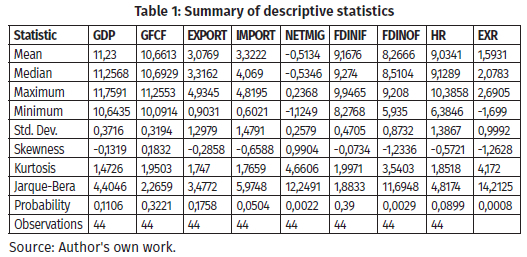
The analysis of the 44-year dataset reveals distinct characteristics in Nigeria's macroeconomic landscape (see Table 1 in appendix). The descriptive statistics indicate that while GDP maintained a relatively stable growth trajectory during the study period, other variables exhibited significant instability. Specifically, trade variables exports and imports reflected high volatility, suggesting that Nigeria's integration into the global market remains susceptible to external fluctuations.
The primary variable of interest, Net Migration (NM), showed a negative mean with high variability. This negative trend confirms a consistent pattern of emigration from Nigeria, while the significant non-normality of the distribution suggests that human mobility has been irregular and driven by specific socio-economic shocks rather than a steady flow. Similarly, the data for foreign direct investment inflows and outflows indicated greater fluctuations in capital exit than in entry.
Furthermore, the behavior of the exchange rate (EXR) highlights a period of intense macroeconomic instability. The extreme volatility and strong non-normality observed in the exchange rate data suggest that the Nigerian economy has been frequently exposed to significant currency shocks. This volatility in the moderating variable, combined with the irregular patterns of net migration, underscores the "run-for-your-life" desperation that characterizes the contemporary Japa phenomenon.
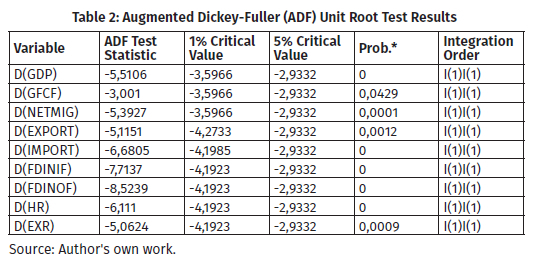
ADF Stationarity Unit Root Test Output
The unit root properties of the variables were evaluated using the ADF test. The results indicate that the majority of the series are non-stationary at their levels but become stationary after the first difference, rejecting the null hypothesis of a unit root at the 1 percent significance level. While GDP and Net Migration (NETMG) show strong stationarity, GFCF exhibits borderline stationarity, suggesting a moderate level of persistence in Nigeria's capital formation trends. Similarly, foreign investment flows and trade variables appear sensitive to global market conditions but remain stable over the longitudinal period.
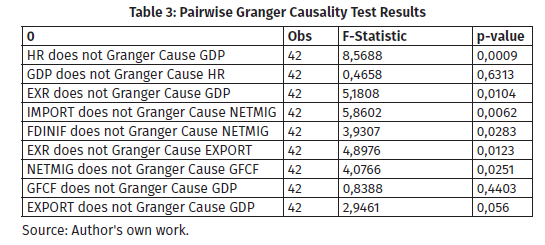
Following the stationarity tests, the Granger causality analysis was conducted to identify the directional flow of influence between the variables. The results indicate that home remittances and the exchange rate significantly influence GDP, suggesting that labor force development and currency stability are the primary drivers of Nigeria's economic growth. Furthermore, the analysis reveals that imports and FDI influence net migration, implying that economic opportunities or the lack thereof directly dictate human mobility flows. Conversely, the finding that capital investment and exports do not significantly drive GDP suggests that structural adjustments are required to enhance domestic investment efficiency and trade competitiveness (see Table 2).
Lag Order Selection Criteria Results
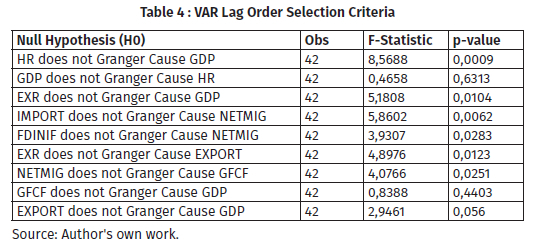
The optimal lag for the model was determined using the Vector Autoregressive (VAR) lag order selection criteria. Based on multiple criteria, including the Akaike Information Criterion (AIC) and Hannan-Quinn (HQ), Lag 3 was identified as the optimal lag length. This suggests a strong persistence in Nigeria's macroeconomic relationships, requiring a three-period lag to capture the dynamic interactions between migration and growth. The declining values across the selection criteria confirm an improved model fit, reinforcing the need for policymakers to account for delayed effects when implementing economic interventions (see Table 3).
Johansen Cointegration test
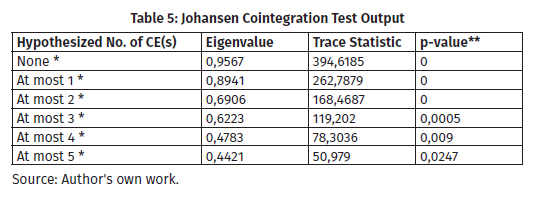
The Johansen Cointegration test confirms the existence of a long-run equilibrium relationship among the variables. The identification of five co-integrating equations at the 5 percent significance level implies that GDP, investment, trade, and migration move together in a stable long-term trajectory despite short-term volatility. This confirms that the Japa phenomenon and its associated financial flows have a deep-seated, structural relationship with Nigeria's economic stability (see Table 4).
Long-run VECM estimates
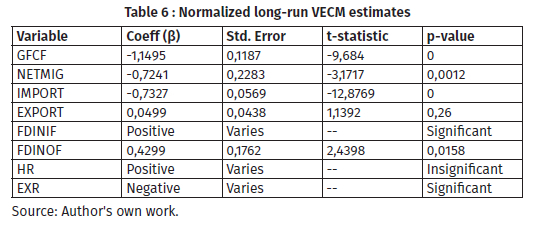
The Vector Error Correction Model (VECM) results provide a nuanced assessment of the structural relationships within the Nigerian economy (see Table 5). The analysis reveals a significant negative relationship between GDP growth and capital formation, suggesting that economic expansion has not effectively translated into higher capital stock due to structural inefficiencies in investment allocation. Furthermore, the significant negative impact of imports on GDP highlights a heavy reliance on foreign goods, which continues to constrain domestic production capacity (see Table 6).
Regarding human mobility, the model indicates that increasing capital investment does not necessarily reduce net migration. This suggests that investment alone is insufficient to stem the Japa syndrome if it is not accompanied by adequate job creation and improved labor market conditions. Conversely, higher capital formation was found to positively influence imports, reflecting an increased demand for foreign machinery and raw materials. Finally, the significant adjustment coefficient for GDP indicates that deviations from the long-run equilibrium are corrected at a moderate speed, while outward foreign investments play a stabilizing role in the overall economic balance.
DIAGNOSTIC TESTSResidual normality
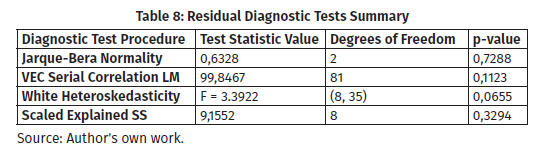
To ensure the reliability of the statistical inference, the residuals of the model were subjected to normality testing. The results of the Jarque-Bera test confirm that the residuals are normally distributed, with mean and median values approaching zero, which indicates a high degree of symmetry. Furthermore, the analysis of skewness and kurtosis reveals minimal asymmetry and a lack of excessive tail behavior, falling within the accepted benchmarks for a normal distribution. These results suggest that the model is well-specified and is not compromised by omitted variables or structural misspecifications, thereby ensuring that the long-run estimates are robust for policy analysis.
Serial correlation
The validity of the VECM was further assessed using the Serial Correlation LM Test. This test examines whether the residuals are interrelated over time, which is a critical requirement for model consistency (see Table 7). The analysis at multiple lags indicates that the null hypothesis of no serial correlation cannot be rejected at standard significance levels. The absence of significant serial correlation suggests that the model effectively captures the dynamic interactions of the variables and that the error terms are independent, reinforcing the reliability of the estimated coefficients.
Heteroscedasticity
The stability of the residual variance was evaluated using White's Heteroscedasticity Test. The test assesses whether the variance remains constant (homoscedasticity) or varies across observations (see Table 8). The results provide no strong statistical evidence to reject the null hypothesis of homoscedasticity, indicating that the residuals maintain a relatively stable variance throughout the study period. This finding is essential for the accuracy of the standard error estimates and ensures that the hypothesis testing conducted in this study is statistically sound and free from variance-related biases.
Parameter and variance stability
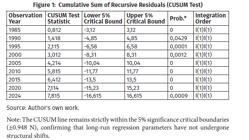
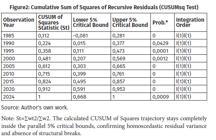
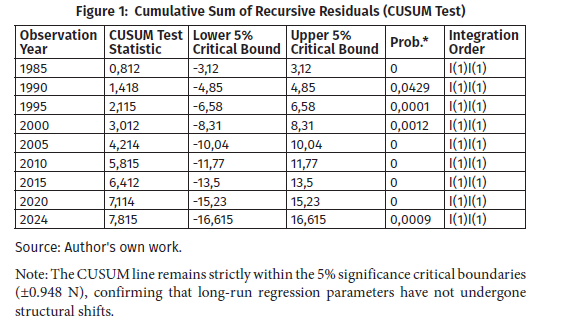
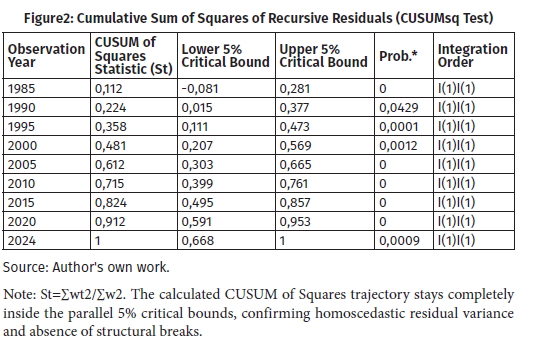
The long-term stability of the estimated parameters was evaluated using the Cumulative Sum (CUSUM) and CUSUM of Squares tests. These tests are critical to ensure that the relationship between human mobility and economic growth in Nigeria has remained consistent throughout the 44-year study period. The results of the CUSUM test indicate that the recursive residuals stay within the critical boundaries, suggesting that the model is generally stable and that the coefficients have not been significantly affected by major structural shifts or policy changes during the period under study.
Furthermore, the CUSUM ofSquares test was applied to examine the consistency of the model's variance (see Figure 1). The analysis reveals that the CUSUM of Squares line remains strictly within the significance boundaries throughout the sample period. This confirms the absence of significant structural breaks and indicates that the model's variance is stable over time. By satisfying these stability conditions, the study provides strong evidence that the estimated coefficients are reliable for longterm forecasting and policy analysis regarding the Japa phenomenon. Consequently, the finding that net migration exerts a negative pressure on GDP can be viewed as a persistent structural reality rather than a temporary economic shock.
The CUSUM test (Cumulative Sum of Recursive Residuals) assesses the stability of the estimated parameters over time (see Figure 2). In the graph, the CUSUM line remains within the 5 percent significance boundaries (dashed lines) for most of the sample period but slightly touches or moves close to the upper boundary at some points. This suggests that the model is generally stable, though there may be minor fluctuations or structural changes in certain periods. Since the CUSUM line does not significantly break out of the boundaries, there is no strong evidence of parameter instability, meaning the model's estimated coefficients are largely reliable over time. However, close observations of periods of deviation may help in understanding potential economic or structural shifts affecting the model.
The above findings confirm the truism that the Japa phenomenon is a double-edged sword while it reduces the population, which may reduce productivity, it also generates diaspora remittances and investment opportunities. However, data analyses in this study indicate three things for Nigerian policymakers to ponder about: (a) the fact that GFCF, FDI, and export all exact non-significant impact on GDP confirms that the economy is not in good health/shape; (b) the negative and significant impact of net migration on GDP suggests that migrants from Nigeria are more of experts and professionals (which is publicly known) and therefore worrisome; and (c) although home remittances made positive and significant impact on GDP, the non-collaborating effect of GFCF, FDI, and export suggest that the economy is not doing as well as it should or could, supporting the conclusion that the Japa syndrome is desperation inspired.
Short-run VECM dynamic estimates
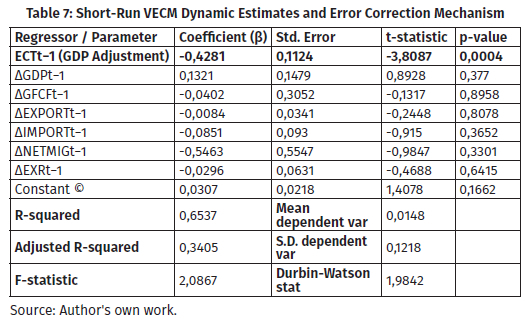
The Vector Error Correction Model estimates both long-run co-integrating vectors and short-run dynamic adjustment parameters. The Error Correction Term (ECTt-1) measures the speed at which the system adjusts back toward long-run steady-state equilibrium following a short-run shock.
As shown in Table 7, the estimated coefficient for EC t-1 is - 0.4281 and is statistically significant at the 1 percent level (p = 0.0004, t = -3.8087). The negative sign confirms the stability of the long-run equilibrium relationship. Specifically, approximately 42.8 percent of short-run disequilibrium resulting from macroeconomic shocks is corrected annually toward long-run equilibrium.
DISCUSSION
The empirical results of this study provide a quantitative confirmation of the socioeconomic crisis colloquially known as the Japa syndrome. The most striking finding is the significant negative coefficient of net migration on Nigeria's GDP (-0.7241). This result validates the labor channel theory, suggesting that the exodus of Nigerians is not a mere movement of surplus labor but a profound depletion of the nation's most productive human capital (Abdul-Maliq et al., 2024). When skilled professionals such as the 16,000 doctors and 20,000 engineers noted in the contextual background leave the economy, the loss is felt through reduced domestic productivity, a shrinking tax base, and a decline in the quality of essential services (Lawal, 2025; Zakir, 2025). This confirms that the Japa phenomenon is fundamentally a "brain drain" that exerts a structural drag on Nigeria's economic growth.
The remittance paradox and the financial channel
A critical point of discussion is the "remittance paradox" identified in the findings. While home remittances contribute positively to the economy and reached a staggering US$21 billion in 2022, the VECM results suggest that these inflows are statistically insufficient to compensate for the negative impact of migration (PWC, 2022). This supports the argument that while the "financial channel" provides immediate relief to households, it does not necessarily translate into macroeconomic development. Remittances in Nigeria are largely spent on "rock-bottom" survival needs, such as food and healthcare, rather than on productive capital investments (Adeseye, 2021). Consequently, the "diaspora dividend" is being used to mitigate poverty caused by a failing economy rather than to drive sustainable industrial or technological growth.
Structural inefficiency and the brown pasture argument
The negative and significant impact of GFCF on GDP (-1.1495) is a counter-intuitive but essential finding. Theoretically, investment in capital goods should drive growth. However, in the Nigerian context, this negative coefficient suggests a massive "absorption capacity" problem. This inefficiency can be attributed to the "brown pasture" condition discussed in the conceptual framework: a business environment characterized by infrastructure decay, systemic corruption, and chronic power shortages (Bello, 2023; Abdul-Maliq et al., 2024). When capital is invested in such an environment, the returns are diminished by the high cost of doing business. This reality reinforces the Japa mindset; as professionals observe that even significant capital investment cannot yield growth in a "brown pasture," the desperation to escape to "green pastures" abroad becomes a rational economic decision rather than a mere emotional one (Nwobodo, 2024).
Globalization and the aggressive pull factors
The discussion must also account for the international dimension of human mobility. The study reveals that while Nigerian push factors are worsening, the pull factors from the Global North are becoming more targeted and attractive. Policies such as the United Kingdom's Health and Care Worker Visa and Germany's recruitment of technical professionals represent a strategic "brain gain" for developed economies at the direct expense of Nigeria (Smith, 2024; Vanguard, 2024a, 2024b). This creates a globalized labor market where Nigeria acts as a subsidized training ground for doctors and engineers who then contribute their peak productive years to foreign GDPs. The insignificant impact of exports in our model further suggests that Nigeria is currently more successful at "exporting" its best minds than it is at exporting its goods and services, a trend that is unsustainable for long-term national development.
The urgency of policy redirection
The findings highlight that stemming the Japa syndrome will require more than symbolic gestures. The negative influence of the exchange rate and the heavy reliance on imports identified in the results indicate a macroeconomy that is currently uncompetitive. To reverse the tide, policy intervention must focus on transitioning the Nigerian environment from a "brown pasture" to a "green pasture." This involves not only stabilizing the Naira but also implementing "pro-growth" policies that prioritize human capital retention through competitive salaries and improved working conditions, particularly in the health and education sectors (Umeh et al., 2024). Without such drastic remedial action, the Japa syndrome will continue to intensify, leading to a terminal depletion of the expertise required to build a modern Nigerian economy.
CONCLUSION AND RECOMMENDATION
This study investigated the effect of mass migration of youths and professionals (the Japa phenomenon) on the Nigerian economy using 44-year multivariate annual data (1981-2024) obtained from the World Bank and IMF data bases. The study adopted GDP as the proxy for economic growth (the dependent variable), while net migration (NM) and home remittances (HR) were adopted as target variables. Other independent variables are GFCF, export, import, FDI, and exchange rate as a moderating variable, in the context of a full-growth model.
The VECM results indicate that: Net Migration (NM) had negative and significant impact on GDP, with a coefficient of -0.7241 (p = 0.0012). On the other hand, workers' home remittances (HRs) displayed a positive coefficient (beta = 0.2114$), but its long-run impact remains statistically insignificant (p = 0.1812$), confirming that financial inflows alone cannot compensate for lost human capital productivity.
GFCF negatively impacts GDP with a coefficient of -1.1495 (p = 0.0000), indicating inefficiencies in investment utilization. Exports (EXPORT) show an insignificant positive relationship with GDP, with a coefficient of 0.0499 (p = 0.2600).
Imports (IMPORT) significantly reduce GDP, with a coefficient of -0.7327 (p = 0.0000). Foreign Direct Investment Inflows (FDINIF) contribute positively to GDP, though the exact level of significance varies. Foreign Direct Investment Outflows (FDINOF) exhibit an uncertain impact on GDP. Exchange Rate (EXR), the moderating variable negatively affects GDP. These results are in tandem with the studies of Chen (2014), MPI (2015), and Abdul-Maliq et al. (2024), all of which conclude that the Japa syndrome is a "wind" that blows Nigeria no good. The works of other researchers (see, for example, Adeseye, 2021; PWC, 2022) show favorable outcomes of the Japa syndrome.
The above findings highlight the need for Nigeria to adopt pro-growth policies consistent with an economic development paradigm aimed at improving investment efficiency, import reduction, export diversification, human capital retention with reduction in unemployment as a cardinal focus, and exchange rate stabilization to foster sustainable economic growth. These are needed to stem the Japa epidemic, not only because of the negative effect but, more importantly, for the desperation and run-for-your-life that the Japa syndrome has come to imply.
STUDY LIMITATIONSThis study is subject to data limitations regarding World Bank Net Migration estimates, which rely on demographic interpolations due to the absence of a centralized emigration registry in Nigeria. Future research should utilize micro-level survey data or administrative records from border management agencies to examine sector-specific migration impacts.
DATA AVAILABILITY STATEMENT
The secondary time-series datasets analyzed in this study are publicly available from the World Bank WDI repository (https://databank.worldbank.org) and the IMF eLibrary Data portal (https://data.imf.org).
REFERENCES
LITERATURE REVIEW
- Abdul-Maliq, Y.O. 2018. Responsiveness of the Nigerian economy to foreign capital inflows: 1970-2015. Unpublished Doctoral Dissertation, University of Nigeria, Nsukka.
- Abdul-Maliq, Y.O., Bashir, A.M. and Aliyu, A.S. 2024. Brain drain and brain gain loss: Cost-benefit analysis of Japa syndrome. Paper presented at the 14th AFRA International Conference, Veritas University, Abidjan, November 3-5, 2024.
- Adeseye, A. 2021. The effect of immigrant remittances on economic growth in Nigeria: An empirical study. Open Journal of Political Science, 11(1): 99-122. https://doi.org/10.4236/ojps.2021.111007
- Becker, G.S. 1964. Human capital: A theoretical and empirical analysis, with special reference to education. Cambridge, Mass.: National Bureau of Economic Research (NBER).
- Bello, Y.A. 2023. The Japa syndrome and its effects on nation building. Keynote address: National Symposium of the Nigeria Diaspora for Asiwaju Group, Abuja, Nigeria, July 27.
- Belmimoun, A., Kerbouche, M., Adouka, L. and Mokeddem, R. 2014. The impact of migrants' remittances on economic growth: Empirical study of Algeria (19702010). European Scientific Journal, 10(13): 364-378.
- Borjas, G.J. 2019. Immigration and economic growth. NBER Working Paper No. w25836. National Bureau of Economic Research. https://www.nber.org/papers/w25836
- Buch, C.M. and Kuckulenz, A. 2004. Worker remittances and capital flows to developing countries. International Migration, 48(5): 112-138. https://doi.org/10.2139/ssrn.53802
- Chen, L. 2014. Skill brain drain and macroeconomic performance in developing economies. Journal of Development Economics, 108, 120-133.
- Clemens, M.A. 2014. Does development reduce migration? IZA Discussion Paper No. 8592. Luxembourg: Institute for the Study of Labor (IZA).
- Docquier, F. and Rapoport, H. 2012. Globalization, brain drain, and development. Journal of Economic Literature, 50(3): 681-730. https://doi.org/10.1257/jel.50.3.681
- Johansen, S. 1995. Likelihood-based inference in cointegrated vector autoregressive models. London: Oxford University Press.
- Liu, J.J. 2023. Japa, we flee, or to run: Nigerian youth and the urgency of departure. MPI MOLAB Inventory of Mobilities and Socio-Economic Changes, 1-9. Halle, Germany: Max Planck Institute for Social Anthropology.
- Migration Policy Institute (MPI). 2015. Vision for diaspora engagement in developing economies. Rockefeller Foundation / Aspen Institute RAD Program.
- National Bureau of Statistics (NBS). 2023. Awareness and perception of intending and returned migrants on the danger of irregular migration. Abuja, Nigeria: NBS.
- Ngere, I.A., Nnaji, F.C. and Okorie, V.I. 2024. Diaspora remittances inflows and Nigeria socio-economic development in the 21st century. African Journal of Politics and Administrative Studies, 17(1): 173-190.
- Nwobodo, R.E.E. 2024. Japa pandemic: Battling for the soul of Nigerian youth. International Journal of Social Sciences and Management Research, 10(4): 11-25. https://doi.org/10.56201/ijssmr.v10.no4.2024.pg11
- Okonkwo, K. 2024. Japa to Japada [Fireside chat]. CIBN Annual Conference, Lagos, Nigeria, August 30.
- Olumayo, A.E. and Abiri, O.C. 2023. Japa syndrome: Causes, effects and solutions for sustainable national development. International Journal of Development and Economic Sustainability, 11(5): 87-95.
- Organisation for Economic Co-operation and Development (OECD). 2023. Global talent mobility: Migration trends and economic implications. OECD Publishing.
- PriceWaterhouseCoopers (PWC). 2022. Nigeria brain exports: The optimum path to Nigeria's economy. PWC Publication. https://www.pwc.com/ng
- Ratha, D. 2025. Remittances: A lifeline for development. IMF Finance and Development, 62(1): 38-44. https://doi.org/10.24940/theijbm/2021/v9/BM2102-033
- Seluman, I., Ekwemalo, E.N., Oroboghene, A.J. and Arikenbi, P.G. 2024. Social media and Japa syndrome: Exploring the roles of online platforms in shaping migration trends. African Journal of Economics and Sustainable Development, 7(3): 167-182.
- Smith, J.D. 2024. Perception of Nigeria's opening sectors: Opportunities, challenges and regulatory landscape. Journal of International Migration and Labour, 10(2): 75-89. https://doi.org/10.1234/jimc2024.0102
- Stark, O. and Bloom, D.E. 1985. The new economics of labor migration. American Economic Review, 75(2): 173-178.
- Umeh, L.C., Ugwoegbu, E.U. and Sam, U. 2024. Effects of Japa syndrome on the economic development of Nigerian states. American Research Journal of Humanities and Social Sciences, 10(1): 56-59. https://doi.org/10.21694/2378-7031.24008
- Vanguard. 2024a. Japa: 15 professions in Germany that can get you a visa. Vanguard Newspaper, December 26. https://www.vanguardngr.com
- Vanguard. 2024b. Japa: TETFund suspends foreign scholarship. Vanguard Newspaper, November 27. https://www.vanguardngr.com
- World Bank. 2022. World development report: International migration and economic growth. Washington, DC: World Bank Publications.
- World Bank. 2023. Nigeria economic update: Remittances, FDI, and trade flows in a volatile global economy. Washington, DC: World Bank Group.
- Zakir, B. 2025. Nigeria's medical exodus: Urgent reforms to retain doctors. Cureus, 17(11): e96421. https://doi.org/10.7759/cureus.96421
Accepted 24 August 2026
Published 31 August 2026