Navigating Borders and Screens: ICT Practices and Digital Migratory Mimicry in the Sub-Saharan Boza Journey
Abstract
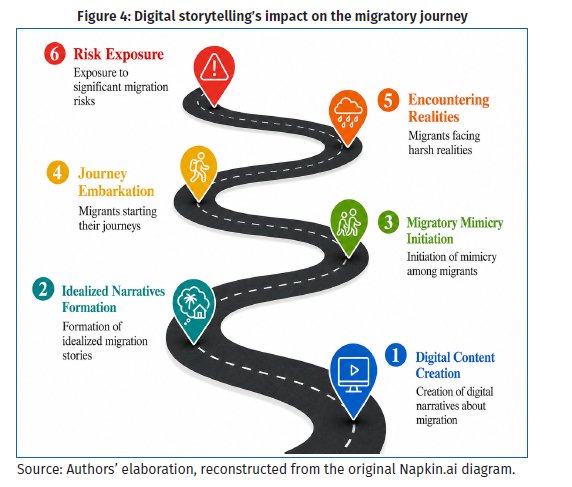
This study addresses methodological and theoretical gaps in digital migration studies. It explores the impact of Information and Communication Technologies (ICTs) on the imaginaries and migration trajectories of undocumented sub-Saharan migrants, notably Cameroonians en route to Europe via Morocco. Drawing on an innovative hybrid, multi-situated approach that combined in-depth biographical interviews, digital narrative cartography, and virtual ethnography of a boza Facebook group, it revealed the profoundly ambivalent role of ICTs across successive stages of the migratory journey. For undocumented migrants, these technologies serve both as empowering survival toolkits and as sources of vulnerability, while contributing to digital imaginaries that may encourage people to replicate migration patterns. The research advanced the notion of "digital migratory mimicry" as an analytical framework for understanding how idealized success narratives, circulating on social media platforms, can reinforce unrealistic aspirations and mimetic orientations toward high-risk migration. This work goes beyond rational-choice models to apprehend undocumented migration as a process intricately shaped by individual affective dynamics and collective digital practices and imaginaries, thus providing new conceptual perspectives for digital migration studies.
ICT practices; sub-Saharan undocumented migrants; boza Facebook groups; map-elicitation interview; virtual ethnography; digital migratory mimicry
 Thumbnail
 Thumbnail
 Thumbnail
 Thumbnail