Navigating Borders and Screens: ICT Practices and Digital Migratory Mimicry in the Sub-Saharan Boza Journey
Abstract
This study addresses methodological and theoretical gaps in digital migration studies. It explores the impact of Information and Communication Technologies (ICTs) on the imaginaries and migration trajectories of undocumented sub-Saharan migrants, notably Cameroonians en route to Europe via Morocco. Drawing on an innovative hybrid, multi-situated approach that combined in-depth biographical interviews, digital narrative cartography, and virtual ethnography of a boza Facebook group, it revealed the profoundly ambivalent role of ICTs across successive stages of the migratory journey. For undocumented migrants, these technologies serve both as empowering survival toolkits and as sources of vulnerability, while contributing to digital imaginaries that may encourage people to replicate migration patterns. The research advanced the notion of "digital migratory mimicry" as an analytical framework for understanding how idealized success narratives, circulating on social media platforms, can reinforce unrealistic aspirations and mimetic orientations toward high-risk migration. This work goes beyond rational-choice models to apprehend undocumented migration as a process intricately shaped by individual affective dynamics and collective digital practices and imaginaries, thus providing new conceptual perspectives for digital migration studies.
ICT practices; sub-Saharan undocumented migrants; boza Facebook groups; map-elicitation interview; virtual ethnography; digital migratory mimicry
INTRODUCTION
Digital technologies, previously luxury items reserved for the affluent, have become accessible across all social strata. Researchers (Diminescu, 2008; Hamel, 2009; Dekker and Engbersen, 2014; Frouws et al., 2016; Akanle et al., 2021) who explored the relationships between migration and digital connectivity drew attention to the reshaping of mobility dynamics, with ICTs now deeply integrated into migratory processes and experiences. Formerly a lonely and arduous undertaking, irregular migration is nowadays increasingly shaped by digital connectivity, though access to mobile technologies remains uneven (Hamel, 2009; Zijlstra and Van Liempt, 2017).
Undocumented migrants rely on mobility technologies to navigate the journey's complexities (Schaub, 2012; Zijlstra and van Liempt, 2017; Gillespie et al., 2018). Social media platforms, messaging applications, and mobile devices play a central role by providing critical resources for information, network building, and journey planning (Porter et al., 2012; Frouws et al., 2016; Seymen, 2017; EU, 2018). However, as previous researchers (Van Esseveld, 2019; Nedelcu and Soysüren, 2020; Schöpke-Gonzalez and Schaub, 2023) have shown, these same technologies can also function as instruments of surveillance, exploitation, and misinformation, intensifying vulnerability and underscoring the paradoxical nature of ICTs in migration contexts.
Building on an interest in the digitization of the migration process, this study pursued two objectives. It first sought to explore how ICTs are used throughout the journey by sub-Saharans following non-conventional migratory routes to cross the Morocco-Europe border. These migrants face unique challenges associated with the irregular nature of their mobility, raising important questions about ICTs' role in the digital navigation of uncertainty and the shaping of the migratory experience. The second aim was to explore ICTs' role in the popularity of irregular migration despite its deadly risks. We hypothesized that social media, particularly Facebook, functions as a web of "digital migratory mimicry." By this notion we mean the socio-numerical process by which digital narratives of successful unauthorized border crossings may reinforce the dynamics of aspiration and imitation, thereby contributing to the reproduction of irregular migratory flows (see forward section "Digital mimicry networks").
DIGITAL PASSAGES: HOW ARE ICTs RESHAPING SUB-SAHARAN IRREGULAR MIGRATION DYNAMICS?
The field of digital migration studies is highly interdisciplinary, with diverse contributions from social sciences and humanities highlighting the pivotal role of ICTs in shaping migration globally. Researchers like Leurs and Prabhakar (2018: 247) emphasize how ICTs have "altered a variety of migration dynamics." In 2015, the images of Syrian refugees making their "digital passage to Europe" left a particularly lasting impression (Gillespie et al., 2018: 1). In the sub-Saharan African context, the transformative impact of mobile telephony and Internet infrastructure on mobility began to emerge as telecommunications operators "introduced a substantive and accessible communications infrastructure to large parts of the trans-Saharan space for the first time" (Schaub, 2012: 127). This has revolutionized various aspects of people's lives, particularly their national, transnational, and intercontinental mobility. Unquestionably, mobility has always existed, but as Nyamnjoh (2013: 108) points out, "What is new today are the forms and dynamism that it has taken as a result of advances in ICTs and transport networks."
Investigating the impact of ICTs on migratory mobility, researchers first noticed a close relationship between Internet access and the desire or intention to migrate. In a study that targeted 50,953 individuals in 29 African countries, Grubanov-Boskovic et al. (2021: 1818) concluded that "on average, simply accessing the web was connected to a higher propensity to aspire to move abroad, and even more making preparation to do so." However, their study's lack of specificity regarding the type of information accessed by participants limits the scope of its conclusions. Further investigation into the content and sources of information consulted should enhance our understanding of this relationship.
ICTs appear to influence the decision-making process by providing key information. According to Frouws et al. (2016: 3), one of the main reasons why irregular migrants and refugees consult virtual networks is "to gather information about suitable destinations and routes as well as integration in their intended destinations." Europe's African diaspora stands as a valuable source of information and many migrants use social media, especially Facebook and WhatsApp, to connect with their European-based compatriots (EU, 2018).
When a migrant decides to embark on the journey to Europe, ICTs assume heightened importance, while smartphones become essential tools for navigating highly perilous routes (Schaub, 2012). Frouws et al. (2016: 3) showed their usefulness for "acquiring passports and legal documents, information about best destinations, routes, and information in transit, cost of migration routes, smuggler contacts and warnings about scams and/or fraudulent smugglers as well as closed routes."
Researchers also frequently highlighted ICTs' social dimension as an often-predominant factor in understanding how migrants appropriate ICTs to their needs, in transit and in destination countries. Seymen (2017) points out that migrants continue to rely on ICTs for the maintenance, building, and mobilization of their social networks. Similarly, Porter et al. (2012) show how ICTs enable the use of social networks, as the migrants advance on their journey. Moreover, Akanle et al. (2021) note that ICTs are primarily used to maintain connections with close relatives, friends, and peers. Other research (Tall, 2004; Hunter, 2018) underscores additional functions, particularly the transfer of remittances to the country of origin, which typically emerges as a critical priority for migrants, once they attain a certain level of economic and social stability in the destination country.
Besides the significant benefits offered to migrants and their families, ICTs' negative impacts, particularly in contexts of surveillance and exploitation, also drew scholarly attention (Schöpke-Gonzalez and Schaub, 2023). Opas and McMurray (2015) show how the perception of Eritrea as an omnipotent and suspicious state fosters self-censorship among Eritrean refugees in Rome, compelling them to self-censor their ICT practices. In her study on ICTs' impacts in refugee communities, particularly concerning kidnapping cases, Van Esseveld (2019) revealed that technology can exacerbate trauma rather than provide support, thus intensifying vulnerabilities and extending distress to the victims' relatives. The findings from these last studies challenged the prevailing view that ICTs inherently promote positive migration outcomes.
Despite these valuable insights into ICTs' role in irregular migration, a critical examination revealed that most researchers focused on specific aspects of the migration process and did not present a holistic exploration of the use of ICTs throughout all the phases of the migratory journey. Such limitation was due either to the migratory status of the study population at the time of research or to the approach's "degree of digital-media-centric-ness" (Leurs and Prabhakar, 2018: 250). Stremlau and Tsalapatanis (2022: 67) confirm our hypothesis by stating that because they did not study the whole process of African migration to Europe, most researchers were "unable to find clear evidence of a general reliance on ICTs and social media during all stages of a journey."
THEORETICAL APPROACHES TO THE PERSISTENCE OF IRREGULAR MIGRATION FLOWS: A CRITICAL ASSESSMENT
Over several decades, international migration analysis was dominated by the neoclassical theory that conceptualizes migrants as rational actors looking to maximize their anticipated economic returns (Todaro, 1969). This approach has been criticized for its economic determinism, disregarding intricate migratory motivations and broader structural and social determinants (Portes, 1997). In response to the neoclassical paradigm, the new economics of labor migration (Stark and Bloom, 1985) re-frames migration as a collective household strategy to mitigate economic risks. Furthermore, migration network theory (Massey et al., 1993) emphasizes the self-sustaining nature of migration, as social connections facilitate and perpetuate it through cost- and risk-diminishing feedback loops.
Though influential, these approaches have considerable shortcomings in accounting for irregular migration. De Haas (2010) contends that expanding network ties do not automatically result in self-sustaining migration flows, since migration-facilitating and migration-undermining processes go together. This criticism aligns with a wider re-evaluation of cumulative causation theory (Massey, 1990) as overly emphasizing migration's inexorability once triggered. Instead, De Haas (2010) advances a richer understanding via the aspirations-capabilities framework. Subsequent migration decisions result from individuals' perceived opportunities, mediated by their group processes and collective imaginaries. Building on this view, Schapendonk (2014) refutes static network theories by arguing that migrants shape networks through their active participation in forming, maintaining, or breaking social connections. His "network work" concept stresses contextual, relationship-specific understanding of social capital, thus reiterating De Haas's emphasis on aspirations and capabilities. This dynamic conceptualization underscores migrants' agency and the networks' context-dependent effects.
Nonetheless, most of these theoretical approaches function in a paradigm assuming rational decision making as using relatively accurate information. Yet, as Carling and Schewel (2018) point out, migration aspirations are often formed through complex social constructs, as well as imaginaries having tenuous connections with factual realities. Migrants and prospective migrants now engage in digital socialization, accessing real-time information through "smartphones and Internet-based communication tools such as WhatsApp and Facebook for migration" (Borkert et al., 2018: 8). An often-overlooked key aspect is ICTs' role in shaping contemporary migration imaginaries, as most research focuses on their functional and utilitarian dimensions. Indeed, the specific mechanisms through which digital imaginaries 3might perpetuate irregular migration flows have not yet been fully investigated. This gap is particularly apparent when considering sub-Saharans' irregular migration to Europe, in the context of digital transformation of migration processes (Dekker and Engbersen, 2014; Zijlstra and Van Liempt, 2017).
This literature review first demonstrates the lack of theoretical analyses assessing the role of digital imaginaries, alongside economic and social determinants, in present-day irregular migration flows. Second, it identifies the need for empirical research on how these imaginaries can perpetuate irregular migration by inducing mimetic desires and irrational risky behavior. The following section outlines the problem statement and research objectives framing this study.
PROBLEM STATEMENTThis study addresses the methodological and conceptual gaps of earlier studies using a dual-pronged focus. First, it adopts a holistic approach to ICTs' role in undocumented sub-Saharan migrants' experience, analyzing the whole migratory process from initial aspirations through transit and residence in Morocco. This analysis highlights interconnections between physical and virtual spheres that form "hybrid spaces" (De Souza e Silva, 2006: 263) where digital and physical realities intertwine. Second, it examines digitally mediated imaginaries, focusing on how social media platforms generate and circulate selective representations of migration success that may reinforce aspirations and mimetic orientations toward high-risk migration.
The first research question explored how ICT use is integrated into the migration experience of undocumented sub-Saharan migrants transiting through Morocco, focusing on the holistic, qualitative, and subjective dimensions of this relationship, and examining the hybridization of physical and virtual spaces along their journey.
The second research question investigated how digital imaginaries circulating through social media-particularly within boza4 Facebook groups-contribute to shaping migration aspirations, and how digitally mediated success narratives may encourage mimetic orientations toward high-risk migration.
STUDY METHODOLOGYReconstructing the digital dimension of the irregular journey through map-elicitation interviews
In the first phase, fieldwork was conducted in Mohammedia (Morocco), where a modest yet noteworthy population of undocumented sub-Saharan migrants lives. Their presence stems from three factors: the city's medium size, its strategic geographical location between Casablanca and Rabat, and established sub-Saharan social networks that facilitate the reception of newcomers. Mohammedia is a haven offering undocumented migrants greater discretion, relative anonymity, and the ability to navigate daily life with reduced policing and security pressures.
The research design integrated biographical interviews and digital narrative cartography.5 This method relied on the use of Google Maps for participatory drawing of migratory routes and "map-elicitation interview."6 The interview structure evolved in a linear diachronic manner,7 pausing at key locations to discuss significant biographical crossroads and trace the evolution of the journey. The combination of participatory digital mapping with map-elicitation interview permitted the reconstruction of life paths and migratory routes, while unveiling the meaning ascribed to the journey.
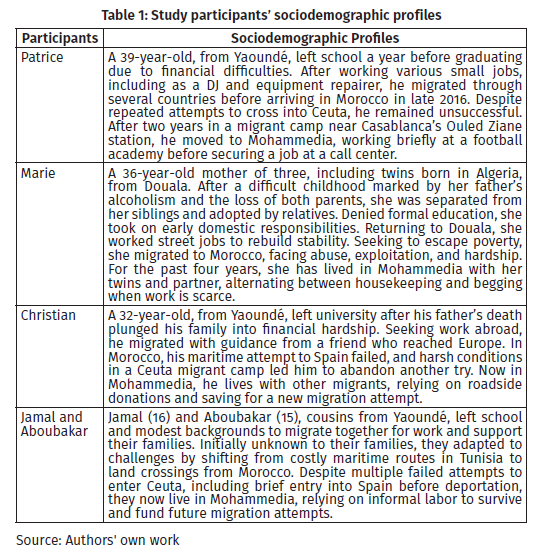
Five participants were recruited through purposive, criterion-based sampling, mainly through direct field encounters in Mohammedia; one participant was introduced by another interviewee. Eligibility required being Cameroonian, having undertaken an irregular overland journey, being undocumented in Mohammedia, having used ICTs during the journey, and having developed an onward project toward Europe by the time of fieldwork. Case selection sought variation in gender, age, migration trajectories, and digitally mediated mobility (see Table 1). The focus on Cameroonians reflected their established local presence, Cameroon's relatively developed Internet infrastructure, and the long Cameroon-Morocco distance,8which offered greater scope for examining ICT use across successive stages.
Adult participants provided oral informed consent after explanation of the study purpose, data use, and the voluntary nature of participation. The two younger participants (15 and 16), unaccompanied and without a parent or legal guardian in Morocco, provided oral assent after the same explanation and were interviewed jointly throughout. Identities were anonymized; trauma-sensitive interviewing, voluntary pauses, participant-controlled pacing, and the unconditional right to withdraw protected participants' autonomy and reduced risks of retraumatization (Hugman et al., 2011).
The small number of interviewees reflects the intensive and methodologically exploratory character of the research design. Map-elicitation required repeated two-to-four-hour sessions, averaging five encounters and 10-20 hours of interaction per participant over six months. Its exploratory application with undocumented sub-Saharan migrants also gave the study a methodologically experimental dimension, requiring a manageable sample and sufficient time for participants to become familiar with the technique. This favored reflective, unpressured engagement, participant welfare, and detailed trajectory reconstruction rather than statistical representativeness.
All interviews were conducted in French and manually transcribed by the researcher; quotations reproduced in the article were subsequently translated into English by the same researcher. Transcripts were organized in a comparative synoptic matrix structured around three stages-pre-migration, the journey to Morocco, and residence in Morocco-and recurrent analytical dimensions, including migration motivations, ICT uses, information seeking, financing, critical events, hardships, and onward projects. This enabled chronological within-case reconstruction and thematic comparison across cases.
Exploring the migration imaginary through the virtual ethnography of Facebook groups
The second phase of the investigation incorporated a virtual ethnography (Hine, 2000) of a boza Facebook group. The aim was to better understand its members' digital practices and interactions, and assess the role of digital content in constructing an idealized image of the undocumented journey.
The process of virtual ethnography began with the compilation of a list of relevant groups using Facebook's integrated search engine and keywords frequently associated with migrant discourse, such as boza, bozayeurs,9 aventuriers (adventurers), soldats migrants (soldier migrants), and infos migrants (migrant updates). This online research identified 72 groups (12 private and 60 public). The researcher subsequently joined 19 groups to observe the nature of content and establish selection criteria.
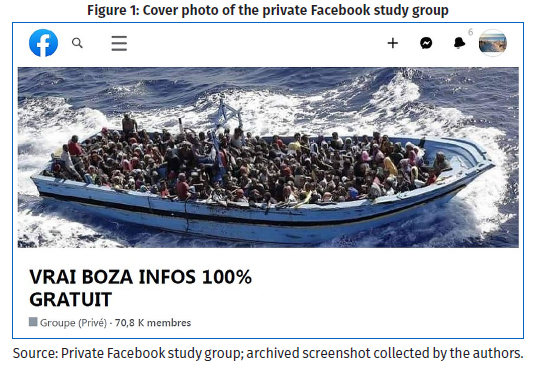
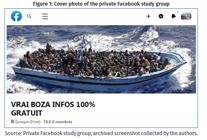
Group selection prioritized specific factors: moderate size for analytical relevance and feasibility; active participation; diverse member profiles (migrants in transit, successful migrants, smugglers, etc.); quality of exchanges; and relevance to the research focus. Following these criteria, the private group named VRAI BOZA INFOS 100% GRATUIT was chosen (see Figure 1).10 In July 2022, it had around 71,000 members, frequent and high-quality interactions, a diverse range of participants, and content aligned with the research objectives.
Data collection focused on July and August 2022, two months characterized by favorable weather and heightened migratory activity. Indeed, given the richness of the boza group content, saturation was reached after the collection of 295 posts. A predefined data collection grid recorded publication dates, authors, content descriptions, interaction metrics, "technodiscourses," and "technographisms" (Paveau, 2019a, 2019b).11 This structured approach enabled a detailed analysis of thematic trends, communication modes, and group interaction dynamics.
NAVIGATING THE IRREGULAR MIGRATION JOURNEY WITH ICTs: A FLEXIBLE AND STRATEGIC USE
Cameroonian undocumented migrants dynamically adjust their ICT use to the specific challenges and opportunities of each phase of a journey. This adjustment is influenced by their changing needs to communicate, be informed, and navigate, as they move from one stage to another. This section presents the interview findings on how ICTs are used throughout the irregular journey.
Understanding the role of ICTs in pre-migration decision making: Evidence from Cameroonian narratives
A chronological analysis of the migration journey revealed that ICTs were already present in the initial decision-making phase. This crucial first stage warrants particular attention to understand how digital content may enter into the formation of migration aspirations. Hamel (2009: 10) highlights the subjective and cognitive dimension of the migratory process: "The act of migration begins in the mind." By exposing individuals to idealized representations, ICTs contribute to the construction of migratory imaginaries. Participants' narratives illustrate the diverse digital stimuli accompanying the emergence of migration aspirations.
Christian (see Table 1) describes the inspiration drawn from social networks:
We see the stars, you see the shoes, the clothes, you look at fashion. You tell yourself, "Maybe one day I'll be like that, a well-dressed star."
For Christian, these images reinforce the appeal of a better life abroad. A similar dynamic appears in Jamal and Aboubakar's narratives (see Table 1), particularly through videos of iconic migrant success:
We used to see that on Facebook, the short videos of people in Europe who had crossed over, like for example, Francis Ngannou,12 the boxer. He passed through here [Morocco]; he was an adventurer. He became a world champion. Currently, that's what's causing many Cameroonians to leave.
These curated digital representations selectively highlight positive outcomes while downplaying the substantial risks inherent in irregular migration. Such selective success-story portrayals contribute to an idealized migration imaginary in which would-be migrants can envision similar pathways while the difficulties of the journey remain largely outside the digital frame.
Marie's (see Table 1) case discloses an additional facet of digital mediation: transnational networks through which migration-encouraging messages circulate. Via WhatsApp communication with a compatriot in Algeria, she was regularly exposed to messages highlighting opportunities while downplaying possible hardships. For instance, her contact urged her:
It's great here, sis, you gotta come. You'll see, you can make some money and stuff.
By emphasizing economic opportunities while omitting structural difficulties, such digitally mediated communication can reinforce idealized perceptions of migration outcomes through an elusive and aspirational discourse.
Patrice's (see Table 1) case reveals another dimension of ICT use: online information became part of a broader comparative reflection on social and political conditions. His exploration of conditions across different nations accompanied the development of a critique of Cameroonian governance. He stated:
When a society is poorly organized and mismanaged, it's not the ordinary citizen who is to blame; it comes from the government, from our leaders. That's why, in our country, we have corrupt leaders, white-collar criminals. ... It's the leaders themselves who are the problem.
His account illustrates how digital information can become intertwined with political dissatisfaction within the gradual construction of a migration project.
The interviewees' experiences reveal three recurrent forms of digital mediation in migration decision making: success narratives, migration-encouraging communication, and digitally informed socio-political reflection. As aspirations became concrete projects, ICTs shifted from an aspirational to an operational function, providing prospective migrants with informational resources, such as advice on routes, transport means, potential dangers, useful contacts, support networks, and practical tips to structure their migration planning. Christian illustrated this transition: Before departure, a friend in Spain sent him Messenger voice messages guiding him through successive stages of the route.
The paradox of digital connectivity: ICTs and migrant experiences en route to Morocco
The participants' testimonies demonstrated ICTs' complex and dual role in transit phases. Mobile technologies function simultaneously as instruments of empowerment and potential sources of vulnerability within journeys marked by insecurity, exploitation, and difficult material conditions.
At the most fundamental level, ICTs can serve as survival toolkits. Patrice's (see Table 1) experience illustrates how digital access to real-time information can prevent life-threatening situations. His daily checking of crowdsourced security updates on Facebook enabled proactive risk assessment:
I learned that Boko Haram13 had committed attacks ... so, I convinced my group to turn back.
This instance shows how instant access to vital information via digital networks can prevent potentially disastrous consequences.
Smartphones' vital role within migration processes is again emphasized by Christian's (see Table 1) stark observation:
If you don't have a phone, you'll have enormous problems.
This statement underscores migrants' dependence on digital technologies for navigating unfamiliar territories, accessing vital information, maintaining support networks, and organizing subsequent stages.
The communal aspect of ICT usage emerges strongly in Jamal's (see Table 1) testimony:
Thanks to the phone, you can call someone for help if you get stuck.
Social media, particularly WhatsApp, enable migrants to build support networks for exchanging vital information regarding routes, danger zones, and employment opportunities. These digital solidarity networks can also empower collective action against exploitation, as demonstrated by Aboubakar's (see Table 1) experience in Tamanrasset (Algeria), where a gold trafficker refused to pay one of their companions after weeks of backbreaking work:
We spread the word. Guys from the network leaned on him, and he finally coughed up the owed cash.
However, while ICTs serve as a vital resource for empowerment and solidarity in the transit setting, their loss can deepen migrants' existing vulnerabilities. Marie's (see Table 1) experience demonstrates how these digital lifelines may be violently severed. Near Abuja (Nigeria), her group was deliberately split by a smuggler and his accomplices; some companions were ambushed, beaten, robbed of money and phones, and left unable to warn Marie of the attackers' arrival. She recounted:
When we arrived at the motel, and time passed with no sign of the others, something was wrong. They arrived at the hotel armed. The guys wanted our money; ... they took what we had and left.
This incident illustrates how losing access to ICTs can dramatically increase migrants' vulnerability within already violent transit environments.
These findings unveiled the ambivalent dynamics of ICT use in transit zones. While serving as survival toolkits, offering empowerment, information access, and solidarity building, they may also deepen existing vulnerabilities when phones are lost, confiscated, or misused within already precarious and violent environments.
This underscores the mixed role of digital technologies in migration trajectories, oscillating between being vital supports and potential hindrances.
Staying connected, moving forward: ICTs and migrant duality in Mohammedia
Undocumented sub-Saharan migrants in Mohammedia displayed an ambivalent relationship with ICTs, reflecting their contradictory aspirations: seeking normalcy while pursuing unfinished migration projects. Settling semi-durational lives in this city, migrants maintain their longing for crossing into Europe. This duality is particularly evident in their digital practices, as their "always-on" smartphones' connectivity transforms Mohammedia into a mega "hybrid space" (De Souza e Silva, 2006), where urban physical spaces overlap with digital network spaces through which migrants connect to previous locations and desired destinations.
The completion of the petit boza (crossing into Morocco) represents more than a physical border crossing. For migrants, Morocco has become a psychological threshold where Europe feels tangibly closer, as Christian (see Table 1) explained:
The difference is that when you were in Oran [Algeria], you told yourself: "I'm still far." But here in Morocco, you're in a positive position. You're at the end of the journey, and you're perfectly focused.
ICTs serve multiple everyday purposes, particularly maintaining emotional connections with family. Patrice (see Table 1) noted:
The phone allowed me to do certain things: dialogue with people who could soothe your heart, because with my child's mother, we talked on the phone. She lifted my spirits, and lifting spirits is very important.
Migrants' digital communications in this context have a dual function: maintaining vital family ties, while strengthening emotional resilience during this liminal phase. However, digital communications also become sources of distress when conveying news about family illness or death. At the same time, ICTs can serve as virtual escape routes from such stresses and daily monotony. As Aboubakar (see Table 1) explained:
It's mainly for distraction, because here, if you don't have a phone, ... maybe your head feels like it's overheating. You're not at ease because you're not in a good mental state.
They engage with multiple platforms, as Jamal (see Table 1) described:
For me, it's Facebook and WhatsApp for talking, TikTok for watching videos, also YouTube for music, and Nigerian series that sometimes play in Hausa.
For those still pursuing European migration, Mohammedia remains a temporary base for unfinished projects under financial constraints. Jamal and Aboubakar (see Table 1), for instance, had already made two unsuccessful attempts near Tangier and continued seeking money for another. ICTs then become crucial tools in planning grand boza attempts, mainly through WhatsApp chats, Facebook groups, and other digital networks. Christian (see Table 1) explained:
It's a group of adventurers. Those who've taken the route, they give you leads, tips to strike. You can get phone numbers, trusted smugglers, everything. They tell you where to go, who you can contact, like this, like that.
This digital networking provides real-time coordination and security measures as a vital support for both Mediterranean crossings and fence-scaling operations at Spanish enclaves (Ceuta and Melilla).
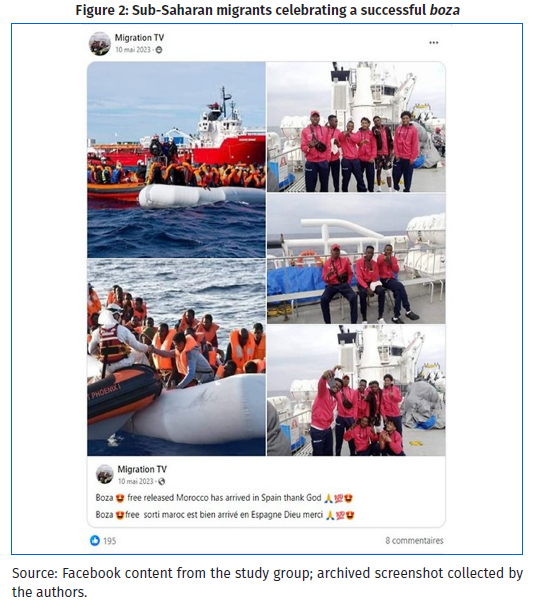
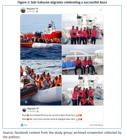
ICTs serve a final purpose: reporting successful crossings (see Figure 2) and producing digital content that simultaneously celebrates individual accomplishments, nourishes the aspirations of would-be adventurers and inspires those already on the road. These narratives rapidly spread within migrant virtual communities, especially boza Facebook groups. The following section shows how the digitization of success stories contributes to a collective imaginary of achievable migration, framing European border crossing as an endeavor within everyone's reach, despite its dangers.
DIGITAL MIMICRY NETWORKS: HOW BOZA GROUPS CURATE BOTH SURVIVAL TIPS AND DEADLY BEHAVIOR
This section focuses on the inner dynamics of boza Facebook groups, where individual practices intersect with collective narratives. In virtual realms, two forces converge: migrant networks' empirically-grounded knowledge and seductive fictions of smuggling economies. Their intersection forms the basis of digital migratory mimicry, in which lived experience coexists with idealized representations of unproblematic boza.
Boza Facebook groups: Between vital information and dangerous illusion
The online ethnography of the Facebook study group (VRAI BOZA INFOS 100% GRATUIT) revealed two predominant dynamics that reflect the specific logics underpinning the group members' digital behavior and distinguish the practices of undocumented sub-Saharan migrants from those of (pseudo-) smugglers.
For undocumented migrants, boza Facebook groups primarily serve an informational function. Navigating the complexities of irregular migration, they rely on these communities as accessible and trustworthy sources of information at every stage of the journey. This relentless search for information drives them to boza groups, where they use their digital skills and Facebook's affordances to facilitate their migration efforts. Building inclusive and reliable digital spaces is a crucial, widely shared goal among bozayeurs. They share informative content ranging from practical advice and personal testimonies to warnings about potential dangers, thus constructing a community knowledge base serving as a kind of collective mentorship through the hardships of the irregular journeys.
However, the virtual community's information dimension is often undermined by (pseudo-) smugglers who steer boza groups toward their interests, compromising the group's credibility and informative reliability. This creates constant tension between genuinely useful information and potentially manipulative misinformation. Navigating online amid these disparate influences, undocumented migrants must rely on their discernment to avoid the pitfalls of disinformation.
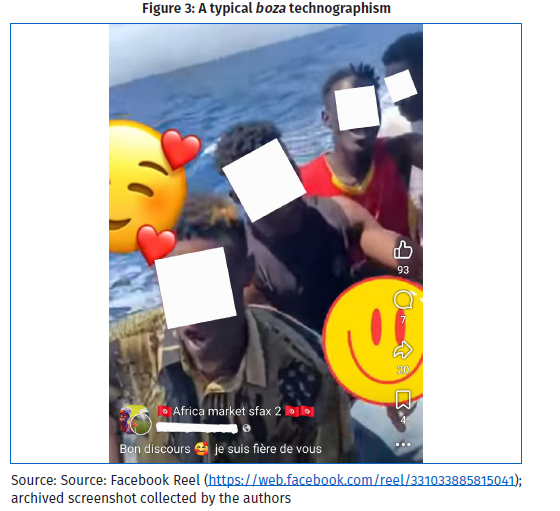
Smugglers are ubiquitous agents, present across all stages of the journey, in both physical and digital spaces of boza communication and transaction. In boza Facebook groups, they compete intensely to enlist migrants, skillfully exploiting the platform's affordances to disseminate promises of guaranteed crossings and frame boza as an easy enterprise. They employ carefully crafted visual communication strategies to maximize their posts' impact, meticulously selecting texts, images, and videos in order to compose visual arrangements balancing appeal and credibility (see Figure 3).
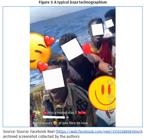
Figure 3 represents a prototypical technographism in which a smuggler combines migrants' favorable video testimonials, a paternalistic endorsement: "Bon discours; je suis fier de vous" (Good speech; I'm proud of you), and positive emoticons (happy smileys) to craft an integrated rhetorical composition that:
• generates irrefutable social evidence through the video format that enhances the authenticity of the migrants' crossing, turning their subjective experience into an undeniable marketing argument;
• establishes a paternalistic dynamic through the enunciation of the phrase "I'm proud of you," coupled with friendly emoticons that create a fake caring relationship masking transactional reality;
• deploys emoticons as affective amplifiers, as the use of positive ones creates a semiotic association between migration attempts and guaranteed positive outcomes.
These promotional strategies can foster an illusory perception of reality among undocumented migrants. Smugglers intentionally minimize irregular migration's risks, presenting boza as a secure way of achieving migratory aspirations. Such framing can create a sense of urgency that may encourage hasty, impulsive decisions to engage the smugglers' services. They make profits from increasing demand, reinforcing their presence in cyberspace, an effective recruitment platform where they vie for potential candidates.
The manufacturing of migration imaginaries: Boza Facebook groups as a crucible of mimetic migratory behavior
Certain contents disseminated through boza virtual communities carry high-stakes repercussions. Through attractive technographisms glorifying boza free (successful crossing to Europe), they contribute to idealized collective narratives that appeal to would-be migrants. A telling example comes from a group member's reaction to a successful crossing narrative: "Que mon tour soit aussi meilleur comme le votre les vrais boza" ("May my turn be as prosperous as yours the true boza"). This fervent comment uncovers the following key dynamics:
• Aspirational cycle: the expression "my turn" suggests that each presumed achievement provides tangible evidence of possible success for others, reinforcing expectations of reproducible outcomes.
• Temporal projection: the future-oriented wishful phrasing, "May my turn be as prosperous as yours" exemplifies how digital narratives fuel migrants' temporal imaginaries.
• Social validation: the designation "real boza" creates an implicit hierarchy that authenticates only successful crossings.
What is particularly significant about this apparently innocuous comment is how small-scale personal expressions can aggregate into collective expectations. Repeated across similar digital interactions, micro-aspirations may form a shared perception in which success appears reproducible. Statements such as "my turn [next]" following success stories reinforce participants' expectations about migration outcomes, while likes and shares increase the visibility of certain narratives over others.
Through these mechanisms, digital migratory mimicry emerges as a process whereby collective digital narratives inflate successes while minimizing challenges. The imaginary of easy achievement may reinforce unrealistic expectations and mimetic behavior, encouraging would-be migrants to envisage similar high-risk journeys.
The romanticized digital portrayals of boza free contrast sharply with the material, physical, and legal hardships of irregular migration, which remain largely absent from celebratory narratives. This selectivity also extends to interpersonal communication. Recalling severe hardships along the journey, Patrice (see Table 1) explained:
Even our parents do not know what we have been through.
Such selective disclosure contributes to an uneven circulation of migration experiences, where successful outcomes remain more visible than the hardships preceding them, potentially reinforcing mimetic aspirations.
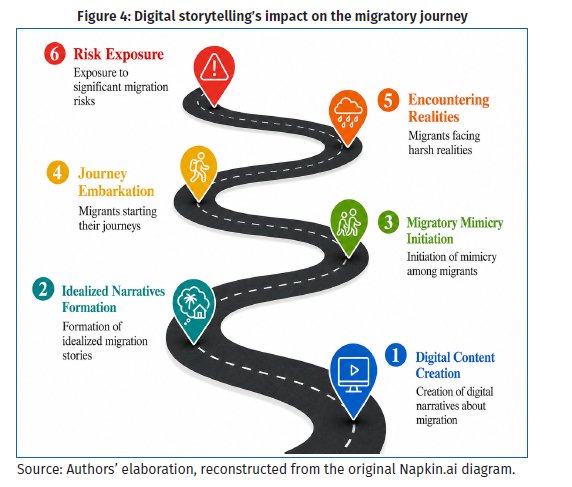
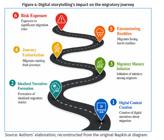
Figure 4 captures this dynamic of digital storytelling in migration pathways, illustrating how social media provide conduits of both information and illusion within a feedback loop that may reinforce migration cycles. Digitized narratives of successful migrants undergo idealization that strips away the harsh realities of migration. These sanitized stories then contribute to digital migratory mimicry and unrealistic expectations among would-be migrants. Narrative transformation and its potential effects on migration decision making illustrate the broader process through which digital technologies both inform and mislead, shaping contemporary migration imaginaries through a complex web of influence.
DISCUSSION
The interview analysis demonstrated how digital content can shape migrants' perceptions and decision-making processes. Whereas Grubanov-Boskovic et al. (2021) quantitatively linked Internet access to a theoretical migration propensity, our qualitative study revealed the intricate mechanisms through which this influence may operate. Circulating success narratives, migration-promoting discourse, and digitally-triggered political consciousness form a digitally mediated web of influence that can shape migrants' perceptions and decisions. Internalizing digital scripts that act upon their imaginaries, prospective migrants gradually envision themselves on the road. These scripts frame both what they think is possible, and what they believe should be done to overcome oppressive conditions. This aligns with De Haas's (2010) assertion that aspirations and capabilities shape migration decisions, as ICTs structure these aspirations through selective representation.
While previous literature (Porter et al., 2012; Frouws et al., 2016; Seymen, 2017; Zijlstra and van Liempt, 2017) confirmed ICTs' utilitarian role in transit zones, our study revealed the necessity of transcending utilitarian reasoning to embrace a critical perspective on their ambivalence. Interviewees' narratives graphically depicted this techno-ambivalence, demonstrating how ICTs are context-specific, acting both as a lifeline and a liability. This finding resonates with Van Esseveld's (2019) account of how traffickers and smugglers manipulate these lifelines as instruments of terror and exploitation.
Upon arrival in Morocco, ICT use undergoes another transformation, while maintaining its ambivalent nature. Digital practices observed in Mohammedia- ranging from WhatsApp chats to social media networking-illustrated a condition of connected liminality, enabling migrants to sustain emotional ties with their home communities, while strategically navigating the precariousness of their "not-yet" status. Extending Diminescu's (2008) concept of the "connected migrant," these findings highlight the opportunities and tensions of digital double presence, as migrants live concomitantly in the now-and-here and the not-yet. This liminal interconnectedness questions the linear conceptualization of migration (Schapendonk, 2012). Indeed, the migrants' journey emerges as a continuous negotiation of hybrid temporalities and spatialities, rather than a unidirectional mobility between fixed points.
The virtual ethnographic study of the Facebook group demonstrated how digital platforms mediate between subjective individual experiences and collective meaning-making, illustrating ICTs' dual role in facilitating physical mobility, while contributing to symbolic frameworks through which mobility is imagined and normalized-with the boza group functioning as a digital crucible where essential information and exploitative practices collide.
The study uncovered the formation of a sophisticated discursive architecture that reframes migratory pathways through a dialectical interplay between utilitarian knowledge transmission and aspirational myth-making, generating an epistemically contested space wherein migrants must critically negotiate competing truth claims.
While prior research (Frouws et al., 2016; EU, 2018) established the informational dimension of virtual networks, our findings revealed how digital interweaving of factual data and aspirational narratives places emphasis on the outcome (arrival in Europe) while obscuring the process (violence, precariousness, exploitation). Migrants not only passionately consume these digital narratives; they also contribute to their reinforcement and ritualization by liking, sharing, and commenting. This participatory engagement resonates with Latonero and Kift's (2018) framework of the "digital infrastructure of movement," which positions social media and digital technologies as constitutive elements of migratory journeys. However, we extend this conceptualization by illustrating how these infrastructures may shape migratory imaginaries and decision making well in advance of physical mobility, broadening the temporal limits of digital mediation within migratory trajectories.
Through narrative sanitization, downplaying hardships, and over-celebrating success stories, potential migrants may become more receptive to digital migratory mimicry. Before manifesting in concrete action, this phenomenon operates within the psychological framework of aspirational cognition, whereby group members imagine themselves as future successful migrants before physically undertaking the journey. Appadurai's (1990) concept of "mediascapes" illuminates this cognitive mechanism. Much like traditional media shaped how we see the world, modern social media function as digital mediascapes through which imaginary worlds of migration circulate, often sidestepping material and temporal realities. Boza Facebook groups propagate a curated representation that reduces years-long, complex migratory trajectories into singular moments of triumphant arrival, constructing a deterritorialized "imagined world" where geographic mobility seems easily attainable.
Smugglers strategically exploit mimetic desire to move by using digital mediascapes as amplifiers of successful crossings, creating a feedback loop that may reinforce migratory aspirations and risky behavior. These communication approaches reflect a broader professionalization of smuggling practices. While Sanchez (2017) observed smugglers relying on territorial knowledge, this study revealed how they now combine geographical expertise with sophisticated digital strategies, navigating virtual roads as effectively as desert trails. In the process, smugglers can subvert boza informational groups, transforming them into symbolic marketplaces of aspirations. This finding echoes Andersson's (2014) "illegality industry," in which actors monetize the production and management of migratory desire and illegality itself, creating an economy built on commodified aspirations. In this digitally mediated boza ecosystem, the undocumented journey may become more accessible in imagination, while remaining treacherous in execution.
STUDY LIMITATIONSSeveral limitations should be considered when interpreting these findings. The interview component involved five Cameroonian participants residing in Mohammedia, while the virtual ethnography focused intensively on one Facebook group; these materials cannot support statistical generalization beyond the cases examined. Moreover, the qualitative, cross-sectional and retrospective design cannot establish prevalence or causal relationships between digital practices, imaginaries, and migration decisions. Digital migratory mimicry should therefore be understood as an analytical proposition grounded in these materials rather than a universal mechanism. Comparative and longitudinal research across nationalities, routes, platforms, and migration stages is needed to assess its broader applicability.
CONCLUSION
This study included three significant contributions. Methodologically, it combines biographical interviews, digital narrative cartography, and virtual ethnography to trace the entanglement between hybrid physical and digital migratory spaces. Empirically, it adopted a holistic approach to examine how undocumented sub-Saharan migrants make strategic and ambivalent use of ICTs across successive stages of their journey. Conceptually, it questioned the relevance of dominant theoretical frameworks by proposing the notion of digital migratory mimicry to understand how digitally mediated imaginaries may impact affect-driven decisions and mimetic behavior, advancing a conceptualization of irregular migration's persistence as a digitally and affectively influenced process. Finally, these findings highlighted the limits of rational risk-based information campaign programs on which migration governance is based, demonstrating the need to engage with the emotionally, socially, and symbolically charged aspects of digitally mediated imaginaries in designing interventions better suited to the hybrid ecosystem of undocumented migration.
REFERENCES
- Akanle, O., Fayehun, O.A. and Oyelakin, S. 2021. The information communication technology, social media, international migration and migrants' relations with kin in Nigeria. Journal of Asian and African Studies, 56(6): 1213-1225. https://doi.org/10.1177/0021909620960148
- Andersson, R. 2014. Illegality, Inc.: Clandestine migration and the business of bordering Europe. 1st ed. Berkeley: University of California Press.
- Appadurai, A. 1990. Disjuncture and difference in the global cultural economy. Theory, Culture & Society, 7(2-3): 295-310. https://doi.org/10.1177/026327690007002017
- Borkert, M., Fisher, K.E. and Yafi, E. 2018. The best, the worst, and the hardest to find: How people, mobiles, and social media connect migrants in(to) Europe. Social Media + Society, 4(1): 2056305118764428.
- Carling, J. and Schewel, K. 2018. Revisiting aspiration and ability in international migration. Journal of Ethnic and Migration Studies, 44(6): 945-963. https://doi.org/10.1080/1369183X.2017.1384146
- De Haas, H. 2010. The internal dynamics of migration processes: A theoretical inquiry. Journal of Ethnic and Migration Studies, 36(10): 1587-1617. https://doi.org/10.1080/1369183X.2010.489361
- Dekker, R. and Engbersen, G. 2014. How social media transform migrant networks and facilitate migration. Global Networks, 14(4): 401-418. https://doi.org/10.1111/glob.12040
- De Souza e Silva, A. 2006. From cyber to hybrid: Mobile technologies as interfaces of hybrid spaces. Space and Culture, 9(3): 261-278. https://doi.org/10.1177/1206331206289022
- Diminescu, D. 2008. The connected migrant: An epistemological manifesto. Social Science Information, 47(4): 565-579. https://doi.org/10.1177/0539018408096447
- European Union (EU). 2018. How West African migrants engage with migration information en-route to Europe. European Commission: Directorate-General for Migration and Home Affairs. https://data.europa.eu/doi/10.2837/97937
- Frouws, B., Phillips, M., Ashraf, H. and Twigt, M. 2016. Getting to Europe the WhatsApp way: The use of ICT in contemporary mixed-migration flows to Europe. Regional Mixed Migration Center. June 15. https://mixedmigration.org/wp-content/uploads/2018/05/015 getting-to-europe.pdf
- Gillespie, M., Osseiran, S. and Cheesman, M. 2018. Syrian refugees and the digital passage to Europe: Smartphone infrastructures and affordances. Social Media + Society, 4(1): 1-12. https://doi.org/10.1177/2056305118764440
- Grubanov-Boskovic, S., Kalantaryan, S., Migali, S. and Scipioni, M. 2021. The impact of the Internet on migration aspirations and intentions. Migration Studies, 9(4): 1807-1822. https://doi.org/10.1093/migration/mnab049
- Hamel, J.-Y. 2009. Information and communication technologies and migration. MPRA paper. No. 39(19175). https://mpra.ub.uni-muenchen.de/19175/1/MPRApaper19175.pdf
- Hugman, R., Pittaway, E. and Bartolomei, L. 2011. When "do no harm" is not enough: The ethics of research with refugees and other vulnerable groups. The British Journal of Social Work, 41(7): 1271-1287. https://mpra.ub.uni-muenchen.de/19175/1/MPRA_paper_19175.pdf
- Hunter, A. 2018. Retirement home? Ageing migrant workers in France and the question of return. Cham, Switzerland: Springer.
- Leurs, K. and Prabhakar, M. 2018. Doing digital migration studies: Methodological considerations for an emerging research focus. In Zapata-Barrero, R. and Yalaz, E., Qualitative research in European migration studies. Cham, Switzerland: Springer, pp. 247-267.
- Massey, D.S. 1990. Social structure, household strategies, and the cumulative causation of migration. Population Index, 56(1): 3-26. https://doi.org/10.2307/3644186
- Massey, D.S., Arango, J., Hugo, G., Kouaouci, A., Pellegrino, A. and Taylor, J.E. 1993. Theories of international migration: A review and appraisal. Population and Development Review, 19(3): 431-466. https://doi.org/10.2307/2938462
- Nedelcu, M. and Soysüren, I. 2020. Precarious migrants, migration regimes and digital technologies: The empowering-control nexus. Journal of Ethnic and Migration Studies, 48(8): 1821-1837. https://doi.org/10.1080/1369183X.2020.1796263
- Nyamnjoh, H.M. 2013. Bridging mobilities: ICTs appropriation by Cameroonians in South Africa and The Netherlands. Doctoral thesis, Leiden University. https://hdl.handle.net/1887/22533
- Opas, M. and McMurray, D. 2015. Under the gaze of the state: ICT use and state surveillance of Eritrean refugees in Italy. Refugee Survey Quarterly, 34(4): 105-125. https://www.jstor.org/stable/48503265
- Paveau, M.-A. 2019a. Introduction. Écrire, parler, communiquer en ligne: Nosvies sociolangagières connectées. Langage et Société, 167: 9-28. https://doi.org/10.3917/ls.167.0009
- Paveau, M.-A. 2019b. Technographismes en ligne: Énonciation materielle visuelle et iconisation du texte. Corela. HS-28: 1-20. https://doi.org/10.4000/corela.9185
- Porter, G., Hampshire, K., Abane, A., Munthali, A., Robson, E., Mashiri, M., Tanle, A. 2012. Youth, mobility and mobile phones in Africa: Findings from a three-country study. Information Technology for Development, 18(2): 145-162. https://doi.org/10.1080/02681102.2011.643210
- Portes, A. 1997. Immigration theory for a new century: Some problems and opportunities. International Migration Review. 31(4): 799-825. https://doi.org/10.2307/2547415
- Sanchez, G. 2017. Critical perspectives on clandestine migration facilitation: An overview of migrant smuggling research. Journal on Migration and Human Security, 5(1): 9-27. https://doi.org/10.1177/233150241700500102
- Schapendonk, J. 2012. Migrants' im/mobilities on their way to the EU: Lost in transit? Tijdschrift voor Economische en Sociale Geografie, 103(5): 577-583. https://doi.org/10.1111/j.1467-9663.2012.00735.x
- Schapendonk, J. 2014. What if networks move? Dynamic social networking in the context of African migration to Europe. Population, Space and Place, 21(8): 809-819. https://doi.org/10.1002/psp.1860
- Schaub, M.L. 2012. Lines across the desert: Mobile phone use and mobility in the context of trans-Saharan migration. Information Technology for Development, 18(2): 126-144. https://doi.org/10.1080/02681102.2011.604082
- Schöpke-Gonzalez, A.M. and Schaub, F. 2023. Mobile phones at borders: Logics of deterrence and survival in the Mediterranean Sea and Sonoran Desert. Information, Communication & Society, 26(14): 2863-2879. https://doi.org/10.1080/1369118X.2022.2113818
- Seymen, S.G. 2017. L'usage des TICs et l´evolution des projets migratoires des migrants Africains en Turquie (le cas d'agglomération d'Istanbul). Doctoral thesis, Strasbourg University.
- Stark, O. and Bloom, D.E. 1985. The new economics of labor migration. The American Economic Review, 75(2): 173-178. http://www.jstor.org/stable/1805591
- Stremlau, N. and Tsalapatanis, A. 2022. Social media, mobile phones and migration in Africa: A review of the evidence. Progress in Development Studies, 22(1): 56-71. https://doi.org/10.1177/14649934211043615
- Tall, S.M. 2004. Senegalese émigrés: New information and communication technologies. Review of African Political Economy, 31(99): 31-48. https://doi.org/10.1080/0305624042000258405
- Todaro, M.P. 1969. A model of labor migration and urban unemployment in less developed countries. The American Economic Review, 59(1): 138-148. https://www.jstor.org/stable/1811100
- Van Esseveld, A. 2019. Tortured on camera: The use of ICTs in trafficking for ransom. In Van Reisen, M., Mawere, M., Stokmans, M. and Gebre-Egziabher, K.A. (eds.), Mobile Africa: Human trafficking and the digital divide. Bamenda, Cameroon: Langaa Research and Publishing CIG, pp. 91-111.
- Zijlstra, J. and Van Liempt, I. 2017. Smart(phone) travelling: Understanding the use and impact of mobile technology on irregular migration journeys. International Journal of Migration and Border Studies, 3(2-3): 174-191. https://doi.org/10.1504/IJMBS.2017.083245
Accepted 24 August 2026
Published 31 August 2026
4 The term boza signifies "victory" in several West African dialects. It is used to denote successful border crossing in sub-Saharan irregular migration contexts. The term encompasses two distinct levels of achievement: petit boza designates entry into Morocco, emphasizing its comparatively moderate challenges, while grand boza denotes the more ambitious passage to Europe. This hierarchical distinction underscores the graduated challenges migrants encounter in their northward adventure.
5 Narrative cartography merges geographic mapping with storytelling to visualize narratives on a map, representing spatial relationships between places, characters, events, and emotions.
6 By "map-elicitation interview," we mean a technique using a map as a memory aid during a biographical interview, similar in principle to photo-elicitation interview (Harper, 1988: 65-66).
7 A life story does not adhere strictly to a chronological narration of events, but rather reflects a complex temporality, intertwining past and present. The diachronic approach aimed to guide participants in connecting their current migratory trajectory to previous life journeys.
8 The participants' Cameroon-Morocco journeys, characterized by non-traditional transit routes, took approximately 12-24 months to complete.
9 Bozayeurs refers to undocumented sub-Saharan migrants attempting/having successfully crossed borders.
10 Access to the boza Facebook group was gained via a membership application, which was duly accepted by the group administrators before the initiation of data collection. Observation was carried out using personal Facebook accounts, with a peripheral, non-participatory strategy, avoiding direct interaction with group members.
11 Following Paveau's (2019a, 2019b) work on the analysis of digital native discourses (ADN), a typology of migrants' Facebook posts was created based on the collection and analysis of the most used technographisms among undocumented sub-Saharan migrants. Paveau (2019a: 12) defines "technodiscourses" or digital native discourses as "productions created online, in a connected environment - whatever might be the devices, the interfaces, the platforms or the writing tools -, in the writing or speaking spaces afforded by internet, and not likely, after digitalization, to migrate from pre-digital writing and editorial spaces towards digital connected spaces." As regards technographism, Paveau (2019b: 6) defines it as "a plurisemiotic production, combining text and image in a digital native multimedia composite, produced by technological tools and gestures and introduced into the norms of digital native discourses."
12 Former "adventurer," Ngannou is now a globally recognized iconic figure in the field of mixed martial arts.
13 Boko Haram, a radical Islamist group founded in Nigeria (2002), is particularly feared by undocumented migrants due to its numerous terrorist attacks, kidnappings, and raids against civilians, security forces, and government targets, causing thousands of casualties and massive population displacements.