The state of the genus Hybomitra Enderlein (Diptera: Tabanidae) in the Afrotropics including phylogenetic analysis and the description of a new species from South Africa
Abstract
The taxonomy of horse flies in the Afrotropics has been neglected in recent times. The genus Hybomitra Enderlein is considered to be Holarctic though 15 species are recorded from the Afrotropics. A collecting trip in South Africa led to the discovery of a new species of Hybomitra, H. phalaros sp. n., described here. Phylogenetic analysis using both mitochondrial and nuclear DNA yields a paraphyletic Hybomitra, comprising biogeographically distinct clades. Taxonomic revision of the Afrotropical Hybomitra is complex due to unavailable type specimens and lack of available material. The whereabouts of these type specimens are discussed, and morphological diagnoses derived from the original descriptions of all the Afrotropical species are provided. The type localities are mapped and discussed in relation to DNA barcoded voucher specimens from the region. Tabanus saxicolus is morphologically evaluated and transferred to Hybomitra as Hybomitra saxicolus n. comb.
Africa; horse fly; Tabanomorpha; Tabanus; taxonomy
INTRODUCTION
There are over 800 species of horse fly in the Afrotropics and nearly 4 500 species worldwide (Chainey 2017). Horse flies are known vectors of vertebrate pathogens including viruses, bacteria and protozoans (Baldacchino et al. 2014; Votýpka et al. 2019). This makes them important in veterinary and economic settings as they can potentially cause serious health issues for animals and thereby impact their economic value to farmers.
Taxonomic research of Tabanidae in the Afrotropics has been very limited since the comprehensive works of Oldroyd (1952, 1954, 1957) and Usher (1965, 1967, 1968, 1970, 1971, 1972). The taxonomy of Hybomitra Enderlein in the Afrotropics has been contentious for a long time (Oldroyd 1954; Chainey and Oldroyd 1980; Chainey 2017). Hybomitra was first recognised as a genus by Enderlein (1922). It is largely viewed as a Nearctic and Palearctic genus identified as having hairy eyes and an ocellar tubercle (Oldroyd 1954). Oldroyd (1954), however, only acknowledged Hybomitra as a subgenus of Tabanus Linnaeus, as he had trouble separating Hybomitra from Tabanus in the Afrotropics. This subgeneric view did not last, and in the World Synoptic Catalogue of Tabanidae, nine African species are listed under Hybomitra (Moucha 1976), omitting several species already described from the Afrotropics at the time. This generic status of Hybomitra was again followed in the Catalogue of Afrotropical Diptera, this time with 15 species listed (Chainey and Oldroyd 1980). The current view in the Manual of Afrotropical Diptera, suggested that Hybomitra in the Afrotropics is doubtful and all the species in this genus should be placed in Tabanus (Chainey 2017). There is no reasoning given in either the Catalogue or the Manual of Afrotropical Diptera (Chainey and Oldroyd 1980; Chainey 2017) for either of the placements of the Afrotropical genus Hybomitra.
A recent collecting trip in the Drakensberg Mountains, South Africa, led to the discovery of a new species of Tabanidae that conforms to the characteristics of Hybomitra. We provide a description of the new species, together with colour photographs, molecular analysis and a detailed summary of what is known about all the Afrotropical species of this genus.
MATERIALS AND METHODS
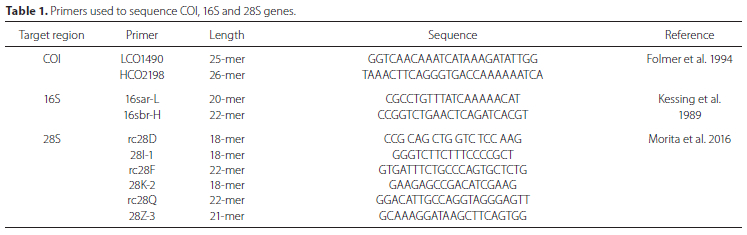
Specimens were collected in the Monk's Cowl Nature Reserve in the Drakensberg Mountain Range, South Africa (29°02' S, 29°24' E) in October 2022 using octenol-baited malaise and Manitoba traps. A hind leg of four specimens were removed and sent to Inqaba Biotechnical Industries (Pty) Ltd in Pretoria, South Africa, for DNA extraction and sequencing. Sequencing was performed using standard protocols using primers for the COI, 16S, and 28S regions (Table 1). The forward and reverse sequences were assembled using CLC Main workbench (https://digitalinsights.qiagen.com/). Assembled sequences were submitted to BOLD and GenBank for accession numbers (Supplementary Material). One COI dataset and two concatenated datasets were constructed using our sequences and reference sequences from GenBank and BOLD (see Supplementary Material). The concatenated datasets comprised either 16S + COI sequence data or 28S + COI sequence data. Datasets were aligned using the online version of MAFFT (https://maffi.cbrc.jp/alignment/server/) under default parameters. The aligned matrices were viewed, edited and truncated using MEGA7 (Kumar et al. 2016), and exported for analysis. A data-display network (DDN) was constructed for the COI data using uncorrected p-distances calculated using all characters in SplitsTree4 (Huson and Bryant 2006). Cluster support was calculated from 1000 bootstrap replicates. RAxML8 (Stamatakis 2014) was used to construct trees using a maximum likelihood approach and the programme specific GTRCAT approximation. Bootstrap support was calculated using the autoMRE bootstopping function in RAxML. Trees were viewed in FigTree4 (http://tree.bio.ed.ac.uk/software/figtree/). The concatenated data was analysed similarly in RAxML, but partitioned per gene region with the GTRCAT approximation independently applied to each partition.
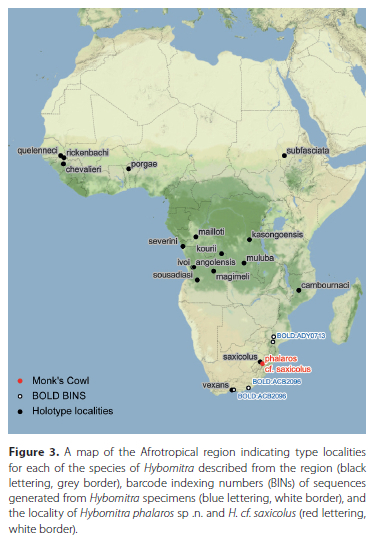
A map was generated in QGIS (http://qgis.org - 2023) using coordinates approximated from the type localities using Google Earth Pro (version 7.3.6.9796). Both geographic and sequence data was available for unidentified material from South Africa that had been uploaded to BOLD. These were also plotted onto the map using the BOLD designated Barcode Index Numbers (BINs). Finally, the newly acquired species from Monk's Cowl in South Africa is also plotted onto the map.
Due to the unavailability of type specimens and identified material for study, the references for the original descriptions of the 15 Hybomitra species listed in the Catalogue ofAfrotropical Diptera (Chainey and Oldroyd 1980) were used to compile a diagnosis for each species and a reference table for the Afrotropical Hybomitra. If more elaborate subsequent morphological descriptions were made, they were used to supplement the morphological diagnoses of the species. Morphological terminology follows Cumming and Wood (2017). The holotype and paratypes of Tabanus saxicolus Usher (1965) were available and were morphologically evaluated and compared to a fresh specimen collected from the type locality.
A morphological diagnosis is also provided for T. saxicolus which is transferred to the genus Hybomitra as H. saxicolus (Usher 1965) n. comb.. Photographs were taken using a Nikon D3200 digital SLR and stacked using Helicon Focus 7.
RESULTS
The concatenated 16S-COI dataset had a total length of1745 base pairs (16S: 557 + COI: 1188), comprised 17 ingroup sequences and one outgroup (see supplementary material). The concatenated
28S-COI dataset had a total length of 2389 base pairs (28S: 1739 + COI: 650), comprised 22 ingroup sequences and three outgroups (see supplementary material). Finally, the COI dataset had a total length of 658 bp and comprised 50 ingroup and two outgroup sequences (see supplementary material). Since the reference sequences of the 16S-COI dataset was mostly extracted from mitochondrial genomes, the full COI gene region could be used for the analysis and is therefore substantially longer than the COI sequences in both other datasets.
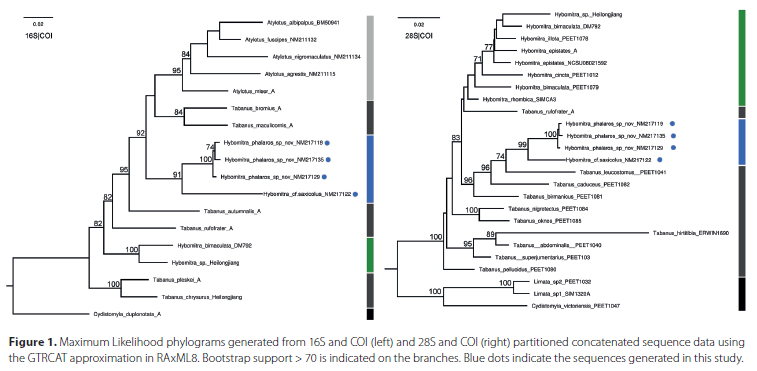
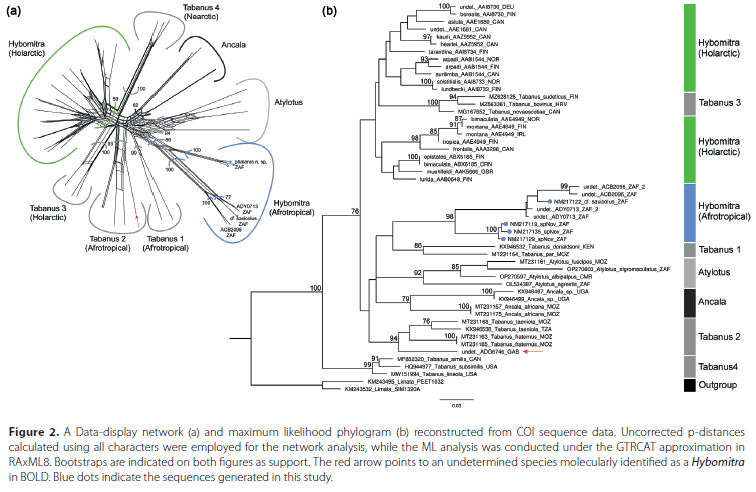
The genera Ancala Enderlein, 1922 and Atylotus Osten Sacken, 1876 were recovered as monophyletic clusters with moderate support (bootstrap support (DDN/ML): 62/79 and 84/92 respectively). In turn, both Tabanus and Hybomitra were paraphyletic across all analyses, forming either two or three separate biogeographically informative groups comprising members of the Holarctic and Afrotropical regions (Figures 1, 2).
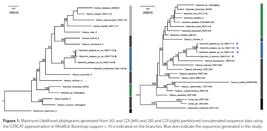
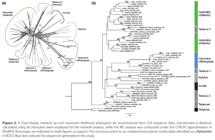
The Afrotropical Hybomitra was consistently recovered as a well-supported clade (bootstrap support: 86/98/91/99) (Figures 1, 2). In the COI dataset, this grouping was exclusive of a specimen from Gabon which was molecularly identified as a Hybomitra species by BOLD (BOLD process ID GMGBA127-17) (Figure 2). Instead, this sequence fell as sister to commonly occurring Tabanus species of the patterned group (Oldroyd 1954) (Figure 2). The monophyly of the Holarctic species remains unresolved, and clustering varied among the analyses. With limited representation, a well-supported clade was recovered when analysing the 16S + COI data. While the monophyly was maintained when 28S + COI was analysed, the support dwindled. The COI analyses also returned dissimilar clustering - the data-display network resulted in a single Holarctic clade lacking strong support, while the ML analysis recovered a paraphyletic Holarctic Hybomitra, with dwindling support in the deeper nodes of the tree.
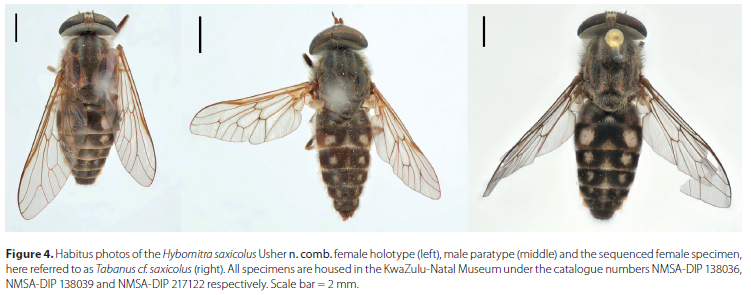
The Afrotropical Hybomitra had support across all analyses. Three sequences from three specimens of the proposed new species Hybomitra phalaros sp.n. formed monophylies with strong support across all the analyses (bootstrap support: 100/100/100/100) and grouped alongside Hybomitra sequences from specimens collected in South Africa (ZAF) (Figures 1, 2, 3). These include two sequences bearing the BIN BOLD:ACB2096, two sequences bearing the BIN BOLD:ADY0713 and a sequence generated in this study from a specimen conforming to the characteristics of Hybomitra (NM217122), but also resembling Tabanus saxicolus (= Hybomitra saxicolus comb. n.), referred to as Hybomitra cf. saxicolus (Figure 4).
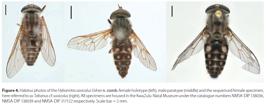
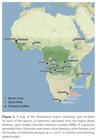
The specimens of Hybomitra phalaros sp. n. and H. cf. saxicolus as well as the holotype of Tabanus saxicolus (= Hybomitra saxicolus n. comb.) were all collected in the Drakensberg mountains, South Africa (Figure 3). The only other species of Hybomitra described from South Africa is H. vexans, collected in relative proximity to the BOLD:ACB2096 specimens. Finally, the BOLD:ADY0713 specimens were also collected from South Africa.
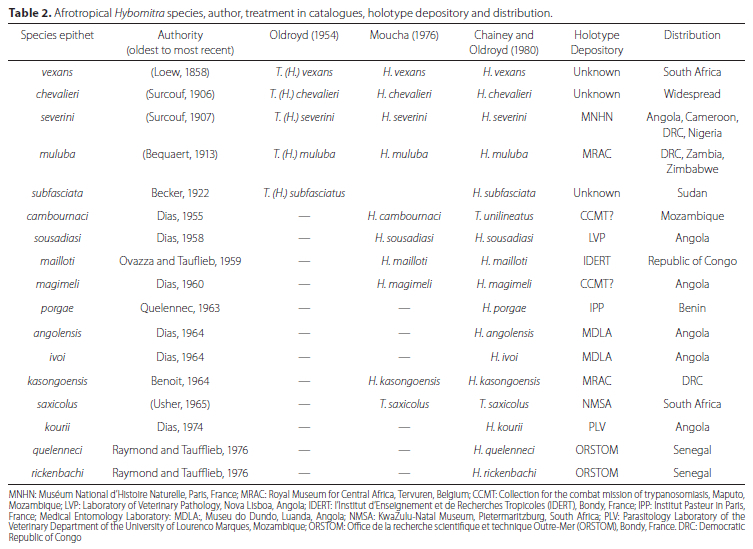
The remaining type localities for the Afrotropical Hybomitra species are mapped in Figure 3. Holotype information including the original descriptions, authors, date, housing institutions, geographic distribution and taxonomic relevance in catalogues are tabulated (Table 2).
DESCRIPTION
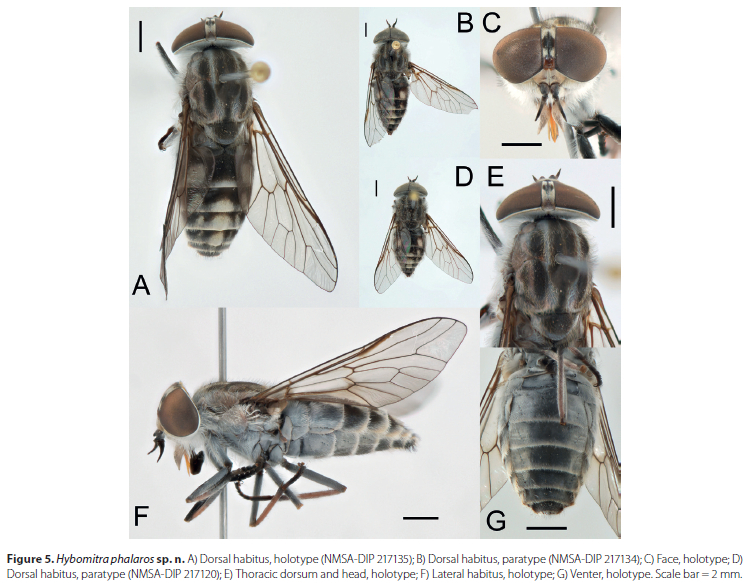
Hybomitra phalaros Williams and Snyman, sp. nov. (Figure 5)
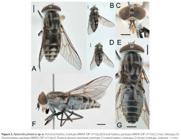
Type Material
Unless otherwise stated, all new type material was deposited in the KwaZulu-Natal Museum (NMSA).
Holotype female, South Africa, KZN, Monk's Cowl Nature Reserve, 29°02' S 29°24' E, 19 October 2022, Williams, Kirstin and Ndlovu, Mandisa, NMSA-DIP 217135; Manitoba trap baited with Octenol. The holotype is in good condition. Paratype, female, South Africa, KZN, Monk's Cowl Nature Reserve, 29°02' S 29°24' E, 14 October 2022, Williams, Kirstin; Ndlovu, Mandisa, NMSA-DIP 217119. Manitoba trap baited with Octenol. Paratype, female, South Africa, KZN, Monk's Cowl Nature Reserve, 29°02' S 29°24' E, 14 October 2022, Williams, Kirstin; Ndlovu, Mandisa, NMSA-DIP 217129. Manitoba trap baited with Octenol. Paratype, female, South Africa, KZN, Monk's Cowl Nature Reserve, 29°02' S 29°24' E, 15 October 2022, Williams, Kirstin; Ndlovu, Mandisa, BMSA(D)135680 (deposited at National Museum, Bloemfontein, South Africa; BMSA). Manitoba trap baited with Octenol. Paratype, female, South Africa, KZN, Monk's Cowl Nature Reserve, 29°02' S 29°24' E, 15 October 2022, Williams, Kirstin; Ndlovu, Mandisa, NHMUK015553676 (deposited at Natural History Museum, London, United Kingdom; NHMUK). Manitoba trap baited with Octenol. Paratype, 2 males, South Africa, KZN, Monk's Cowl Nature Reserve, 29°02' S 29°23' E, 13 October 2022, Williams, Kirstin; Ndlovu, Mandisa, NMSA-DIP 217126 and NMSA-DIP 217120. Malaise trap. Paratype, male, South Africa, KZN, Monk's Cowl Nature Reserve, 29°02' S 29°23' E, 14 October 2022, Williams, Kirstin; Ndlovu, Mandisa, NMSA-DIP 217134. Malaise trap. Paratype, 2 males, South Africa, KZN, Monk's Cowl Nature Reserve, 29°02' S 29°23' E, 15 October 2022, Williams, Kirstin; Ndlovu, Mandisa, NHMUK015553677 (deposited at NHMUK) and BMSA(D)135379 (deposited at BMSA). Malaise trap.
Diagnosis
The only medium sized (± 14 mm) Afrotropical species with black antennae, sublateral and medial grey/white markings along the apical margin of tergites 2-5, lacking a distinct medial grey/white triangle on tergite 2, and with sternites that are dark grey medially, laterally flanked by lighter grey, completely lacking reddish colour. Using these characters, H. phalaros sp. nov. can be distinguished from H. angolensis, H. cambournaci, H. chevalieri, H. ivoi, H. kourii, H. mailloti, H. muluba, H. porgae, H. quelenneci, H. sousadiasi and H. subfasicata by its black antennae. It differs from H. kasongoensis by the lack of brown lateral spots on the abdomen, from H. rickenbachi by the lack of a white, medial triangle on the second tergite and from H. severini by the lack of a reddish venter. It is distinguished from H. vexans by the lack of red lateral colouration on the second tergite.
Description
Adult Female
Length 14 mm.
Head: Eyes with short white hairs. Frons parallel, pale grey with sparse pale yellow-white hairs, ocellar tubercle raised, dark brown with black hairs above and around side. Lower callus square, laterally reaching the eye margin, shiny red-brown; upper callus spindle-like, black, meeting lower callus. Upper callus surrounded by black, spindle-like patch wider than callus, extending to eye margins. Edges of patch along eyes may be brown in some specimens due to rubbing of tomentum. Subcallus prominent, red-brown in ground colour, covered in pale yellow tomentum that rubs off easily. Antennae: Scape and pedicel black in ground colour, covered in a grey tomentum. Dark orange ground colour visible medially on scape. Numerous black setae with cluster on upper angle of scape. First segment of flagellum triangular, black with small dark orange crescent dorsally. Remaining flagellomeres black. Palpi: First segment pale grey covered in fine, long white hairs; second segment swollen, tapering to a point, pale yellow to white, shorter white hairs at base, black and white hairs from the middle to apex of anterior surface of palp.
Thorax: Mesonotum with two medial dark brown stripes joining at the point of the transverse suture to form one stripe basally, extending to scutellum. Two sublateral dark brown stripes not reaching scutellum. Area between dark brown stripes forming grey vitta with fine yellow hairs. Dark brown stripes with black and yellow hairs. Edges of transverse suture pale orange. Scutellum dark brown with black and yellow hairs, posterior margin of scutellum grey with long yellow and white hairs, lateral margins grey with long white hairs. Humeral lobe yellow-white with sparse long white hairs, notopleural lobe pale pinkish-grey with long black hairs. Pleura grey; long white hairs on anepisternum, anepimeron, katepisternum and katatergite; meron bare.
Legs: Coxae dark brown integument covered in grey tomentum with long shiny white hairs. Femora: fore femur dark brown covered in silver grey tomentum with dense long shiny white hairs on outer surface, inner surface dark brown to black; mid and hind femora dark brown covered in silver grey tomentum with dense long shiny white hairs. Tibiae: dull orange becoming black towards the base, covered in shorter silver white hairs giving the appearance of being grey depending on the angle viewed. Basal 7/8 of mid and hind tibiae dull orange, apical 1/8 black, mid tibiae with spines basally. Tarsi dark brown to black.
Wings: Hyaline, veins brown, no appendix to R4. thickened with a brown stigma where it meets costal vein. Calypters opaque, pale yellow. Haltere with stalk yellowish, blending to brown at apex, knob with some yellow, otherwise brown.
Abdomen: Dark brown to black with a characteristic pattern of grey-coloured markings. First tergite mostly grey, covered in long white hairs with medial dark brown horizontal stripe not reaching edges, composed mostly oflong, dense black hairs. Apical margin of tergites 2-7 pale grey. Pale grey sublateral markings on tergite 2 roughly oval, no medial pattern. Grey sublateral markings on tergite 3 smaller than on tergite 2, roughly oval with medial grey half circle pattern originating from apical margin. Tergite 4 with smaller grey sublateral marking, medial grey marking almost triangular. Tergite 5 similar pattern to 4 but with decreasing size of sublateral markings. Small medial marking on tergite 6, no sublateral markings. No markings on tergite 7. Black hairs in the dark brown areas, white and yellow hairs in pale grey areas. Venter grey with apical margin of sternites pale yellow-grey. Hairs black medially creating the impression of a dark medial band, white hairs on rest of venter.
Males
Similar to the females but with holoptic eyes and a more tapered/ pointed abdomen.
Distribution
Drakensberg Mountain range, KwaZulu-Natal, South Africa.
Etymology
This epithet is from the Greek meaning white-spotted in reference to the white markings on the abdomen.
Morphological diagnoses and taxonomic notes
The following morphological diagnoses of all Hybomitra species described from the Afrotropics are entirely based on the literature. Most descriptions were originally not published in English and had to be translated. Several brief, diagnostic-like descriptions appear quite short and/or incomplete due to limited informative characteristics in the original descriptions. Where relevant, any additional taxonomic notes are provided at the end of each diagnosis.
Hybomitra angolensis (Dias, 1964)
Diagnosis: Basal callus reddish-brown, upper callus narrow and black, antennae orange, dark medial spot on the first two segments of the abdomen and the wings greyish-brown and infuscated, no appendix on R4 (Dias 1964).
Hybomitra chevallerl (Surcouf, 1906)
Synonyms: Tabanus nagamiensis Carter, 1912 Therioplectes procedens Seguy, 1933 Tabanus santanai Dias, 1953
Diagnosis: Eyes brown, lacking stripes, abdomen greyish with a broad darker medial band, triangular pale spots laterally on abdomen, wings transparent, grey, with no appendix, halters reddish (Surcouf 1906). Eyes hairy, antennae yellow/orange with terminal segment blackish, abdomen black-brown with three rows of grey triangles, central triangle equilateral, sublateral triangles right angled or irregular in shape, wings clear with stigma almost invisible (Oldroyd 1954).
Notes: There are no illustrations with the original description which makes it very difficult to interpret the description, especially the patterning on the abdomen. The descriptions by Oldroyd (1954) provides far more detail and were therefore used to add a more precise diagnosis above.
Hybomitra ivol (Dias, 1964)
Diagnosis: Eyes bare, lower callus bright yellow, antennae with first three segments yellow with a reddish basal portion on segment three, terminal segments black, sublateral markings on abdomen absent with only traces on second and third segments and an incomplete and barely visible medial marking. Wings slightly tinged yellow with no appendix on R4 (Dias 1964).
Hybomitra kasongoensis (Benoit, 1964)
Diagnosis: Eyes sparsely but distinctly hairy, lower callus rectangular, separated from the eyes, antennae black, tergites black with narrow, yellow distal zone from second segment, two large brown lateral spots covering part of tergite 1 and 3 and the whole of tergite 2, a fringe of black bristles on tibia 3, wings slightly smokey with light brown stigma (Benoit 1964).
Hybomitra kourii (Dias, 1974)
Diagnosis: Eyes hairy, basal callus rectangular, covering area between the eyes, shiny and yellowish, upper callus same colour, narrow, reaching upper third of forehead, protruding pseudo-tubercle, antennae first segment with abundant black hairs, second segment reddish, third segment with basal portion reddish, rest black, terminal segments black. Abdomen with predominantly black tergites with yellow margins and brownish-yellow hairs, first tergite with two sublateral clumps of white hairs and white hairs on lateral margins, venter black, posteriorly marginated with yellow, covered with whitish-grey tomentum, wings hyaline, yellowish stigma (Dias 1974).
Hybomitra magimeli (Dias, 1960)
Diagnosis: Distal end of third segment of the antennae and the terminal segments black, edges of the frontal band are parallel and relatively narrow, femora of third pair of legs are uniformly brown, no appendix on the R wing vein (Dias 1960).
Notes: There is no description for this species, only a comparative diagnosis with H. sousadiasi and no illustrations are provided.
Hybomitra mailloti (Ovazza and Taufflieb, 1959)
Diagnosis: The base of the antennae is orange/red and the terminal segments black/brown, abdomen with medial grey parallel edged stripe from tergite 1 - 6, lateral light grey spots on tergites 1-6 decreasing in size, transparent wings with a brown stigma (Ovazza and Taufflieb 1959).
Hybomitra muluba (bequaert, 1913)
Diagnosis: First three segments of antennae orange becoming black towards the distal end of the third segment, terminal segments dark brown/black, abdomen dark brown with three longitudinal series of spots, the medial composed of grey, isosceles triangles, pale brown lateral triangles have a straight inner edge and a serrated outer edge, wings are transparent with an indistinct grey stigma (Bequaert 1913).
Hybomitra porgae (Quelennec, 1963)
Diagnosis: Distinctly hairy eyes, first three segments of antennae yellowish, terminal segments black, abdomen light brown with three bands of grey spots (Quelennec 1963).
Hybomitra quelenneci Raymond and Taufflieb, 1976
Diagnosis: Short, dense distinct hair on eyes, first two segments of antennae yellow, third segment reddish, dark at apex, terminal segments brown, matte brown abdomen, a medial stripe of light triangles, equilateral on second tergite and flattened on first, third and fourth, a line of light grey spots laterally, venter light grey, wings transparent, no appendix on R4, halteres with brown base and white apex (Raymond and Taufflieb 1976).
Hybomitra rickenbachi Raymond and Taufflieb, 1976
Diagnosis: Eyes with short, indistinct hairs, antennae first and second segments grey, third segment dark brown, terminal segments dark brown, abdomen dark shiny grey, three rows of light spots with fuzzy edges, narrow and elongated medial triangles, wings transparent, no appendix on R4, haltere with brown base and white apex (Raymond and Taufflieb 1976).
Hybomitra severini (Surcouf, 1907)
Diagnosis: Calli dark brown, first segment of antennae brown with black pubescence, second segment, reddish brown, third segment black, abdomen brown with a medial white triangle on the third, fourth and fifth segment, two whitish lateral spots on the second, third and fourth segments, reddish venter, transparent wings, brownish stigma, haltere brown with yellow knob (Surcouf 1907).
Notes: There are no illustrations accompanying the original description.
Hybomitra sousadiasi (Dias, 1958)
Diagnosis: Eyes bare, calli yellowish-brown, antennae reddish with final two segments infuscated, abdomen brown, light, indistinct medial stripe formed by narrow interrupted triangles from second to sixth segment. Indistinct sublateral spots on first six segments, venter brown, clear wings with yellow stigma, short appendix on R4 (Dias 1958).
Hybomitra subfasciata (Becker, 1922)
Diagnosis: Eyes with short, white-grey hair, antennae red-yellow, terminal segments black, abdomen dull leather-yellow, dull reddish-brown central stripe, faint, grey-dusted triangular spots on terminal segments, sublateral brown triangular spots form jagged longitudinal stripes on the last four segments, venter leathery yellow, wings clear with no appendix (Becker 1922).
Notes: It was originally described as Therioplectes subfasciata. There are no illustrations with the original description.
Hybomitra vexans (Loew, 1858)
Diagnosis: Second segment of the abdomen is broadly red on the sides, lateral whitish spot on second and third segment, wings grey, stigma dark brown, no appendix (Loew 1858). Lower callus rectangular, red-brown with black upper edge, upper callus lanceolate, black, first three segments of antennae dark covered in grey tomentum, third segment diffusely orange basally, terminal segments black, abdomen sepia-brown, sublateral spots, pale, on tergites 1 - 6, irregular, ill-defined medial triangles on all tergites except seventh, wings clear with dark yellow-brown stigma (Usher, 1971).
Notes: There are no illustrations with the original description. Usher (1971) completed a redescription of H. vexans from two males and a female specimen noting similar behavioural and morphological characteristics to H. saxicolous.
Tabanus cambournaci (Dias, 1955)
- junior synonym of Tabanus unilineatus Loew 1852.
Diagnosis: Eyes bare, antennae first two segments greyish-brown, third segment reddish-brown, subcallus dirty brown, a medial abdominal stripe made up of triangles on each segment, no lateral markings on the abdominal segments and no appendix on R4 (Dias 1955).
Notes: It was described by Dias (1955) as Tabanus (Hybomitra) cambournaci from Mutuali, Mozambique. It was listed in the World Synoptic Catalogue of Tabanidae (Moucha 1976) as Hybomitra cambournaci but has subsequently been synonymised with Tabanus unilineatus (Chainey and Oldroyd 1980). There is no publication that explains this synonymy and the placement of Tabanus unilineatus should be investigated in relation to Hybomitra. We have included the type locality of H. cambournaci on the map provided, without challenging the synonymy.
DISCUSSION
The results presented here echo that the well-established paraphyly of Tabanus is in dire need of revision and the description of several new genera is likely needed (Figures 1 and 2). This will, in turn, render Tabanini as a polyphyletic assemblage of genera (Morita et al. 2016). Understanding Hybomitra within this complex taxonomic grouping is, by extension, problematic.
Morita et al. (2016) placed the Holarctic members of Hybomitra as a weakly supported clade within Tabanini, a relationship based on one mitochondrial and three nuclear genes and low taxon coverage. Our results, with similar low taxon coverage, do not support or refute the monophyly, but emphasise the need for a more comprehensive and representative investigation into the monophyly of Hybomitra and its utility as a genus. This is significant since these results, including sequences from Afrotropical members of Hybomitra for the first time, indicate that a second well-supported clade of Hybomitra is present. It can be argued that if Hybomitra, as currently understood, is accepted at genus level, then at least two subgenera should be erected - one for the Afrotropical taxa, and one for the Holarctic taxa. The problem with this view is that Hybomitra did not form a monophyly in any of the analyses. This is then indicative of two completely separate groupings each deserving generic status. The presence of the ocellar tubercle would then be viewed as a plesiomorphic character within the Tabanini, rather than a synapomorphic character of Hybomitra.
Alternatively, should Tabanus be kept as a genus, paraphyletic or not, Hybomitra could be placed as a subgenus within Tabanus, a view put forward by Chainey (2017) in his synopsis of the Afrotropical Tabanidae. In that sense, the need for at least a second subgenus will nevertheless be required, each subgenus representing members of the Holarctic and Afrotropical regions respectively. While this might not be the case for the Holarctic Hybomitra, a morphological revision alongside sequence analysis for the Afrotropical Hybomitra is currently nearly impossible. In fact, even the production of a comprehensive morphological key to the species of the Afrotropical Hybomitra is currently difficult - mostly due to the unavailability of type specimens and/or any identified specimens.
The whereabouts of most of the type specimens, though listed in the publications (Table 2), are actually unknown. The original descriptions, often coupled with a general lack of illustrations, are often vague and hard to interpret and work beyond the original descriptions are rare and/or incomplete. As part of this study, the authors attempted to confirm that the types are located at the institutions listed in the publications. This has proven to be very difficult as several of the institutions/organisations listed no longer exist or are not accessible. As an example, the Museu Regional de Dundo in Angola has been closed to the public and scientific community since 2005 (Kirk-Spriggs 2017). Other collections such as those of the L'lnstitut d'Enseignement et de Recherches Tropicoles (IDERT) and Office de la recherche scientifique et technique Outre-Mer (ORSTOM) were seemingly integrated into other collections, but exactly where has been difficult to determine. Finally, the large Travassos Santos Dias collection, known as the collection for the Combat Mission of Trypanosomiasis, was likely integrated into the collection of the Parasitology Laboratory of the Veterinary Department of the University of Lourenco Marques, now known as the Centro de Biotecnologia at the Eduardo Mondlane University, Maputo, Mozambique (Snyman et al. 2020). The Centre is, however, not currently operating as a collection facility. Even so, visits to the collection can be arranged and digitisation of the specimens is being planned (Dr FC Mulandane pers. comm.).
Apart from type material, there is a general lack of material identified as Hybomitra spp. available for study in accessible collections (Snyman et al. 2020). The designation of replacement types is thus also not an option. Taxonomic studies relating to Hybomitra in the Afrotropics are thus complex. The purpose of this work is to draw attention to the missing types and/or collections and provide a start for future studies aiming to study Hybomitra taxonomy in the region. These will include the need for specimen collection from type localities to provide material that could potentially serve as neotypes. The morphological diagnoses provided here could be of use for identification of material in the absence of keys.
The most recent key in the region only includes species from Angola, which is less than half the species listed in the Catalogue of Afrotropical Diptera (Chainey and Oldroyd 1980; Dias 1964) and the authors of the most recent Hybomitra species, prior to this paper, stated that they would not attempt a key until a revision of the genus in the Afrotropical region is done (Raymond and Taufflieb 1976). The diagnoses provided in this paper will hopefully provide at least a general description of the species in English. They also raise the issue of what characteristics determine which species belong to Hybomitra. Several of the descriptions/ diagnoses indicate the lack of hairy eyes (Dias 1958; Dias 1964), while others make no mention of the hairiness of the eyes (Loew 1858; Surcouf 1907; Bequaert 1913; Ovazza and Taufflieb 1959; Benoit 1964; Dias 1964). While the presence of hair on the eyes is discreet, the extent of hairiness of eyes is a subjective measure and difficult to align with the generic concept of Hybomitra (Oldroyd 1954). That leaves only the presence of an ocellar tubercle as the character that separates Hybomitra from Tabanus that agrees with the original description of the Hybomitra genus (Enderlein 1922). Since males have holoptic eyes, they do not have an ocellar tubercle, which makes the generic identification of males using morphology very difficult.
Five of the species that were described before the publication of the World Synoptic Catalogue of Tabanidae (Moucha 1976) are not included in the catalogue, but they are included in the Catalogue of Afrotropical Diptera (Chainey and Oldroyd 1980) (Table 2). It is concerning as the World Synoptic Catalogue of Tabanidae is used as a reference for generating species lists.
Following the information in the Catalogue of Afrotropical Diptera (Chainey and Oldroyd 1980) and from this study, southern Africa is home to H. chevalieri, H. phalaros sp. n., H. saxicolus and H. vexans, with the latter three described from South Africa. This count excludes T. cambournaci due to its synonymy with T. unilineatus. The remaining majority of the type localities are distributed across central and west Africa (Figure 3).
From a molecular perspective, the only publicly available sequences of Hybomitra from the Afrotropical region are from South Africa and Gabon (Figure 2). The sequence from Gabon, however, is likely a misidentification. Analyses consistently placed the sequence sister to the taeniola-fraternus subgroup in Tabanus (Oldroyd 1954). This subgroup comprises some of the most common Tabanus species of the Afrotropics and bears little resemblance to Hybomitra.
The proposed species, Hybomitra phalaros sp. n. is sister to the remaining Hybomitra sequences from southern Africa, including H. cf. saxicolus and can therefore be viewed as molecularly quite distinct and a separate taxonomic unit (Figure 2). This distinct difference, coupled with the morphological differences between H. phalaros sp. n. and H. saxicolus + H. chevalieri, as well as the geographic distance between the locality of H. phalaros sp. n. and the remaining species (other than H. saxicolus, and H. vexans) provide strong support to confidently assign it as a distinct species.
While we can confidently assume that H. phalaros sp. n. is sister to the remaining sequences from South Africa, the relationships among H. cf. saxicolous, BOLD:ACB2096 and BOLD:ADY0713 is unclear. The sequences assigned to BIN BOLD:ACB2096 were generated from larvae and therefore cannot be morphologically compared to the adults available for this study. The larvae were collected in the Eastern Cape and thus share a distribution with H. vexans and perhaps H. chevalieri. These specimens could thus be either one of the species or represent an undescribed species. The sequences assigned to BOLD:ADY0713, in turn, were generated from adults collected in an area possibly overlapping with that of H. chevalieri. One of the vouchers was photographed (BOLD ID: SAFRA5363-18). While the voucher loosely resembles the description of H. chevalieri, the photo could not be used for a species determination. It is worth noting that the voucher specimen is quite damaged and that most of the setae/hair has been rubbed off, making determination in the future challenging as well. Thus, currently, the molecular signature of all Afrotropical species, apart from the newly described species, is unknown. The Hybomitra cf. saxicolus voucher might represent Hybomitra saxicolus as the distribution is similar and the morphology overlap, at least between female specimens.
Tabanus saxicolus was described by Usher (1965) as being in the chevalieri-group, which was at the time considered to be Tabanus (Hybomitra) chevalieri (Oldroyd 1954). This concept was followed by Raymond and Taufflieb (1976) where they compared a new species they described to "Hybomitra saxicola" (assumed misspelling of H. saxicolus). The presence of an ocellar tubercle and hairy eyes (Usher 1965), would suggest that the species she described as T. saxicolus should be placed in Hybomitra and is therefore transferred to the genus as Hybomitra saxicolus n. comb.. The females of the species can be distinguished from all other Afrotropical Hybomitra spp. by the following combination of characters taken from the description of Usher (1965): Eyes with numerous short, yellowish hairs, first two segments of antennae grey, third segment orange-brown basally otherwise black, terminal segments black, abdomen blackish brown, medial triangles and lateral spots pale grey, triangles and spots becoming progressively smaller from 2nd segment to the 6th, wings transparent, no appendix on R4 of female, haltere yellowish blending to brown at apex (Usher 1965). The identification of males is more complex.
The male paratypes of H. saxicolus show morphological differences to the female holotype - specifically in the colour of the antennae, wing venation and the abdominal patterning. While all the types were collected from approximately the same geographical area, the holotype and paratypes were not collected during the same collection event (Usher 1965). The male paratypes have an appendix on R4 which is absent in the female (Figure 4). This is noteworthy, since this is not a sexual dimorphic character in the morphologically similar H. vexans (Usher 1971). Furthermore, a larger grey triangular shaped spot on the second tergite extending to the hind margin of the first tergite is present in the male while, in the female this spot/mark is not as triangular and does not reach the apical margin of the first tergite (Figure 4). The antennae of the female have a small orange crescent at the base of the third segment and the rest of the segment is dark brown to black while in the males most of the third segment is orange only becoming black towards the distal end. These differences have been ascribed to the holotype being female and the paratypes being males. However, since the paratypes were not collected at the same time as the holotype and the morphological differences are stark, the paratype males and holotype female, could possibly constitute different species.
The H. cf. saxicolus specimen that was collected in this study generally conforms to the morphology of the female holotype (Figure 4), but the colour differences in the antennae are apparent, closer to what is seen in the male paratypes. Since only a single specimen was collected, we could not assess morphological variation and could thus not confidently assign the name H. saxicolous to the specimen. Future collection events will hopefully yield additional specimens that could elucidate both the perceived sexual dimorphism of H. saxicolus as well as the variation in antennal colouration. It is possible that the colouration is due to fading during specimen preservation and that the specimen is indeed H. saxicolous. In that case, from a southern African perspective, sequence data is needed from only H. chevalieri and H. vexans to inform the status of the two BINs to better understand the diversity of the subregion. From an Afrotropical perspective, however, very challenging taxonomic studies will need to be undertaken to understand and resolve Hybomitra from a morphological and molecular perspective.
CREDITKW - Conceptualisation, funding acquisition, investigation, methodology, writing - original draft preparation. LS - Conceptualisation, methodology, data analysis, data curation, writing - original draft preparation.
ORCID IDSKirstin A. Williams: https://orcid.org/0000-0001-5542-6808
Louwtjie P. Snyman: https://orcid.org/0000-0002-5768-7216
ACKNOWLEDGEMENTS
Martin Hauser and Kurt Jordaens for assisting in finding literature. Rhodes University for RC Funding. The National Research Foundation of South Africa for funding via the Research Development Grants for Y-Rated Researchers.
REFERENCES
- Baldacchino F, Desquesnes M, Mihok S, Foil LD, Duvallet G, Jittapalapong S. 2014. Tabanids: Neglected subjects of research, but important vectors of disease agents! Infection, Genetics and Evolution. 28: 596-615. https://doi.org/10.1016/j.meegid.2014.03.029
- Becker T. 1922. Wissenschaftliche Ergebnisse der mit Uhnterstiitzung der Akademie der Wissenschaften in Wien aus der Erbschaft Treitl von F. Werner unternommenen zoologischen Expedition nach dem anglo-agyptischen Sudan (Kordofan) 1914. Denkschriften der Kaiserlichen Akademie der Wissenshaften. p. 57-82.
- Bequaert J. 1913. Tabanides recueillis au Congo belge par la mission pour étude de la maladie du sommeil. II. Tabaninae. Revue Zoologique Africaine. 449-467.
- Chainey J. 2017. Tabanidae (Horse Flies, Deer Flies and Clegs). In: Kirk-Spriggs, A.H. and Sinclair, B.J. (Ed). Manual of Afrotropical Diptera. Vol. 2. Nematocerous Diptera and lower Brachycera. Suricata 5.
- South African National Biodiversity Institute, Pretoria; p. 893-913.
- Chainey JE, Oldroyd H. 1980. Family Tabanidae. In: R. W. Crosskey (Ed), Catalogue of the Diptera of the Afrotropical region. British Museum (Natural History), London; p. 275-306.
- Cumming JM, Wood, DM. 2017. Adult morphology and terminology. In: Kirk-Spriggs, A.H. and Sinclair, B.J. (Ed). Manual of Afrotropical Diptera. Vol. 1. Itroductory chapters and keys to Diptera families.
- Suricata 4. South African National Biodiversity Institute, Pretoria; pp 89-134.
- Dias JAT. 1955. Alguns novos tabanídeos (Diptera, Tabanidae) para a fauna de Moçambique. Anais do Instituto de Medicina Tropical. 12: 732-755.
- Dias JAT. 1958. Description of a new species of African tabanid belonging to the subgenus Hybomitra Enderlein, 1922 (Tabaninae, Diptera). Journal of the Entomological Society of Southern Africa. 21: 117-120.
- Dias JAT. 1974. Uma nova especie de tabanideo (diptera:tabanidae) para a fauna de Angola: Tabanus (hybomitra) kourii. Faculdade de Veterinaria - Lourenco Marques (Mocambique). 109-115.
- Kessing B, Croom H, Marin A, McIntosh C, McMillan WO, Palumbi S. 1989. The Simple Fool's Guide to Pcr. Univeristy of Hawaii, Honolulu. p.1-24.
- Kirk-Spriggs AH. 2017. Introduction and brief history of Afrotropical Dipterology. In: Kirk-Spriggs AH, Sinclair BJ (ed). Manual of Afrotropical Diptera. Vol. 1. Introductory chapters and keys to Diptera families. Suricata 4. South African National Biodiversity Institute, Pretoria; p. 1-68.
- Loew H. 1858. Bidrag till kannedomen om Afrikas Diptera. Ofversigt af Kongl. Vetenskaps-akademiens forhandlingar. 15: 335-341.
- Morita SI, Bayless KM, Yeates DK, Wiegmann BM. 2016. Molecular phylogeny of the horse flies: A framework for renewing tabanid taxonomy. Systematic Entomology. 41: 56-72. https://doi.org/10.1111/syen.12145
- Moucha J. 1976. Horse-flies (Diptera: Tabanidae) of the World Synoptic Catalogue. Acta Entomologica Musei Nationalis Pragae. 7: 1-319.
- Oldroyd H. 1952. The horse-flies (Diptera: Tabanidae) of the Ethiopian region. Vol. I. Haematopota and Hippocentrum. British Museum of Natural History, London; p. 251.
- Oldroyd H. 1954. The Horse-flies of the Ethiopian Region. Vol. II. Tabanus and related genera. British Museum of Natural History, London; p. 341.
- Oldroyd H. 1957. The horseflies of the Ethiopian region. Vol. III. Subfamilies Chrysopsinae, Scepsidinae and Pangoniinae, and a revised classification. British Museum of Natural History, London; p. 489.
- Ovazza M, Taufflieb R. 1959. Une nouvelle espéce de taon de la region de Brazzaville: Tabanus (Hybomitra) mailloti n. sp. (Diptera, Tabanidae). Bulletin de lu Société de Pathologie exotique. 52: 299-304.
- Quelennec G. 1963. Tabanides du Dahomey. Bulletin de la Société de Pathologie exotique. 55: 1180-1196.
- Raymond HL, Taufflieb R. 1976. Hybomitra quelenneci n. sp. et Hybomitra rickenbachi n. sp. du Senegal orental (Dipt. Tabanidae). Bulletin de la Société entomologique de France. 81: 197-202.
- Snyman LP, Neves L, Lempereur L, Bosman AC. 2020. Overview of the horseflies (Diptera: Tabanidae) of South Africa: assessment of major collections for spatiotemporal analysis. Austral Entomology. 59: 549-560. https://doi.org/10.1111/aen.12466
- Stamatakis A. 2014. RAxML Version 8: A tool for Phylogenetic Analysis and Post-Analysis of Large Phylogenies. Bioinformatics. 30: 1312-1313.
- Surcouf JMR. 1907. Insectes Diptéres: les Tabanides du Musée royal d'Histoire naturelle de Belgique. (Deuxiéme note.) Description de deux espéces nouvelles. Bulletin du Museum d'Histoire naturelle, Paris. 13: 258-260.
- Usher PJ. 1965. Records and descriptions of Tabanidae from Southern Africa (Diptera). Annals of the Natal Museum. 18: 27-87.
- Usher P. 1967. Three new species of Tabanidae from Southern Africa (Diptera). Annals of the Natal Museum. 18: 595-606.
- Usher P. 1968. New and little-known South African Tabanidae (Diptera). Annals of the Natal Museum. 20(1): 15-36.
- Usher P. 1970. Descriptions of two new species of Amanella, and a new record of Tabanus minuscularius Austin (Diptera: Tabanidae). Annals of the Natal Museum. 20(2): 329-339.
- Votýpka J, Brzoňová J, Ježek J, Modrý D. 2019. Horse flies (Diptera: Tabanidae) of three West African countries: A faunistic update, barcoding analysis and trypanosome occurrence. Acta Tropica. 197. https://doi.org/10.1016/j.actatropica.2019.105069

Accepted: 21 October 2024