Review of Liriomyza huidobrensis (Blanchard, 1926) (Diptera: Agromyzidae) on potatoes in South Africa, with special reference to biological control using entomopathogens and parasitoids
Abstract
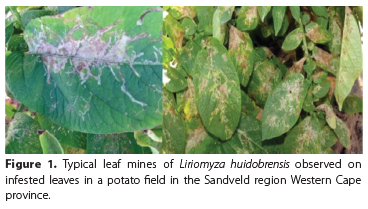
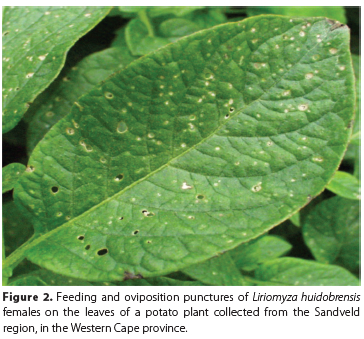
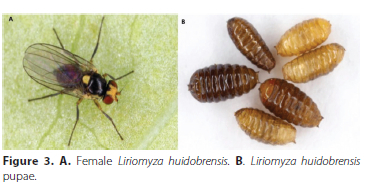
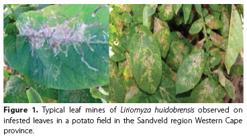
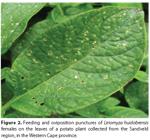
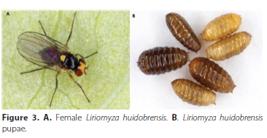
Potatoes are among the four most widely consumed vegetable crops worldwide. However, a potato crop can be infested by various pests like the devastating leaf miner, Liriomyza huidobrensis (Blanchard, 1926) (Diptera: Agromyzidae). This leaf miner has, since the early 2000s, become an important pest of potatoes in South Africa. It is highly invasive, causing up to 70% damage of solanaceous crops. Direct damage results from the adult female flies feeding on the leaf mesophyll during oviposition, and the larvae mining the leaves. Indirect damage is induced through pathogens entering through perforations that act as vectors of plant diseases. Biocontrol agents, such as entomopathogenic nematodes (EPNs), entomopathogenic fungi (EPF) and parasitoids, have shown potential for control of L. huidobrensis. This review investigates the biology and morphological identification of L. huidobrensis, its host range and the potential of associated biocontrol agents, like EPNs, EPF and parasitoids, as future control options.
biocontrol agents; entomopathogenic nematodes; entomopathogenic fungi; potato leaf miner; Diglyphus isaea
 Thumbnail
 Thumbnail
 Thumbnail