Real estate investment trusts: A price-based risk-adjusted performance study in South Africa
Abstract
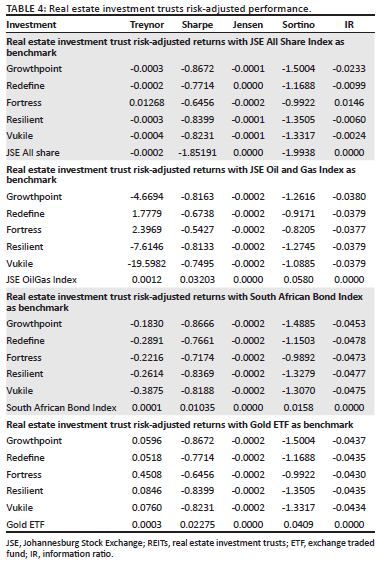
ORIENTATION: The study examined the price-based, risk-adjusted return performance of South African real estate investment trusts (REITs) relative to alternative benchmark investments RESEARCH PURPOSE: To assess the risk-compensation ability of REIT investments on a capital-return basis compared with other asset classes, thereby informing tactical asset-allocation decisions for short-term investors MOTIVATION FOR THE STUDY: Limited attention has been given to how South African REITs perform on a capital-return basis when dividend income is excluded, particularly during periods of economic instability RESEARCH DESIGN, APPROACH AND METHOD: Daily price-based risk-adjusted returns for the leading REITs were benchmarked against the Johannesburg Stock Exchange (JSE) All Share Index, JSE Oil and Gas Index, South African Bond Index, and the NewGold Exchange-Traded Fund using the Treynor, Sharpe, Sortino, Jensen Alpha and Information Ratio measures MAIN FINDINGS: REITs showed superior capital-return performance under the Treynor measure but underperformed alternative investments under the Sharpe, Sortino, Jensen Alpha and Information Ratio measures. Results reflect capital performance only, excluding income distributions PRACTICAL/MANAGERIAL IMPLICATIONS: On a capital-gains basis, REITs may underperform alternatives, influencing liquidity and short-term allocation decisions for investors seeking capital stability CONTRIBUTION/VALUE-ADD: The study contributes to ongoing discussions on asset-class performance by providing South African evidence of REITs' capital-return sensitivity to multiple risk-adjusted metrics and their interaction with other assets such as bonds, oil and gold, thereby enhancing understanding of their tactical-allocation role
South Africa; REITs; risk-adjusted returns; investments; capital return
 Thumbnail