Reward preferences to attract and retain Generation Z
Abstract
ORIENTATION: Generation Z (Gen Z), born between the mid-1990s and early 2000s, has become an essential part of the workforce. However, attracting and retaining this generation is challenging because of their distinct work expectations. To remain competitive, organisations must understand Gen Z's reward preferences RESEARCH PURPOSE: This study aims to explore the total reward preferences of Gen Z, identifying the factors that most effectively attract and retain this generation in the workplace MOTIVATION FOR THE STUDY: As Gen Z enters the workforce, their unique expectations for extrinsic and intrinsic rewards present new challenges and opportunities for employers. Understanding these preferences is crucial for developing reward systems that attract and retain talent, ensuring long-term organisational success. RESEARCH DESIGN, APPROACH AND METHOD: A qualitative, interpretivist approach using phenomenological methodology was adopted. Semi-structured interviews provided insights into reward preferences and retention factors, with data analysed inductively to identify themes. MAIN FINDINGS: The study found that Gen Z values extrinsic rewards such as compensation, benefits and recognition. However, intrinsic motivators such as personal growth, a sense of purpose and the desire to impact also significantly influence their job satisfaction and organisational commitment PRACTICAL/MANAGERIAL IMPLICATIONS: Organisations aiming to attract and retain Gen Z employees should implement reward strategies that balance extrinsic and intrinsic motivators, aligning with their values to enhance engagement, satisfaction and retention. CONTRIBUTION/VALUE-ADD: This research offers key insights into Gen Z's reward preferences and provides practical guidance for tailoring reward systems to meet their expectations, promoting a more engaged and productive workforce.
rewards; total rewards; extrinsic; intrinsic reward; Generation Z; talent retention; total reward strategy
Introduction
The study of generational differences has garnered significant interest in management research, particularly concerning their impact on workplace factors such as rewards, motivation and performance. Generation Z (Gen Z), born between 1990 and 2000, is now entering the workforce (Mastrolia & Willits 2013), displaying distinct values, attitudes and career choices compared to previous generations, such as Millennials (born between 1981 and 1996). Generation Z prioritises different aspects of work, signalling a shift in workplace dynamics (Lyons, Ng & Schweitzer 2014; McGinnis & Ng 2016). As organisations increasingly employ Gen Z, understanding their reward preferences is crucial for effective talent management and retention. In 2020, Gen Z comprised approximately 35% of the global workforce, with Millennials accounting for 24% (ManpowerGroup 2016). These generations comprise more than half of the global labour pool, underscoring the need for strategies that appeal to their values to maintain a competitive edge.
Recent studies indicate that motivating Millennial and Gen Z employees is a top priority for many organisations (Bińczycki, Łukasiński & Dorocki 2023; Gochangco & Ocenar 2024). Research consistently shows a strong correlation between rewards and employee motivation (Elrayah & Semlali 2023; Wahyuhadi, Hidayah & Aini 2023). However, human resource (HR) departments often struggle to identify, which rewards resonate with these younger workers (Bazatova & Nilsson 2024; Hollenbeck 2024). Whether monetary or non-monetary, rewards are crucial incentives that influence employees' job satisfaction, engagement and retention (Hollenbeck 2024). As a result, total reward systems, which integrate both compensation and recognition policies, have gained traction in addressing generational differences in the workplace (Davids 2018).
Human resource strategies are pivotal in attracting and retaining skilled talent. Effective reward systems are linked to higher employee morale and overall organisational success (Bussin et al. 2019). With labour costs often exceeding 50% of corporate expenses, it is critical for organisations to strategically manage their human capital by aligning reward structures with employee preferences. A 'one-size-fits-all' reward approach is ineffective in today's diverse work environment (Bussin et al. 2019). Employees value incentives that reflect their personal and professional needs, including flexible work arrangements and programmes that enhance their quality of life (Hashmi, Al Ghaithi & Sartawi 2023; Paudel et al. 2024). Moreover, Morrell and Abston (2018) and Mikler (2022) projected that Gen Z would make up 50% of the workforce by 2020 and reach 75% by 2025, further emphasising the urgency for companies to adapt their reward strategies to this demographic.
Generation Z employees expect immediate feedback, recognition and involvement in decision-making processes at work (Racolţa-Paina & Irini 2021). Organisations incorporating these preferences into their reward programmes will likely see improved engagement and retention (Acheampong 2021; Pasko et al. 2021). Offering flexible benefits such as additional vacation days or lifestyle perks aligns well with Gen Zs desire for career balance. Moreover, organisations with a nuanced understanding of generational preferences can create targeted reward strategies that yield long-term success (Davids 2018). The challenge lies in attracting and retaining Gen Z talent while also keeping them motivated; failing to do so risks the loss of valuable employees and undermines HR efforts (Acheampong 2021).
Attracting, retaining and motivating talent requires proper reward structures (Amushila & Bussin 2021). Sorn et al. (2023) state that addressing compensation-related issues is crucial for improving employee retention. In addition, retaining skilled and talented employees is crucial for an organisation's success, as it can lead to increased productivity, improved performance and reduced turnover costs (Sorn et al. 2023). Research shows that Gen Z's reward preferences differ from those of previous generations (Narayanan 2022; Weber 2024). Pandita (2022) states that effective strategies for managing Gen Z talent stem from a deeper understanding of their values and motivations. To design an attractive employer brand, it is important for organisations to gain an in-depth understanding of what this generation expects from, and appreciates about, employers (Lassleben & Hoffman 2023).
Managing generational variations has become more prominent in HR, particularly in designing and implementing total reward strategies. While Millennials are distinct from earlier generations, Gen Z presents unique characteristics that demand attention. Unlike previous generations, Gen Z is less focussed on lifelong job security and more on rapid growth opportunities and continuous feedback (Dunne 2022). This generation expects ongoing technical development, recognition and task completion over adherence to traditional workplace structures. Madden (2024) attests that technology platforms have led to the democratisation of information and the deconstruction of rigid hierarchies, which raises important considerations about the organisational structures that best align with Gen Z's preferences. Similarly, Kraght and Brøndum (2025) highlight that Gen Z rejects rigid workplace norms and prioritises mentorship over hierarchy. They are deeply engaged with social justice and environmental causes, further shaping their work expectations and rewards (Acheampong 2021).
Despite the growing interest in Gen Z, there remains a gap in research on their specific reward preferences. Most studies have examined general populations; therefore, more targeted research is needed (Acheampong 2021; Narayanan 2022; Nguyen et al. 2022). While prior studies (Nguyen et al. 2022) have explored Gen Z's preference for non-financial rewards in emerging economies, limited research addresses how these preferences are managed within South Africa's unique labour market, characterised by socio-economic disparities and workplace diversity (Fobian & Maloa 2022; Mabaso & Mathebula 2025; Musakuro & De Klerk 2021). Existing studies (Ochis 2024) suggest that current reward offerings may not align with Gen Z's expectations for purpose-driven work, digital engagement and career development opportunities. Furthermore, research by Kgarimetsa and Naidoo (2024) indicates a critical knowledge gap in effective retention strategies for Gen Z talent. Mina et al. (2021) emphasise that the arrival of Gen Z in the workforce introduces new skills and innovation and evolving reward preferences that may challenge traditional reward models. These findings raise important questions about the adequacy of current reward systems in attracting and retaining Gen Z employees. This study aims to explore the total reward preferences of Gen Z, identifying the factors that most effectively attract and retain this generation in the workplace. Therefore, this study aims to unearth the reward preferences that retain Gen Z in organisations.
Theoretical framework
Understanding the reward preferences of Gen Z in organisations can be done through several theoretical perspectives, including Generational Theory (Howe & Strauss 1991), Expectancy Theory (Vroom 1964) and Social Exchange Theory (SET; Blau 1958).
Generational theory
The Generational Theory posits that individuals born within the same period share similar beliefs, attitudes and life experiences, shaping their behaviours in various contexts, including the workplace. These shared historical, social and cultural experiences foster a generational identity that influences feelings towards organisations and authority (Selin et al. 2020). This theory provides insights into Generation Z's differing work attitudes and preferences compared to earlier generations (Gabrielova & Buchko 2021). The members of Gen Z were born between 1995 and 2015 and, at the time of the study, were 29 years of age. However, it is essential to recognise the diversity and complexity among individuals within a generation, as not all members will exhibit the same preferences or values (Leslie et al. 2021). Studies suggest that generational differences may be overstated, with factors such as job roles, organisational culture and personal traits substantially impacting employee behaviour and preferences (Wong et al. 2008). Therefore, while Generational Theory is relevant in exploring reward preferences for retaining Gen Z, it should not be the sole framework applied. Furthermore, understanding the generational context is vital as employees across various cultures and economies exhibit generational disparities in work values, adherence to psychological contracts, career mobility and motivation. Generational cycles, lasting approximately 20 years, can be categorised into four life stages: childhood, young adulthood, midlife and elderhood (Okros 2020).
Expectancy theory
Expectancy theory, introduced by Vroom (1964), asserts that employees are motivated by the expectation that their efforts will lead to effective performance, resulting in desirable rewards (Vroom 1964). This theory emphasises that human behaviour is goal-oriented, with individuals inclined to pursue actions that yield the highest subjective utility. The motivation to act is influenced by the anticipated outcomes of one's efforts and the desirability of those outcomes. Thus, to retain Gen Z employees effectively, organisations must demonstrate the link between performance and rewards, ensuring that rewards are perceived as desirable and attainable (Malini & Washington 2014). By aligning reward systems with the expectations of Gen Z, organisations can enhance motivation and engagement among this cohort.
Social exchange theory
Social Exchange Theory, developed by Homans in 1958, frames social interactions as reciprocal exchanges between participants, such as employees and their organisations (Cropanzano et al. 2017). This theory suggests that employees expect to receive rewards commensurate with their contributions to the organisation. An effective reward system for retaining Gen Z should offer incentives perceived as fair and equitable, addressing employees' achievements and needs (Cropanzano et al. 2017). By integrating these theoretical perspectives, organisations can better understand the dynamics influencing Gen Z's reward preferences. While Generational Theory provides context regarding shared values and attitudes, Expectancy Theory and SET offer insights into the mechanisms that drive motivation and retention. A comprehensive approach that considers individual and collective factors will enable organisations to tailor their reward strategies effectively.
Therefore, attracting and retaining Gen Z employees emphasises understanding their unique preferences and motivations. By leveraging insights from Generational Theory, Expectancy Theory and SET, organisations can create reward systems that align with the expectations of this cohort, fostering a motivated and engaged workforce.
Generation Z in organisations
Generation Z represents the youngest generation entering the workforce, yet there is no universal agreement on their birth years. Most scholars, including Panwar and Mehta (2019), Protsiuk (2024) and Gomez et al. (2019), define Gen Z as those born between 1995 and 2010, while others, such as Mahmoud et al. (2020) and Ozkan and Solmaz (2015), extend the range to include those born after 2000. For this study, Gen Z will be defined as individuals born between 1995 and 2010 to maintain consistency. This cohort, also known as 'post-Millennials', 'iGen' or 'TrueGen', grew up in the post-9/11 era and have experienced significant global events, including the coronavirus disease 2019 (COVID-19) pandemic (Acheampong 2021). Surrounded by technology and social media, they are often stereotyped as tech-dependent but are also socially conscious and driven by ethical values (Hemantha & Janadari 2023). In the workplace, Gen Z seeks mentorship, professional development and flexible work arrangements. They value entrepreneurial and collaborative environments and prefer technology-enabled career growth (Gaidhani, Arora & Sharma 2019). Compared to previous generations, they are more financially conscious and globally aware (Abu Daqar et al. 2021). Francis and Hoefel (2018) highlight their concern for inclusivity and freedom of expression, which reflects their openness to diverse perspectives while remaining loyal to their values (Magano et al. 2020).
Conceptualisation of employee rewards
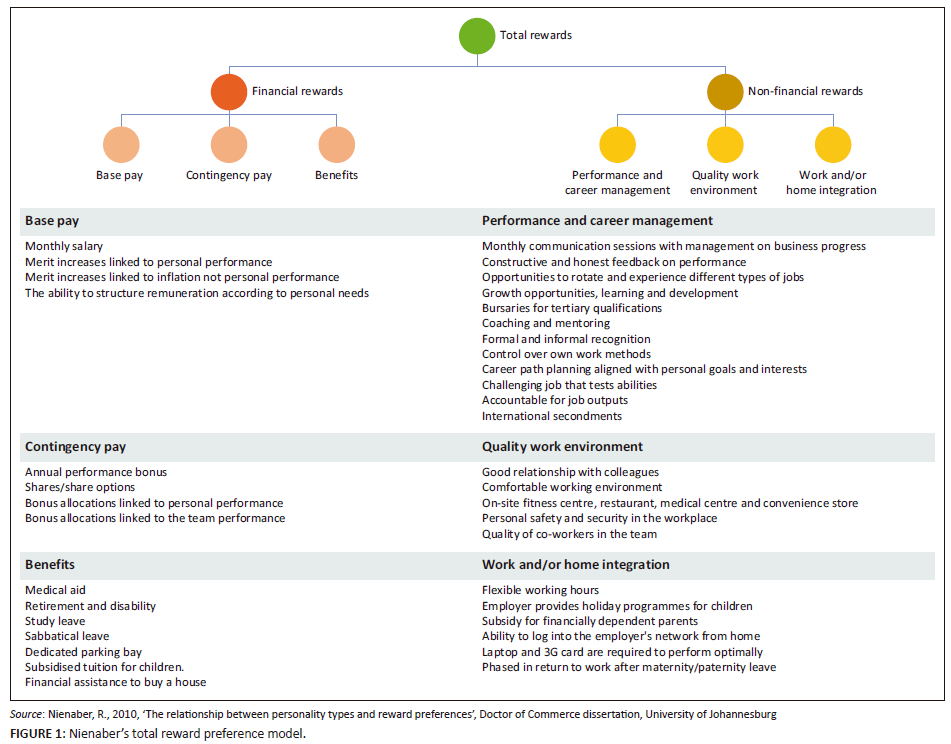
Compensation is broadly categorised into direct or indirect payments, including salaries, bonuses and benefits (Gerhart 2008). These rewards include all monetary returns, tangible services and benefits an employee receives as part of their employment. Reward management involves a set of policies and practices to ensure that employees are compensated fairly and recognised for their contributions to organisational performance (Dunne 2022). For reward systems to be effective, they must meet the business' and its stakeholders' needs. This study adopts Nienaber's Total Rewards Preference Model (2010) (depicted in Figure 1) as its theoretical framework because of its comprehensive and integrated approach to understanding employee reward preferences. The model categorises rewards into monetary, non-monetary and work environment rewards, aligning with contemporary concepts of total rewards that extend beyond traditional compensation strategies. This holistic perspective makes it particularly relevant for exploring Gen Z reward preferences. Several total reward models have been developed, offering comparable reward classifications and strategies. For instance, the WorldatWork Total Rewards Model emphasises compensation, benefits, work-life effectiveness, performance management, talent development and recognition (WorldatWork 2021). Similarly, the Towers Perrin model organises rewards into tangible rewards (pay and benefits) and intangible rewards (learning and work environment) (Armstrong 2010). Zingheim and Schuster's 2006 model highlights four interconnected reward components: individual growth, total pay, a compelling future and a positive workplace (Armstrong 2010). However, Nienaber's model stands out for its focus on individual reward preferences, making it particularly well-suited to exploring Gen Z employees' dynamic and individualised preferences. Unlike models prioritising broad organisational strategies, Nienaber's approach allows for a better analysis of how specific reward elements align with personal values and expectations. This adaptability is crucial for contextualising reward systems within the post-pandemic South African labour market, where socio-economic factors, workplace diversity and evolving labour expectations influence reward effectiveness. By applying Nienaber's model, this study examines the alignment or misalignment between existing reward practices and Gen Z's preferences, providing actionable insights for optimising total rewards to enhance motivation, engagement and retention within this emerging workforce.
Monetary rewards
Monetary or financial incentives are powerful motivators in situations involving promotions or bonuses. Organisations seek to control costs while motivating employees to perform better, while employees seek fair compensation for their efforts and diligence. According to Base (n.d.), individual performance-related pay, skill-based pay and profit-sharing can boost motivation, increase productivity and reduce costs. Research by González Navarro, Selva Olid and Sunyer Torrents (2022) suggests that, except for Baby Boomers, most generations rank their compensation package as the most significant aspect of rewards, with variable pay being less important. Similarly, Elago's (2023) study found that Gen X, Gen Y and Baby boomers prefer compensation as their most preferred rewards. According to Nienaber (2011), base pay is a fixed salary determined by the organisation's pay structure and job evaluation. In addition, contingency, performance-based pay rewards employees for individual, group or organisational achievements (Nienaber 2011). This type of remuneration includes short-term incentives such as team or individual bonuses and long-term rewards such as stock options or share appreciation rights. Employers use this pay structure to motivate employees and improve performance (Hoole & Hotz 2016). Monetary rewards also include benefits. Employee benefits have grown significantly in importance since the early 20th century. Benefits are crucial in enhancing employees' quality of life, shielding them from financial risk and showing that the employer cares for their well-being (Armstrong 2010). Popular programmes include medical coverage, mental health support and paid leave (Center 2012).
Further studies conducted by Barkhuizen et al. (2024) and Mabaso and Mathebula (2025) indicate that different generations value distinct monetary rewards. Baby Boomers prioritise long-term, fixed compensation, while Gen X values a balance between fixed and variable pay. On the other hand, Gen Z prefers customisable reward packages focussing on financial compensation (Alimin & Tukiran 2024). Rubin and Sun (2021) emphasise that Gen Z is drawn to personalised rewards and financial stability, whereas development opportunities and flexible compensation are key for older generations.
Non-monetary rewards
Non-monetary rewards, which do not involve direct financial compensation, are also significant in motivating employees. These rewards can include services such as health benefits, pension schemes' and lifestyle incentives such as paid vacations or access to private healthcare (Agbenyegah 2019). Non-monetary rewards can be divided into two categories: tangible and intangible rewards. The incentive alternatives must be tailored to each person's personality and interests. Different reward methods can satisfy employees' diverse requirements and qualities (Davids 2018). Different generations value different non-financial rewards. Veterans value non-financial rewards such as flexible hours, part-time hours and recognition of expertise and experience (Mashele 2023). Baby Boomers prefer liberty, healthcare, retirement benefits and acknowledgement of their labour. Flexibility in employment, work-life balance and gratification in the form of concrete incentives are valued by Gen X (Dent 2024).
Talent retention
Organisations face significant challenges in retaining Gen Z employees, as this generation is known for its high turnover rates. Many Gen Z employees are willing to leave their jobs if they are dissatisfied or their career aspirations do not align with the company's mission and values (Ngotngamwong 2019). The Deloitte 2018 Survey found that 61% of Gen Z employees were planning to leave their jobs in a couple of years. A survey by Forbes (2021) revealed that 56% of Gen Z plan to change their jobs in upcoming years. Similarly, Microsoft and Bankrate reported a 54% and 74% of Gen Z, respectively, quit their jobs (Dhini 2022). Aggarwal et al. (2022) study revealed that 73% of Gen Z quit their jobs in their organisations as their expectations with the workplace norms were not met. Rohayati et al. (2023) study shows that most Gen Z employees prefer to be unemployed rather than feel unhappy at work. Therefore, exploring reward preferences becomes crucial to retaining Gen Z workers in any talent retention strategy.
One effective strategy involves understanding Gen Z employees' specific needs and preferences and tailoring compensation packages accordingly. Research indicates that Gen Z highly values non-cash benefits, such as flexible work schedules, professional development opportunities and work-life balance. Offering benefits incorporating these factors can significantly enhance employee retention (Connolly 2017). This study aims to contribute to the existing literature by addressing specific gaps in understanding the total reward preferences of Gen Z employees within the South African labour market. While several studies (Acheampong 2021; Madden 2024; Narayanan 2022) have explored Gen Z's reward preferences globally, limited research has contextualised these findings within South Africa's unique socio-economic and organisational landscape.
This research seeks to differentiate between monetary and non-monetary rewards that most effectively attract and retain Gen Z employees in South Africa while examining the alignment or misalignment between current organisational reward structures and Gen Z's expectations, particularly in industries undergoing digital transformation. In addition, it will explore the interplay between rewards, organisational culture and psychological factors influencing Gen Z's career decisions, such as purpose-driven work and ethical leadership. Furthermore, the study will provide industry-specific insights to inform HR strategies for improving talent retention in South Africa's diverse workforce. By focussing on these dimensions, this research will offer a localised and understanding of Gen Z's reward preferences, bridging the gap between existing global studies and practical applications for South African organisations.
Research design
This study was conducted in the financial sector, providing insights into the reward preferences of Gen Z employees within this industry. The findings reflect the perspectives of participants working in financial institutions, where factors such as salary, career growth and flexibility were emphasised over employee well-being and health benefits.
Research approach
An interpretivist qualitative research approach was employed for this study. Interpretivism emphasises the importance of understanding individuals' perspectives and the meanings they attach to their experiences (Alharahsheh & Pius 2020). When exploring the total reward preferences of Gen Z, it is essential to understand their subjective experiences and how they perceive rewards. Qualitative research focusses on understanding human behaviour, attitudes and values through observation and interpretation using more descriptive data and smaller numbers. It offers deeper insights into the research context (Ahmed et al. 2019).
Research design
This study utilises an exploratory research design. According to Swedberg (2020), this type of research aims to discover something new that is generally not known at the beginning of the study. Makki and Abid (2017) state that everyone in the workplace prefers specific rewards, which could be intrinsic or extrinsic. However, this research seeks to explore which rewards are most preferred by Gen Z in the workplace.
Research strategy
For this study, a phenomenological research strategy was employed to explore Gen Z's experiences and perceptions of reward preferences in the workplace. Phenomenology investigates individuals' lived experiences to gain deeper insights into how they interpret and ascribe meaning to those experiences (Delve & Limpaecher 2022). This approach is appropriate for studying reward preferences as it reveals subjective realities and personal interpretations of Gen Z employees regarding reward systems' effectiveness, alignment and perceived value. The choice of phenomenology is justified for several reasons. Firstly, Gen Z's preferences are inherently subjective and shaped by personal values and workplace experiences, which cannot be fully captured through quantitative methods. Phenomenological research provides rich, descriptive data on how they respond to monetary, non-monetary and work environment rewards, aligning with the study's goal of identifying misalignments between reward systems and Gen Z's expectations. Secondly, this strategy helps explore emerging workforce trends such as purpose-driven work and digital engagement that differ from older generations. Finally, findings based on lived experiences offer practical insights for designing tailored reward systems to enhance engagement, motivation and retention. Therefore, phenomenology provides a robust framework for bridging gaps between organisational practices and employee needs.
Research method
Population and sampling
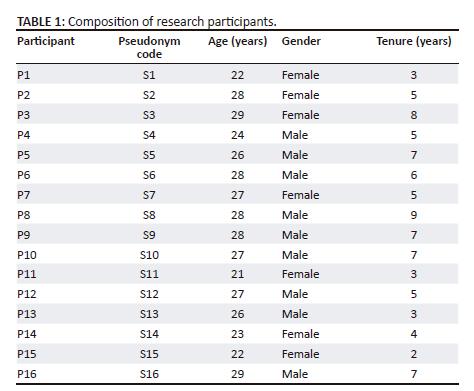
This study employed purposive sampling, a non-probability sampling technique where participants were intentionally selected based on specific characteristics relevant to the research objective (Etikan, Musa & Alkassim 2016). This approach was appropriate to ensure the sample represented the target generational cohort (Gen Z), whose reward preferences and motivators were the primary focus. Participants were selected based on characteristics such as age range (born between 1995 and 2010, employment status and experience working within South African organisations. These criteria ensured that the sample was aligned with the generational context necessary to explore the study's objectives. The sample size of 15 Gen Z participants was determined based on data saturation, where additional interviews would yield no significant new insights (Guest, Bunce & Johnson 2006). This study's purposive sampling method and sample size selection allowed for a rich, qualitative understanding of reward preferences while adhering to the study's generational focus and methodological rigour. The composition of the research participants is illustrated in Table 1.
Data collection method
This study used semi-structured interviews to collect data, allowing for flexibility in exploring participants' experiences while aligning with the study's objectives. Fontana and Frey (2005) describe interviews as conversations designed to gather insights into participants' experiences and interpretations of phenomena. Semi-structured interviews were selected because they are compatible with phenomenological research, providing an open yet guided structure to elicit rich, descriptive accounts of lived experiences (Creswell & Poth 2018). This method is ideal for capturing the nuanced perspectives of Gen Z regarding their reward preferences. Before each interview, participants provided informed consent, and appointments were scheduled at their convenience (Collis & Hussey 2021). Interviews were conducted online using Microsoft Teams, allowing audio recording and automatic transcription (McGrath et al. 2019). This approach enhanced efficiency and data accuracy. The researchers reviewed and refined the transcripts to ensure fidelity to participants' responses. Each interview lasted between 20 and 60 min, depending on the depth of responses. The combination of semi-structured interviews and a digital platform facilitated a comprehensive and context-sensitive exploration of reward preferences, aligning with the study's qualitative, phenomenological framework. The following are examples of questions participants were asked during the interviews: What factors do you consider most important when choosing an employer? How important is salary compared to other forms of rewards and benefits? Besides salary, what financial incentives (e.g., bonuses, profit sharing, commission) motivate you to stay in a job? If you could design the perfect reward system for Gen Z employees, what would it include?
Data analysis
A popular technique for analysing qualitative data is thematic analysis. In order to find the commonalities within a given subject, the researcher can see collective meaning and shared experiences with the aid of thematic analysis (Braun & Clarke 2021). The researcher used Braun and Clarke's (2021) paradigm for thematic analysis to analyse the data. Thematic analysis, using an inductive approach, identified six key themes related to Gen Z's reward preferences. These themes were derived directly from participant data, reflecting recurring patterns in their experiences and perceptions. Each theme incorporates relevant sub-themes, providing a nuanced understanding of how reward strategies align (or misalign) with Gen Z's unique workplace expectations. The six steps are as follows: familiarisation with the data, coding, searching for themes, reviewing, defining, naming and writing up (Braun & Clarke 2021). The researcher became familiar with the data by printing out the transcriptions, highlighting phrases or subjects, which the various participants consistently used, and creating themes from subjects common to all participants. Following their evaluation, the themes were given names and definitions. The researcher's final stage was writing up the results.
Quality assurance in qualitative research
The trustworthiness of this research was established through dependability, confirmability, credibility and transferability. Dependability was ensured by aligning the study's outcomes with the raw data collected, allowing future researchers to duplicate the findings (Lishner 2015; Stratford & Bradshaw 2016). Confirmability was achieved by maintaining an audit trail, ensuring that the results stemmed from the data, not researcher bias (Haven & Van Grootel 2019). Credibility was maintained by accurately representing participants' perspectives through prolonged engagement, reflection, participant validation and thorough analysis (Saunders, Lewis & Thornhill 2019). Finally, transferability was ensured by applying the findings to business and governmental contexts, offering insights into Gen Z's reward preferences (Stoecker & Brydon-Miller 2013).
Ethical considerations
Ethical approval to conduct this study was obtained from the University of Johannesburg Department of Industrial Psychology and People Management (IPPM) Research Ethics Committee on 20 June 2023. The ethical clearance number is IPPM-2023-791(H).
Ethical considerations are critical in qualitative research involving human participants, guiding researchers to act responsibly and protect participants' rights (Saunders et al. 2019). Participation in this study was voluntary, and informed consent was obtained through consent forms detailing the study's purpose, objectives and participants' rights, including the option to withdraw at any point (Connelly 2014). Ethical approval was obtained from the relevant institutional review board to ensure compliance with ethical guidelines. Participants were recruited using purposive sampling, targeting individuals born between 1995 and 2010 who were employed in South African organisations. Recruitment strategies included direct invitations sent through professional networks, referrals and workplace contacts to ensure access to Gen Z employees fitting the study's criteria. The recruitment process emphasised voluntary participation, ensuring that individuals understood the confidentiality and anonymity protections. Confidential information was removed from the data to safeguard participant privacy, and pseudonyms were used in all reporting. Emotional risks were mitigated by creating a supportive interview environment, with clear communication of participants' rights to skip questions or pause interviews if needed. Objectivity, transparency and proper acknowledgement of all contributions ensured ethical integrity throughout the research process.
Results
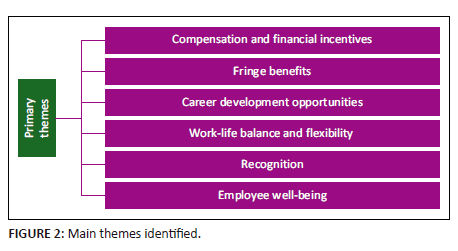
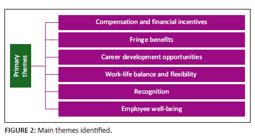
Six main themes emerged during the coding process: compensation and financial incentives, fringe benefits, career development opportunities, work-life balance and flexibility, recognition and employee well-being. These themes, illustrated in Figure 2, reflect recurring patterns in the data and align with the study's objectives. Each theme includes relevant sub-themes, laying the groundwork for a comprehensive analysis of total reward strategies.
Theme 1: Compensation and financial incentives
Financial incentives and compensation are the highest-ranking rewards that attract and retain Gen Z. The findings from this theme emphasised the value Gen Z placed on employee compensation, including performance-based pay, salary, financial aid for education, paid time off and fringe benefits, among others. An analysis of the data revealed that the most often discussed sub-themes under compensation were highly competitive pay and benefits perks. When asked which total rewards are of utmost importance, almost all employees replied with monetary rewards, salary or financial rewards. Most participants, when asked about their experience with total rewards and which total rewards they value the most, asserted that bonuses are what keeps and attracts them:
'I get cash prizes when I achieve my goals. As a store manager, one of my benefits is that on top of my salary, I also get bonuses because of my responsibilities.' (S13, 26, Male, 3)
'I feel like bonuses are relevant to me, when they give you additional pay for doing more than you should have, as well as many companies have these travelling incentives and travelling is expensive on its own.' (S14, 23, Female, 4)
'Monthly salary 4[th] yearly bonuses.' (S5, 26, Male, 7)
Participants 13 and 15 stated how they would love to compensate for their performance through pay increases or monetary rewards. When asked what types of rewards are most effective in retaining Gen Z, they responded:
'Vacations, maybe during your birthday, they give employees a day off or an option to knock off early, performance-based pay.' (S15, 22, Female, 2)
'Performance-based rewards for me, I feel like they are more relevant.' (S13, 26, Male, 3)
Even though most participants are into monetary rewards, Participants 9, 10, 11 and 15 mentioned the importance of rewards, which also help boost their performance. Preferences for pay transparency is one of the recommendations which was raised by the participants when asked and they had the following to say:
'Organisations can make sure that they include few people that are also part of Generation Z group in their recruitment teams. They should also fulfil their agreements and ensure that they include salary on their job posts.' (S15, 22, Female, 2)
'It's not just about the salary; when my manager acknowledges my hard work, I feel more motivated to perform better.'(S9, 28, Male, 7)
'Bonuses are great, but I also want to know that I'm growing in my role and being recognized for my contributions.' (S10, 27, Male, 7)
'I would be more interested in a job if I knew upfront what the salary was. It makes it easier to compare and decide if it's worth applying for.' (S11, 21, Female, 3)
'When salaries are hidden, it feels like the company is not being honest. Knowing the pay range makes me trust them more.' (S15, 22, Female, 2)
Participant 7 also shared the same view when asked what organisations can do to use total rewards to attract Gen Z effectively:
'I think companies should ensure that on their job adverts they make sure that the salary is available, because that's one thing one would want to know when applying for a job. What they offer.' (S7, 27, Female, 5)
Theme 2: Fringe benefits
Generation Z employees emphasise the importance of comprehensive benefits packages that go beyond traditional compensation. Generation Z employees prefer working in organisations that pay for benefits. Several participants highlighted specific types of benefits they find valuable:
'I prefer medical aid, salary, month-to-month benefits.' (S7, 27, Female, 5)
'We are a generation that wants to be paid for everything; this includes additional allowances such as travel and housing benefits.' (S4, 24, Male, 5)
'Financial rewards should be supplemented by additional fringe benefits are the most important to me due to personal responsibilities.' (S11, 21, Female, 3)
Theme 3: Career development opportunities
Self-development has emerged as a crucial element influencing hiring and retention decisions among Gen Z employees. Participants explicitly emphasised this and shared sentiments highlighting its significance within this evolving workforce. Career growth has been a significant concern for this evolving workforce and a vital work value for Generation Z. This view was shared by two participants (S1 and S5).
Participant 1, when asked what type of total rewards are most effective in retaining Gen Z replied:
'Maybe career opportunities and career advancement programmes.' (S1, 22, Female, 3)
Participant 5 added:
' … training programmes to help better skills.' (S5, 26, Male, 7)
Generation Z is willing to improve its skills as the company takes full responsibility for the financial costs. Participant 14 elaborated further:
'I feel like companies should invest in my career advancement, so they should offer either free courses or pay like a sum of the persons cause that they would like to do to help them better themselves.' (S14, 23, Female, 4)
Even though no participants mentioned the importance of mentoring, P10 explained how to have someone who guides and applauds them for the job done helps boost and make her want to expand her skills even more.
Theme 4: Recognition
Most participants prefer recognition and rewards as part of their total rewards packages. Participants 12 and 8 stated:
'I have been awarded on top three performers in the first quarter of 2023, the petrol stipend and public acknowledgement really boosted my confidence and desire to even perform at a high level.' (S12, 27, Male, 5)
'For I feel recognition is important maybe create the top achiever of the month poster and of cause the salary.' (S8, 28, Male, 9)
Participant 12 agrees when he explains:
'Psychological rewards like public acknowledgement in the workplace are more important.' (S12, 27, Male, 5)
Participant 9 endorses this idea with the statement:
'As much as monetary rewards are important, psychological rewards are more important as far as me unleashing my potential is concerned. Being psychologically recognised for my performance can boost my appetite to perform much better.'(S9, 28, Male, 7)
Participants favour recognition for performing optimally. Participant 4 supports this notion by emphasising the need to create a, 'top achiever of the month poster'.
Participant 9 further states that:
' … benefits such as awards and trophies may boost employee satisfaction.' (S9, 28, Male, 7)
Furthermore, she suggests retaining Gen Z organisations may have:
'Regular performance reviews per year and publicly reward high achievers with awards and trophies.' (S9, 28, Male, 7)
Participant 12 explained that public acknowledgement boosts her confidence and desire to perform exceptionally. Moreover, it promotes a high-performance culture and upholds a culture of acknowledging high achievers through prizes and gifts. Participant 14 upholds that receiving consistently positive feedback weekly benefits her overall performance:
' … consistent rewards for consistent efforts sustain motivation of Generation Z employees.' (S14, 23, Female, 4)
Theme 5: Employee well-being
Employee well-being and health benefits do not seem like an essential part of total rewards for Gen Z. Generation Z prefer employee well-being and health benefits as part of their total rewards. Most participants indicated that employee well-being and health benefits are a key factor in retaining and attracting Gen Z. Participant 7 believes that employee well-being and health benefits can retain Gen Z effectively:
'make it a priority because a positive culture leads to increased positivity and good well-being of employees.' (S7, 27, Female, 5)
However, other participants prefer monetary compensation as part of their total rewards package:
'I don't really look at health benefits when choosing a job. Salary and career growth matter more to me.' (S3, 29, Female, 8)
'For me, flexibility and a good salary are more important than medical aid or wellness programmes.' (S8, 28, Male, 9)
Participant 13 thinks employee well-being and health benefits should be added to total rewards:
'The most important thing when it comes to people in the workplace is their health. Where we live in a day and age where people's health isn't necessarily the best when it comes to mental. Counselling services, anything that has to do with your mental health are essential. I do see it a lot with our generation when it comes to mental health and a lot of people aren't working anymore because of their mental health might be as bad as it is. Push their agenda when it comes to making sure that their staffs mental health is alright.' (S13, 26, Male, 3)
Lastly, participant 14 believes that employee well-being and health benefits can retain Gen Z in an organisation:
'I feel like it's really important because the amount of work that we've been put through in school compared to what will be put through work is like way more and I feel like people like to be rewarded, especially regarding mental health.' (S14, 23, Female, 4)
Theme 6: Work-life balance and flexibility
Participants of Gen Z preferred work-life balance and flexible work arrangements. Concerning workplace flexibility, the evidence suggested flexible work arrangements, such as flexible work hours and remote working. Participant 15 stated that flexible working hours assist Gen Z to:
'… spend quality time with their families during the week, allowing them to engage more meaningfully in family activities, share important moments with loved ones, and participate in daily routines that strengthen their bonds and create lasting memories.' (S15, 22, Female, 2)
Participants 1 suggested that working from home may allow her ample responsibility to structure her work schedule to ensure she can complete her work-related tasks effectively and accommodate activities outside of work. Participant 1 further stated that she prefers flexible reward packages regarding remote working options to support work-life balance. She further states that:
'Working from home assists to perform better.' (S1, 22, Female, 3)
Participant 6 also went on to elaborate on why this is an effective reward:
'I feel like money, flexibility of where once can work because a lot of Gen Z's do not like to be micromanaged as maybe they can be flexible working at home and not really go to the office every day and maybe the organisation can help with assisting us to pay for our fees.' (S6, 28, Male, 6)
Participant 1, when asked about any additions or recommendations she would like to add, said:
'Generation Z wants levels of compensation that enable true work-life balance, so this will have to include covering the current cost of living and enabling remote work opportunities.' (S1, 22, Female, 3)
Discussion
This study aimed to explore the total reward preferences of Gen Z, identifying the factors that most effectively attract and retain this generation in the workplace. Compensation, particularly financial rewards, emerged as the most significant factor for attracting and retaining Gen Z employees. Participants consistently highlighted competitive pay, bonuses and performance-based compensation as central to their job satisfaction. These findings align with those of Syal et al. (2024), who found that financial rewards significantly contribute to retaining Gen Z employees. Previous research supports this positive relationship between rewards and talent retention (Hassan 2022; Sarkar et al. 2021). Providing solid financial incentives results in a sense of satisfaction among Gen Z employees (Syal et al. 2024). Participants mentioned specific examples, such as cash prizes and bonuses for exceeding job expectations, as essential motivators. Others highlighted vacation time or early leave options as critical components of performance-based rewards. Pay transparency also emerged as an essential factor, with participants emphasising companies' need to communicate salary details clearly in job postings. Some participants indicated they would likely leave the organisation without salary increases. This finding aligns with research that shows financial and non-financial incentives can enhance employee engagement and retention (Bachmann et al. 2022).
Similarly, Sodircuka and Chesnovicka (2017) found that competitive compensation is crucial for attracting and retaining Gen Z employees. Gelber (2021) further describes Gen Z as 'money-minded', observing that 7 out of 10 respondents identified wages or salary as their primary motivator in the workplace. In addition, 58% of Gen Z participants stated they would work longer or less flexible hours if paid more (Gelber 2021), a trend also observed by Chaudhary (2019), who found that more than half of Gen Z employees ranked salary as their most important motivator. However, beyond financial rewards, Gen Z also values a balance between work-life aspects. Research shows that they seek a combination of financial and non-financial rewards, with flexibility and comprehensive benefits being important factors (Dunne 2024; Kirchmayer & Fratričová 2020).
Regarding non-financial rewards, participants valued comprehensive benefits packages, including medical aid, travel and housing allowances. These benefits were seen as essential to complementing financial rewards, especially given the increasing responsibilities of employees. Fringe benefits are crucial to retention (Sodircuka & Chesnovicka 2017), with some participants preferring these over salary increases. Dunne (2024) found that fringe benefits ranked higher for Gen Z than previous generations, and this preference aligns with findings from Hemantha and Janadari (2023), which showed that fringe benefits increase Gen Z retention and reduce labour turnover. Career development emerged as another critical theme. Generation Z employees strongly desire career growth and advancement opportunities, which they view as integral to any total rewards package. This is consistent with Dunne's (2024) research, which emphasises that career progression and training are vital motivators for Gen Z. Similarly, Hemantha and Janadari (2023) found a positive relationship between learning and development opportunities and talent retention, with many participants indicating that companies offering free courses or covering educational costs would enhance their loyalty and performance.
Recognition and rewards were also highly valued by Gen Z employees. Public acknowledgement, awards and psychological rewards such as praise for performance were identified as essential motivators. Regular performance reviews, public recognition and consistent positive feedback helped sustain motivation and confidence. Agarwal et al. (2018) suggested that organisations should move beyond a one-size-fits-all approach to recognition and rewards, adapting to the diverse needs of today's workforce. Sapta et al. (2021) similarly indicated that competitive recognition programmes could help retain top talent. Work-life balance and flexible work arrangements were also crucial to Gen Z employees. Many participants preferred flexible working hours and the option to work remotely, which allowed them to manage their personal and professional lives more effectively. Flexibility extended beyond working hours includes the ability to move between departments or locations (Pelta 2019). Mahra (2020) found that 79% of Gen Z employees value flexibility, and Mullen's (2021) study further emphasised that flexibility improves productivity and performance. Remote work, in particular, was seen as a way to enhance work-life balance.
However, flexibility alone is not a standalone solution for reducing turnover among Gen Z employees (Protsiuk 2024). Improving work-life balance and flexibility positively impacts employee retention (Sanchez et al. 2020; Shanani et al. 2020; Syal et al. 2024) but organisations must combine these strategies with other rewards for comprehensive retention approaches. Finally, while not as frequently emphasised, employee well-being and mental health benefits were essential to some Gen Z employees. Participants pointed out the need for organisations to prioritise mental health by offering counselling services and fostering a positive workplace culture. They found that mental health support would improve employee performance and retention. Generation Z values a holistic approach to total rewards, combining financial compensation, benefits, career growth, recognition, flexibility and well-being. Adopting a total rewards strategy that addresses financial and non-financial aspects is essential for organisations looking to attract and retain this workforce effectively.
Practical implications
Although career development opportunities are often encouraged, Gen Z employees indicated that they feel constrained by rigid, generalised growth plans that do not meet their personal career aspirations or the need to develop their skills quickly. Organisations must go beyond traditional compensation offerings to close these gaps by introducing clear, transparent compensation frameworks linked to individual performance outcomes and continuous feedback to build trust and motivation. In addition, designing flexible, adaptable career paths allows employees to shape their careers, be supported by mentors and access various skills development opportunities. Integrating technology-enabled recognition systems aligned with Gen Z's digital preferences provides personalised, real-time recognition of achievements and boosts engagement. By addressing these deep, systemic issues, organisations can develop tailored total rewards strategies that authentically reflect Gen Z's unique values and expectations, ultimately leading to improved employee retention, motivation and engagement.
Financial rewards such as cash prizes and early leave options can also be strong motivators, boosting engagement and satisfaction. Career development is a top priority for Gen Z, making learning and development opportunities vital for retention. Employers should provide continuous learning, career advancement and upskilling programmes, including covering educational costs. Structured career progression paths and mentorship programmes can support Gen Zs professional growth, increasing their loyalty to the organisation. Work-life balance and flexibility are highly valued by Gen Z, who prioritise work-life balance. Organisations can continue implementing flexible working hours, remote work options and hybrid models to meet these preferences. Flexibility to move between departments or locations also appeals to Gen Z's desire for variety. However, flexibility alone is insufficient; it should be combined with other rewards to create a holistic retention strategy.
Recognition is another essential motivator for Gen Z. Organisations should establish formal recognition programmes that offer public acknowledgement, praise and awards. Regular feedback and performance reviews provide the validation Gen Z employees seek, sustaining engagement. Tailoring recognition to individual needs ensures that employees feel valued. Fringe benefits such as medical aid, housing allowances and travel perks complement financial rewards and are critical for retention. Mental health and well-being support are also increasingly important to Gen Z.
The study emphasises the need for a total rewards strategy that balances financial compensation, career development, recognition, flexibility and well-being. This comprehensive approach will enhance employee engagement, reduce turnover and help organisations attract top talent. By aligning reward systems with Gen Z's values and expectations, companies can build a motivated and loyal workforce.
Conclusion
This study aimed to explore the total reward preferences of Gen Z, identifying the factors that most effectively attract and retain this generation in the workplace. The findings highlight that competitive compensation is crucial for attracting and retaining Gen Z employees. Financial rewards, such as salaries, bonuses and performance-based incentives, emerged as the primary motivators, with pay transparency playing a significant role in reducing turnover. Non-financial rewards, including career development opportunities, work-life balance and flexibility, were also highly valued. Generation Z seeks continuous learning and professional growth, making learning and development programmes essential for retention.
In addition, recognition and psychological rewards are important for motivating Gen Z employees. Public acknowledgement and regular feedback are critical in maintaining employee engagement and satisfaction. Furthermore, fringe benefits, such as medical aid and housing allowances, complement financial rewards and contribute to retention. Mental health support and well-being programmes were also identified as key factors in fostering a positive workplace culture.
The study concludes that organisations should adopt a total rewards strategy that balances financial and non-financial rewards. A comprehensive approach that includes competitive compensation, career development, recognition, flexibility and well-being support will be effective in attracting and retaining Gen Z. By aligning reward systems with Gen Z's preferences, companies can build a motivated, loyal workforce and reduce turnover. The findings underscore the importance of creating tailored, dynamic reward strategies to meet the evolving needs of this generation.
Competing interests
The author declares that no financial or personal relationships inappropriately influenced the writing of this article.
Author's contribution
C.M. is the sole author of this research article.
Funding information
This research received no specific grant from any funding agency in the public, commercial or not-for-profit sectors.
Data availability
Data supporting this study and findings are available on reasonable request from the author, C.M.
Disclaimer
The views and opinions expressed in this article are those of the author and are the product of professional research. The article does not necessarily reflect the official policy or position of any affiliated institution, funder, agency or that of the publisher. The author is responsible for this article's results, findings and content.
References
Acknowledgements
Literature review
- Abu Daqar, M.A., Arqawi, S. & Abu Karsh, S., 2021, Fintech in the eyes of Millennials and Generation Z (the financial behavior and Fintech perception).
-
Acheampong, N.A.A., 2021, 'Reward preferences of the youngest generation: Attracting, recruiting and retaining Generation Z into public sector organisations', Compensation & Benefits Review 53(2), 75-97. https://doi.org/10.1177/0886368720954803
» https://doi.org/10.1177/0886368720954803 -
Agbenyegah, G., 2019, 'Effect of financial and non-financial rewards on employee motivation in financial institution in Ghana', International Journal of Innovative Research and Development 8(8), 121-130. https://doi.org/10.24940/ijird/2019/v8/i8/JUL19029
» https://doi.org/10.24940/ijird/2019/v8/i8/JUL19029 -
Aggarwal, A., Sadhna, P., Gupta, S., Mittal, A. & Rastogi, S., 2022, 'Gen Z entering the workforce: Restructuring HR policies and practices for fostering the task performance and organisational commitment', Journal of Public Affairs 22(3), e2535. https://doi.org/10.1002/pa.2535
» https://doi.org/10.1002/pa.2535 -
Ahmad, S., Wasim, S., Irfan, S., Gogoi, S., Srivastava, A. & Farheen, Z., 2019, 'Qualitative v/s. Quantitative research summarised review', Population 1(2), 2828-2832. https://doi.org/10.18410/jebmh/2019/587
» https://doi.org/10.18410/jebmh/2019/587 - Alharahsheh, H.H. & Pius, A., 2020, 'A review of key paradigms: Positivism vs interpretivism', Global Academic Journal of Humanities and Social Sciences 2(3), 39-43.
- Alimin, I. & Tukiran, M., 2024, 'Exploring the efficacy of reward systems for Generation Z and Millennials: A systematic literature review', International Journal of Social and Management Studies 5(4), 10-20.
-
Alturkey, Y., 2020, Renewed purpose: WorldatWork newly debuted 2020 total rewards model. LinkedIn, viewed 23 February 2024, from https://www.linkedin.com/pulse/renewed-purpose-worldatwork-newly-debuted-2020-total-rewards-yousef.
» https://www.linkedin.com/pulse/renewed-purpose-worldatwork-newly-debuted-2020-total-rewards-yousef -
Amushila, J. & Bussin, M.H., 2021, 'The effect of talent management practices on employee retention at the Namibia University of Science and Technology: Middle-level administration staff', South African Journal of Human Resource Management 19(1), a1485. https://doi.org/10.4102/sajhrm.v19i0.1485
» https://doi.org/10.4102/sajhrm.v19i0.1485 - Armstrong, M., 2010, Armstrong's handbook of reward management practice: Improving performance through reward, Kogan Page Publishers, London.
-
Barkhuizen, E.N. & Mabaso, C., 2024, 'Exploring meaningful rewards for pharmaceutical employees during COVID-19', SA Journal of Industrial Psychology 50(1), 1-12. https://doi.org/10.4102/sajip.v50i0.2107
» https://doi.org/10.4102/sajip.v50i0.2107 - Base, M.K., n.d., Types of financial rewards in modern organisations, MBA Knowledge Base.
-
Bazatova, P. & Nilsson, R., 2024, Attracting talent: Understanding Generation Z job seekers, Diva Portal, Dalarna University, School of Culture and Society, viewed 13 July 2024, from https://du.divaportal.org/smash/get/diva2:1866416/FULLTEXT01.pdf
» https://du.divaportal.org/smash/get/diva2:1866416/FULLTEXT01.pdf -
Bińczycki, B., Łukasiński, W. & Dorocki, S., 2023, 'Determinants of motivation to work in terms of industry 4.0 - The Gen Z perspective', Sustainability 15(15), 12069. https://doi.org/10.3390/su151512069
» https://doi.org/10.3390/su151512069 -
Blau, P.M., 1964, 'Justice in social exchange', Sociological Inquiry 34(2), 193-206. https://doi.org/10.1111/j.1475-682X.1964.tb00583.x
» https://doi.org/10.1111/j.1475-682X.1964.tb00583.x -
Braun, V. & Clarke, V., 2021, 'One size fits all? What counts as quality practice in (reflexive) thematic analysis?', Qualitative Research in Psychology 18(3), 328-352. https://doi.org/10.1080/14780887.2020.1769238
» https://doi.org/10.1080/14780887.2020.1769238 - Bunton, T.E. & Brewer, J.L., 2012, 'Discovering workplace motivators for the millennial generation of IT employees', in Proceedings of the 1st annual conference on research in information technology, pp. 13-18, Alberta, Calgary.
-
Bussin, M.H., Serumaga-Zake, P. & Mohamed-Padayachee, K., 2019, 'A total rewards framework for the attraction of Generation Y employees born 1981-2000 in South Africa', SA Journal of Human Resource Management 17(1), 1-14. https://doi.org/10.4102/sajhrm.v17i0.1066
» https://doi.org/10.4102/sajhrm.v17i0.1066 - Center, G.F., 2012, Total rewards toolkit, Grameen Foundation Human Capital Center, Washington, DC.
-
Chatzopoulou, E. & De, K.A., 2021, 'Millennials' evaluation of corporate social responsibility: The wants and needs of the largest and most ethical generation', Journal of Consumer Behaviour 20(3), 521-534. https://doi.org/10.1002/cb.1882
» https://doi.org/10.1002/cb.1882 - Collis, J. & Hussey, R., 2021, Business research: A practical guide for students, Bloomsbury Publishing.
- Connelly, L.M., 2014, 'Ethical considerations in research studies', Medsurg Nursing 23(1), 54-56.
- Connolly, H., 2017, 'For generation Y, what is their preferred method of reward management for those working in Ireland?', Doctoral dissertation, National College of Ireland.
- Creswell, J. & Poth, C., 2018, Qualitative inquiry and research design: Choosing among five approaches, 4th edn., Sage.
-
Cropanzano, R., Anthony, E.L., Daniels, S.R. & Hall, A.K., 2017, 'Social exchange theory: A critical review with theoretical remedies', Academy of Management Annals 11(1), 479-516. https://doi.org/10.5465/annals.2015.0099
» https://doi.org/10.5465/annals.2015.0099 - Davids, A., 2018, 'Investigating the use of generational cohort theory to identify total reward preferences', Masters dissertation, University of Cape Town.
-
Delve, H.L. & Limpaecher, A., 2022, Delvetool. What is phenomenological research design? Essential guide to coding, viewed 25 February 2024, from https://delvetool.com/blog/phenomenology.
» https://delvetool.com/blog/phenomenology - Dent, R.I., 2024, 'Employee engagement in public sector organizations', Doctoral dissertation, Liberty University.
- Dhini, V., 2022, Bukan Gaji, Ini yang Dicari Gen Z dan Milenial Saat Bekerja, Databoks.
- Dunne, A., 2022, 'Do different generations have different reward preferences? A comparative study analysing the motivators and reward preferences of Gen Z in comparison to Gen Y', Doctoral dissertation, National College of Ireland.
- Edirisooriya, W.A., 2014, 'Impact of rewards on employee performance: With special reference to ElectriCo', in Proceedings of the 3rd International Conference on Management and Economics, vol. 26, pp. 311-318, Faculty of Management and Finance, University of Ruhuna.
-
Elago, E., 2024, 'Demographic analysis of reward preference in the Social Security Commisssion', Master of Commerce Dissertation, Faculty of Commerce, School of Management Studies, viewed 18 February 2024, from https://hdl.handle.net/11427/40263.
» https://hdl.handle.net/11427/40263 -
Elrayah, M. & Semlali, Y., 2023, 'Sustainable total reward strategies for talented employees' sustainable performance, satisfaction, and motivation: Evidence from the educational sector', Sustainability 15(2), 1605. https://doi.org/10.3390/su15021605
» https://doi.org/10.3390/su15021605 -
Etikan, I., Musa, S.A. & Alkassim, R.S., 2016, 'Comparison of convenience sampling and purposive sampling', American Journal of Theoretical and Applied Statistics 5(1), 1-4. https://doi.org/10.11648/j.ajtas.20160501.11
» https://doi.org/10.11648/j.ajtas.20160501.11 -
Fobian, D. & Maloa, F., 2020, 'Exploration of the reward preferences of generational groups in a fast-moving consumer goods organisation', SA Journal of Human Resource Management 18(1), 1-11. https://doi.org/10.4102/sajhrm.v18i0.1244
» https://doi.org/10.4102/sajhrm.v18i0.1244 - Fontana, A. & Frey, J.H., 2005, 'The interview', in The Sage handbook of qualitative research, vol. 3, pp. 695-727.
-
Francis, T. & Hoefel, F., 2018, 'True Gen': Generation Z and its implications for companies, viewed n.d., from https://www.mckinsey.com/industries/consumer-packaged-goods/our-insights/true-gen-generation-z-and-its-implications-for-companies.
» https://www.mckinsey.com/industries/consumer-packaged-goods/our-insights/true-gen-generation-z-and-its-implications-for-companies -
Gabrielova, K. & Buchko, A.A., 2021, 'Here comes Generation Z: Millennials as managers', Business Horizons 64(4), 489-499. https://doi.org/10.1016/j.bushor.2021.02.013
» https://doi.org/10.1016/j.bushor.2021.02.013 - Gaidhani, S., Arora, L. & Sharma, B.K., 2019, 'Understanding the attitude of Generation Z towards workplace', International Journal of Management, Technology and Engineering 9(1), 2804-2812.
-
Gerhart, B. (ed.), 2008, 'Compensation', in The Routledge companion to strategic human resource management, pp. 238-258, Routledge, London. https://doi.org/10.4324/9780203889015
» https://doi.org/10.4324/9780203889015 -
Gochangco, J.P.M. & Ocenar, M.M.M., 2024, 'Exploring the work motivational factors of Generation Z workforce in selected BPO companies: Basis for job satisfaction', International Journal for Multidisciplinary Research 6(3), 1-7. https://doi.org/10.36948/ijfmr.2024.v06i03.20912
» https://doi.org/10.36948/ijfmr.2024.v06i03.20912 -
Gomes, S., Lopes, J.M. & Nogueira, S., 2023, 'Willingness to pay more for green products: A critical challenge for Gen Z', Journal of Cleaner Production 390, 136092. https://doi.org/10.1016/j.jclepro.2023.136092
» https://doi.org/10.1016/j.jclepro.2023.136092 -
González Navarro, F., Selva Olid, C. & Sunyer Torrents, A., 2022, 'The influence of total compensation on job satisfaction', Universitas Psychologica 20, 1-15. https://doi.org/10.11144/Javeriana.upsy20.itcj
» https://doi.org/10.11144/Javeriana.upsy20.itcj -
Guest, G., Bunce, A. & Johnson, L., 2006, 'How many interviews are enough? An experiment with data saturation and variability', Field Methods 18(1), 59-82. https://doi.org/10.1177/1525822X05279903
» https://doi.org/10.1177/1525822X05279903 -
Hashmi, M.A., Al Ghaithi, A. & Sartawi, K., 2023, 'Impact of flexible work arrangements on employees' perceived productivity, organisational commitment and perceived work quality: A United Arab Emirates case-study', Competitiveness Review: An International Business Journal 33(2), 332-363. https://doi.org/10.1108/CR-10-2020-0130
» https://doi.org/10.1108/CR-10-2020-0130 -
Hassan, Z., 2022, 'Employee retention through effective human resource management practices in Maldives: Mediation effects of compensation and rewards system', Journal of Entrepreneurship, Management and Innovation 18(2), 137-174. https://doi.org/10.7341/20221825
» https://doi.org/10.7341/20221825 -
Haven, T.L. & Van Grootel, D.L., 2019, 'Preregistering qualitative research', Accountability in Research 26(3), 229-244. https://doi.org/10.1080/08989621.2019.1580147
» https://doi.org/10.1080/08989621.2019.1580147 - Hemantha, M.V.R.R. & Janadari, M.P.N., 2023, 'Impact of extrinsic and intrinsic rewards on employee retention among Generation Z: Special reference to the textile industry in Sri Lanka (p. 51)', in P. Gamage (ed.), Proceedings of the 7th CIPM international research symposium, CIPM Sri Lanka, Colombo.
- Hollenbeck, S.J., 2024, 'Exploring recognition, rewards, and the multi-generational workforce during the COVID-19 pandemic', Doctoral dissertation, University of New England.
-
Hoole, C. & Hotz, G., 2016, 'The impact of a total reward system of work engagement', SA Journal of Industrial Psychology 42(1), 1-14. https://doi.org/10.4102/sajip.v42i1.1317
» https://doi.org/10.4102/sajip.v42i1.1317 -
Ismail, D.H., Nugroho, J. & Rohayati, T., 2023, 'Literature review: Soft skill needed by Gen Z in the era RI 4.0 and society 5.0', Majalah Ilmiah Bijak 20(1), 119-131. https://doi.org/10.31334/bijak.v20i1.3119
» https://doi.org/10.31334/bijak.v20i1.3119 -
Kgarimetsa, T.S. & Naidoo, C., 2024, 'Effect of employee recognition and flexible working arrangement on Generation Z retention', SA Journal of Human Resource Management 22, 1-11. https://doi.org/10.4102/sajhrm.v22i0.2770
» https://doi.org/10.4102/sajhrm.v22i0.2770 -
Kraght, H. & Brøndum, L., 2025, 'Bridging the generational divide: Soft skills and value perceptions of Gen Z in the workforce', Journal of Innovation in Polytechnic Education 6(2), 41-70. https://doi.org/10.69520/jipe.v6i2.209
» https://doi.org/10.69520/jipe.v6i2.209 -
Lassleben, H. & Hofmann, L., 2023, 'Attracting Gen Z talents: Do expectations towards employers vary by gender?', Gender in Management: An International Journal 38(4), 545-560. https://doi.org/10.1108/GM-08-2021-0247
» https://doi.org/10.1108/GM-08-2021-0247 -
Leslie, B., Anderson, C., Bickham, C., Horman, J., Overly, A., Gentry, C. et al., 2021, 'Generation Z perceptions of a positive workplace environment', Employee Responsibilities and Rights Journal 33, 171-187. https://doi.org/10.1007/s10672-021-09366-2
» https://doi.org/10.1007/s10672-021-09366-2 -
Lishner, D.A., 2015, 'A concise set of core recommendations to improve the dependability of psychological research', Review of General Psychology 19(1), 52-68. https://doi.org/10.1037/gpr0000028
» https://doi.org/10.1037/gpr0000028 -
Lyons, S.T., Ng, E.S. & Schweitzer, L., 2014, 'Changing demographics and the shifting nature of careers', Human Resource Development Review 13(2), 181-206. https://doi.org/10.1177/1534484314524201
» https://doi.org/10.1177/1534484314524201 -
Mabaso, C.M. & Mathebula, S., 2025, 'Total rewards for attracting and retaining Millennials in the workplace post-COVID-19', SA Journal of Human Resource Management 23, 13. https://doi.org/10.4102/sajhrm.v23i0.2855
» https://doi.org/10.4102/sajhrm.v23i0.2855 - Madden, C., 2024, 'Unlocking the motivation of Gen Z at work: An empirical approach', Doctoral dissertation, Alphacrucis University College.
-
Magano, J., Silva, C.G., Figueiredo, C.P., Vitória, A., Nogueira, T. & Dinis, M.a.P., 2020, 'Generation Z: Fitting project management soft skills competencies - A mixed-method approach', Education Sciences 10(7), 187. https://doi.org/10.3390/educsci10070187
» https://doi.org/10.3390/educsci10070187 -
Mahmoud, A.B., Fuxman, L., Mohr, I., Reisel, W.D. & Grigoriou, N., 2021, '"We aren't your reincarnation!" workplace motivation across X, Y and Z generations', International Journal of Manpower 42(1), 193-209. https://doi.org/10.1108/IJM-09-2019-0448
» https://doi.org/10.1108/IJM-09-2019-0448 -
Makki, A. & Abid, M., 2017, 'Influence of intrinsic and extrinsic motivation on employee's task performance', Studies in Asian Social Science 4(1), 38-43. https://doi.org/10.5430/sass.v4n1p38
» https://doi.org/10.5430/sass.v4n1p38 - Malini, P.H.H. & Washington, A., 2014, 'Employees' motivation and valued rewards as a key to effective QWL- from the perspective of expectancy theory', TSM Business Review 2(2), 45-54.
- ManpowerGroup, 2016, Millennial careers: 2020 vision: Facts, figures and practical advice from workforce experts, ManpowerGroup, Milwaukee, WI.
- Mashele, M., 2023, 'Total reward preferences: A quantitative empirical study of employee retention and attraction in SMMEs in South Africa', Master's thesis, University of Witwatersrand.
-
Mastrolia, S.A. & Willits, S.D. (eds.), 2013, 'Millennials: What do we really know about them?', in Advances in accounting education: Teaching and curriculum innovations, vol. 14, pp. 47-72, Emerald Group Publishing Limited, Leeds. https://doi.org/10.1108/S1085-4622(2013)0000014009
» https://doi.org/10.1108/S1085-4622(2013)0000014009 -
McGinnis Johnson, J. & Ng, E.S., 2016, 'Money talks or millennials walk', Review of Public Personnel Administration 36(3), 283-305. https://doi.org/10.1177/0734371X15587980
» https://doi.org/10.1177/0734371X15587980 -
McGrath, C., Palmgren, P.J. & Liljedahl, M., 2019, 'Twelve tips for conducting qualitative research interviews', Medical Teacher 41(9), 1002-1006. https://doi.org/10.1080/0142159X.2018.1497149
» https://doi.org/10.1080/0142159X.2018.1497149 - Mikler, V.S., 2022, Career motivation in Millennials and Generation z as predictors of turnover intention and organizational commitment, Walden University, Minneapolis, MN.
-
Mina, M., Souad, R., Abdelkabir, A.M. & Mohamed, F., 2021, 'Generation Z, postmodern generation, challenges and issues for human resources management', International Journal of Science and Research 10(3), 1253-1260. https://doi.org/10.21275/SR21314180134
» https://doi.org/10.21275/SR21314180134 -
Morrell, D.L. & Abston, K.A., 2018, 'Millennial motivation issues related to compensation and benefits: Suggestions for improved retention', Compensation & Benefits Review 50(2), 107-113. https://doi.org/10.1177/0886368718822053
» https://doi.org/10.1177/0886368718822053 - Mullen, O., 2021, 'What do Z want? An exploratory study into the rewards that motivate Generation Z', Master's thesis, National College of Ireland.
-
Musakuro, R.N. & De Klerk, F., 2021, 'Academic talent: Perceived challenges to talent management in the South African higher education sector', SA Journal of Human Resource Management 19, 1394. https://doi.org/10.4102/sajhrm.v19i0.1394
» https://doi.org/10.4102/sajhrm.v19i0.1394 -
Narayanan, S., 2022, 'Does Generation Z value and reward corporate social responsibility practices?', Journal of Marketing Management 38(9-10), 903-937. https://doi.org/10.1080/0267257X.2022.2070654
» https://doi.org/10.1080/0267257X.2022.2070654 - Ngotngamwong, R., 2019, 'Why do millennials leave?', Human Behavior, Development & Society 20(4), 7-17.
-
Nguyen Ngoc, T., Viet Dung, M., Rowley, C. & Pejić Bach, M., 2022, 'Generation Z job seekers' expectations and their job pursuit intention: Evidence from transition and emerging economy', International Journal of Engineering Business Management 14, 18479790221112548. https://doi.org/10.1177/18479790221112548
» https://doi.org/10.1177/18479790221112548 - Nienaber, R., 2010, 'The relationship between personality types and reward preferences', Doctor of Commerce dissertation, University of Johannesburg.
-
Nienaber, R., Bussin, M. & Henn, C., 2011, 'The relationship between personalities types and reward preferences', Acta Commercii 11(2), 56-79. https://doi.org/10.4102/ac.v11i2.153
» https://doi.org/10.4102/ac.v11i2.153 - Ochis, K., 2024, Gen Z in work: A practical guide to engaging employees across the generations, Taylor & Francis.
- Okros, A., 2020, Generational theory and cohort analysis, Springer EBooks, pp, 33-51.
-
Ozkan, M. & Solmaz, B., 2015, 'The changing face of the employees-generation Z and their perceptions of work (a study applied to university students)', Procedia Economics and Finance 26, 476-483. https://doi.org/10.1016/S2212-5671(15)00876-X
» https://doi.org/10.1016/S2212-5671(15)00876-X -
Pandita, D., 2022, 'Innovation in talent management practices: Creating an innovative employer branding strategy to attract generation Z', International Journal of Innovation Science 14(3/4), 556-569. https://doi.org/10.1108/IJIS-10-2020-0217
» https://doi.org/10.1108/IJIS-10-2020-0217 - Panwar, S. & Mehta, A., 2019, 'Fostering leadership in Generation Z: Onus on whom?', IUP Journal of Soft Skills 13(3), 65.
-
Pasko, O., Zhang, L., Oriekhova, A., Gerasymenko, N. & Polishchuk, O., 2023, 'Solving the choice puzzle: Financial and non-financial stakeholders preferences in corporate disclosures', Investment Management & Financial Innovations 20(4), 434. https://doi.org/10.21511/imfi.20(4).2023.34
» https://doi.org/10.21511/imfi.20(4).2023.34 -
Paudel, R., Kunwar, V., Ahmed, M.F. & AYedgarian, V., 2024, 'Work-life equilibrium: Key to enhancing employee job satisfaction', Educational Administration: Theory and Practice 30(7), 1146-1159. https://doi.org/10.53555/kuey.v30i7.6956
» https://doi.org/10.53555/kuey.v30i7.6956 -
Protsiuk, O., 2024, 'The mediation effect of supervisor support and total rewards on the relationship between flexible work arrangements and turnover intentions in Gen Z', International Journal of Organizational Analysis. https://doi.org/10.1108/IJOA-04-2024-4418
» https://doi.org/10.1108/IJOA-04-2024-4418 - Racolţa-Paina, N., Irini, R. 2021, 'Generation Z in the workplace through the lenses of human resource professionals - A qualitative study', Quality - Access to Success 22(183), 78-85.
-
Rohayati, T., Destalani, A.A., Arizka, H.D., Fahrezi, M.D. & Dwidienawati, D., 2023, 'Impact of job satisfaction, positive organisational culture and meaningful work on turnover intention in Gen Z', WSEAS TRANSACTIONS on SYSTEMS 22, 613-621. https://doi.org/10.37394/23202.2023.22.62
» https://doi.org/10.37394/23202.2023.22.62 -
Rubin, E. & Sun, K., 2021, Does Gen Z value different things at work than prior generations and what total rewards attract them?, Center for Advanced Human Resource Studies, viewed 15 February 2024, from https://hdl.handle.net/1813/110976
» https://hdl.handle.net/1813/110976 -
Sarkar, J., Jena, L.K. & Sahoo, K., 2023, 'Mediating role of need satisfaction on total reward management towards retention: A conceptual framework', Vilakshan - XIMB Journal of Management 20(2), 210-222. https://doi.org/10.1108/XJM-03-2021-0083
» https://doi.org/10.1108/XJM-03-2021-0083 - Saunders, M., Lewis, P. & Thornhill, A., 2019, Research methods for business students, 8th edn., Pearson.
-
Scholz, C. & Rennig, A., 2019, Generations Z in Europe ([edition unavailable]), Emerald Publishing Limited, viewed 18 February 2024, from https://www.perlego.com/book/887901/generations-z-in-europe-inputs-insights-and-implications-pdf.
» https://www.perlego.com/book/887901/generations-z-in-europe-inputs-insights-and-implications-pdf - Selin, J., Westermark, M. & Abdul, S., 2020, Attracting and retaining millennials in the lCT sector.
-
Sorn, M.K., Fienena, A.R., Ali, Y., Rafay, M. & Fu, G., 2023, 'The effectiveness of compensation in maintaining employee retention', Open Access Library Journal 10(7), 1-14. https://doi.org/10.4236/oalib.1110394
» https://doi.org/10.4236/oalib.1110394 - Stoecker, R. & Brydon-Miller, M., 2013, 'Action research', in Reviewing qualitative research in the social sciences (pp. 21-37), Routledge.
- Stratford, E. & Bradshaw, M., 2016, 'Qualitative research design and rigour', in Qualitative research methods in human geography, Oxford University Press, University of Tasmania, Ontario.
- Strauss, W. & Howe, N., 1991, Generations: The history of American's future, 1584-2069, William Morrow and Company, Inc, New York, NY.
- Swedberg, R., 2020, 'Exploratory research', in C. Elman, J., Gerring, J. Mahoney (eds.), The production of knowledge: Enhancing progress in social science, pp. 17-41, Cambridge University Press, London, UK.
- Syal, A., Rosnani, T., Daud, I., Kalis, M.C.I. & Hendri, M.I., 2024, 'The influence of reward, work-life balance on employee retention: The mediating effect of Job satisfaction Generation Z employees in West Kalimantan', Journal of Management Science (JMAS) 7(1), 270-279.
- Vroom, V.H., 1964, Work and motivation, p. 38, John Willey & sons, New York, NY.
-
Wahyuhadi, J., Hidayah, N. & Aini, Q., 2023, 'Remuneration, job satisfaction, and performance of health workers during the COVID-19 pandemic period at the Dr. Soetomo hospital Surabaya, Indonesia', Psychology Research and Behavior Management 2023, 701-711. https://doi.org/10.2147/PRBM.S396717
» https://doi.org/10.2147/PRBM.S396717 -
Weber, J., 2024, 'Assessing the value orientation preferences and the importance given to principled moral reasoning of Generation Zs: A cross-generational comparison', Business and Society Review 129(1), 26-49. https://doi.org/10.1111/basr.12348
» https://doi.org/10.1111/basr.12348 -
Wong, M., Gardiner, E., Lang, W. & Coulon, L., 2008, 'Generational differences in personality and motivation: Do they exist and what are the implications for the workplace?', Journal of Managerial Psychology 23(8), 878-890. https://doi.org/10.1108/02683940810904376
» https://doi.org/10.1108/02683940810904376 -
WorldatWork, 2021, What is total rewards?, viewed 18 February 2024, from https://web.archive.org/web/20210310101254/ https://www.worldatwork.org/total-rewards-model/
» https://web.archive.org/web/20210310101254/ https://www.worldatwork.org/total-rewards-model/

Accepted: 27 Mar. 2025
Published: 09 June 2025