Constructing theoretical frameworks in social science research
Abstract
Theoretical frameworks generally serve as the intellectual scaffolding that underpins research processes in the social sciences, providing an analytical lens through which researchers make sense of complex social phenomena. This article is an exploration of the fundamental role of theoretical frameworks in social science research. Firstly, it sheds light on its ontological, epistemological and methodological design imperatives, beginning with an elucidation of the concept of theoretical frameworks within the realm of social science research. Secondly, the significance of integrating theoretical frameworks in the research process is analysed, with an emphasis on the fact that it enhances the rigour and clarity of scholarly inquiry by guiding researchers when formulating research questions and hypotheses and in the interpretation of research findings. It conducts a literature review following an abstract conceptual design in an interpretivist research paradigm. Steps are proposed that can be followed when constructing a theoretical framework, using the construct 'poverty' as example. Since social science research deals with intricate and multifaceted social phenomena, theoretical frameworks provide researchers with a structured lens through which they can make sense of this complexity, offering a systematic way to organise and analyse data and observations. They also ensure that the study is focussed and aligned with existing knowledge and relevant theories. TRANSDISCIPLINARY CONTRIBUTION: The significance of inter-, multi- and transdisciplinarity in the construction of theoretical frameworks in social science research are expounded by accentuating the ways in which knowledge domains and methodologies of multiple disciplines create a comprehensive understanding of complex social phenomena.
theory; theoretical frameworks; social science; research; poverty; interdisciplinarity; transdisciplinarity; ideology; paradigms; concepts; constructs
Introduction
The construction of theoretical frameworks is deeply rooted in philosophical inquiry, ideological perspectives and intellectual exploration. Such frameworks mirror the meta-perspectives of the social sciences, allowing for profound reflection on the complexities of human behaviour and the nature of social dynamics.1
It is generally expected that postgraduate students of the social sciences, both basic and applied, include relevant theoretical frameworks in their research. It is, furthermore, assumed that theses and dissertations should make an original contribution to the existing corpus of knowledge pertaining to a particular field of study by reflecting on the support base of theory or, conversely, by demonstrating ways in which the theory might not be as explanatory as originally assumed. However, postgraduate students often find it difficult to acquire scholarly work that takes a particular theoretical approach because journal articles or textbooks are domain or topic focussed and rarely explain the epistemological, ontological, teleological or sociological dimensions applicable to scholarly inquiry into those domains or topics.2,34 5678 9109
The peculiar nature of social science research
Social science research can be regarded as a systematic and structured process aimed at understanding human behaviour, societies, group dynamics and social phenomena.11,1213,143,15,16
Unlike the (logic-)positivistic approach typically followed in natural science research, contemporary social science research makes provision for postmodern traditions characterised by naturalistic and interpretivist paradigms.17
These paradigms facilitate insights into complex, often unquantifiable, human behaviour and social dynamics.318193,4,20
It is generally expected that the social sciences should contribute to the development of knowledge that can lead to positive societal changes and improvement in human conditions. This requires 'theoretical sensitivity' (p. 1).2122
The theory of 'theory' and theoretical frameworks
In postgraduate studies, candidates often confuse the notion of 'theory' with a literature study (p. 95).723
Theories differ vastly in terms of form, scope and function. Functional theories are aimed mainly at establishing mental models and typologies for the purpose of analysis.2425265
The development of theories in the social sciences is typically a dynamic and iterative process. It often involves a combination of deductive reasoning (starting with general principles and deriving specific hypotheses) and inductive reasoning (starting with observations and data and generating theories from these observations).27,2829
In the dynamic interplay of an apparently endless number of variables influencing social dynamics and human behaviour, social scientists utilise theoretical frameworks as their compass or 'guide' (p. 56).81303132 33342013
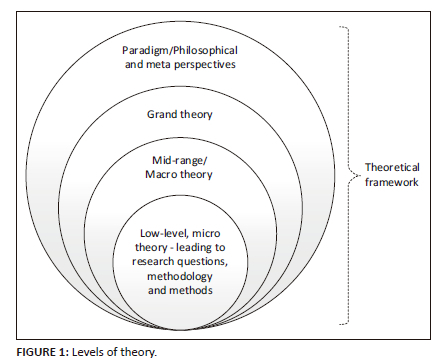
Four layers or levels of theory are distinguishable (see Figure 1). Meta-theory refers to a high order, abstract framework incorporating fundamental underlying philosophical dimensions and perspectives.352223 3636
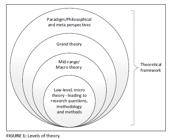
Theoretical frameworks in social science research should preferably incorporate, or at least consider, all four levels of theory.
The theory-ideology-paradigm interfaces
Theory, ideology and scientific paradigms are interconnected in the realm of knowledge construction and production. This is particularly true in the social sciences. Understanding their relationships can help shed light on how ideas and beliefs shape scientific inquiry in general and the construction of theoretical frameworks in particular.3,35
As noted earlier, theories are an integral part of scientific inquiry and provide a structure for understanding and explaining the social world. The development and acceptance of theories can be influenced by ideological beliefs. Ideology refers to a system of beliefs, values and ideas that guide individual or collective behaviour and thoughts.37383922409,41
In addition to ideology, theories are typically formulated within the context of scientific paradigms. The latter are dominant or widely accepted models or frameworks for conducting research within a particular field.424344
It is important to recognise that while there are links between theory, ideology and scientific paradigms, the scientific researcher strives for objectivity and empirical validation. Sound scientific practice involves subjecting theories to empirical testing and peer review to reduce the impact of ideology and ensure that theories and paradigms are grounded in evidence.45
Inter- and transdisciplinary perspectives of theoretical frameworks
Social science is generally organised in various knowledge domains. Over time, each of these domains has been further divided into fields, subfields and disciplines.4647484946
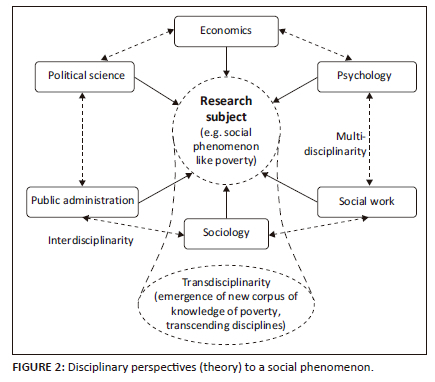
Because of the multidimensional nature of social constructs and phenomena, social science research often involves collaboration between different disciplines, in recognition of the fact that human behaviour and society are multifaceted and complex. To supplement their corpus of knowledge, researchers might therefore draw appropriate theories, models and approaches from various adjacent or reference disciplines to gain a holistic and comprehensive understanding.50,51Figure 2).
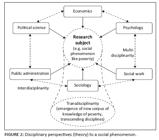
Unlike multidisciplinarity, which involves the engagement of multiple disciplines in a research project or problem without necessarily integrating the approaches or knowledge, interdisciplinarity involves the collaboration and integration of knowledge from two or more academic disciplines to address a specific problem or question.5253
Transdisciplinarity constitutes an attempt to go beyond interdisciplinarity, with the aim of creating a new, holistic understanding of a problem by integrating knowledge from multiple disciplines, along with insights from non-academic stakeholders (such as practitioners, communities or policymakers).5455
Both inter- and transdisciplinarity play important roles in the construction of theoretical frameworks in social science research, each offering unique benefits and insights. Interdisciplinary perspectives (represented by the dashed-lined arrows between disciplines in Figure 2) are significant in constructing theoretical frameworks because they enable social scientists to draw upon the knowledge and methodologies of multiple disciplines to create a comprehensive understanding of complex social phenomena. This approach facilitates a holistic view of the subject under investigation, and, by integrating insights from various disciplines, researchers can delve deeply into the complexities of social issues and gain a nuanced understanding. The combination of different disciplinary approaches can lead to the discovery of connections and patterns that might be overlooked when using a single disciplinary lens.
Multidisciplinary perspectives (represented by the solid-lined arrows between the disciplines and the research subject in Figure 2) are significant in constructing theoretical frameworks when researchers aim to include a wide range of disciplinary perspectives without necessarily seeking deep integration. Researchers can explore several dimensions of a problem in parallel, which might be helpful in terms of gaining diverse insights. Interdisciplinary perspectives, in turn, are highly significant for the construction of theoretical frameworks, as they make it possible to integrate theories and knowledge domains from various disciplines. A new corpus of knowledge emerges because of insights gained by inter- and multidisciplinary collaboration. The new body of knowledge usually transcends individual disciplines and cannot necessarily be traced back to the original disciplines. The aim of utilising this approach is to address complex, real-world problems from a holistic perspective. It encourages a comprehensive understanding of social issues by integrating academic knowledge with practical insights and experiences.53
The significance of inter- and transdisciplinarity in constructing theoretical frameworks in social science research depends on the research goals, the level of abstraction and the complexity of the social issue being studied. Researchers should carefully choose the approach that best aligns with their objectives and the depth of integration required to advance understanding and address practical challenges in the social sciences.
The significance of literature reviews for the construction of theoretical frameworks
Literature reviews involve a comprehensive examination of existing academic literature, including studies in which similar or related topics have been investigated. A literature review requires researchers to synthesise and summarise the findings of previous studies.5657
Theoretical frameworks typically emerge from a robust literature review through a systematic process of synthesising and integrating existing knowledge, theories, models and concepts related to the topic of interest. These existing theories become the foundation upon which the research is built. As theoretical frameworks are constructed based on a specific theoretical perspective or school of thought, the literature review helps researchers to choose the most appropriate theoretical perspective that aligns with the research objectives and the existing body of knowledge. Considering interdisciplinarity, researchers might select one or more theories or combine elements from multiple theories to construct a customised framework. The literature review informs the conceptualisation of key variables and constructs in the study. The theory's principles and propositions guide the formulation of testable statements about the relationships between variables.2
The interrelationship between theoretical and conceptual frameworks
Conceptual and theoretical frameworks are both critical components of social science research. Adom et al.5834
According to Chukwuere,59260592
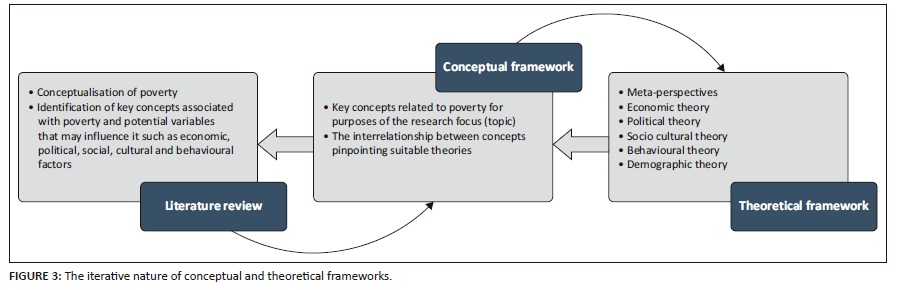
A literature review reveals that there is limited consensus regarding the linear or unidirectional nature of conceptual and theoretical frameworks. Scholars such as Chukwuere59 18582917Figure 3 illustrates the omnidirectional position held in the view of the author by using 'poverty' as an example.
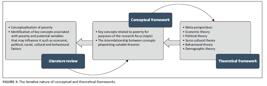
The relationship between concepts guides the identification of appropriate theories, while the 'content' of theories might also inform the conceptual framework. As confirmed by Fuhse,2222
A theoretical framework introduces and describes the theory or theories underpinning the research problem by offering theoretical perspectives on the interrelationships of concepts and the possible causality of identified variables in the conceptual framework. A study concerned with democracy, for example, will have to include consideration of aspects such as the level and quality of citizen participation. Once this has been established (by means of a robust literature review), the theoretical framework will have to include theories pertaining to the relationship between 'democracy' and 'participation'. Thus, theoretical frameworks support research by describing and/or drawing from relevant theoretical aspects obtained in previous work. In short, a conceptual framework can be regarded as the map that guides the construction of a study's theoretical framework. It helps one to organise ideas and provides a starting point for further research. Theoretical frameworks are employed when there are existing theories or models that can be applied to the research problem. Researchers typically use theoretical frameworks to develop hypotheses, design studies and make predictions based on established principles.
Conceptual frameworks are often more flexible than theoretical frameworks, allowing researchers to modify and refine them as the study progresses or as new insights emerge. Theoretical frameworks are relatively less adaptable as they are based on established theories. Changes to a theoretical framework typically involve a substantial revision of the study design and research approach.
The significance of theoretical frameworks in the research process
Social science research typically progresses in several phases, each with its specific objectives and activities. These phases are often iterative, meaning researchers might revisit and revise earlier stages as they progress. These phases are dependent on the nature, purpose and scope of the research.
As such, theoretical frameworks might be variously constructed and applied in action, basic, applied, correlational, qualitative, quantitative or survey research. Theoretical frameworks play a pivotal role in the research process, guiding and informing various stages of a study in the social sciences.2
• Conceptual phase: This phase entails the demarcation of the study focus and the formulation of the research problem, objectives and questions. Researchers typically define the problem based on gaps in existing knowledge or real-world issues. The a priori knowledge of researchers, inclusive of their worldview, disciplinary paradigm and philosophical or meta-perspectives, is instrumental in guiding them in formulating research questions by providing a theoretical lens through which to view the research problem.
• Designing and planning phase: The designing and planning phase of social science research lays the foundation for the entire study and influences the quality and validity of the research findings. Based on the demarcation of the research problem and literature review conducted in the first phase, researchers should decide on the research design and appropriate methodology, including the methods for data collection, such as surveys, interviews, case studies or content analysis. They should also consider the appropriate target population and the most suitable sampling strategy. Researchers should also factor in ethical considerations, including informed consent, privacy and the protection of human subjects. The outcome of the planning phase should provide clarity regarding operational issues of the research such as the most appropriate data analysis approach, the use of suitable software, budget and resource requirements, as well as the timeline for the study. It should be noted that the choice of research design, including the selection of data collection methods and sampling strategies, is influenced by the theoretical framework. The framework informs the research design in terms of ensuring that it is capable of testing the hypotheses or central theoretical statements derived from the theory.
• Empirical phase: This phase entails the actual operationalisation of the design and planning. It includes data collection by means of surveys, interviews or other means that align with the theoretical framework.11
• Analytical phase: Theoretical frameworks continue to feature in the data analysis phase. Researchers use the theory to guide the selection of statistical or qualitative analysis techniques and to interpret the findings in light of the theory's predictions. Data analysis involves the processing and interpretation of the collected data. Researchers use statistical, qualitative or other analytical techniques to answer the research questions and test hypotheses. This phase also entails the interpretation of results, generalisation, deductions and findings. Researchers use theoretical perspectives to make sense of their data and draw meaningful conclusions about the social phenomena under investigation. By grounding research in established theories, scholars can apply their findings to a wider context. Researchers compare the empirical results with the theoretical expectations, helping to validate or refine the theory. Fuhse22
• Dissemination phase: The dissemination phase entails the transmission of knowledge through the reporting of the results by means of a dissertation, thesis, research reports or scholarly articles. In the discussion and conclusion sections of a dissertation or thesis, the theoretical framework should be revisited. Researchers should assess the implications of their findings for the theory and its broader relevance to the field. The use of theory in research thus contributes to the cumulative development of knowledge in social sciences. New research often builds upon or refines existing theories, leading to a deeper understanding of social processes. Research can contribute to the advancement of social theories by testing, expanding or challenging existing frameworks. Empirical findings might lead to the refinement or development of new theories to better explain social phenomena. Researchers might draw on the theory to recommend interventions or strategies based on the theory's insights. By identifying gaps in the existing theory or unexplored aspects of the research problem, researchers can suggest areas for further study.
Thus, throughout the research process, theoretical frameworks serve as a foundational structure, providing a roadmap that links the research questions, data collection, analysis and interpretation. They ensure that the study is conceptually grounded and that the research findings contribute to the broader theoretical knowledge in the field.
Addressing the 'how to' question: A theoretical framework for scholarly inquiry into 'poverty' as an example
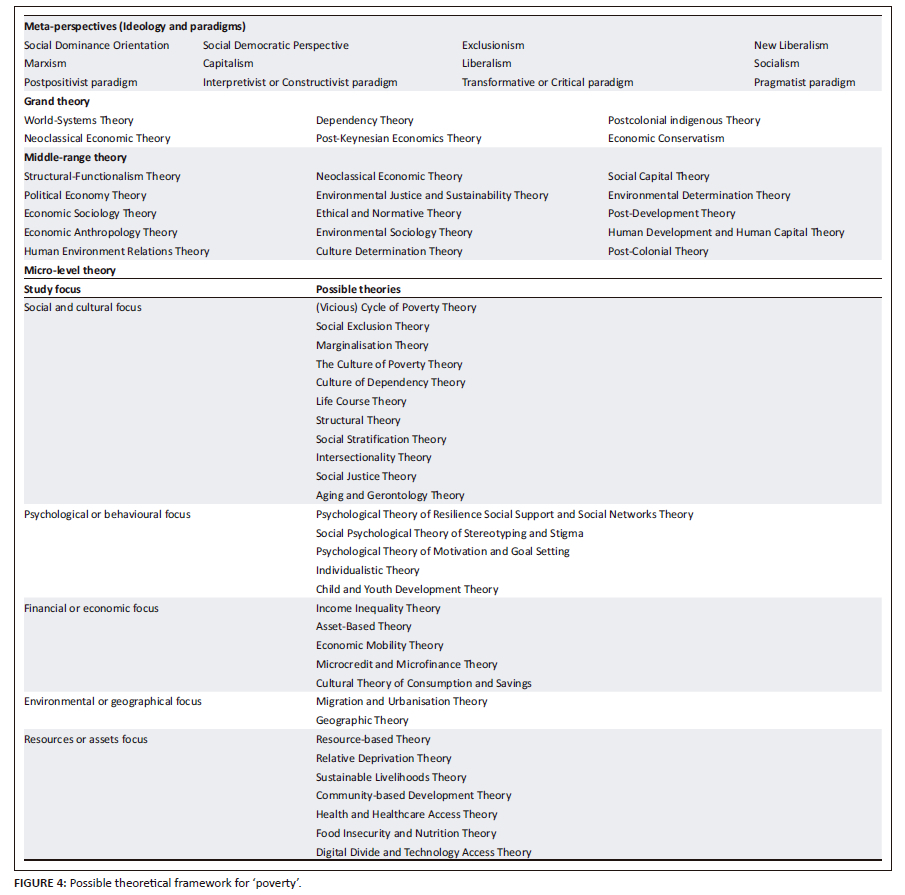
The purpose of this section is to provide guidance for the construction of a theoretical framework by proposing practical steps that should be followed. It is important to note that the use of poverty and the research angle will significantly influence the design of the theoretical framework. For example, rural or urban settings, country cases, gender considerations and ideological contemplations will all eventually influence the choice of theory. Also, the specific research angles, such as social, economic, education, capacity, technology, job creation or community development perspectives will, of course, dictate the mid-level and micro theories eventually chosen for the research. The scope of this article does not allow for an elaborate theoretical framework, and therefore only the construct 'poverty' is used as a practical example. No claims regarding the completeness of the proposed theoretical framework are made. It merely serves as an example and is subject to refutation and adjustments. The recommended steps to construct a theoretical framework will be outlined first, followed by the proposed possible grand, mid-level and micro theories applicable to poverty (Figure 4).

Step 1: Literature review and conceptualisation (conceptual framework)
Constructing a theoretical framework for research on absolute and relative poverty involves identifying the key elements and variables that contribute to a deeper understanding of poverty as a socio-economic phenomenon. The first step is to clearly conceptualise the notion 'poverty' to identify all related concepts, constructs and variables that might influence its nature and scope. A robust literature study will reveal that poverty in its most basic form represents a state of economic deprivation and low living standards. Deprivation includes exclusion from things that determine the quality of life, including food, shelter, clothing and access to clean water. As such, poverty does not refer only to restrained access to financial resources (i.e. income) but also to limited or no access to essentials for a minimum standard of living.
Step 2: Identify concepts, constructs and core dimensions associated with poverty
Once a comprehensive definition of poverty is established, the second step is to identify its core dimensions, as each dimension might require the investigation of a unique theory. The literature study undertaken in Step 1 will show that dimensions of poverty typically include the following:
• Economic poverty, including factors related to income, assets and financial wellbeing.
• Social poverty, including factors such as education, healthcare and access to social services.
• Environmental poverty, including considerations such as living conditions, housing and access to safe environments.
• Psychological poverty, including dimensions relating to the psychological wellbeing of individuals living in poverty, including self-esteem, mental health and stress.
The core dimensions and indicators of poverty outlined by scholars, such as education, health and living standard, are useful in this regard.
Step 3: Identify determinants and mediating variables
The third step is to identify the relationship between the determinants and mediating variables of poverty. These can vary significantly based on individual and contextual factors. For example, low educational attainment can lead to reduced employment opportunities, which, in turn, can contribute to economic poverty. Cultural and societal norms can influence an individual's access to social and health support networks and government assistance. Mediating variables might include socio-economic status, employment opportunities, government policies and social safety nets, income levels, education attainment, access to healthcare and overall health status, housing quality and psychological wellbeing. The successful completion of this step is dependent on the quality and scope of step 1, the literature review, to conceptualise poverty.
Step 4: Consider suitable ideological and paradigmatic perspectives and identify a grand theoretical framework
Typical ideological and paradigmatic perspectives of poverty include Marxist theories, which generally hold that the poor are poor because they are powerless and exploited by capitalists. Liberal theories, on the other hand, maintain that the poor are poor as they are inefficient.
Step 5: Consider interdisciplinary perspectives for theory identification
Scholarly inquiry into poverty is a multidisciplinary endeavour because it encompasses a wide range of social, economic and cultural aspects. Several disciplines might contribute to the study of poverty (cf. Figure 1). Each discipline might offer appropriate micro theories to investigate the dimensions, determinants and mediating variables. Some of the key disciplines and study domains applicable to the scholarly inquiry into poverty include the following:
• Economics: Here the focus is on the economic factors that contribute to poverty, economic growth and development strategies, as well as issues related to employment, wages and labour market dynamics, which are critical to understanding income poverty. Economic theories such as neoclassical economics can help one to analyse economic poverty. Here focus is on factors such as income, consumption and wealth disparities. Income inequality theory concerns the distribution of income within a society and how disparities in income contribute to poverty. The Gini coefficient and the Kuznets curve are often used in this context.
• Sociology: This discipline concerns the social structures and systems that perpetuate poverty, including issues related to social class, race and gender. It also includes an exploration of urban poverty, including issues such as slums, housing and social services in urban areas. Social capital theory is focussed on how social networks, relationships and community connections impact an individual's wellbeing and access to resources. Social exclusion theory, as another example, concerns how certain groups or individuals are marginalised or excluded from participating in social, economic or political life, while structural functionalism is an examination of how social structures and institutions contribute to persistent poverty. It is, basically, an exploration of how systems such as education or labour markets can reinforce inequality.
• Political Science: This study field is characterised by an examination of political dynamics, inclusive of how government policies impact poverty, social welfare and poverty alleviation programmes. In the case of political economy, scholars in this discipline explore the intersection of politics and economics, including how political decisions affect poverty.
• Public Administration and Management: Here the primary focus is on the implementation of government policies, strategies and programmes to address systemic poverty through job creation, economic stimuli packages, social safety nets and grants, employment and labour policies, housing assistance, education initiatives, skills training, universal and preventive healthcare, agricultural and rural development programmes and community development initiatives. Theories pertaining to policy analysis and public administration facilitate the evaluation of the effectiveness of government policies and programmes aimed at poverty alleviation.
• Anthropology: This study domain comprises an investigation of the cultural aspects of poverty, including how cultural norms and practices impact access to resources. Scholars in this field might also study economic systems, trade and exchange in a variety of cultures, shedding light on poverty dynamics. Cultural poverty theories, for example, relate to how cultural norms, values and practices can influence access to resources and opportunities. Feminist theories emphasise the gendered aspects of poverty and how social, economic and political structures can reinforce gender disparities, while intersectionality theory accommodates how multiple aspects of identity (e.g. gender, race, class) intersect to create unique experiences of poverty.
• Psychology: This field is an exploration of the psychological aspects of poverty, including its impact on mental health and stress, and how cognitive biases and decision-making processes influence economic choices related to poverty. Capability approach theory, for example, characterises poverty in terms of the capabilities and freedoms that individuals have, encompassing not only the economic aspects but also health, education and other dimensions of wellbeing.
• Public Health: This domain concerns the relationship between poverty and health outcomes, including access to healthcare and the social determinants of health. Its focus is on the unique challenges of rural poverty, including agricultural livelihoods and infrastructure access. Urbanisation and urban poverty theory, for example, concern the issues specific to urban areas, such as slums, housing and access to urban services.
• Education: This domain constitutes a study of the role of education in poverty alleviation and how educational disparities contribute to poverty and the impact of poverty on academic achievement and educational outcomes. Human development theory, for example, exemplified by the Human Development Index, accommodates multiple dimensions of poverty, such as health, education and standard of living.
• Social Work: Scholars in this field might address poverty through social work interventions, including assistance and support for vulnerable populations. They might also study the development and impact of social policies on poverty reduction.
Researchers draw from these and other related disciplines to gain a comprehensive understanding of the causes and consequences of poverty and to develop effective policies and interventions for poverty alleviation. It is important to note that poverty is not limited to a single dimension, and that these dimensions often overlap and interact.
Step 6: Identify middle range and micro theories
The final step entails the actual construction of a suitable theoretical framework based on the outcomes of steps 1 to 5. Behavioural theories are focussed on individual behaviours, as driven by incentives and culture. The emphasis in structural theories is on the demographic and labour market context, which causes both behaviour and poverty. The assumption of political theories is that power and institutions cause policy, which in turn can cause poverty and which moderate the relationship between behaviour and poverty.
Considering these categories, Figure 4 reflects a broad theoretical framework for poverty. The content was populated through an extensive literature review covering the theoretical work on poverty.
By integrating theories from these levels or layers, researchers can gain a comprehensive understanding of the multifaceted nature of social constructs such as poverty. These theories will guide the selection of variables, data collection methods and the analysis of the research findings, facilitating a rich exploration of the causes and consequences of poverty and the potential interventions to address it.
Because of the infused nature of theory, it should be noted that a neat distinction between meta-theory, grand theory and middle-range theories is simply not possible. Depending on the focus, nature, scope and conceptual framework of the study, it is recommended that postgraduate students choose from these framework examples one grand theory and to imbed it in suitable ideological and paradigmatic perspectives. Furthermore, researchers should adopt one middle-range theory and imbed it in the selected grand theory and two or more micro-level theories relevant to the focus and locus of the study undertaken.
Conclusion
The significance of constructing theoretical frameworks in social science research cannot be overstated. Theoretical frameworks are pivotal in advancing understanding of the complex and dynamic nature of human behaviour and society. As social science research deals with intricate and multifaceted social phenomena, theoretical frameworks provide researchers with a structured lens through which they can make sense of this complexity, offering a systematic way to organise and analyse data and observations. They also ensure that the study is focussed and aligned with existing knowledge and relevant theories.
Theory thus serves as a cornerstone of social science research, providing a structured and systematic approach to understanding, explaining and investigating the social world. The utilisation of theory in research also enhances the rigour and relevance of the research findings and helps researchers to contribute to the broader body of knowledge in their respective fields. Meta-theory, inclusive of philosophical, ideological and paradigmatic perspectives, shapes the way researchers develop and evaluate theories. Ideology can influence metatheoretical choices, which, in turn, guide the development of paradigms within a discipline. Disciplinary traditions incorporate these paradigms into established practices. Grand, macro and micro theories represent the different levels of theoretical abstraction within a discipline, with each level influenced by the broader metatheoretical and ideological context. The relationship between these concepts is complex and interdependent, with each playing a role in the development and evolution of social science theories. Theoretical frameworks often transcend disciplinary boundaries, promoting inter- and transdisciplinary research. This integration of ideas and concepts from various social science fields fosters a more holistic understanding of complex social phenomena.
Theoretical frameworks are not static; they can evolve and adapt to changing social contexts and emerging research findings. This adaptability ensures that theories remain relevant and continue to inform ongoing social science research.
Competing interests
The author declares that he has no financial or personal relationships that may have inappropriately influenced him in writing this article.
Author's contributions
G.v.d.W. is the sole author of this review article.
Ethical considerations
This article followed all ethical standards for research without direct contact with human or animal subjects.
Funding information
This research received no specific grant from any funding agency in the public, commercial or not-for-profit sectors.
Data availability
Data sharing is not applicable to this article as no new data were created or analysed in this study.
Disclaimer
The views and opinions expressed in this article are those of the author and are the product of professional research. The article does not necessarily reflect the official policy or position of any affiliated institution, funder, agency or that of the publisher. The author is responsible for this article's results, findings and content.
Acknowledgements
References
- 1. Salawu RO, Bolatitio AS, Masibo S. Theoretical and conceptual frameworks in research: conceptual clarification. Eur Chem Bull. 2023;12(12):2103-2117.
-
2. Grant C, Osanloo A. Understanding, selecting, and integrating a theoretical framework in dissertation research: Creating the blueprint for 'House'. Admin Issues J: Connecting Educ Pract Res. 2014;4(2):12-22. https://doi.org/10.5929/2014.4.2.9
» https://doi.org/10.5929/2014.4.2.9 -
3. Omodan BI. A model for selecting theoretical framework through epistemology of research paradigms. Afr J Inter/Multidis Stud. 2022;4(1):275-285. https://doi.org/10.51415/ajims.v4i1.1022
» https://doi.org/10.51415/ajims.v4i1.1022 - 4. Babbie E, Mouton J. The practice of social research. Cape Town: Oxford University Press; 2011.
-
5. Brydges M, Batt AM. Untangling the web: The need for theory, theoretical frameworks, and conceptual frameworks in paramedic research. Paramedicine. 2023;20(4):89-93. https://doi.org/10.1177/27536386231177348
» https://doi.org/10.1177/27536386231177348 -
6. Casanave CP, Li Y. Novices' struggles with conceptual and theoretical framing in writing dissertations and papers for publication. Publications. 2015;3(2):104-119. https://doi.org/10.3390/publications3020104
» https://doi.org/10.3390/publications3020104 - 7. Hofstee E. Constructing a good dissertation: A practical guide to finishing a masters, MBA or PhD on schedule. Sandton: EPE; 2018.
- 8. Kumar R. Research methodology: A step-by-step guide for beginners. 4th ed. London: SAGE; 2014.
- 9. Mensah RO, Frimpong A, Acquah A, Babah PA, Dontoh J. Discourses on conceptual and theoretical frameworks in research: Meaning and implications for researchers. J Afr Interdis Stud. 2020;4(5):53-64.
- 10. Ritchie J, Lewis J, Nicholls CM, Ormston R. Qualitative research practice: A guide for social science students and researchers. London: SAGE; 2014.
-
11. Mohajan HK. Qualitative research methodology in social sciences and related subjects. J Econ Dev Environ People. 2020;7(1):23-48. https://doi.org/10.26458/jedep.v7i1.571
» https://doi.org/10.26458/jedep.v7i1.571 - 12. Silverman D. Qualitative research. London: SAGE; 2010.
- 13. Hiebert J, Cai J, Hwang S, Morris AK, Hohensee C. Doing research: A new researcher's guide. Cham: Springer; 2023.
- 14. Punch KF. Introduction to social research: Quantitative and qualitative approaches. London: Sage; 2013.
- 15. Berg BL. Qualitative research methods for the social science. 8th ed. Long Beach: Allyn and Bacon; 2012.
- 16. George AL, Bennett A. Case studies and theory development in the social science. Cambridge, MA: MIT Press; 2005.
-
17. Garvey CM, Jones R. Is there a place for theoretical frameworks in qualitative research? Int J Qual Methods. 2021;20:1-7. https://doi.org/10.1177/1609406920987959
» https://doi.org/10.1177/1609406920987959 -
18. Williams DM. A meta-theoretical framework for organizing and integrating theory and research on motivation for health-related behavior. Front Psychol. 2023;14:1130813. https://doi.org/10.3389/fpsyg.2023.1130813
» https://doi.org/10.3389/fpsyg.2023.1130813 -
19. Thirsk LM, Clark AM. Using qualitative research for complex interventions: The contributions of hermeneutics. Int J Qual Methods. 2017;16(1), 1-10. https://doi.org/10.1177/1609406917721068
» https://doi.org/10.1177/1609406917721068 - 20. Flick U. An introduction to qualitative research. 5th ed. London: SAGE; 2014.
- 21. Glaser BG. Theoretical sensitivity. Mill Valley, CA: Sociology Press; 1978.
-
22. Fuhse JA. How can theories represent social phenomena? Sociol Theor. 2022;40(2):99-123. https://doi.org/10.1177/07352751221087719
» https://doi.org/10.1177/07352751221087719 - 23. De Vos AS, Strydom H, Fouché CB, Delport CSL. Research at grass roots for the social sciences and human service professions. 3rd ed. Pretoria: Van Schaik; 2005.
- 24. Bauer AM, Meyerhuber M. Empirical research and normative theory: Transdisciplinary perspectives on two methodical traditions between separation and interdependence. Berlin: De Gruyter; 2020.
-
25. Bowman Q. Re-engaging normative and empirical democratic theory: Or, why normative democratic theory is empirical all the way down. Crit Rev. 2022;34(2):159-201. https://doi.org/10.1080/08913811.2022.2054612
» https://doi.org/10.1080/08913811.2022.2054612 -
26. Abend G. The meaning of theory. Soc Theor. 2008;26(2):173-199. https://doi.org/10.1111/j.1467-9558.2008.00324.x
» https://doi.org/10.1111/j.1467-9558.2008.00324.x -
27. Timmermans S, Tavory I. Theory construction in qualitative research: From grounded theory to abductive analysis. Sociol Theor. 2012;30(3):167-186. https://doi.org/10.1177/0735275112457914
» https://doi.org/10.1177/0735275112457914 -
28. Van der Waldt G. The judicious use of theory in social science research. TD: J Transdis Res Southern Afr. 2020;17(1):a1039. https://doi.org/10.4102/td.v17i1.1039
» https://doi.org/10.4102/td.v17i1.1039 -
29. Collins CS, Stockton CM. The central role of theory in qualitative research. Int J Qual Methods. 2018;17(1):1-10. https://doi.org/10.1177/1609406918797475
» https://doi.org/10.1177/1609406918797475 - 30. Maree JG, editor. Complete your thesis or dissertation successfully: Practical guidelines. Cape Town: Juta; 2012.
- 31. Anfara Jr VA, Mertz NT (Eds.). Theoretical frameworks in qualitative research. 2nd ed. Thousand Oaks, CA: Sage; 2015.
- 32. Connaway LS, Radford ML. Research methods in library and information science. Los Angeles, CA: ABC-CLIO; 2016.
- 33. Radhakrishna R, Yoder E, Ewing J. Strategies for linking theoretical framework and research types. Proc Am Assoc Agr Educ Res Conf. 2007;34:692-694.
-
34. Varpio L, Paradis E, Uijtdehaage S, Young M. The distinctions between theory, theoretical framework, and conceptual framework. Acad Med. 2020;95(7):989-994. https://doi.org/10.1097/ACM.0000000000003075
» https://doi.org/10.1097/ACM.0000000000003075 -
35. Allana S, Clark A. Applying meta-theory to qualitative and mixed-methods research: A discussion of critical realism and heart failure disease management interventions research. Int J Qual Methods. 2018;17(1):1-19. https://doi.org/10.1177/1609406918790042
» https://doi.org/10.1177/1609406918790042 -
36. Liehr P, Smith MJ. Middle range theory: Spinning research and practice to create knowledge for the new millennium. Adv Nurs Sci. 2009;21(4):81-91. https://doi.org/10.1097/00012272-199906000-00011
» https://doi.org/10.1097/00012272-199906000-00011 -
37. Coelho-Lima F, Varela V, Bendassolli PF. Ideology, sense, and meaning: A theoretical-methodological approach. Cult and Psychol. 2021;27(1):152-171. https://doi.org/10.1177/1354067X21993795
» https://doi.org/10.1177/1354067X21993795 -
38. Hancock CL. Ideologies of poverty and implications for decision-making with families during home visits. Ling Edu. 2023;78:1-13. https://doi.org/10.1016/j.linged.2023.101231
» https://doi.org/10.1016/j.linged.2023.101231 -
39. Waldfogel HB, Sheehy-Skeffington J, Hauser OP, Kteily NS. Ideology selectively shapes attention to inequality. Psychol Cogn Sci. 2021;118(14):e2023985118. https://doi.org/10.1073/pnas.2023985118
» https://doi.org/10.1073/pnas.2023985118 -
40. Svejvig P. A meta-theoretical framework for theory building in project management. Int J Project Manage. 2021;39(8):849-872. https://doi.org/10.1016/j.ijproman.2021.09.006
» https://doi.org/10.1016/j.ijproman.2021.09.006 - 41. Kumatongo B, Muzata KK. Research paradigms and designs with their application in education. J Lex Term. 2021;5(1):16-32.
-
42. Möller K, Halinen A. Clearing the paradigmatic fog - How to move forward in business marketing research. Indust Market Manag. 2022;102(1):280-300. https://doi.org/10.1016/j.indmarman.2022.01.021
» https://doi.org/10.1016/j.indmarman.2022.01.021 - 43. Davies C, Fisher M. Understanding research paradigms. J Aust Rehabil Nurs Assoc. 2018;21(3):21-25.
-
44. Kaushik V, Walsh CA. Pragmatism as a research paradigm and its implications for social work research. Soc Sci. 2019;8(9):255. https://doi.org/10.3390/socsci8090255
» https://doi.org/10.3390/socsci8090255 -
45. Angeles RN, Dolovich L, Kaczorowski J, Thabane L. Developing a theoretical framework for complex community-based interventions. Health Promot Pract. 2014;15(1):100-108. https://doi.org/10.1177%2F1524839913483469
» https://doi.org/10.1177%2F1524839913483469 -
46. Martin-Martin A, Orduna-Malea E, Delgado López-Cózar E. A novel method for depicting academic disciplines through Google Scholar Citations: The case of bibliometrics. Scientomet. 2018;114(3):1251-1273. https://doi.org/10.1007/s11192-017-2587-4
» https://doi.org/10.1007/s11192-017-2587-4 -
47. Krishnan A. What are academic disciplines? Some observations on the disciplinarity vs. interdisciplinarity debate [homepage on the Internet]. [cited 2024 May 5]. Southampton, University of Southampton, National Centre for Research Methods. NCRM Working Paper Series 03/09; 2009. Available from: https://eprints.ncrm.ac.uk/id/eprint/783/1/what_are_academic_disciplines.pdf
» https://eprints.ncrm.ac.uk/id/eprint/783/1/what_are_academic_disciplines.pdf -
48. Tight M. Higher education: Discipline or field of study? Tertiary Edu Manage. 2020;26:415-428. https://doi.org/10.1007/s11233-020-09060-2
» https://doi.org/10.1007/s11233-020-09060-2 -
49. Bath D, Smith C. Academic developers: An academic tribe claiming their territory in higher education. Int J Acad Dev. 2004;9(1):9-27. https://doi.org/10.1080/1360144042000296035
» https://doi.org/10.1080/1360144042000296035 -
50. Bardecki MJ. Multi-disciplinarity. In: Leal Filho W, editors, Encyclopedia of sustainability in higher education. Cham: Springer; 2019, pp. 1179-1184. https://doi.org/10.1007/978-3-030-11352-0_90
» https://doi.org/10.1007/978-3-030-11352-0_90 -
51. Saint-Pierre C, Herskovic V, Sepúlveda M. Multidisciplinary collaboration in primary care: A systematic review. Fam Pract. 2018;35(2):132-141. https://doi.org/10.1093/fampra/cmx085
» https://doi.org/10.1093/fampra/cmx085 -
52. Dalton A, Wolff K, Bekker B. Multidisciplinary research as a complex system. Int J Qual Methods.2021;20:160940692110384.https://doi.org/10.1177/16094069211038400
» https://doi.org/10.1177/16094069211038400 - 53. Van der Waldt, G. Public administration and transdisciplinarity: A modalistic approach toward knowledge co-construction. Int J Hum Soc Sci. 2014;4(6):120-134.
-
54. Schmalz, DL, Janke MC, Payne LL. Multi-, inter-, and transdisciplinary research: Leisure studies past, present, and future. J Leis Res. 2019;50(5):389-393. https://doi.org/10.1080/00222216.2019.1647751
» https://doi.org/10.1080/00222216.2019.1647751 -
55. Baker V, Ataria J, Ankeny R, Bray H. Transdisciplinary science and the importance of indigenous knowledge. Integrated Environ Assess Manage. 2024;20(3):805-816. https://doi.org/10.1002/ieam.4847
» https://doi.org/10.1002/ieam.4847 - 56. Van der Waldt G. Elucidating the application of literature reviews and literature surveys in social science research. Admin Publ. 2021;29(1):1-20.
-
57. Snyder H. Literature review as a research methodology: An overview and guidelines. J Bus Res. 2019;104:333-339. https://doi.org/10.1016/j.jbusres.2019.07.039
» https://doi.org/10.1016/j.jbusres.2019.07.039 - 58. Adom D, Hussein EK, Agyem JA. Theoretical and conceptual framework: Mandatory ingredients of a quality research. Int J Sci Res. 2018;7(1):438-441.
- 59. Chukwuere J. Theoretical and conceptual framework: A critical part of information systems research process and writing. Rev Int Geo Educ. 2021;11(9):2678-2683.
- 60. Ravitch SM, Riggan M. Reason and rigour: How conceptual frameworks guide research. 2nd ed. Thousand Oaks, CA: Sage; 2017.

Accepted: 15 July 2024
Published: 14 Aug. 2024