




Services on Demand
Journal

Article
 English (pdf)
 Article in xml format
 Article references
 Automatic translation
 Send this article by e-mail
Indicators
Related links
-
 Cited by Google
 -
 Similars in Google
Share

 Permalink
Communitas
On-line version ISSN 2415-0525Print version ISSN 1023-0556
Communitas (Bloemfontein. Online) vol.29 Bloemfontein 2024
https://doi.org/10.38140/com.v49i.8590
ARTICLES
Gen Z and Cause Marketing - A Q-Methodology perspective
Nyiko Sibusiso SitholeI; Dr Roela HattinghII
IDepartment of Strategic Communication, University of Johannesburg, Johannesburg, South Africa. Email: nyikosibu41@gmail.com. ORCID: https://orcid.org/0009-0005-5007-7553
IIDepartment of Strategic Communication, University of Johannesburg, Johannesburg, South Africa. Email: rhattingh@uj.ac.za. ORCID: https://orcid.org/0000-0003-1638-6916
ABSTRACT
South African brands use different strategies such as cause marketing (CM) to establish connections with their stakeholders. In CM, a for-profit organisation supports a non-profit organisation (NPO) through consumers' participation in transactional or non-monetary activities to achieve organisational goals. Q-methodology (Q) was used to study how campaign structural elements on Instagram influence Generation Z's attitudes towards CM in South Africa. A concourse comprising 100 fictitious Instagram posts was developed, drawing inspiration from current global campaigns. The Q-set of 24 (piloted) cards obtained from the concourse were selected using Fisher's (1960) balanced block design. The population sample (P-set) included 12 heterogeneous Gen Z participants. One of the researchers also participated in the study for self-reference purposes. Ken-Q Analysis version (2.0.1) evaluated this study's findings, and a Q factor analysis was conducted using Centroid extraction accompanied by Varimax rotation, producing three viewpoints. Viewpoint 1: Keep it practical had six participants who enjoyed trustworthy campaigns that were easy to engage in. Viewpoint 2: Stop tokenising causes had three participants who detested brands that inappropriately use charity-linked campaigning to appeal to their consumers for profit-driven reasons. Viewpoint 3: Aesthetics and accessibility are crucial had four participants who focused on CM campaigns' visual appeal.
Keywords: marketing communication, brand communication, cause marketing, Q-methodology, Instagram, Generation Z, campaign structural elements
INTRODUCTION
As the world continues to face sustainability-related challenges such as food insecurity, geopolitical instability and social injustice, organisations constantly seek ways to alleviate these issues. Some organisations are more proactive than others regarding systematically reporting their good deeds through annual reports and posting highlights about their corporate social responsibility (CSR) projects online (Trialogue, 2023). In doing so, it appears that organisations are attempting to balance being profitable and socially responsible, which is a daunting challenge considering the complexities surrounding being transparent and purpose-washing (i.e., inauthentic philanthropic gestures) (Moharam et al., 2020). This has motivated some organisations to view the activity of corporate social investment (CSI) as more than donating money to organisations towards ethically contributing to the betterment of society (Meintjes & Botha, 2021). However, in recent times organisations have been competing on global platforms such as the Dow Jones Sustainability Index for the title of most purpose-driven organisation (Park et al., 2023), which raises the question of how these brands convince consumers that their efforts are sincere.
Organisations use many avenues to communicate their social advocacy-related efforts, and this is often practiced through cause marketing (CM). CM initiatives are advertising campaigns involving collaborations between for-profit organisations and NPOs to tackle social challenges (Sitto & Lubinga, 2021). For-profit brands initiate CM campaigns by creating promotional sales where consumers participate in a specific activity (i.e., purchasing a pink breast cancer-themed chocolate bar to donate to charity). Strictly speaking, there is no universal or one-style-fits-all strategy due to the numerous types of CM campaigns. Commonly, transaction-based campaigns are used by organisations triggered by consumers' monetary participation (i.e., purchase one chocolate, and we will donate R20 towards fighting breast cancer). CM research primarily focuses on transaction-based campaigns; however, there is a shift towards studying non-monetary-based formats (Handa & Gupta, 2020; Gupta & Handa, 2024). This shift has been motivated by consumers who want reassurance that their donations contribute meaningfully to people's lives (Dugan, Clarkson & Beck, 2021; Bizcommunity, 2022).
Generally, stakeholders such as Generation Z (Gen Z) tend to criticise brands that show inaction towards pertinent matters that occur within their communities (Du Plessis, 2021). A total of 71% of South African Gen Z consumers are of the view that brands should address issues within their communities (InSites-Consulting, 2022). Research has shown that Gen Zs tend to support organisations that are ethical in their use of CM campaigning, and they appreciate brands that promote their initiatives on image and video-based platforms (Konstantinou & Jones, 2022; Sithole & Sitto, 2022; Thomas, Bhatt & Patel, 2022). However, regarding CM, appealing to Gen Z is a challenge because only 12% have an understanding of it (DoSomething-Strategic, 2019). South African brands use a one-style-fits-all strategy (generic, mundane, inconsistent, and non-tailored messaging) when disseminating information about their CM campaigns. This could weaken their ability to encourage Gen Z consumers to participate in CM campaigns. Research on digital cause marketing in South Africa is scarce (Van Schoor, 2021); this study offers an opportunity to provide a new perspective on Gen Z consumers' perceptions of this topic.
The primary objective of this study was to investigate how structural elements of the Instagram campaign influence Gen Z's perceptions regarding non-monetary-based CM in South Africa. The following research questions guided this study:
Primary research question
How do campaign structural elements on Instagram influence Gen Z's perceptions of non-monetary-based cause marketing in South Africa?
Research sub-questions
RQ1: How is the connection between the product type and the brand promoting a non-monetary-based
CM campaign perceived by South African Gen Z consumers?
RQ2: How does the donation recipient proximity of a non-monetary CM campaign influence
South African Gen Z consumers' perceptions towards the initiative?
RQ3: How does Gen Z's perception of the strategic communication legitimacy of a non-monetary-based CM Instagram post influence their social word-of-mouth engagements?
LITERATURE REVIEW
Paradigm shifts in sustainability research
Sustainability research has evolved, and organisations continuously adapt how they frame their social responsiveness within integrated reports. Globally, there are numerous benchmarking criteria goals that corporate organisations seek to align with, such as the United Nations Sustainable Development Goals (Banasick & Radovic, 2019). There are concepts that organisations refer to in their reports, which include CSR, CSI and Environmental, Social and Governance (ESG) (Kazmierczak, 2022; Park et al., 2023). CSR connects to an organisation's ethos and promises to improve environmental and social conditions (Park et al., 2023). CSR is initiated through CM, charity sponsorships and other goodwill actions (Moharam et al., 2020). CSI puts CSR into action by supplying financial and non-monetary resources (Kazmierczak, 2022; Trialogue, 2023). Scholars and industry practitioners have called for a more evidence-based evaluation benchmarking framework to measure an organisation's sustainability efforts, as seen through the rise of ESG reporting (Kazmierczak, 2022). ESG reporting provides empirical evidence of organisations' charity-related commitments, which offers a method to measure their social impact (Masongweni & Simo-Kengne, 2024). This study focused on CM, which stems from CSR. The following section highlights the importance of campaign structural elements.
Campaign structural elements
Most CM campaigns contain specific messages designed to resonate with consumers. These cues are called campaign structural elements, influencing how consumers perceive and participate in a CM campaign (Grau & Folse, 2007; Human, 2016). There are dozens of campaign structural elements, and the following section will explain each one with a South African example:
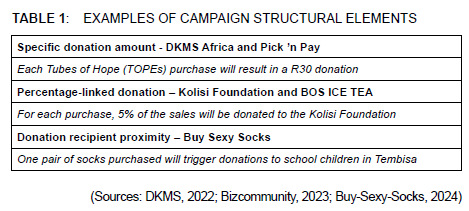
Research indicates that consumers can identify specific aspects of CM messaging that appeal to them. For example, young consumers such as Generation Z prefer campaigns that address issues pertinent to them, such as poverty and unemployment (InSites-Consulting, 2022). Ordinarily, the most used form of CM is transaction-based. However, there are also licensing alliances where an NPO lends its brand logo to for-profit organisations for promotional purposes and sponsorship programmes that involve companies associating themselves with social causes (Moharam et al., 2020). In CM research, there is a shift toward studying consumers' perceptions of non-monetary-based CM (Handa & Gupta, 2020; Ye et al., 2024). Non-monetary-based campaigns are believed to be more sustainable and authentic than transaction-focused campaigns because tangible resources are donated to people in need (Chang et al., 2018; Gupta & Handa, 2024). Within the corporate industry, non-financial donations are becoming the preferred choice for companies to select within their CSI programmes (Trialogue, 2023). Non-monetary-based contributions have increased from 29% in 2021 to 77% in 2022 (Trialogue, 2022), and NPOs in South Africa reported that 83% of the donations they received were non-cash related (Trialogue, 2023). These figures suggest that organisations want to contribute meaningfully to alleviating social challenges in South Africa. Within the non-monetary-based category, this study focused on Buy-One-Give-One (BOGO) campaigns, which involve organisations donating an equivalent or exact product to a charity triggered by a consumer purchase (Hamby, 2016). To illustrate, Always South Africa (feminine hygiene products) facilitates the Keeping Girls in School programme, which forms part of Procter and Gambles' (P&G) greater CSR strategy to help disadvantaged young women and educate them about menstrual hygiene (Bizcommunity, 2022). This campaign was also launched via Facebook through #KeepingGirlsinSchool, where the Always brand communicated with its audience and engaged in conversations about feminine hygiene.
Another unique CM format that was investigated in this study was one-for-one campaigns. This type of CM also allows consumers to repost social media content to participate in raising donations, which is different from the traditional product purchase format (Handa & Gupta, 2020). For example, #GoodFollowsGood by Standard Bank is a one-for-one non-monetary-based campaign that was initiated on X. Every time someone tweeted a positive comment using #GoodFollowsGood, Standard Bank printed 3D stationery and donated to schools (Bizcommunity, 2018). Thus, buy-one-give-one and one-for-one CM campaigns allow consumers to engage with their favourite brands whilst contributing to the betterment of society. Although the previously mentioned campaigns are innovative, one can question the social impact of these initiatives and the type of social impact they bring about.
Achieving social impact
CM has the intention of positively influencing the lives of donation recipients. However, the way it is practised could be questionable. Research shows that CM in some instances is used by organisations to latch onto social causes to gain profit inauthentically. For example, during Pride Month there are controversial debates among the LGBTQAI+ community about the sincerity of corporate organisations' commitment towards inclusion (Champlin & Li, 2020; Vredenburg et al. 2020; Rusch, 2023). This phenomenon of purpose-washing is not limited to Pride Month; in some cases, racial equality, social justice, equal pay, breast cancer awareness, and other social causes have been inappropriately used by organisations that seek to boost their reputation and competitive advantage (DoSomething-Strategic, 2019). Studies have shown that some Gen Z consumers do not favour engaging with brands that misuse the popularity of social causes for their profit-driven interests (Ciszek & Lim, 2021; Konstantinou & Jones, 2022; Sithole & Sitto, 2022). Thus, organisations should reflect on how they design their CM campaigns because Gen Z consumers are known for being critical of brands that create little social impact (Thomas et al., 2022).
Generation Z: social advocacy and Instagram
Regarding social advocacy, Gen Z is disruptive, and they have changed how businesses view social responsibility. Some Gen Zs challenge themselves to become active players in tackling issues they care about (Positive-Equation, 2021). Concerning CM, Gen Z is more inclined to engage in non-monetary donations, including organising protests such as Friday for Future (related to climate change), signing petitions, donating non-perishable food, and being vocal on social media (Konstantinou & Jones, 2022; Charity-Link, 2023). South African CM research has focused chiefly on studying consumers' perceptions towards campaigns distributed on traditional advertising, such as print media, that is, flyers and posters (Corbishley & Mason, 2011; Bester & Jere, 2012; Human & Terblanche, 2012; Human, 2016; Van Schoor, 2021; Matiringe-Tshiangala & Nhedzi, 2022; Terblanche, Boshoff & Human-Van Eck, 2022).
This study focused on CM campaign promotions on social media, specifically Instagram. The justification behind this is that research shows that campaigns that are communicated digitally improve the chances of the message reaching wider audiences (Tanford, Kim & Kim, 2020). Gen Z also uses social media to empower and educate themselves about societal matters (Du Plessis, 2021). Moreover, they use social media to explore their aesthetic preferences related to fashion, lifestyle content and personal branding (Vitelar, 2019). Instagram was selected because statistics show that Gen Z constitutes 32.2% of active Instagram users (2.4 million) in South Africa (Statista, 2023). Unlike Facebook and X, Gen Z prefers image and video-based platforms such as Instagram and Tik-Tok because they can easily express themselves visually (InSites-Consulting, 2022; Konstantinou & Jones, 2022).
Theoretical framework
The complex nature of this study required the utilisation of a transdisciplinary theoretical framework, which inspects and integrates concepts from varied spheres of knowledge. The stakeholder theory developed by Edward Freeman in 1984 (Fontaine, Haarman & Schmid, 2006) is aimed at understanding the relationship between an organisation's actions and consumers' reception of messaging within CM campaigns. Special attention was paid to exploring how organisations decide which aspects of the campaign messaging to emphasise and how transparent they are willing to be about the attention of running a CM initiative. This study advances the stakeholder theory by showing how the convergent strand can be used as an effective lens to see how organisations can balance making profits whilst being socially responsible (Meintjes & Botha, 2021). The stakeholder theory was used to interpret how Gen Z consumers view messages from organisations regarding CM on Instagram.
The prosocial behaviour theory was used to evaluate Gen Zs voluntary participation or non-participation in specific CM campaigns. Based on the work of Edward O. Wilson in 1975, the prosocial behaviour theory's basic tenets state that people are motivated by various factors when they consider engaging in philanthropic or unselfish behaviour (Eisenberg & Mussen, 1989). Prosocial behaviours can be practised as kind acts, voluntary gestures of support, or assisting other people outside of one's capacity (Eisenberg & Mussen, 1989). Thus, this theory shows that Gen Zs can select whether they want to engage in CM campaigns, and it was used to establish why some of them display prosocial behaviour and what hinders them from participating in campaigns they perceive as too taxing or demanding.
METHODOLOGY
Research approach, design and worldview
Q-methodology (Q) was used to investigate how structural elements of the campaign on Instagram influence Gen Z's perceptions regarding CM campaigns. Q was selected because the focus of this study was understanding subjective perceptions, and the nature of Q is well-equipped to uncover unique findings as opposed to traditional research approaches, such as qualitative or quantitative methods (Webler, Danielson & Tuler, 2009). Q integrates empirical data derived from factor analysis and interviews to reveal the opinions of individuals (Watts & Stenner, 2012). The use of Q in the study showed that research participants could express themselves broadly, and they unpacked which aspects of CM campaigns they agreed and disagreed with, making this study exploratory. This study used an interpretive research paradigm lens because the key focus was on subjectivity. Thus, the researchers were not interested in objectivity and did not seek to make statistical generalisations to the Gen Z population (Ramlo, 2024). Instead, the goal was to make substantive inferences about Gen Z's views towards Instagram CM campaigns.
Data collection
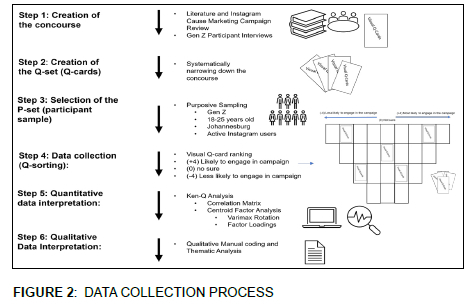
Data collection took place in three phases comprising of six steps.
Step 1: Creation of the concourse
The concourse describes the vast representation of the subject of interest (Duncan Millar, Mason & Kidd, 2022) in terms of the different types of discourse on CM. This study's concourse involved a literature review of research on campaign structural elements and Gen Z charitable behaviour, and a review of CM content on Instagram was conducted. Initial interviews with Gen Z individuals also guided the researchers to create 100 Instagram mock-up campaigns designed using Canva. Thus, the Q-set is a collection of statements/cards from the concourse related to the subject matter, and this study used a quasi-naturalistic strategy (i.e., using primary and secondary sources) (McKeown & Thomas, 2011).
Step 2: Creation of the Q-set (Q-cards)
From the 100 Instagram mock-up creations, the researchers used Fisher's balanced block design (Fisher, 1960) to narrow the concourse to a representative Q-sample. The selection of the final Q-set was systematic in that it followed a 2x4 factorial design, resulting in eight cells in the 100 cards that were compiled. A structured Q-sample involves selecting statements that are predefined categories (Brown, 1980; McKeown & Thomas, 2011). The block in Table 2 accommodates eight cells per block (2x4 = 8), and the researchers selected n = 3 cards from each cell to reach a sample of 24 Instagram cards. For example, the purposeful category included practical campaigns because they deal with the fundamental problems surrounding social causes.
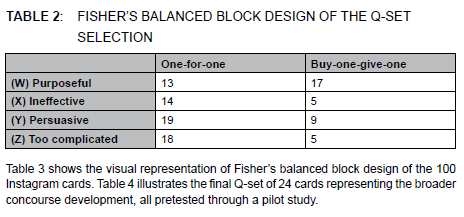
Table 3 shows the visual representation of Fisher's balanced block design of the 100 Instagram cards. Table 4 illustrates the final Q-set of 24 cards representing the broader concourse development, all pretested through a pilot study.
Step 3: Selection of the P-set (participant sample)
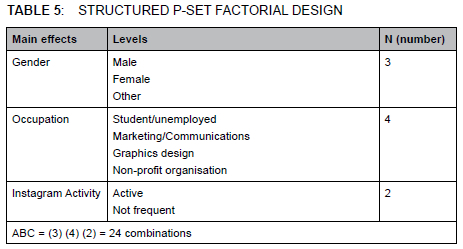
This study had a structured P-set, followed by Fisher's balanced block design to recruit Gen Zs to join the study. The P-set consisted of heterogeneous Gen Zs aged 18 to 25 residing in the Johannesburg area in South Africa's Gauteng province. After ethical approval was obtained, the researchers contacted the participants through email invitations containing information about the study. Twelve Gen Z participants responded to the invitation and signed consent forms to participate in the study.
Step 4: Data collection (Q-sorting)
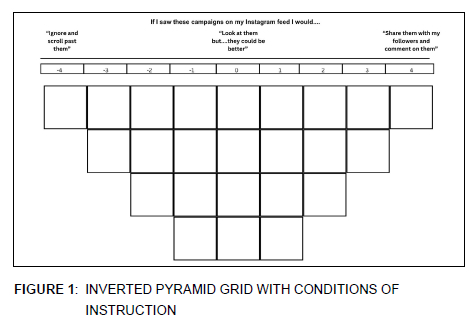
The Gen Z participants arranged the visual Q-cards on an inverted pyramid grid (forced distribution board, i.e., placing cards in the available spaces only) (Webler et al., 2009; Hempel, 2021) following conditions of instruction which guided them through the sorting process (see Figure 1). The Gen Zs placed the Q-cards on a Likert grid scale (Zabala, Sandbrook & Mukherjee, 2018) from +4 (share them with my followers and comment on them), 0 (Look at them but ... they could be better), and -4 (ignore and scroll past them). They could also move the cards until they were satisfied with their choices. After that, the researchers took pictures of their sorts for data processing. In this study, the Likert grid scale does not require a Cronbach Alpha reliability assessment because, unlike in R-methodology studies, Q methodology does not aim to generalise findings to large population samples statistically.
Step 5: Quantitative data interpretation
The first part of the data interpretation involved using Ken Q Analysis (version 2.0.1) to understand the arrangement of the different participant Q-sorts (Banasick, 2019). Essentially, Ken Q conducts a factor analysis to reveal statistical insights from the participants' different card placements on the grid shown in Figure 1. For this article, the researchers will show results from factor extraction (reducing larger sets of data to create interpretable information). In addition, during this process Centroid analysis and Varimax rotation were used to determine the factor loadings of the participants. The quantitative data presented in this study include rotated factor scores, factor characteristics, and composite factor sorts.
Step 6: Qualitative data interpretation
Post-sort interviews with the Gen Z participants were audio recorded and transcribed. The transcriptions were processed through Taguette (an open-source qualitative software) using open coding initially and then in vivo, descriptive and evaluative coding to form themes that were used to interpret the findings (Saldaña, 2013; Rampin & Rampin, 2021).
Trustworthiness, rigour and ethical considerations
Q-studies do not conform to the standard method of assessing reliability and validity because the focus is on understanding participants' subjective opinions (Valenta & Wigger, 1997). Regarding validity, this study's concourse was reviewed by Gen Z research participants during the initial stages of the card creation, which was done to ensure that the cards resonated with them. Regarding reliability, the factor extraction results had at least two participants loaded on them. The creditability and transferability of the findings were ensured as a detailed overview of the participant sorting arrangements was conducted, and member checks were facilitated. This study challenges the issue of guaranteeing generalisability to the Gen Z population because, unlike in regular quantitative studies that zone in on sampling techniques, proportion and measuring scale reliability, Q seeks to make substantive generalisation to a population (Thomas & Baas, 1993). Thus, the researchers sought to understand Gen Z's perceptions, attitudes, thoughts, and feelings towards CM. There is no hierarchical positioning between statistical and substantive generalisability because they have different goals.
The University of Johannesburg's Code of Academic and Research Ethics was adhered to, which asserts that higher degree researchers must illustrate that they have considered all the ethical implications related to their study (Research Ethical Clearance number: REC-01-454-2023). Gen Zs were informed about how their data would be protected and that their involvement in this study remained discreet. This complements South Africa's Protection of Personal Information (POPIA) Act by ensuring that information such as emails and the recordings of the participants would not be shared with anyone outside of the researcher, supervisor and UJ institution (De Bruyn, 2014). The study did not delve into sensitive topics, and no intended harm was involved in participating in this project. Regarding the copyright and usage of the design elements, according to the Canva Free Media License Agreement (Canva, 2024), any free photographs, music and video files can be used for commercial and non-commercial purposes without any formal attribution.
RESULTS AND DISCUSSION
The Q-findings from this study are explained using the results from the factor analysis, factor characteristics and composite factor scores, which have been purposefully selected to fit the scope of the article.
Rotated factors
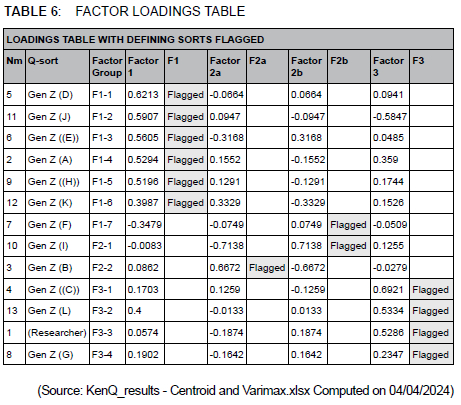
The researchers extracted factors using Centroid analysis because the Q-set structure was experimental in that it was designed to explore which elements of CM campaigns appeal to Gen Z. Factor extraction was facilitated based on the number of Q-sorts (for 13 to 18 participants, three factors were extracted) (Watts & Stenner, 2012). Rotating the factors enhances the ability to see which participants are loaded on which factor. Varimax rotation was used because it generated a nearly mathematically accurate solution (Ramlo, 2016; Ramlo et al. 2019). Table 6 presents the factor loading for each participant and how each Q-sort represents a factor. Ken Q Analysis automatically highlights significant factor loadings (± 0.39); however, the researcher also highlighted the Q-sorts of Gen Z (G and F) due to their valuable insights. Factor 2 initially had two loadings with negative coefficients. To address this, the factor was inverted to ensure that these loadings represented their respective perspectives. After the inversion, Factor 2 was split into two separate factors, Factor 2a and Factor 2b. This division was done to represent opposite factor loadings that mirror each other.
Composite factor sorts and data interpretation
The results from the factor extraction have been displayed in composite factor arrays (henceforth known as viewpoints) in Figures 4, 6, 7 and 9. These illustrate how the participants in each factor generally sorted their Instagram cards based on how much they would "share them with my followers and comment on them" (+4), "look at them but think they could be better" (0), and how much they would "ignore and scroll past them" (-4).
Viewpoint 1: Keep it practical
Six Gen Zs in Factor 1 had strong opinions about the content they saw in the CM campaigns, particularly regarding the trustworthiness of the message presented. These participants were from diverse backgrounds and mentioned that sorting the different cards was an engaging experience. To elaborate, Gen Zs compared the 24 cards (samples) with each other, helping them to vocalise why specific campaigns were more appealing than others. In Q-studies, the sample population is represented by Q-cards or statements, unlike in regular surveys, where the sample population consists of subjects (participants) who may never or rarely interact with each other (Brown, 1980). Thus, the samples (cards) interacted, influencing where the Gen Zs would place them on the distribution board. Regarding the CM campaign, Viewpoint 1 Gen Zs want to see responsive, sincere, authentic and purposeful campaigns. They said they share campaigns with their followers if the issues are pertinent to their lives. Concerning non-monetary-based campaign formats, Viewpoint 1 Gen Zs prefer one-for-one campaigns because, for example, they can repost social media content to participate in raising donations (Handa & Gupta, 2020). Additionally, this group stated that donations such as food, blood, and educational resources are meaningful contributions that brands can supply to non-profit organisations.
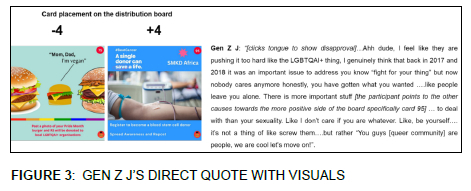
Viewpoint 1 confirms CM studies that consumers tend to perceive non-monetary-based campaigns as genuine because they believe this gesture requires more significant effort than traditional transaction-based campaigns (Chang, Lo & Lee, 2016; Chang et al., 2018). These participants stated that they would engage with and comment on Instagram campaign posts that are meaningful to them. One critical insight from Viewpoint 1 is that Gen Zs carefully consider the pros and cons before participating in a specific campaign. Concerning card 75, depicted in Figure 3, Gen Z J mentioned that "For me, it's like, do I donate blood or go to a pride parade?". Like the other Ave participants on Viewpoint 1, Gen Z J described how they support the LGBTQAI+ community. However, they have Pride Month fatigue and are tired of hearing the inauthentic statements and the corporatisation of social inclusivity-related messages. The stakeholder theory was used to interpret Gen Z's perceptions of the messaging within the Instagram campaigns. Organisations should be cautious when communicating activism-linked campaigns as Gen Zs are discerning, and at times, they will not hesitate to speak out against inauthentic promises.
Viewpoint 2a/b: Stop tokenising causes
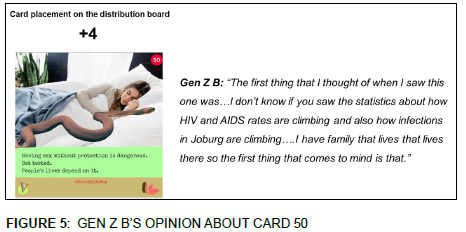
Three Gen Zs were grouped into Viewpoint 2a/b (Figure 6 and 7) because they sorted the Q-cards based on how they perceived which campaigns were genuine or mere corporatised charitable giving. As the methodology section states, Factor 2 had two inverted negative coefficient loadings. Then bipolar Factor 2 was split into Factor 2a and Factor 2b (this represents opposite factor loadings that mirror each other). Figure 6 shows how these Gen Zs preferred campaigns addressing food security, homelessness and education issues. They also mentioned that they do not want to participate in negatively framed campaigns (i.e., depressing) because they enjoy seeing light-hearted content on Instagram. For example, in Figure 5, Gen Z B placed card 50 "(Vector #WorldAidsDay (50))" on +4, and she explained that the visual is humorous and this campaign reflects the reality of sexually transmittable diseases in South Africa. Gen Zs in Viewpoints 2a and 2b reflected on their personal lives and how those influenced their preference for sharing visual cards. Viewpoints 2a and 2b Gen Z do not participate in every campaign they may see on Instagram, which means that a one-style-fits-all strategy will not convince them to engage. This finding suggests that Gen Z consumers donate or ignore campaigns based on their moods or their feelings toward social causes.
Viewpoint 3: Aesthetics and accessibility are crucial
Viewpoint 3 Gen Zs, unlike the other groups, were more concerned about the aesthetic appeal of the Instagram campaigns than the campaign structural elements embedded within them (see Figure 9). These Gen Zs were critical of campaigns they deemed poorly designed concerning the colours used, image resolution, and message comprehension. This finding connects with research that found that Instagram users tend to share and comment on CM content with high-resolution images (i.e., non-pixelated) (Ryu, 2024). To illustrate, Figure 8 shows card 55 (a gender-based violence awareness campaign), and Gen Z C and G stated that the Google suggestions tab was a unique feature they hardly see being used in campaigns. These seemingly small details are the factors that campaigns must be cognisant of when they design CM advertising material, including using relevant visuals appropriate for Instagram capabilities.
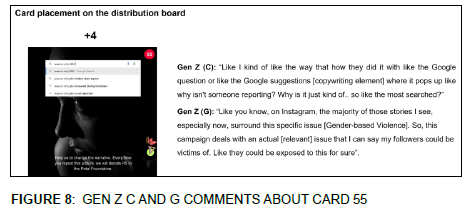
Additionally, Viewpoint 3 Gen Zs want to engage with credible campaigns created by brands that have a track record of fulfilling the promises they state with their CSR reports (see Figure 8). This connects to the promised impact evidence of the new campaign structural elements that consumers want to see when participating in CM campaigns (Shanbhag et al., 2024). The promised impact evidence campaign structural element essentially gives consumers additional information about what will happen once they donate to a charity (i.e., where their non-perishable item donations will end).
Practical implications
This study revealed a new perspective in CM research by gaining insight into some Gen Z perceptions towards non-monetary-based campaigns. The participants from this study were clustered into groups based on their Q-sorts (Viewpoint 1: Keep it practical; Viewpoints 2a and 2b: Stop tokenising causes; and Viewpoint 3: Aesthetics and Accessibility are crucial). The three perspectives can be used to segment Gen Z consumers, and they could be used in conjunction with LSMs (Living Standard Measure) or SEMs (Socio-Economic Measure) to identify specific audiences who will engage with CM campaigns. All the viewpoints indicate that some Gen Z consumers desire organisations to be more committed to societal issues instead of wanting them to create social impact. Thus, campaign developers should endeavour to appeal to Gen Zs when creating campaigns and be cognisant of the factors that may deter or encourage participation.
LIMITATIONS AND SUGGESTIONS
This study's Q-set was not diverse enough. Most of the participants were clustered into Viewpoint 1. The concourse development was time-consuming (four months) due to the researcher's admittedly poor copywriting skills. Regarding the P-set, there were many black (African) and female participants, which limited the diversity of the perspectives that emerged from the study. This study lacks statistical generalisability because the findings do not represent the larger South African Gen Z population. Future researchers should investigate consumers' perceptions towards CM partnerships between NPOs and for-profit organisations (such as DKMS Africa and Pick 'n Pay).
REFERENCES
Al-Zu'bi, M. & Radovic, V. 2019. SDG 11 Sustainable Cities and Communities: Towards, Inclusive, Safe, and Resilient Settlements. URL: https://www.scienceopen.com/book?vid=11c3de2b-00da-4d7d-b5fb-a83e1c7fb18f [Accessed on 19 July 2024]. https://doi.org/10.1108/9781787569218 [ Links ]
Banasick, S. (2019). Ken-Q Analysis [Software]. URL: https://shawnbanasick.github.io/ken-q-analysis/ [Accessed on 19 July 2024]. [ Links ]
Bester, S. & Jere, M.G. 2012. Cause-related marketing in an emerging market: Effect of cause involvement and message framing on purchase intention. Journal of Database Marketing and Customer Strategy Management, 19(4): 286-293. https://doi.org/10.1057/dbm.2012.26 [ Links ]
Bizcommunity. 2018. Standard Bank turns #GoodFollowsGood into stationery. URL: https://www.bizcommunity.com/Article/196/371/181411.html [Accessed on 12 February 2024]. [ Links ]
Bizcommunity. 2022. P&G's Always Keeping Girls in School programme makes an important intervention in the lives of South Africa's schoolgirls. URL: https://www.bizcommunity.com/Article/196/342/228715.html [Accessed on 12 February 2024]. [ Links ]
Bizcommunity. 2023. Bos Ice Tea launches limited edition can with rugby icon, Siya Kolisi. URL: https://www.bizcommunity.com/Article/196/162/241140.html [Accessed on 8 March 2024]. [ Links ]
Brown, S.R. 1980. Political subjectivity: Applications of Q methodology in political science. New Haven, CT: Yale University Press. [ Links ]
Buy-Sexy-Socks. 2024. About Us. URL: https://buysexysocks.com/about/ [Accessed on 6 April 2024]. [ Links ]
Canva. 2024. Free Media License Agreement. URL: https://www.canva.com/policies/free-media-license-agreement-2022-01-03/ [Accessed on 7 April 2024]. [ Links ]
Champlin, S. & Li, M. 2020. Communicating support in Pride Collection advertising: The impact of gender expression and contribution amount. International Journal of Strategic Communication, 14(3): 160-178. https://doi.org/10.1080/1553118X.2020.1750017 [ Links ]
Chang, A., Lo, W. & Lee, S.-Y. 2016. Heightened corporate social responsibility: Insight from the evolving value creation of buy-one give-one model. Journal of Small Business and Entrepreneurship Development, 4(2): 12-20. https://doi.org/10.15640/jsbed.v4n2a2 [ Links ]
Chang, C.T., Chen, P.C., Chu, X.Y., Kung, M.T. & Huang, Y.F. 2018. Is cash always king? Bundling product-cause fit and product type in cause-related marketing. Psychology & Marketing, 35(12): 990-1009. https://doi.org/10.1002/mar.21151 [ Links ]
Charity-Link. 2023. The charity fundraising potential of Gen Z. URL: https://www.charitylink.net/blog/charity-fundraising-potential-of-gen-z [Accessed on 4 September 2023]. [ Links ]
Ciszek, E. & Lim, H.S. 2021. Perceived brand authenticity and LGBTQ publics: How LGBTQ practitioners understand authenticity. International Journal of Strategic Communication, 15(5): 395-409. https://doi.org/10.1080/1553118X.2021.1988954 [ Links ]
Corbishley, K.M. & Mason, R.B. 2011. Selection of causes according to socio-demographic status in South Africa. Journal of Promotion Management, 17(2): 228-240. https://doi.org/10.1080/10496491.2011.580686 [ Links ]
De Bruyn, M. 2014. The Protection of Personal Information (POPI) Act - Impact On South Africa. International Business & Economics Research Journal, 13(6): 1315-1340. https://doi.org/10.19030/iber.v13i6.8922 [ Links ]
DKMS. 2022. How to give hope to SA's blood cancer patients this Sunflower Day. URL: https://www.dkms-africa.org/get-involved/stories/how-to-give-hope-to-sa-s-blood-cancer-patients-this-sunflower-day [Accessed on 2 September 2023]. [ Links ]
Du Plessis, C. 2021. Achieving brand sustainability through brand purpose, authenticity and engagement. In: Benecke, D.R., Verwey, S. & Phumo, T. (eds). Strategic communication: South African perspectives. Cape Town: Oxford University Press. [ Links ]
Dugan, R.G., Clarkson, J.J. & Beck, J.T. 2021. When cause-marketing backfires: Differential effects of one-for-one promotions on hedonic and utilitarian products. Journal of Consumer Psychology, 31(3): 532-550. https://doi.org/10.1002/jcpy.1229 [ Links ]
Duncan Millar, J., Mason, H. & Kidd, L. 2022. What is Q methodology? Evidence-Based Nursing, 25(3): 77-78. https://doi.org/10.1136/ebnurs-2022-103568 [ Links ]
Eisenberg, N. & Mussen, P.H. 1989. Introduction. In: Eisenberg, N. & Mussen, P.H. (eds). The roots of prosocial behavior in children. Cambridge, UK: Cambridge University Press. https://doi.org/10.1017/CBO9780511571121 [ Links ]
Fisher, R.A. 1960. The design of experiments. New York: Hafner. [ Links ]
Fontaine, C., Haarman, A. & Schmid, S. 2006. The Stakeholder Theory. Edaly Education. [ Links ]
Grau, S.L. & Folse, J.A.G. 2007. Cause-related marketing (CRM) the influence of donation proximity and message-framing cues on the less-involved consumer. Journal of Advertising, 36(4): 19-33. https://doi.org/10.2753/JOA0091-3367360402 [ Links ]
Gupta, S. & Handa, M. 2024. Rethinking the boundaries of cause-related marketing: Addressing the need for a new definition. International Review on Public and Nonprofit Marketing, 21(3): 659-689. https://doi.org/10.1007/s12208-024-00398-6 [ Links ]
Hamby, A. 2016. One for me, one for you: cause-related marketing with buy-one give-one promotions. Psychology and Marketing, 33(9): 692-703. https://doi.org/10.1002/mar.20910 [ Links ]
Handa, M. & Gupta, S. 2020. Digital cause-related marketing campaigns: Relationship between brand-cause fit and behavioural intentions. Journal of Indian Business Research, 12(1): 63-78. https://doi.org/10.1108/JIBR-09-2019-0285 [ Links ]
Hempel, A.C. 2021. Using visual Q-methodology to explore Danish children's outdoor play preferences. Children, Youth andEnvironments,31(1): 88-115. https://doi.org/10.7721/chilyoutenvi.31.1.0088 [ Links ]
Human, D. 2016. The influence of cause-related marketing campaign structural elements on consumer intention, attitude and perception. Unpublished doctoral thesis, University of Stellenbosch, South Africa. Stellenbosch Institutional Repository. URL: http://hdl.handle.net/10019.1/100297 [ Links ]
Human, D. & Terblanche, N. 2012. Cause-related marketing in South Africa: The influence of structural campaign elements. Developments in Marketing Science: Proceedings of the Academy of Marketing Science, 24(2): 143-147. https://doi.org/10.1007/978-3-319-10864-3_80 [ Links ]
InSites-Consulting. 2022. Ready for the Zoomers? Gen Z Report: South African Edition. URL: https://www.insites-consulting.com/reports/gen-z-report/ [Accessed on 3 April 2023]. [ Links ]
Kazmierczak, M. 2022. A literature review on the difference between CSR and ESG. Scientific Papers of Silesian University of Technology. Organization and Management Series, 2022(162): 275-289. https://doi.org/10.29119/1641-3466.2022.162.16 [ Links ]
Konstantinou, I. & Jones, K. 2022. Investigating Gen Z attitudes to charitable giving and donation behaviour: Social media, peers and authenticity. Journal of Philanthropy and Marketing, 27(3). https://doi.org/10.1002/nvsm.1764 [ Links ]
Masongweni, V.V. & Simo-Kengne, B.D. 2024. The impact of sustainable investment on Arm performance in South Africa. South African Journal of Accounting Research, 38(2): 146-173. https://doi.org/10.1080/10291954.2024.2306701 [ Links ]
Matiringe-Tshiangala, T. & Nhedzi, A. 2022. Does the use of cause-related marketing in fast food restaurants lead to different consumer perceptions? Communitas, 27: 85-105. https://doi.org/10.18820/24150525/Comm.v27.7 [ Links ]
McKeown, B. & Thomas, D. 2011. Q-Methodology. Thousand Oaks, CA: SAGE. [ Links ]
Meintjes, C. & Botha, Y. 2021. Brand legitimacy and social justice: Building social capital through corporate social responsiveness. In: Benecke, D.R., Verwey, S. & Phumo, T. (eds). Strategic communication: South African perspectives. Cape Town: Oxford University Press. [ Links ]
Moharam, F.O., Moussa Elsamadicy, A. & Medhat, N.E. 2020. Cause-related marketing: A conceptual and theoretical review. IOSR Journal of Business and Management (IOSR-JBM), 22(10): 17-26. [ Links ]
Park, J.G., Park, K., Noh, H. & Kim, Y.G. 2023. Characterization of CSR, ESG, and corporate citizenship through a text mining-based review of literature. Sustainability, 15(5): 3892. https://doi.org/10.3390/su15053892 [ Links ]
Positive-Equation. 2021. What should nonprofits know about Gen-Z with DoSomething Strategic's Mary Noel [Video File]. URL: https://www.youtube.com/watch?v=OHNrAhw5TvQ&t=4s [Accessed on 23 June 2023]. [ Links ]
Ramlo, S. 2016. Centroid and theoretical rotation: Justification for their use in Q methodology research. Mid-Western Educational Researcher, 28(1): 5. [ Links ]
Ramlo, S. 2024. Non-statistical, substantive generalization: lessons from Q methodology. International Journal of Research & Method in Education, 47(1): 65-78. https://doi.org/10.1080/1743727X.2023.2173735 [ Links ]
Ramlo, S., Starvaggi, D., Mitchell, R. & Roketenetz, L. 2019. Operant subjectivity developing concourse and selecting a Q sample: Preparation for a Q study about urban, American, middle-school science students' views of nature. Operant Subjectivity: The International Journal of Q Methodology, 41: 110-120. https://doi.org/10.22488/okstate.20.100575 [ Links ]
Rampin, R. & Rampin, V. 2021. Taguette: open-source qualitative data analysis. Journal of Open Source Software, 6(68): 3522. https://doi.org/10.21105/joss.03522 [ Links ]
Rusch, M. 2023. True colours or rainbow-washing exposed?! - Company Pride in and through digital and social media reviewed. ILCEA, (51). https://doi.org/10.4000/ilcea.17655 [ Links ]
Ryu, S. 2024. From pixels to engagement: examining the impact of image resolution in cause-related marketing on Instagram. Journal of Research in Interactive Marketing, 18(4). https://doi.org/10.1108/JRIM-08-2023-0262 [ Links ]
Saldaña, J. 2013. The Coding Manual for Qualitative Researchers. Thousand Oaks, CA: SAGE. [ Links ]
Shanbhag, P.R., Pai, P.Y., Pattusamy, M., Kidiyoor, G. & Prabhu, N. 2024. Keeping promises in cause-related marketing campaigns: development and validation of promised impact evidence scale. Journal of Consumer Marketing, 41(2): 239-257. https://doi.org/10.1108/JCM-11-2022-5705 [ Links ]
Sithole, N.S. & Sitto, K. 2022. The authenticity and effectiveness of cause marketing campaigns of fast-food brands: Perceptions of South African Generation Z consumers. Paper presented International Conference on Multidisciplinary Research, Mauritius. URL: https://myres.net/proceedings/MyRes_2022_Proceedings_Dec_2022_Mauritius_final.pdf [Accessed on 3 April 2023]. [ Links ]
Sitto, K. & Lubinga, E. 2021. Collaboration and co-creation in the online brand space. In: Benecke, D.R., Verwey, S. & Phumo, T. (eds). Strategic communication: South African perspectives. Cape Town: Oxford University Press. [ Links ]
Statista. 2023. Distribution of Instagram users in South Africa as of May 2023, by age group. URL: https://www-statista-com.eu1.proxy.openathens.net/statistics/1028334/south-africa-instagram-user-age-distribution/ [Accessed 3 September 2023]. [ Links ]
Tanford, S., Kim, M. & Kim, E.J. 2020. Priming social media and framing cause-related marketing to promote sustainable hotel choice. Journal of Sustainable Tourism, 28(11): 1762-1781. https://doi.org/10.1080/09669582.2020.1760287 [ Links ]
Terblanche, N.S., Boshoff, C. & Human-Van Eck, D. 2022. The influence of cause-related marketing campaign structural elements on consumers' cognitive and affective attitudes and purchase intention. International Review on Public and Nonprofit Marketing, 20: 193-223. DOI: https://doi.org/10.1007/s12208-022-00338-2 [ Links ]
Thomas, D. & Baas, L.R. 1993. The issue of generalization in Q methodology: 'Reliable Schematics' revisited. Operant Subjectivity, 16: 18-36. https://doi.org/10.22488/okstate.92.100599 [ Links ]
Thomas, S., Bhatt, V. & Patel, R. 2022. Impact of skepticism on CRM luxury campaign participation intention of Generation Z. International Journal of Emerging Markets. https://doi.org/10.1108/IJOEM-10-2021-1568 [ Links ]
Trialogue. 2022. Trialogue: Business in Society Handbook 2022. URL: https://trialogue.co.za/publications/ [Accessed on 5 May 2023]. [ Links ]
Trialogue. 2023. Trialogue: Business in Society Handbook 2023. URL: https://trialogue.co.za/businessinsocietyhandbook/trialogue-business-in-society-handbook-2023-free-online-version/ [Accessed on 5 May 2023]. [ Links ]
Valenta, A.L. & Wigger, U. 1997. Q-methodology: definition and application in health care informatics. Journal of the American Medical Informatics Association, 4: 501-510. https://doi.org/10.1136/jamia.1997.0040501 [ Links ]
Van Schoor, M-L. 2021. Cause-related marketing in South Africa: Effects of donations and rewards on consumers' perceived motives, perceived fairness, attitudes and purchase intention. Unpublished Master's dissertation. University of Stellenbosch, South Africa. Stellenbosch Institutional Repository. URL: https://scholar.sun.ac.za/handle/10019.1/124195 [Accessed on 5 September 2023]. [ Links ]
Vitelar, A. 2019. Like Me: Generation Z and the use of social media for personal branding. Management Dynamics in the Knowledge Economy, 7(2): 257-268. https://doi.org/10.25019/mdke/7.2.07 [ Links ]
Vredenburg, J., Kapitan, S., Spry, A. & Kemper, J.A. 2020. Brands taking a stand: Authentic brand activism or woke washing? American Marketing Association, 39(4): 444-460. https://doi.org/10.1177/0743915620947359 [ Links ]
Watts, S. & Stenner, P. 2012. Theory and Q Methodology: From Stephenson to Constructionism. In: Watts, S. & Stenner, P. (eds). Doing Q Methodological Research: Theory, Method and Interpretation. London: SAGE. https://doi.org/10.4135/9781446251911 [ Links ]
Webler, T., Danielson, S. & Tuler, S. 2009. Using Q Method to reveal social perspectives in environmental research. Greenfield, MA: Social and Environmental Research Institute. [ Links ]
Ye, S., Liu, Y., Gu, S. & Chen, H. 2021. Give goods or give money? The influence of cause-related marketing approach on consumers' purchase intention. Frontiers in Psychology, 11. https://doi.org/10.3389/fpsyg.2020.533445 [ Links ]
Zabala, A., Sandbrook, C. & Mukherjee, N. 2018. When and how to use Q methodology to understand perspectives in conservation research. Conservation Biology, 32(5): 1185-1194. https://doi.org/10.1111/cobi.13123 [ Links ]
Date submitted: 25 September 2024
Date accepted: 1 October 2024
Date published: 31 December 2024


