




Services on Demand
Journal

Article
 English (pdf)
 Article in xml format
 Article references
 Automatic translation
 Send this article by e-mail
Indicators
Related links
-
 Cited by Google
 -
 Similars in Google
Share

 Permalink
African Vision and Eye Health
On-line version ISSN 2410-1516Print version ISSN 2413-3183
AVEH vol.84 n.1 Cape Town 2025
https://doi.org/10.4102/aveh.v84i1.992
ORIGINAL RESEARCH
Optometry practice in Saudi Arabia: Optometrists' current status and future perspectives
Waleed M. Alghamdi
Department of Optometry, College of Applied Medical Sciences, Qassim University, Buraidah, Saudi Arabia
ABSTRACT
BACKGROUND: There is a paucity of research evidence on the status, future directions and practice of optometry in Saudi Arabia
AIM: This study assesses the current status of optometric practice in Saudi Arabia, identifies the range of services provided by optometrists and explores their perspectives on future developments in the field
SETTING: Licensed optometrists across Saudi Arabia
METHODS: Data were gathered using an online self-administered questionnaire. The data collection instrument was a validated structured questionnaire, adapted from similar studies and modified to fit the specific context of Saudi Arabia
RESULTS: A total of 228 optometrists completed the survey, with a mean age of 30.7 ± 5.2 years. Almost 59% worked in hospital-based settings, while 32% were employed in private optical centres. About 82% reported that refractive services and prescribing optical appliances were their primary roles. However, only 6% provided comprehensive eye care services, including prescribing topical therapeutics. More than two-thirds (70%) expressed high confidence in performing advanced ocular procedures. Approximately 62% suggested expanding their role to provide more independent primary eye care services directly to the community. Additionally, 24% supported advancing various sub-specialities of optometry
CONCLUSION: Optometric practice in Saudi Arabia is advancing, but systemic, regulatory and educational barriers need addressing to fully realise its potential. Overcoming these challenges will enhance care quality, reduce visual impairments and significantly improve the health and well-being of the Saudi population
CONTRIBUTION: This study examines the expanding roles of optometrists in primary care, focussing on improving distribution and fostering specialisation
Keywords: optometry; primary eye care; public health; refractive errors; Saudi Arabia.
Introduction
Optometrists are primary healthcare providers who specialise in the eye and visual system, delivering a wide range of services including refraction, diagnosis, management of ocular diseases and visual rehabilitation.1,2,3 They play a vital role in addressing eye care needs across global, regional and local levels. As the demand for eye care grows, particularly in areas with limited access to ophthalmologists, optometrists are increasingly stepping into roles traditionally held by ophthalmologists and other specialists.4,5,6 This expanding scope of practice reflects the profession's essential contribution to improving the accessibility and quality of primary eye care services worldwide.7,8
The optometry profession in Saudi Arabia has advanced significantly since the establishment of the first BSc programme at King Saud University in 1985, followed by the introduction of the Doctor of Optometry programme at Qassim University in 2007, which is now the sole degree required to practise in the country.2,9 The profession has grown, with optometrists increasingly contributing to both public and private healthcare sectors. However, challenges remain, including regulatory limitations and varying scopes of practice across different settings.2 Optometrists are vital in combating visual impairment (VI) and blindness through early detection and management of conditions such as uncorrected refractive errors, diabetic retinopathy and amblyopia, ultimately enhancing quality of life.10
The prevalence of blindness and VI in Saudi Arabia varies significantly across regions, remaining a critical public health issue. Studies indicate that VI prevalence can range from 2.6% to as high as 7.5% in some areas,9,11,12 which is 20 times the average rate in the United States. Additionally, 17.5% of Saudi children suffer from uncorrected refractive errors, a major contributor to VI,13 while amblyopia affects about 3.2% of the population, compared to a global rate of 1.3%.14 Glaucoma impacts 5.6% of those under 40, well above the global rate of 2.2%,15,16 and diabetic retinopathy affects 36% of those with Type 2 diabetes, potentially impacting over a million people. These statistics highlight the urgent need for comprehensive eye care services in the country.
Most optometrists in Saudi Arabia currently engage in traditional roles, such as providing refractive services and prescribing optical appliances. However, there is an emerging trend towards subspecialisation in areas like contact lens fitting, keratoconus management, paediatric optometry and ophthalmic diagnostic imaging. This shift reflects a global movement where optometrists increasingly expand their scope of practice, particularly in regions where the demand for primary eye care services is high. Therefore, the present study seeks to evaluate the current status of optometric practice in Saudi Arabia, identify the spectrum of services offered by optometrists and analyse their perspectives on the future trajectory of the profession.
Research methods and design
Study design
This study employed a cross-sectional design to evaluate the current status and future directions of optometry practice in Saudi Arabia. Conducted in January and February 2023, the research targeted licensed optometrists across the country through a web-based survey. The survey was distributed via the Saudi Society of Optometry's email list and various social media platforms. Data were collected using a self-administered online questionnaire, which gathered information on the services provided, the nature of the optometric practice, demographic characteristics and the participants' confidence in performing various ocular examinations.
Sampling method
A nonprobability sampling method was utilised for this study, with all registered optometrists being eligible to participate. The inclusion criterion was being a registered optometrist practising in Saudi Arabia who consented to participate in the study.
Data collection procedure
Data were collected using a validated structured questionnaire (see Appendix 1), adapted from similar studies, and modified to fit the specific context of Saudi Arabia. The questionnaire included sections on demographics, education, current practice settings, primary and additional roles, confidence in performing various procedures and areas for professional development. A pilot study involving eight optometrists who were not part of the study sample was conducted to refine the questionnaire. Feedback from the pilot study was used to make necessary modifications. To reach the registered optometrists, contact information was obtained from the Saudi Society of Optometry. An information document explaining the study's aim and the importance of participation was sent to the optometrists a month before data collection began. Consent was obtained 2 weeks prior to data collection from those willing to participate. Subsequently, a Google Form link to access and complete the questionnaire was sent to them.
Data analysis
The collected data were kept anonymous and analysed using SPSS 25.0 (IBM Corporation, Armonk, NY). Descriptive statistics were used to summarise the information. Microsoft Excel version 16.58 (Microsoft Corporation, Redmond, WA) was utilised to create graphs where appropriate.
Ethical considerations
Ethical approval for the study was obtained from the Qassim University Ethics Committee (reference no.: 24-89-08), and the research was conducted in accordance with the guidelines of the Declaration of Helsinki. Informed consent was obtained from all participants, with the study's purpose clearly explained to them. The collected data have been kept confidential, with no individual information recorded. Participation in the study was entirely voluntary.
Results
Demographic characteristics
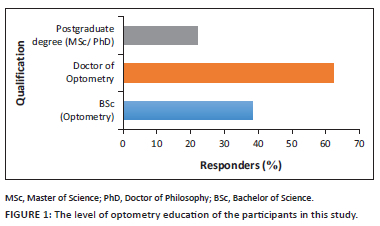
A total of 228 participants completed the survey, of which 42% were female, with a mean age of 30.7 ± 5.2 years. The education level among participants varied: 62% held a Doctor of Optometry degree from Saudi universities, 38% had a BSc in Optometry and 22% had a postgraduate degree in Optometry, as shown in Figure 1.
Geographic distribution and work setting
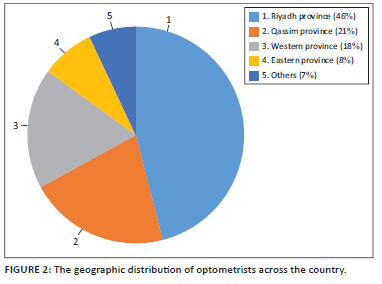
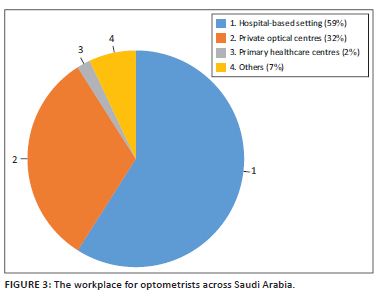
Optometrists were unevenly distributed across the kingdom, with 46% practising in Riyadh Province, 21% in Qassim Province and the remaining distributed in other regions, as shown in Figure 2. More than 59% worked in hospital-based settings, while only 32% were employed in private optical centres, as presented in Figure 3.
Primary and supplementary roles of optometrists
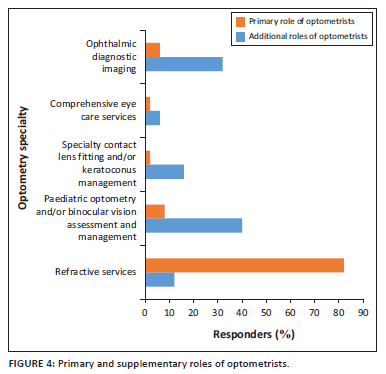
Approximately 82% of optometrists reported that refractive services and prescribing optical appliances were their primary roles. Additional roles included performing paediatric eye care services, ophthalmic diagnostic imaging and speciality contact lens fitting, including keratoconus management. However, only 6% provided comprehensive eye care services, including prescribing topical therapeutics as displayed in Figure 4.
Level of confidence in performing ocular procedures
Over 70% of optometrists reported high confidence in performing advanced ocular procedures, including dry eye or ocular surface diagnosis and management, dilated fundus exams, and diagnosing glaucoma and diabetic retinopathy, as presented in Figure 5.
Future directions for optometrists in Saudi Arabia
After analysing the keywords from the survey responses, approximately 62% of optometrists suggested expanding their role to provide more independent primary eye care services directly to the community. Frequently mentioned keywords included 'independence', 'community services' and 'primary care'. Additionally, 24% of respondents believed that there should be more focus on advancing various sub-specialities of optometry. Common keywords among these respondents included 'sub-specialties', 'advanced practice', and 'further training'. Specific sub-specialities mentioned included myopia control, keratoconus management and low vision rehabilitation.
Discussion
The rising prevalence of VI because of uncorrected refractive errors and other treatable ocular conditions underscores the urgent need for an adequately trained optometric workforce to address primary eye care needs in Saudi Arabia.15,16,17 This study sought to assess the current landscape of optometric practice, outline the scope of services provided and explore perspectives on the future path of the profession. The findings indicate a progressive expansion in the role of optometrists, moving beyond traditional refractive services to encompass sub-specialities and advanced ocular procedures, mirroring global advancements in optometric practice.2,3 One notable finding from our survey is the high level of confidence among optometrists in performing advanced ocular procedures, such as dry eye and ocular surface diagnosis, dilated fundus exams, and diagnosing glaucoma and diabetic retinopathy. This suggests that optometric education and training programmes in Saudi Arabia are effectively equipping practitioners with essential skills. However, despite this confidence, the provision of comprehensive eye care services, including the prescription of topical therapeutics, remains limited, indicating potential regulatory or systemic barriers.
Another critical issue highlighted by the study is the challenge of the practitioner-to-population ratio, which currently falls short of the optimal 1: 10 000.2 This issue is compounded by the unequal distribution of optometrists, with a concentration in major urban centres such as Riyadh and Qassim, leaving rural and underserved areas with inadequate access to eye care services. This maldistribution exacerbates health disparities and contributes to the high prevalence of avoidable VI in these regions. These findings align with a previous study18 which revealed that the disparity and inappropriate distribution of eye care professionals are major barriers to accessing eye care services. Addressing this imbalance necessitates a multifaceted approach that goes beyond simple incentives. Strategic initiatives could include policy reforms to expand the scope of optometric practice, targeted investments in rural healthcare infrastructure and the development of specialised training programmes focussed on the unique challenges of underserved areas. Additionally, partnerships between government agencies, educational institutions and professional organisations could foster a more equitable distribution of resources and support systems, ultimately enhancing the accessibility and quality of eye care services across the country.
The study also emphasises the need to expand the role of optometrists in delivering primary eye care services directly to the community. Currently, a significant proportion of eye care services in Saudi Arabia are provided through hospital-based settings. Integrating optometrists more effectively into primary healthcare centres and enabling them to operate more independently could enhance access to eye care, reduce waiting times and improve patient outcomes. Incorporating the private sector and insurance companies to cover optometric services, which are not currently covered by insurance, is key to this integration. This would support the financial viability and accessibility of these services outside hospital settings. This approach aligns with broader healthcare policy shifts towards preventive care and early intervention, ensuring that optometrists play a more prominent role in the overall healthcare system.19,20
Moreover, the survey responses indicate a growing interest among optometrists in sub-specialities such as paediatric optometry and keratoconus management. This finding is consistent with a recent study21 on the role of optometrists in managing corneal ectasia at multiple medical centres in Saudi Arabia. Fostering these interests through specialised training programmes and continuous professional development opportunities could enhance the quality and breadth of eye care services available to the Saudi population. Additionally, establishing clear clinical guidelines and pathways for optometrists to follow when managing specific conditions could further integrate their services into the broader healthcare system. The introduction of advanced diagnostic technologies and tele-optometry could also play a significant role in transforming optometric practice in Saudi Arabia. These technologies can enhance the diagnostic capabilities of optometrists, facilitate remote consultations and improve patient monitoring and follow-up care.22 However, the adoption of such technologies requires substantial investment in infrastructure and training, as well as regulatory frameworks to ensure data security and patient confidentiality. Finally, public awareness and education campaigns are crucial to enhancing the utilisation of optometric services. Many patients may not be fully aware of the range of services that optometrists can provide or the importance of regular eye examinations. Educational initiatives aimed at informing the public about the role of optometrists, the benefits of preventive eye care, and the availability of advanced diagnostic and therapeutic services could drive higher engagement with eye care services and promote better eye health outcomes.
This study has some limitations, including potential self-reported bias, as responses were based on personal perceptions rather than objective clinical data. The cross-sectional design may limit insights into long-term trends. Additionally, the sample, consisting of licensed optometrists in Saudi Arabia, may not fully represent all practitioners, particularly those in rural areas. Despite these limitations, the study provides valuable insights into optometric practice in Saudi Arabia, identifies the range of services offered by optometrists and analyses their perspectives on the future directions of the profession.
Conclusion
In conclusion, optometric practice in Saudi Arabia is advancing, but systemic, regulatory and educational barriers need addressing to fully realise its potential. Most optometrists in Saudi Arabia work in hospital-based settings, with refractive services reported as their primary role. A smaller percentage reported providing comprehensive eye care services, including the prescribing of topical therapeutics. Expanding roles in primary care, improving distribution, fostering specialisation and embracing new technologies are essential steps. Overcoming these challenges will enhance care quality, reduce VIs and significantly improve the health and well-being of the population.
Acknowledgements
Competing interests
The author declares that he has no financial or personal relationships that may have inappropriately influenced him in writing this article.
Author's contributions
W.M.A. is the sole author of this research article.
Funding information
This research received no specific grant from any funding agency in the public, commercial or not-for-profit sectors.
Data availability
The data are available from the corresponding author, W.M.A., upon request.
Disclaimer
The views and opinions expressed in this article are those of the author and are the product of professional research. The article does not necessarily reflect the official policy or position of any affiliated institution, funder, agency or that of the publisher. The author is responsible for this article's results, findings and content.
References
1. Kiely PM, Slater J. Optometry Australia entry-level competency standards for optometry 2014. Clin Exp Optom. 2015;98(1):65-89. https://doi.org/10.1111/cxo.12216 [ Links ]
2. Aldebasi YH, Ahmed MI, Monaco WA. Are optometrists necessary in primary health care centres in Saudi Arabia? Afr Vision Eye Health. 2018;77(1):a402. https://doi.org/10.4102/aveh.v77i1.402 [ Links ]
3. Kiely PM, Chappell R. A global competency based model of scope of practice in optometry. World Council of Optometry. 2015:65-72. [cited 2024 Mar 12]. Available from: https://worldcouncilofoptometry.info/wp-content/uploads/2017/03/wco_global_competency_model_2015.pdf [ Links ]
4. Patel D, Gilbert C. Investment in human resource improves eye health for all. Community Eye Health. 2018;31(102):37-39. [ Links ]
5. Alrasheed S. Systematic review and meta-analysis of childhood visual impairment in the Eastern Mediterranean Region. East Mediterr Health J. 2023;29(6):482-490. https://doi.org/10.26719/emhj.23.020 [ Links ]
6. Nabwera HM, Purnell S, Bates I. Development of a quality assurance handbook to improve educational courses in Africa. Hum Res Health. 2008;6:28. https://doi.org/10.1186/1478-4491-6-28 [ Links ]
7. Aldebasi MH, Alsobaie NA, Aldayel AY, Alwusaidi KM, Alasbali T. Public awareness regarding the differences between ophthalmologists and optometrists among Saudi Adults living in Riyadh: A quantitative study. J Ophthalmol. 2018;2018:7418269. https://doi.org/10.1155/2018/7418269 [ Links ]
8. Ramke J, Evans JR, Habtamu E, et al. Grand challenges in global eye health study group. Grand Challenges in global eye health: A global prioritisation process using Delphi method. Lancet Healthy Longev. 2022;3(1):e31-e41. https://doi.org/10.1016/S2666-7568(21)00302-0 [ Links ]
9. Al-Ghamdi AS. Adults visual impairment and blindness - An overview of prevalence and causes in Saudi Arabia. Saudi J Ophthalmol. 2019;33(4):374-381. https://doi.org/10.1016/j.sjopt.2019.10.001 [ Links ]
10. Alrasheed HS, Alghamdi W. Systematic review and meta-analysis of the prevalence of myopia among school-age children in the Eastern Mediterranean Region. East Mediterr Health J. 2024;30(4):312-322. https://doi.org/10.26719/2024.30.4.312 [ Links ]
11. Al Ghamdi AH, Rabiu M, Hajar S, Yorston D, Kuper H, Polack S. Rapid assessment of avoidable blindness and diabetic retinopathy in Taif, Saudi Arabia. Br J Ophthalmol. 2012;96(9):1168-1172. https://doi.org/10.1136/bjophthalmol-2012-301874 [ Links ]
12. Hajar S, Al Hazmi A, Wasli M, Mousa A, Rabiu M. Prevalence and causes of blindness and diabetic retinopathy in Southern Saudi Arabia. Saudi Med J. 2015;36(4):449-455. https://doi.org/10.15537/smj.2015.4.10371 [ Links ]
13. Alghamdi W. Prevalence of refractive errors among children in Saudi Arabia: A systemic review. Open Ophthalmol J. 2021;15(1):1-7. https://doi.org/10.2174/1874364102115010089 [ Links ]
14. Challa NK. Prevalence of amblyopia among the children of Saudi Arabia: A systematic review, 1990-2020. Afr Vision Eye Health. 2022;81(1):a752. https://doi.org/10.4102/aveh.v81i1.752 [ Links ]
15. Flaxman SR, Bourne RRA, Resnikoff S, et al. Global causes of blindness and distance vision impairment 1990-2020: A systematic review and meta-analysis. Lancet Glob Health. 2017;5(12):e1221. https://doi.org/10.1016/S2214-109X(17)30393-5 [ Links ]
16. Khandekar R, Chauhan D, Yasir ZH, Al-Zobidi M, Judaibi R, Edward DP. The prevalence and determinants of glaucoma among 40 years and older Saudi residents in the Riyadh Governorate (except the Capital) - A community based survey. Saudi J Ophthalmol. 2019;33(4):332-337. https://doi.org/10.1016/j.sjopt.2019.02.006 [ Links ]
17. Alrasheed SH, Challa NK. Prevalence of hyperopia in school-aged children in eastern Mediterranean region: A systematic review and meta-analysis. Saudi J Ophthalmol. 2024;38(3):243-251. https://doi.org/10.4103/sjopt.sjopt_47_23 [ Links ]
18. Kahloun R, Khairallah M, Resnikoff S, et al. Prevalence and causes of vision loss in North Africa and Middle East in 2015: Magnitude, temporal trends and projections. Br J Ophthalmol. 2019;103(7):863-870. https://doi.org/10.1136/bjophthalmol-2018-312068 [ Links ]
19. Alrasheed SH, Mohamed ZD, Alluwimi MS. Childhood visual impairment causes and barriers to accessing eye care: A suggested approach for Africa. Afr J Prim Health Care Fam Med. 2024;16(1):a4556. https://doi.org/10.4102/phcfm.v16i1.4556 [ Links ]
20. World Council of Optometry. WCO's concept of optometry [homepage on the Internet]. [cited 2024 Jul 17]. Available from: https://worldcouncilofoptometry.info/concept-of-optometry/ [ Links ]
21. Alghamdi M, Aldakhil S, Alrasheed S, et al. Demographic and clinical characteristics of patients with corneal Ectasia at Multiple Medical Centers in Saudi Arabia: A hospital based study. Oman Med J. 2024;39(4):e649. https://doi.org/10.5001/omj.2024.88 [ Links ]
22. Saudi Society of Optometry (SSO) [homepage on the Internet]. [cited 2024 Jul 17]. Available from: https://sso.org.sa/ [ Links ]
 Correspondence:
Waleed Alghamdi
walghamdi@qu.edu.sa
Received: 08 Sept. 2024
Accepted: 17 Feb. 2025
Published: 15 Apr. 2025
Appendix 1
Current scope of optometry practice in Saudi Arabia
1. Email ……………….
2. What is your nationality? …………………….
3. What is your gender?
□ Female
□ Male
4. What is your year of birth? …………………
5. Do you practise as optometrist at the moment?
□ Yes - Full time job
□ Yes - Part time job
□ Yes - Full time job and part time job
□ No
□ I am a student/Intern
6. Where do you work in Saudi Arabia?
□ Riyadh - Central Province
□ Mecca Province - Madina Province
□ South regions of Saudi (Albaha, Abha, Jizan, Najran)
□ Qassim Province - Hail Province
□ Eastern Province
□ North Regions of Saudi Arabia
□ Other: __________________________
7. Are you licensed as Optometrist by the Saudi commission of health specialties (SCFHS)?
□ Yes, as Specialist
□ Yes, as Senior Specialist
□ Yes, as Consultant
□ No, I'm not licensed yet
8. What was the type of the optometry programme that you graduated from?
□ Optometry Doctor
□ BSc (Optometry)
□ Other: __________________________
9. Which University did you graduate from?
□ King Saud University
□ Qassim University
□ Albaha University
□ Others (Outside Saudi Arabia)
10. Year of graduation …………………
11. Have you ever attended any postgraduate studies in Optometry/Vision Science?
□ No
□ Yes, Masters Yes, PhD
□ Other: __________________________
12. Have you ever attended any postgraduate or professional studies in other fields such as MBA, or Health management?
□ No
□ Yes (please specify below)
□ Other: __________________________
13. Where do you currently work?
□ Public Hospital (Ministry of Health)
□ Primary Care Centres (Ministry of Health)
□ Military Hospital/University Hospital
□ Tertiary Hospital (Ex: KKESH, Dahran Eye Hospital)
□ Private Medical Centre/Private Eye Medical Centre
□ Private Optical Centre
□ Other: __________________________
14. What is your main role at your current job?
□ Refraction/vision test
□ Soft contact lenses fitting including toric and multifocal fitting
□ Keratoconus management with RGP/scleral lenses
□ Low vision and rehabilitation
□ Paediatric Optometry
□ Imaging, ultrasound and diagnostics (OCT, IOL calculation, visual field …etc)
□ Primary eye care including ocular diseases diagnosis/management and referral
□ Screening
□ Not clinical- including teaching, research or health related management roles
□ Not clinical - sales, business or administration related to industry
□ Other: __________________________
15. What are your secondary (additional) roles at your current job?
□ Refraction/vision test
□ Soft contact lenses fitting including toric and multifocal fitting
□ Keratoconus management with RGP/scleral lenses
□ Low vision and rehabilitation
□ Paediatric optometry
□ Imaging, ultrasound and diagnostics (OCT, IOL calculation, visual field …etc)
□ Primary eye care including ocular diseases diagnosis/management and referral
□ Screening
□ Not clinical- including teaching research or management roles
□ Not clinical - sales, business or administration related to industry
16. What are the areas/skills in Optometry that you would like to develop more?
□ Myopia control
□ Dry eye/ocular surface disorders management
□ Speciality soft contact lenses (e.g. Toric or Multifocal)
□ Keratoconus management with RGP/scleral lenses
□ Low vision and rehabilitation
□ Paediatric optometry
□ Vision therapy
□ Imaging, ultrasound and technology (OCT, IOL calculation, visual field …etc)
□ Ocular diseases diagnosis and management/therapeutics
□ Other: __________________________
17. How confident are you in performing the following ocular procedures?

18. In your opinion, what are the necessary roles that should be added to your scope of optometric practice? ……………………………………


