




Services on Demand
Journal

Article
 English (pdf)
 Article in xml format
 Article references
 Automatic translation
 Send this article by e-mail
Indicators
Related links
-
 Cited by Google
 -
 Similars in Google
Share

 Permalink
South African Journal of Occupational Therapy
On-line version ISSN 2310-3833Print version ISSN 0038-2337
S. Afr. j. occup. ther. vol.55 n.2 Pretoria Aug. 2025
https://doi.org/10.17159/2310-3833/2025/vol25no2a2
VONA DU TOIT MEMORIAL LECTURE
25th Vona du Toit Memorial Lecture: Synergies in the conceptualisation of resilience and participation following occupational disruption: Reflections informed by an integrative review
Lana van Niekerk
Associate Professor, Division Occupational Therapy, Department of Health and Rehabilitation Sciences, Faculty of Medicine and Health Sciences, Stellenbosch University, Bellville, Cape Town, South Africa. https://orcid.org/0000-0003-0003-6006
ABSTRACT
Prepared as a memorial lecture the article commences with a reflection by the author on the development of a personal construction of resilience that serves as a modified form of bracketing. Next, a snapshot-history of publications on resilience is provided, with the assumption that publications illustrate research activity in the field. The broad scope and meaning of the term 'resilience' is then be contextúa Used, with some attention to alignment with the scope of occupational therapy practice. Lastly, an integrative review - undertaken to explore the synergies between the concepts resilience and participation in occupation - is presented and compared to findings of a study that was undertaken to explore the participation of persons with psychiatric disability in work. Recognition of the synergies between participation in occupation and resilience has potential to enhance outcomes for occupational therapists and users of their services.
IMPLICATIONS FOR PRACTICE
• More explicit attention on resilience of occupational therapy service users is likely to improve achievement of occupational outcomes.
• The likelihood of fostering occupational performance through explicit attention directed at enhancing the latent resilience of occupational therapy service users is demonstrated.
• Elements identified to be evident in resilient responses can be harnessed to foster resilience.
Keywords: Vona du Toit Model of Creative Ability, occupational therapy intervention, function and participation, role performance, flexibility of adaptive responses, good health and wellbeing
INTRODUCTION
A conceptualisation of the synergies between resilience and elements that foster participation following occupational disruption was presented as part of the 25th Vona du Toit Memorial Lecture, at the Occupational Therapy Association of South Africa congress in July 2021. The lecture commenced with the author paying tribute to the immense influence Vona du Toit had on the occupational therapy profession in South Africa, including the Vona du Toit Model of Creative Ability (VdTMoCA) has stood the test of time. The model continues to guide occupational therapy practice in South Africa and making inroads abroad. The author's role as supervisor of a doctoral study1 exploring the philosophical foundation of the VdTMoCA was acknowledged to illustrate her ongoing interest in the VdTMoCA. She shared how the Model kindled a personal interest to look beyond the impact of illness or injury on function and recognise that participation is strongly shaped by interrelated identity constructs that include resilience. The reflections shared in the article draws on an integrative review and research undertaken to explore the influences that shape participation of persons with psychiatric disability in work.
A personal construction of resilience
The author grew up in an Afrikaans-speaking, white farming community situated in a small town called Clocolan in what was then the Orange Free State Province. Enculturation in this community included development of a strong appreciation for the value placed on resilience. Resilience was generally accepted as an essential human trait - one that was assumed to be required for normal and functional living. The Afrikaans saying: 'n boer maak 'n plan' captures the prominence given to the concept. The phrase captures a belief and expectation that people are basically resilient; that individual, with support from family and community, possess what is required to overcome adversity through ingenuity, strength, persistence, endurance and creativity. The assumption was generalised to fellow South Africans, reinforced the Basotho farm workers and their families who contributed to her upbringing as they embodied perseverance and patiently fostered resilience. In the 80s early 90s, when South Africa transitioned into a democracy and the author was conscientized to understand the depth and scope of disruption and limitation imposed by apartheid on the humanity and occupational opportunities of Black South Africans. After 1994 when the nation celebrated a successful transition the stories of people and families that endured, despite extreme hardship and loss of loved ones, bore testimony of the exception resilience that were shown by the majority of South Africans during prolonged times of hardship and constant disruption. Conversely, the author neither recalled the term 'resilience' being used while growing up, nor identified it as a focus during undergraduate education, thus identified the disjuncture experienced when juxtaposing the lack of engagement with a term in which so much value is placed.
Having recognised the value placed on resilience and seeking to find synergies with occupational therapy conceptualisation, a critique of a strong prevailing expectation of personal resilience was required to consider potential negative consequences. This critique assumes a prevailing hegemony in which personal resilience is expected and revered in South Africa. As a point of departure, people might be expected to 'make it on their own' in contexts that lack the occupational opportunities required for them to thrive. Those who, who for various reasons, require support might be judged as lacking resilience. Blame might be assigned to individuals who are not able to overcome adversity, in the process ignoring that environmental influences that restrict participation are harsh or unjust. When such assumptions about personal resilience prevail, hardship, vulnerability or other factors with potential to limit or disrupt occupational participation might not be disclosed, thus intervention that could effectively restore, maintain or enhance health and wellness is not accessed. In addition, contexts that require adaptation or enrichment to alleviate occupational injustice and reduce occupational risk factors go unnoticed. Socio-political and economic forces that do not foster resilience will not be recognised as such. Care should thus be taken to problematize and contextualise the prevailing hegemony of resilience to ensure a balanced perspective in which resilience is fostered while guarding against taking a deficit approach when individuals or communities are considered as lacking resilient.
The article reports an explorative journey undertaken to explore how conceptualisation of occupational therapy and resilience might connect or overlap. The journey commenced with a snap-shot review of research in occupational therapy and resilience; undertaken to explore the relative absence of resilience in occupational therapy thinking and practice during the 80s and 90s. Next, an integrative review was undertaken to capture synergies in the conceptualisation of occupational therapy and resilience. This was done to find points of connection and overlap that might deepen inform occupational therapists' thinking and guide intervention as reported in research on participation of persons with psychiatric disability in work.
Snapshot review of research on resilience
A snapshot review, to capture the publication history of resilience was motivated by a perceived disjuncture between the value placed on resilience and the relative neglect of the concept in occupational therapy.
To chart the publication trajectory of research on resilience three stages were followed:
Stage 1: Charting the trajectory of resilience research across all field:
A search was conducted on Scopus, chosen for its multi-professional focus and reputation for quality, peer-reviewed research. The search, last updated in April 2024, undertaken with no filters and using the term resilience in 'all fields' yielded 846 856 hits. In order to identify publications that focused specifically on resilience, rather than those in which resilience is mentioned, the search was repeated to identify only sources in which the term resilience appeared in the title; it yielded 60 522 hits. The numbers of publication tell a story, but I was also interested in the breadth of focus the field. Focusing only on the titles of research on resilience, I used a Google Jamboard to develop categories that captured the types of resilience and the factors that required such resilience. Categories were developed until no new categories were developed for 20 consecutive articles; these are shown in Table I (page 3) which illustrates the breadth of interest in resilience across diverse fields, systems and structures.
Fields that are obviously relevant to occupational therapy are those pertaining health, wellness and health systems. However, when considering all occupational categories contained in the scope of occupational therapy2, societal, infrastructure, work and labour also become relevant. While the breadth of research on resilience was somewhat surprising, more research on resilience in the fields of learning and education was expected.
Stage 2: Charting the trajectory of resilience and occupational therapy research
To obtain an idea of publication trends pertaining resilience in the field of health a search was performed on the EBSCO Host platform with Academic Search Premier, Africa-Wide Information, CINAHL and MEDLINE databases activated. The broad search, updated in April 2024 included all sources (no filters) with the terms resilience, resiliency or resilient appearing in the title of article yielded 221 189 hits. When the same databases were searched, using only the term resilience 173 770 sources were found. The first source was published in 1920. For the sake of comparison, the same search was repeated within the field of occupational therapy. A broad search including occupational therapy, occupational therapist, or occupational therapists yielded 194 419 hits. The search, using only occupational therapy in the title, yielded 121 018 sources. The first publication on occupational therapy was in 1917, three years earlier than the first publication on resilience.
To capture the trend of publications over time, the number of publications were explored for 10-year intervals, from 1920 to 2023. The results, shown in Table II (below) indicate a surprisingly low number of publications on resilience up to 1990, followed by a very rapid increase from 2010.
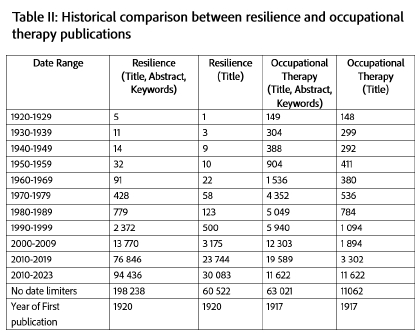
The results for occupational therapy (Table II adjacent), showed a higher number of publications than for resilience up to 1990. However, occupational therapy publications did not follow the rapidly increasing trend that was observed for research in resilience after 1990. A comparison of the trends showed that research in the occupational therapy commenced earlier and remained higher up to 2009, but that the increase since then was more gradual.
Stage 3: Comparing research in resilience and occupational therapy
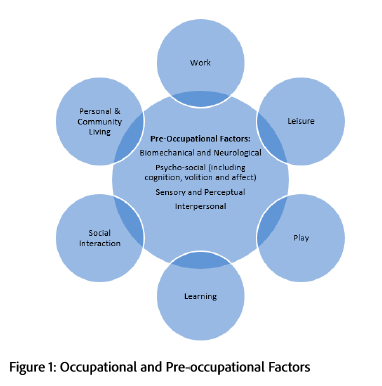
Publications on resilience increased dramatically from 2010 onwards with a rapid explosion even before the COVID19 Pandemic. Looking at the publication trend for resilience in isolation, it was not clear how much of the growth in publications should be ascribed to general trends in research brought about by macro factors such as advancement in technology, increased access to information, ease of global collaboration, data availability and commercial interests. Reasons for the sharp increase in focus would require further research but might have to do with increasingly challenging demands associated with occupational performance that requires resilience on a day-by-day basis. The implications for occupational therapy and occupational science are obvious. To focus the review on synergies between resilience and occupational therapy, alignment between the scope of occupational therapy and types of resilience require consideration. The latest revised South African Scope of Occupational Therapy2 contains six occupational categories and four categories of pre-occupational factors as shown in Figure 1 (page 4). In the revision of the scope document, occupational categories were deliberately placed as predominant to pre-occupational factors to emphasize the profession's unique and holistic approach in facilitating the occupational engagement within contexts including and beyond health.
INTERGRATIVE REVIEW
Resilience in occupational therapy
An integrative review was undertaken with aim to provide a synthesis of synergies in research, practice and conceptualisation in the fields of occupational therapy and resilience. The purpose was to illustrate how conceptualisation in these fields might overlap or interact in ways that deepen insights or produce new perspectives that might inform occupational therapy practice. The review followed four steps
Step 1: The process commenced with a search conducted on 15th June 2021 using the EBSCO Host platform with Academic Search Premier, Africa-Wide Information, CINAHLand MEDLINE and E-Journals activated. The search strings used were 'resilience or resiliency or resilient' (In Title) AND 'occupational therapy or occupational therapist or occupational therapists' (All Fields). The search yielded 177 sources that were exported into Rayyan3.
Step 2: Selection of sources for inclusion in the review. Firstly, titles and abstracts were reviewed, then full text review was undertaken. Two criteria were used for title and abstract screening, and again for full text review; namely sources had to pertain resilience and align with the occupational therapy scope of practice. The Prisma diagram in Figure 2 (below) provides a breakdown of the full process.

Step 3: Data extraction was undertaken to capture key aspects of methodology used and the conceptualization of resilience as a construct.
Step 4: Atlas Tl, a qualitative data analysis software package, was used to analyse the findings, discussion and conclusion sections of 17 sources that were included in the review, these are shown in Table III (below).

FINDINGS
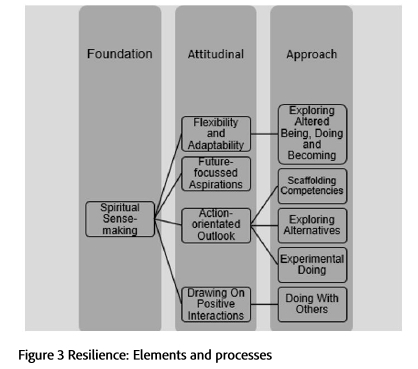
Categories were inductively formed to provide an integrated perspective of the inherent elements and processes of resilience, emerged from the analysis; these are shown in Figure 3 (below). The category, 'spiritual sense-making' seemed to serve as a foundation for four attitudinal categories, namely 'flexibility and adaptability', 'future-focused aspirations', 'action-oriented outlook', and 'drawing on positive interactions'. Approaches used were 'exploring altered being, doing and becoming', 'scaffolding competencies', 'exploring alternatives' and 'experimental doing'.
The body of research pertaining both resilience and occupational therapy focused predominantly on three population groups namely, users of occupational therapy services, occupational therapists and occupational therapy students. The populations of occupational therapy service users were children, families with disabled children and adults. Occupational therapy students tended to be involved in research that correlated resilience as a variable with well-being, competence or academic performance. Conversely, factors that might improve the resilience of students were explored. Research involving occupational therapists tended to correlate resilience with longevity, healthfulness or other professional practice variables.
DISCUSSION
Spiritual sense-making seemed to be providing a foothold for resilient responses to adverse events or conditions. This seemed to be tied with flexibility and openness to consider and explore altered realities. Articles that focused on resilience of children especially illustrated an openness to explore different ways of being, doing and becoming. Children and adults alike seemed to draw courage from success-experiences. Lessons were extrapolated (explicitly or implicitly) from successful doing.
Not surprisingly, regaining lost competencies was a strong focus of articles included in the review. This aspect was often the focus of rehabilitation and required assistive technology. Findings pertaining to adults who were particularly resilient captured an action-orientated approach in which participants were deliberate in scaffolding the competencies required to regain independence, sometimes with the help of family members. Regaining competence strongly reinforced further exploration and mastery, thus building resilience through experimentation that involved trial and error.
A future-focused attitude seemed to feature strongly in the reasoning and experiences of participants. This element seemed to be tied with spiritual sense-making and was, for some, a deliberate focus. When participants were unable to find ways to do activities independently, they relied on support and benefitted greatly from the interactions with others.
From the sources included in the review, children seemed to find it easier to 'bounce back' and more readily re-imagined future possibilities. Conversely, adults revealed a need to return to 'the way things were' or 'business as usual'. As such, children seemed more open to 'being different' from before the adverse event that required a resilient response, if they could do the things they wanted to do. For adults, resilience contained elements contributing to 'recovery' as their main aspiration, while children seemed to 'transform' in their journey to resilience. Children reflected on their healing with a tendency to highlight new learning, new experiences, new people while adults tended to highlight activities they were once again able to do. The bidirectional relationship between resilience and doing reminded strongly of well-known principles underpinning occupation and health that characterise occupational therapy practice and research.
Synergies with research on participation of persons with psychiatric disability in work
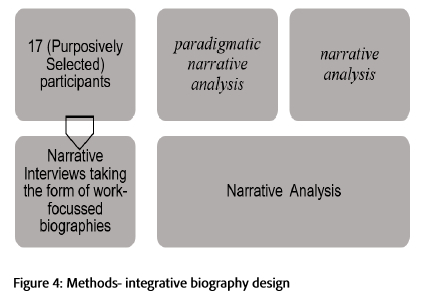
Research undertaken to explore the influences on the work-lives of persons with psychiatric disability will be used here to illustrate the link of occupational therapy to resilience. Figure 4 (below) illustrates a summary of the methods used for the integrative biography design that was informed by a narrative inquiry21,22.
The factors that bolstered resilience seemed to resonate strongly with categories that emerged from research undertaken to explore the influences that shape participation of persons with psychiatric disability in the work. The Model of Participation or Restriction, depicted in Figure 5 (adjacent), was developed to depict these influences and demonstrate how these shape propensities to participate in work or restrict such participation.
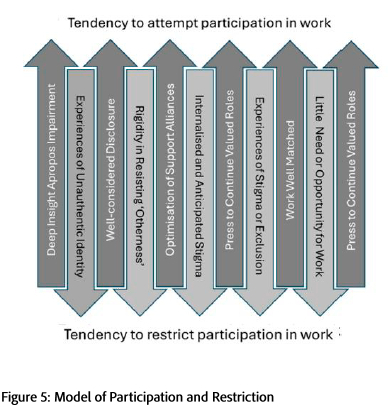
Within the Model of Participation or Restriction each arrow, which depicts a category of influence, can be shaded darker or lighter to depict its prominence according to a participant's experience. The combined picture will depict the propensity to participation or restriction will indicate the tendency of a participant to either participate in work or restrict such participation. The influences captured in the Model of Participation or Restriction Figure 5 (adjacent) will be briefly introduced and synergies with research on resilience will be highlighted
The category experiences of unauthentic identity captured identity-related ways in which the psychiatric impairment changed persons in ways they did not recognise as themselves21. They use terms such as 'crazy', 'alien' and 'strange' to describe their experiences and referred to consequences as humiliating or damaging. Intense experiences of unauthentic identity seemed to lead to restriction from participation work. A similar category, rigidity in resisting 'otherness', captured experiences of alienation that was particularly evident when participants were not disclosing their impairment, often because they anticipated stigma. The obvious link with the category internalised and anticipated stigma had to do with participants' appraisal of their fit in contexts - from the vantage point of the other. As such, the category was shaped by participants' predictions and experiences of'normal' people's reaction to them. Synergies between the category flexibility and adaptabilityin attitude, which support an approach for exploring altered being, doing and becoming that emerged as inherent elements of resilience are depicted in Figure 3 (page 5). The other two categories with tendency to restrict participation in work captured in the Model of Participation or Restriction are experiences of stigma or exclusion and little need or opportunity for work. These categories pertained availability of occupational opportunities in external environments, therefore, can be expected to impact resilience in similar ways.
The category, deep insight apropos impairment, captured the sophisticated insights that some participants developed regarding their participation and the personal strategies they developed to mitigate negative effects as far as possible. Participants' narratives revealed their explicit consideration of strategies to manage the effect of impairment on their doing. Similar strategies were captured in the scaffolding competencies, exploring alternatives and experimental doing categories that improved resilience.
Two categories, namely well-considered disclosure and optimisation of support alliances were similarto drawingon positive interactions and doing with others that featured prominently as elements supporting resilience. Predominant elements inherent in the resilience approach were having future-focussed aspirations and in terms of strategies, being action-focussed.
When participants had the opportunity to continue roles they performed prior to onset of illness (or relapse) they tended to do so. When the demand and opportunity for role performance remained, for example family responsibilities, participants continued performing such roles. Continuation of the worker role had something to do with the extent to which the role had been habituated into the routine of a participant's life22.
CONCLUSION
The synergies between resilience and occupational therapy pertained (re)establishing doing with recognition of the bi-directional effect such doing will have with identity, health, and quality of life outcomes. The positive spin-off garnered from doing was acknowledged by service users and service providers alike.
The most striking feature that influenced resilience seemed to be the flexibility of adaptive responses following an event that caused occupational disruption. Such flexibility was linked to people's propensity to assimilate an altered sense of self and thus their readiness to explore alternative ways of doing. Conversely, those who invested significant energy in a quest to restore their doing, beingand becoming in line with pre-disruption patterns tended to restrict attempts to adapt or explore occupational opportunities.
The connection between doing differently and being differently might be underestimated with a strong focus in rehabilitation on the former. This disjuncture seems to be more pronounced in real world contexts than during rehabilitation in health service contexts. For this reason, support seems to be particularly valuable during transitions that are required for people to resume role performance following occupational disruption.
Occupational therapists should take care to balance interventions that restore function in medical or simulated contexts with those that facilitate participation and inclusion. For this reason, an emphasis on occupation-based practice in real world context should be prioritised. Such practice will not only ensure that relevant support is offered during occupational transitions but will allow our profession to realise our full potential.
Acknowledgements
During my preparations for the 25th Vona du Toit Memorial Lecture, I often found myself reminiscing; recalling the many opportunities and rich experiences I've been privileged to have, and it filled me with immense gratitude My learning and development have been informed and enriched by the colleagues, mentors and students I've interacted with throughout my career. We all shift between the roles of student and teacher, as we work and learn together, thus shaping one another in a multitude of ways. I appreciate this opportunity to recognise how much my life has been enriched by colleagues and to say, 'thank you'.
My professional journey has been shaped and enriched by many remarkable South African occupational therapists. I do my work in the profession because you allow and enabled me to do so. I thank you for your support. I have the urge to mention people and teams that contributed specifically to my career; but refrain from doing so because that would take up the entire manuscript - however, I would be remiss not to mention Ruth Watson, who supervised my research at masters and doctoral, and who, together with a few other visionary occupational therapists of her time, fostered scholarship in occupational therapy, to all our benefit.
Conflicts of interest declarations
No conflict of interest to declare. No primary data was collected for this manuscript
Contribution of the author
The author, Lana van Niekerk was nominated for and awarded the 2020 Vona du Toit memorial lecture. This lecture entitled: The 25th Vona du Toit Memorial Lecture: Resilience Contextualized: Occupational Implications was presented on 15th July 2021. The conceptual piece provides a summary of the lecture.
REFERENCES
1. Coetzee, Z., A critical ethnography of the Vona du Toit Creative Ability Model (VdTMoCA) in the South African occupational therapy context. 2022, Stellenbosch: Stellenbosch University. [ Links ]
2. Health Professions Act: Regulations Defining the Scope of the Profession of Occupational Therapy. 2021. p. 122-125. [ Links ]
3. Ouzzani, M., Hammady, H., Fedorowicz, Z. and Elmagarmid, A., 2016. Rayyan-a web and mobile app for systematic reviews. Systematic reviews, 5, pp.1-10. DOI https://doi.org/10.1186/s13643-016-0384-4 [ Links ]
4. Abelenda, J. and Helfrich, C.A., 2003. Family resilience and mental illness: The role of occupational therapy. Occupational Therapy in Mental Health, 19(1), pp.25-39. DOI: https://doi.org/10.1300/J004v19n01_02 [ Links ]
5. Arima, H., Akiyama, T, de Moura, P.A., Bernick, P., Sakai, Y, Ozaki, Y, Matsumoto, S., Ohki, Y, Igarashi, Y, Tachimori, H. and Yamaguchi, S., 2021. Resilience building for mood disorders: Theoretical introduction and the achievements of the Re-Work program in Japan. Asian Journal of Psychiatry, 58, p.102580. DOI: https://doi.org/10.1016/j.ajp.2021.102580 [ Links ]
6. Ashby, S.E., Ryan, S., Gray, M. and James, C, 2013. Factors that influence the professional resilience of occupational therapists in mental health practice. Australian Occupational Therapy Journal, 60(2), pp.110-119. DOI: https://doi.org/10.1111/1440-1630.12012 [ Links ]
7. Bowden, L, Reed, K. and Nicholson, E., 2018. The contribution of occupation to children's experience of resilience: A qualitative descriptive study. Australian Occupational Therapy Journal, 65(4), pp.268-275. DOI: https://doi.org/10.1111/1440-1630.12462 [ Links ]
8. Brown, T, 2021. The response to COVID-19: Occupational resilience and the resilience of daily occupations in action. Australian Occupational Therapy Journal. 68(2): p. 103-105. DOI: https://doi.org/10.1111/1440-1630.12721 [ Links ]
9. Brown, T., Yu, M.L., Hewitt, A.E., Isbel, ST., Bevitt, T. and Etherington, J., 2020. Exploring the relationship between resilience and practice education placement success in occupational therapy students. Australian Occupational Therapy Journal, 67(1), pp.49-61.. DOI: https://doi.org/10.1111/1440-1630.12622 [ Links ]
10. Brown, T, Yu, M.L. and Etherington, J., 2021. Listening and interpersonal communication skills as predictors of resilience in occupational therapy students: A cross-sectional study. British Journal of Occupational Therapy, 84(1), pp.42-53. DOI:https://doi.org/10.1177/0308022620908503 [ Links ]
11. Falk-Kessler, J., Kalina, J T. and Miller, P., 2012. Influence of occupational therapy on resilience in individuals with multiple sclerosis. International Journal of MS Care, 14(3), pp.160-168. DOI https://doi.org/10.7224/1537-2073-14.3.160 [ Links ]
12. George, M., Brown, T. and Yu, M.L., 2022. The relationship between resilience, reflective thinking and professionalism in Australian undergraduate occupational therapy students. Scandinavian Journal of Occupational Therapy, 29(3), pp.229-241.DOI: https://doi.org/10.1080/11038128.2021.1908421 [ Links ]
13. Hildenbrand, W.C., 2019. Let's start here: Relationships, resilience, relevance. The American Journal of Occupational Therapy, 73(6), pp.7306130010p1-7306130010p10.DOI: https://doi.org/10.5014/ajot.2019.736004. [ Links ]
14. Kotera, Y, Green, P. and Sheffield, D., 2022. Positive psychology for mental wellbeing of UK therapeutic students: relationships with engagement, motivation, resilience and self-compassion. International Journal of Mental Health and Addiction, 20(3), pp.1611-1626. DOI:https://doi.org/10.1007/s11469-020-00466-y [ Links ]
15. Matuska, K. ed., 2014. The art and science of resilience. OTJR: Occupation, Participation and Health, 34(1), pp.2-3.DOI: https://doi.org/10.3928/15394492-20131211-01 [ Links ]
16. MacDonald, K. and Fenton, L, 2018. Identifying the role of occupational therapists in promoting student resilience: An environmental scan of mental health initiatives on Canadian university campuses. Occupational Therapy Now, 20(1), pp.24-26. [ Links ]
17. Price, P., Kinghorn, J., Patrick, R. and Cardell, B., 2012. "Still there is beauty": one man's resilient adaptation to stroke. Scandinavian Journal of Occupational Therapy, 19(2), pp.111-117. DOI: https://doi.org/10.3109/11038128.2010.519402. [ Links ]
18. Rasa, A.R., Haghgoo, H.A., Khankeh, H. and Hosseini, S.A., 2018. The process of non-resilience in a spinal cord injury population in Iran: a grounded theory. International Journal of Therapy and Rehabilitation, 25(7), pp.327-334. DOI: https://doi.org/10.12968/ijtr.2018.25.7327 [ Links ]
19. Santoso, TB., Ito, Y, Ohshima, N., Hidaka, M. and Bontje, R, 2015. Resilience in daily occupations of Indonesian mothers of children with autism spectrum disorder. The American Journal of Occupational Therapy, 69(5), pp.6905185020p1-6905185020p8. DOI: https://doi.org/10.5014/ajot.2015.017566 [ Links ]
20. Vaughan-Horrocks, H., Reagon, C. and Seymour, A., 2021. The experiences of veterans with mental health problems participating in an occupational therapy and resilience workshop intervention: an exploratory study. British Journal of Occupational Therapy, 84(9), pp.531-540. DOI: https://doi.org/10.1177/0308022620977818 [ Links ]
21. van Niekerk, L, 2016. Identity construction and participation in work: Learning from the experiences of persons with psychiatric disability. Scandinavian Journal of Occupational Therapy, 23(2), pp.107-114. DOI: https://doi.org/10.3109/11038128.2015.1091895 [ Links ]
22. van Niekerk, L., 2009. Participation in work: A source of wellness for people with psychiatric disability. Work, 32(4), pp.455-465. DOI: https://doi.org/10.3233/WOR-2009-0856 [ Links ]
 Correspondence:
Lana van Niekerk
lanavn@sun.ac.za
Submitted: 25 August 2024
Reviewed: 14 November 2024
Revised: 30 January 2025
Accepted: 19 March 2025
EDITOR
Blanche Pretorius
https://orcid.org/0000-0002-3543-0743
DATA AVAILABILITY
From the corresponding author
FUNDING
No funding was received.

