




Services on Demand
Journal

Article
 English (pdf)
 Article in xml format
 Article references
 Automatic translation
 Send this article by e-mail
Indicators
Related links
-
 Cited by Google
 -
 Similars in Google
Share

 Permalink
South African Journal of Libraries and Information Science
On-line version ISSN 2304-8263Print version ISSN 0256-8861
SAJLIS vol.91 n.2 Pretoria 2025
https://doi.org/10.7553/91-2-2436
RESEARCH ARTICLES
Strengthening service delivery to support the information needs of users at Springs Public Library in South Africa
Dorothy Mosadi MalekanaI; Kabelo Given ChumaII
IJunior Lecturer in the Department of Information Science at the University of South Africa, Pretoria. malekmd@unisa.ac.za ORCID: 0009-0003-8062-1906
IILecturer in the Department of Information Science at the University of South Africa, Pretoria. chumakg@unisa.ac.za ORCID: 0000-0002-5817-6063
ABSTRACT
South Africa public libraries face significant challenges in delivering quality services to meet the diverse needs of their users. The Springs Public Library is no exception, encountering challenges that hinder the provision of quality library services. Therefore, this study aimed to explore service delivery at the Springs Public Library in Gauteng Province, South Africa. A qualitative research approach was used in this study. A purposive sampling was used to select four librarians, three library assistants, and library manager. The results revealed four main themes and 20 categories: (1) legal frameworks for service delivery (Batho Pele Principles, Protection of Personal Information Act, Constitution of the Republic of South Africa); (2) causes of poor service delivery (lack of infrastructure, corruption, limited budget, and poor internet connectivity; (3) effects of poor service delivery (decreased library usage, user disappointments and frustrations and damaged reputation). The study underscores the need for Springs Public Library to establish and enforce well-defined policies and procedures to enhance service delivery and effectively meet the diverse needs of its users. The library should actively collaborate with local government and stakeholders to secure increased funding and better budget allocations. This study has broader implications for other public libraries in similar contexts, providing insights that can inform future strategies to strengthen public libraries' role in fostering knowledge, access to information, and community empowerment. It is concluded that clear policies and legal frameworks are crucial for guiding service standards and ensuring consistent, high-quality experiences for library users.
Keywords: Service delivery, public libraries, information and learning needs, library services, patrons, South Africa
1 Introduction and background of the study
Service delivery represents one of the most visible functions of the library system, where both users and other stakeholders access information and resources to meet their diverse information needs. Eyo (2024) affirms that service delivery has long been considered a core mission of public libraries. Similarly, Ntogo-Saghanen and Echedom (2023) emphasise that the effective delivery of library services that address the needs and aspirations of citizens, decision-makers, and lifelong learners remains a long-standing goal of the information profession. As a result, public libraries have been established to support government efforts in providing library services to communities. According to Rajurkur (2011) and Sibiya and Chuma (2021), public and academic libraries are primarily responsible for collecting, processing, disseminating, storing, and utilising information to serve their communities. Specifically, public libraries are tasked with ensuring the provision of effective library services to their communities. Hamad, Al-Fadel and Fakhouri (2023) advocate the view that public libraries are service-oriented organisations that provide relevant resources and quality services to meet the information needs of their users. Khan, Gupta, Sinhababu and Chakravarty (2023) emphasise that quality-of-service delivery is the most critical aspect of library operations. The goal of service quality is to continuously improve the services offered, aligning them with the expectations of users (Kulkarni & Deshpande 2012).
Although public and community libraries play a crucial role in delivering essential services, many public libraries in low-and middle-income countries face significant challenges in achieving effective service delivery. Baada, Ayoung, Bekoe and Azindow (2020) and Sahabi and Otobo (2021) stipulate that efficient delivery of library services remains an ongoing challenge for numerous public libraries in developing countries such as Nigeria, Congo, Tanzania, Zimbabwe, South Africa, and Ghana. Similarly, Anene, Achebe and Uzoechina (2020) note that community libraries in these regions are burdened with a multitude of challenges that impact their ability to provide effective service delivery to users and society. In low- and middle-income countries such as Nigeria, Tanzania, Kenya and South Africa, several factors contribute to poor service delivery in community libraries, including limited access to technological and financial resources, staff shortages, inadequate technical infrastructure, structural issues, lack of standards, legal frameworks, operational inefficiencies, insufficient citizen participation, lack of funds, corruption and weak leadership and management (Anyim 2018; Onsinyo 2018; Saibakumo 2021). Kulli (2017) identifies additional root causes of poor service delivery in public libraries in developing countries, such as a lack of accountability and transparency, inadequate skills, insufficient funding, poor resource allocation, poor decisionmaking, and inefficiencies in technology and energy supply. These challenges collectively hinder the ability of public libraries to deliver high-quality services that meet the information needs of their users.
Given this context, the literature demonstrates that effective and reliable service delivery is one of the greatest challenges facing South African public or community libraries. Ntsala and Mahlatji (2016) argue that service delivery has been a persistent issue in many South African public libraries, partly due to corruption, political patronage, and inadequate technological infrastructure. Jiyane, Mugwisi and Moyane (2016) concur, emphasising that service delivery remains a pressing issue for South African public or community libraries as a whole. Similarly, Bopape, Dikotla, Mahlatji, Ntsala and Makgahlela (2021) highlight that public libraries in South Africa face a multitude of challenges that hinder effective and efficient service delivery. These challenges include insufficient funding, inadequate staffing, low remuneration of library staff, outdated collections, limited study materials, poor infrastructure, and the lack of automated library services. Furthermore, Mojapelo (2017) warns that poor service delivery in public libraries is further aggravated by funding shortages, while other critical factors, such as space, resources, electricity, internet connectivity, equipment, and security, are also impacted. Ngcobo (2020) attests that inadequate funding for community libraries affects the provision of efficient service delivery to users in South Africa. Additionally, the conditional grant allocated to public libraries plays a crucial role in resource acquisition and service provision. While the Provincial Library Services are responsible for acquiring resources such as books and digital materials, the day-to-day operations, including staffing, maintenance, and infrastructure, fall under the jurisdiction of municipalities. This fragmented funding and management structure often leads to inefficiencies, delays, and disparities in service delivery, further exacerbating the challenges faced by public libraries.
In light of this situation in South Africa, the Springs Public Library faces a plethora of challenges that hinder the effective delivery of quality library services. According to the South African National Council for Library and Information Services (SANCLIS), nearly 65% of public libraries in the Gauteng and KwaZulu Natal struggle with inadequate funding, leading to resource shortages and service disruptions. Additionally, a report by the Department of Sport, Arts, and Culture (2022) indicates that over 40% of users have reduced their visits to public libraries due to poor service delivery, outdated collections, and limited internet access. This trend is evident at the Springs Public Library, where it has been observed that many users no longer visit or fully utilize the library and its resources due to poor service delivery and the limited availability of books, digital resources, and study facilities. According to the mandate of the Springs Ekurhuleni Metropolitan Municipality (2019), inadequate funding and limited budget allocations from the state government significantly contribute to poor service delivery at the Springs Public Library. This is a pressing issue that requires urgent intervention from both the government and the municipalities in the Gauteng Province. The Ekurhuleni Metropolitan Municipality has made ongoing efforts to improve service delivery at the Springs Public Library, including resource allocation, the reimplementation of policies and procedures, and staff training. However, these initiatives have often failed due to poor execution and ineffective decision-making. Despite the considerable efforts of the municipality, service delivery remains a significant challenge. To address this issue, this study aimed to explore service delivery to better support the information needs of users at the Springs Public Library in Gauteng Province of South Africa. This study contributes to the broader understanding of public library service delivery in South Africa, offering recommendations for improvements that can be applied to similar libraries in the country. This study also highlights the importance of aligning library services with users' evolving information needs, ultimately contributing to more effective and sustainable public library operations in the region.
2 Problem statement
Service delivery is considered the most crucial aspect of public library operations. Peter and Florence (2014) and Kaushal and Yadav (2022) emphasize that public and community libraries are expected to consistently deliver efficient and effective services to their users. In South Africa, public libraries are mandated to provide high-quality services to users; however, many libraries are struggling to meet these expectations (Matodzi 2019). The overarching problem that leads to this study is that Springs Public Library continues to face difficulties in providing high-quality services and meeting the growing demands of its users. Regular observations by Springs Library staff have highlighted several challenges that hinder service delivery, including inadequate funding, outdated technology, insufficient resources, a lack of updated materials, limited computer systems, and the absence of online resources.
Moreover, the library has struggled to adapt to advancements in digital media and technology. These challenges have resulted in a decline in library visits, as many users feel the library no longer meets their informational and personal needs. Farah (2013) and Omotunde and Alegbeleye (2021) assert that poor service delivery negatively affects library usability and reduces user engagement with library resources. Despite recognizing the common challenges to service delivery, there is limited information available to the municipality and library officials on which specific challenges most significantly hinder the use of the Springs Public Library.
3 Aim and research objectives of the study
This study aimed to explore service delivery at the Springs Public Library in Gauteng Province of South Africa. This study hopes to achieve the following research objectives:
• To examine the current state of service delivery in community libraries at the Springs Public Library in Gauteng Province, South Africa
• To assess policy and legal frameworks that govern service delivery at the Springs Public Library in Gauteng Province, South Africa.
• To establish the root causes of poor service delivery at the Springs Public Library in Gauteng Province, South Africa.
• To examine the effects of poor service delivery at the Springs Public Library in Gauteng Province, South Africa.
5 Theoretical framework of the study
The theoretical framework is a crucial component of the research process, serving as the foundation that supports or underpins a study. According to Salawu, Shamsuddin and Bolatitio (2023), a theoretical framework plays a vital role in research as it helps to organise and guide the research process, while also linking the researcher to existing body of knowledge in the field. This study applied the service quality model (SERVQUAL) as a foundational framework for understanding and assessing service quality at the Springs Public Library. According to Hoque, Akhter, Absar, Khandaker, and Al-Mamun (2023), SERVQUAL model is a service quality framework used to measure service quality and assess user satisfaction. Lu and Lin (2024) advocate the view that there are five dimensions identified by the SERVQUAL model that shape service quality: tangibility, reliability, responsiveness, assurance, and empathy.
In this regard, the study adapted tangibility to evaluate and understand the current state of service delivery through assessing the quality and availability of resources at the Springs Public Library. In this study, reliability was applied to identify specific causes and areas contributing to poor service delivery in the library. Conversely, responsiveness was also examined, focusing on the staff's willingness and ability to assist users promptly and address their needs. Inadequate responsiveness can lead to user dissatisfaction and adversely affect perceptions of service quality. Evaluating this dimension enabled the researchers to identify possible bottlenecks contributing to poor service delivery.
5 Literature review on library service delivery
The literature review for this study covers the following theme (a) policy and legal frameworks governing service delivery in libraries, (b) rooting causes of poor service delivery in libraries, and (c) consequences of poor service delivery in libraries.
5.1 Current state of library service delivery in community libraries in South Africa
There is no doubt that the quality of public library service delivery in many parts of South Africa is poor, due to numerous contributing factors. Supporting this assertion, Davis (2009), Boloka (2023) and Mpanza, Luthuli and Kalusopa (2024) highlights the challenges faced by community libraries in rural areas across various provinces in South Africa, including the Eastern Cape, Limpopo, KwaZulu-Natal, and North West. These libraries often struggle with issues such as insufficient resources, outdated materials, and conflicting administrative directives. Such challenges collectively hinder community libraries from fulfilling their intended role in supporting information access, resulting in users lacking essential resources for decision-making, which ultimately affects their ability to meet both informational and personal needs. Khanya and Dikotla (2021) further emphasise that the provision of community library services in rural communities, particularly in Limpopo Province, remains inadequate due to a lack of sufficient financial, capital, and human resources. Similarly, Shandu, Evans and Mostert (2014) and Mojapelo (2020) stress that the conditions in many community libraries within Gauteng Province, such as in Katlehong and Germiston, and Limpopo province are not conducive to effective library service provision.
These libraries face issues such as unbalanced collections and a disproportionate distribution of materials, which fail to meet the educational, personal, and informational needs required by modern standards. As a result, the poor state of library services in South Africa limits access to essential information and hampers the libraries' ability to support diverse needs of users effectively. Addressing these deficiencies is essential to enhance the impact of community libraries in South Africa and to ensure that they meet the evolving information, educational, and personal needs of their users. Existing studies primarily examine challenges in rural community libraries, particularly in provinces like Limpopo, Eastern Cape, and KwaZulu-Natal. However, urban public libraries, such as those in Springs, Johannesburg, and Pretoria, may face distinct challenges that are not sufficiently explored. Given differences in population density, digital access, and user expectations, research on urban public library service delivery is needed to address unique infrastructural and policy constraints in metropolitan areas.
5.2 Policy and legal frameworks governing service delivery in community libraries in South Africa
Moyana and Chuma (2023) stipulate that service delivery in any organisations or institutions must be governed by set of legislation and regulations enacted by the government of the respective country. In South Africa, public libraries are legally required to adhere strictly to such legislation to ensure the effective and efficient delivery of library services. Ledwaba (2021) emphasises that public libraries must comply with various laws, including the Constitution of the Republic of South Africa (No. 108 of 1996), the Copyright Act (No. 98 of 1978), the Legal Deposit Act (No. 54 of 1997), the National Council for Library and Information Services Act (No. 6 of 2001), the National Library of South Africa Act (No. 92 of 1998), and the Promotion of Access to Information Act (No. 2 of 2000).
Mojapelo and Dube (2014) caution that the legislative framework guiding the development and provision of library and information services includes the Protection of Personal Information (PoPI) Act (No. 4 of 2013), the South African Community Library and Information Services Bill (2010), the South African Library for the Blind Act (No. 91 of 1998), the South African Public Library and Information Services Bill, and the Municipal Finance Management Act (No. 56 of 2003). Non-compliance with these legal requirements can significantly hinder the quality of library services and prevent libraries from effectively meeting information needs of their users.
Despite the comprehensive nature of these laws, non-compliance remains a significant challenge in many public libraries across South Africa. In particular, limited understanding of the complex legislative landscape and insufficient training often lead to poor implementation of key regulations (Zulu, Ngoepe and Saurombe 2017; Chuma and Mthethwa 2024). This lack of compliance has been identified as a major contributor to poor service delivery in libraries. When public libraries fail to fully align with these legal requirements, it impedes their ability to effectively serve the information needs of their users. This can result in delayed or inadequate access to resources, privacy and data security breaches, and the inability to provide services that meet national standards (Eneya, Mostert and Ocholla 2020). Furthermore, non-compliance can hinder the library's ability to access funding and support from government agencies, further exacerbating resource shortages and operational inefficiencies.
5.3 Causes of poor service delivery in community libraries in South Africa
There are several root causes of poor service delivery in public libraries. Kulli (2017) identifies key factors such as ineffective communication, poor time management, insufficient training, a lack of belief in the library's mission or services among librarians and personal issues affecting work performance. Rafiq, Batool, Ali and Ullah (2021) stress that poor library service arises when user needs and expectations are not met, when there is a failure to effectively manage library service operations and organisational standards, and when there is a lack of motivation and poorly executed service plans. Aminuzzaman (2010) and Dube and Jacobs (2023) underscore that the factors such as funding and budget constraints, insufficient training, lack of professional development, outdated technological infrastructure, limited collection and poor adherence to legal framework affect the ability of community libraries to cater high-quality services.
Nduka, Adekanye and Adedokun (2021) highlights common causes of poor service delivery, including a lack of public involvement, budget constraints, interference by councillors, weak leadership, inadequate infrastructure, and insufficient skills. Mubofu (2023) stipulates that challenges to efficient and effective library service delivery include inefficient resource management, interference from central government entities, substandard infrastructure, and limited autonomy for local government officials. Aminuzzaman (2010) further emphasises that a severe shortage of logistical support, such as transportation, along with poor managerial skills, hampers the formulation and implementation of sustainable strategies. The literature primarily focuses on challenges within public libraries, but there is no comparative analysis between different library service models, such as public vs. academic libraries, community-driven vs. government-funded libraries, or digital vs. physical library services. Such a comparison could identify best practices and alternative service delivery strategies.
5.4 Effects of poor service delivery in community libraries in South Africa
Service delivery remains a critical challenge for community libraries across South Africa. Kuli (2017) and Adayi, Kudu, Dutse and Oche (2021) argue that poor service delivery can deter potential library users even before they visit, discourage existing users from returning, and make it difficult to attract qualified staff, as potential employees may perceive that poor service delivery extends to staff as well. Cruz, Mendes, Lizarelli and Cauchick-Miguel (2020) articulate that inadequate service provision can prevent users from accessing the library and utilising its resources effectively and efficiently. This underutilisation can lead to a waste of government investment and resources.
Ntsala and Mahlatji (2016) and Adeyemi, Sanni, Shittu, Shiru and Shittu (2025) postulate that the lack of effective service delivery can provoke negative reactions from users, including damaging library property or resources out of frustration. Additionally, poor service quality due to diminishing resources can result in a decline in library usage, as users may not perceive value in the available services. Yerima (2016) identifies several common effects of substandard service delivery in community libraries, such as the loss of both current and potential users, damage to the library's reputation, and a gradual decline in the quality and availability of library resources and services. Ultimately, the impact of poor service delivery in public or community libraries extends beyond the immediate loss of users. It affects the library's ability to fulfil its mission as a community resource, leading to a cycle of reduced engagement and further strain on already limited resources. Addressing these service delivery challenges is crucial for ensuring that community libraries continue to serve as vital information hubs within their communities.
The literature briefly touches on the attraction of qualified staff but does not delve deeply into the role of library staff satisfaction, morale, and training in affecting service delivery. There is a need for studies on how staff perceptions of service quality and workplace conditions influence their ability to provide high-quality services. Understanding staff experiences and challenges could offer insights into internal factors that perpetuate poor service delivery.
6 Research methodology
This study was conducted at the Springs Public Library, which is part of the Ekurhuleni Metropolitan Municipality in Gauteng Province, South Africa. Data were collected from October 2022 to November 2022. This study was positioned within the interpretivist paradigm. A qualitative research approach was used for this study because it allows for an in-depth exploration of the root causes and effects of poor service delivery at the Springs Public Library. Given the complex and multidimensional nature of service delivery challenges, qualitative research provides a rich, detailed understanding that cannot be captured through purely numerical data. Data for this study were collected through semi-structured interviews with purposively selected four librarians, three library assistants, and library manager who interact with the library's services. The semi-structured format allowed for flexibility, enabling participants to elaborate on their responses. The inclusion criteria were to have at least two years of working experience in the library. The interviews were guided by an interview protocol. Each interview lasted approximately 20-30 minutes and were audio recorded with participants' permission and fully transcribed verbatim in Microsoft Office.
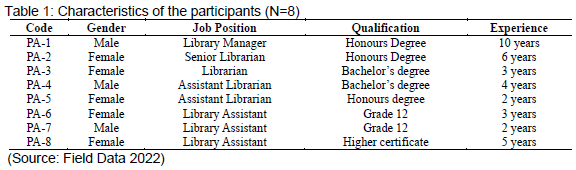
Data saturation was achieved in the 6th interview. The collected data were analysed using the thematic analysis and NVivo version 13 software package. The researchers achieved credibility through member checking and prolonged engagement with the participants. For confirmability, 3 external reviewers were consulted to review and confirm the quality of interviews and categories to reach consensus. With regards to dependability, all the procedures of the study were reported. The College of Human Sciences Research Ethics Review Committee at the University of South Africa (UNISA) granted approval for this study (approval number: CA4_29112022_CREC_CHS_2022). Verbal and written informed consent were obtained from all participants before commencements of the interviews. Confidentiality and privacy of the participants were maintained through anonymising the collected data and using pseudonyms and codes as indicated in Table 1.
7 Results
This section presents the results of this study. In this study, eight library staff members gave full consent and participated in this study. The study comprised of five females and three males. Thus, female participants were more dominant than male participants. In terms of qualification, participants had Grade 12 (matric), higher certificate, bachelor's degree and honours degree in Library and Information Science (LIS). Their working experience ranged between 2 to 10 years as illustrated in Table 1.
The following table presents the themes, categories, and sub-categories emerged during the data collection.
7.1 Current state of service delivery at the Springs Public Library
Farah (2013) emphasises that understanding the strengths and weaknesses of library service delivery enables libraries to implement strategies to improve service quality, thereby increasing user satisfaction and engagement. During the interviews, participants voiced their complaints about the poor state of service delivery at Spring Public Library due to numerous contextual factors that contribute to the situation. For example, two of the participants said:
"To be honest with you, the current state of our service delivery is poor and most of the users have raised too many complaints about the condition of our library. I think this is because our library contains outdated books and resources and some of our computers and printing devices are broken and not fully functional." (PA-1).
"I believe the state of our library is poor because we lack many of the resources and materials needed to meet the demanding information and personal needs of our users. It is quite frustrating to work in such an environment."(PA-3).
7.2 Policy and legal framework governing service delivery at the Springs Public Library
Zulu, Ngoepe and Saurombe (2017) contend that legal frameworks are essential in governing service provision and delivery, particularly in public institutions such as libraries. They provide a framework for ensuring consistency, accountability, and fairness in how services are delivered to the public citizens. During the interviews, study participants highlighted various pieces of legislation that the Springs Public Library adheres to in governing its service provision. For instance, one of the participants said:
"Thank you for the question, Ms Malekana^uhm our library has implemented and complied with several pieces of legislation and regulations that govern service delivery to the users in our community which include the Batho Pele Principles, Protection of Personal Information Act 4 of 2013, and the Constitution of the Republic of South Africa Act 1996. These regulations outline the most important guidelines on the provision of services and how services should be rendered to meet the needs of our users." (PA-2).
On the contrary, another participant also elaborated that:
"Our library adheres to various laws that regulate the provision of library services. Some key pieces of legislation that come to mind include the Constitution of the Republic of South Africa, the Promotion of Access to Information Act, the South African Public Library and Information Services Bill, and the Municipal Systems Act. These laws are useful in terms of guiding on how we should deliver services to our users and the broader community." (PA-5).
As a follow-up question, participants were asked whether their libraries had established any service delivery policies that provide a clear framework for delivering library services to users. Nearly all participants revealed that their libraries had not implemented any such policies for service delivery. For example, one of the participants expressed that:
"Our library currently lacks established policies that outline a clear framework and set of standards for delivering library services to the public or our users. This is a serious problem for us, because if there is no formal guidance to ensure consistency, quality, and accountability in how our library services are provided^. this may affect our ability to meet the demanding needs of our users effectively and to deliver services in a structured and standardised manner." (PA-1).
7.3 Causes of poor service delivery at Springs Public Library
Poor service delivery in public libraries is influenced by various factors. During the interviews, participants identified several contributors to the inadequate delivery of library services. The following participants provided different responses regarding the root causes of poor library service delivery.
"In our library, we are faced with so many significant challenges that affect service delivery. Most of the challenges that impede quality service delivery in our library include the lack of technological infrastructure, lack of resources, corruption and fraud and lack of motivational abilities among our staff." (PA-8).
"I think we struggle to cater for good quality services because our library struggles with limited funds and budget allocations, which affect the availability of resources and the ability to maintain the facility and our effort then we end up providing poor services to our users." (PA-6).
"I believe the problem is that many of our materials are outdated and do not meet the current information needs of the community. There is no budget for acquiring new books or digital resources. In addition to this, our library building is old, and many of our facilities are not up to standard. The lack of a comfortable reading space or proper study areas discourages users from spending time in the library. All of these issues limit our ability to cater for good quality services." (PA-2).
"Our library has very slow internet, making it difficult for users to access online resources or use digital services. It affects users who rely on the library for doing their research and school assignments." (PA-4).
7.4 Effects of poor service delivery at Springs Public Library
During the interviews, participants voiced their concerns, stating that they had experienced numerous effects as a result of poor service delivery. For instance, one of the participants expressed that:
"Due to the lack of up-to-date resources, many of our users have stopped visiting the library altogether. They often express their frustrations with the limited availability of relevant books and materials, which impact their ability to complete research or find the information they need." (PA-2).
"Poor service delivery has damaged our library's reputation in the community. Users complain that our services are slow, and many feel that their needs are not being prioritised. As a result, word-of- mouth has spread, and fewer people see the library as a valuable resource." (PA-5).
"We often hear from users that they are frustrated with the outdated technology in the library, such as slow computers and limited internet access. This has made it difficult for them to complete tasks, and many have opted to go elsewhere, leading to a noticeable drop in library visits." (PA-7).
"Some of our regular users have expressed disappointment with the library services they receive, citing long waiting times and unhelpful staff. They have mentioned that this has discouraged them from returning, which directly affects our engagement with the community." (PA-3).
8 Discussion of the results
This section discusses the results of the study. Based on the results, it was found that the state of service delivery at the Spring Public Library is inadequate. The results showed that the library complies with several key pieces of legislation, including the Batho Pele Principles, the Protection of Personal Information Act, the Constitution of the Republic of South Africa, the South African Public Library and Information Services Bill, the Promotion of Access to Information Act and the Municipal Systems Act. The results revealed that the Springs Public Library has not established policies and procedures to govern service delivery. This aligns with the findings of Enweani and Eke (2018) and Rajendran and Ladan (2020), who found that many libraries in Nigeria also lack service delivery policies and procedures. The results revealed several key factors contributing to poor service delivery at the Springs Public Library, including the absence of technological infrastructure and resources, poor internet connectivity, limited funding and budget allocations, inadequate facilities, corruption and fraud, outdated resources and materials, and a lack of motivational strategies.
These results are consistent with those of a study conducted by Abbas and Mairiga (2022) in academic libraries, which highlighted outdated library materials and resources, poor infrastructure, insufficient internet connectivity, insufficient facilities, and inadequate funding as significant challenges to quality library services, especially in rural and semi-rural communities. The results revealed that the Spring Public Library experienced decreased usage, user dissatisfaction, frustrations among users, and a damaged reputation due to poor service delivery, exacerbated by various contributing factors. These results correlate with those of Okafor (2020), who found that libraries in Nigeria are experiencing a decrease in library visits, poor usage of library materials and resources and operation inefficiencies because of poor service delivery. These results align with those of Okafor (2020), who reported that libraries in Nigeria have similarly experienced declines in library visits, underutilisation of library materials and resources, and operational inefficiencies as a result of poor service delivery.
10. Conclusion and recommendations
Community libraries are service-oriented organisations where the quality of services plays a crucial role in the development and dissemination of knowledge. The study aimed to explore service delivery at the Springs Public Library in Gauteng Province of South Africa. The study findings identified several key factors contributing to poor service delivery at the Springs Public Library, including a lack of technological infrastructure and resources, unreliable internet connectivity, limited funding and budget allocations, inadequate facilities, issues of corruption and fraud, outdated materials, and the absence of motivational strategies. It was found that the Springs Library faced declining usage, user dissatisfaction, patron frustrations and a tarnished reputation due to poor service delivery, which was aggravated by multiple contributing factors.
The study offers significant contributions to policy by identifying gaps in service delivery policies and procedures and providing insights that can guide policymakers in drafting or revising regulations to improve library services. Additionally, it emphasises the need for staff training in areas such as library service, digital literacy, and resource management. The results of this study have broader implications for other public libraries in similar contexts, providing insights that can inform future strategies to strengthen the roles of public libraries in fostering knowledge, access to information and community empowerment. In conclusion, clear and strict policies and procedures are crucial for guiding service standards and ensuring consistent and high-quality experiences for library users. The following recommendations were made in line with the findings of the study:
• The Springs Public Library should develop, implement, and rigorously enforce clear policies and procedures designed to enhance service delivery. These measures should be tailored to effectively address the diverse information and educational needs of users, ensuring accessibility, efficiency, and a high-quality library experience for all patrons.
• The library should actively seek funding opportunities or establish strategic partnerships to support infrastructure upgrades. These improvements should focus on creating a more inclusive, modern, and welcoming environment that caters to the diverse needs of all users, ensuring accessibility, comfort, and enhanced learning experiences.
• The library should actively collaborate with local government authorities and key stakeholders to advocate for increased funding and improved budget allocations. Strengthening these partnerships will help secure the necessary financial resources to enhance library services, expand collections, upgrade infrastructure, and meet the evolving needs of the community.
• The Springs Public Library should prioritize the regular updating of its materials and resources to ensure they remain current, relevant, and aligned with the evolving informational and educational needs of its users.
• The library should implement a comprehensive feedback system that actively gathers input from users through surveys, suggestion boxes, and focus groups. This approach will allow the library to identify specific areas of dissatisfaction, assess user needs, and make data-driven improvements to enhance overall service delivery and user experience.
References
Abbas, K.D. and Mairiga, D.U. 2022. Perception of Academic Librarian's Towards Knowledge Sharing for Service Delivery in University Libraries in Kaduna State. Samaru Journal of Information Studies, 22(1): 14-25. [ Links ]
Adayi, O.I., Kudu, D., Dutse, L.I. and Oche, N.A. 2021. Empirical investigation of the extent of utilization of social media for effective Library and Information Service delivery in selected university libraries in Abia State, Nigeria. Library Philosophy and Practice, pp.1-16.
Adeyemi, I., Sanni, R., Shittu, R., Shiru, M. and Shittu, F. 2025. Perceived Influence of Innovation Management on Library Service Delivery in Selected Academic Libraries in Kwara State, Nigeria. International Information & Library Review, pp.1-20.
Aminuzzaman, SM. 2010. Local Governance Support Project-Learning and Innovation Component (LGSP-LIC). Local Government Division, Government of Bangladesh.
Anene, I.A, Achebe, N.E. and Uzoechina, C.E. 2020. Application of Information Communication Technologies for effective user education programme in federal university libraries in South East, Nigeria. International Journal of Library and Information Science, 12(1): 16-30. [ Links ]
Anyim, WO. 2018. E-Library resources and services: Improvement and innovation of access and retrieval for effective research activities in university e-libraries in Kogi State Nigeria. Library Philosophy and Practice, pp.0_1-21.
Baada, F.N.A, Ayoung, A.D, Bekoe, S. and Azindow, F.B. 2020. Resource constraints and quality public library service delivery in Ghana. International Information and Library Review, 52(1): 10-31. [ Links ]
Boloka, M.J. 2023. 15 Public Library Infrastructure During COVID-19 in Limpopo Province. Information Services for a Sustainable Society, p.225.
Bopape, S.T, Dikotla, M, Mahlatji, M, Ntsala, M. and Lefose, M. 2021. Public and community libraries in Limpopo Province, South Africa: prospects and challenges. South African Journal of Libraries and Information Science, 87(1): 9-19. [ Links ]
Chuma, K.G. and Mthethwa, S.N. 2024. Cyberthreats, Vulnerabilities and Cyberattacks Targeting Hospitals in Pretoria, South Africa During the Covid-19 Pandemic. Acta Criminologica: African Journal of Criminology & Victimology, 37(1): 23-45. [ Links ]
Cruz, K.F.S, Mendes, G.H.S, Lizarelli, F.L. and Cauchick-Miguel, P.A. 2020. Antecedents and consequences of library service innovation: An investigation into Brazilian academic libraries. The Journal of Academic Librarianship, 46(6):102235. [ Links ]
Davis, G. 2009. Towards a transformed library and information sector in South Africa: rethinking roles. South African Journal of Libraries and Information Science, 75(2): 131-137. [ Links ]
Dube, T.V. and Jacobs, L. 2023. Academic library services extension during the COVID-19 pandemic: Considerations in higher education institutions in the Gauteng Province, South Africa. Library Management, 44(1/2):17-39. [ Links ]
Eneya, D., Mostert, B.J. and Ocholla, D.N. 2020. University of Zululand Library and Inclusive Education: Responding to the Needs of Students with Disabilities. Mousaion, 38(1). [ Links ]
Enweani, U.V. and Eke, C.C. 2018. Challenges to library and information services (LIS) delivery in the 21st century: the situation in three academic libraries in Imo State, Nigeria. Library Philosophy and Practice, p.1.
Eyo, E.B. 2024. Challenges and strategies of shaping the Cross River State Public Library for quality service delivery in the 21st century. Journal of Library Services and Technologies, 6(2): 126-135. [ Links ]
Farah, R.M. 2013. Factors influencing quality service delivery in public libraries: a case study of Garissa provincial library (Doctoral dissertation, University of Nairobi). [ Links ]
Hamad, F, Al-Fadel, M. and Fakhouri, H. 2023. The provision of smart service at academic libraries and associated challenges. Journal of Librarianship and Information Science, 55(4): 960-971. [ Links ]
Hoque, U.S, Akhter, N, Absar, N, Khandaker, M.U. and Al-Mamun, A. 2023. Assessing service quality using SERVQUAL model: An empirical study on some private universities in Bangladesh. Trends in Higher Education, 2(1): 255-269. [ Links ]
Jiyane, G.V, Mugwisi, T. and Moyane, S.P. 2016. Market orientation as a strategy for service delivery in public libraries: a case study of the northern region in KwaZulu-Natal, South Africa. Mousaion: South African Journal of Information Studies, 34(4): 59-80. [ Links ]
Kaushal, V. and Yadav, R. 2022. The role of chatbots in academic libraries: An experience-based perspective. Journal of the Australian Library and Information Association, 71(3), pp.215-232. [ Links ]
Khan, R, Gupta, N, Sinhababu, A. and Chakravarty, R. 2023. Impact of conversational and generative AI systems on libraries: A use case large language model (LLM). Science and Technology Libraries, 1-15.
Khanya, I.A. and Dikotla, M. 2021. Digitalisation of library services as a magnifying factor in improving public library services in Limpopo. Library Philosophy and Practice, 0: 1-14. [ Links ]
Kulkarni, M. and Deshpande, N.J. 2012. Empowering library users, establishing channel of communication for service quality expectations of trainers from government administrative training institute libraries in India. Paper presented at the 203 conferences, India. http://conference.ifla.org/past-wlic/2012/203-kulkarni-en.pdf. (Accessed 01 September 2022).
Kulli, I.M. 2017. Effect of poor customer service delivery in an academic library 1st library department seminar Baze University. Masters Dissertation. Abuja: Nigeria. [ Links ]
Ledwaba, L.S. 2021. Regulatory frameworks impacting on the South African public libraries' internet access. Public Library Quarterly, 40(3): 203-220. [ Links ]
Lu, Y. and Lin, S. 2024 Digital transformation in college libraries: The effect of digital reading on reader service satisfaction. PLoS ONE, 19(8): e0307699. [ Links ]
Mojapelo, S. and Dube, L. 2014. School library development vs policy provision: divergence or convergence? Mousaion, 32(4): 1-12. [ Links ]
Mojapelo, S.M. 2017. Challenges faced by libraries in a democratic South Africa: a case of three community libraries in Limpopo Province. Information Development, 2(3):91-130. [ Links ]
Mojapelo, S.M. 2020. The internet access and use in public libraries in Limpopo Province, South Africa. Public Library Quarterly, 39(3): 265-282. [ Links ]
Matodzi, T.A., 2019. A model for enhanced functionality of public libraries as hubs of information for rural community development: Mutale case study (Doctoral dissertation). [ Links ]
Moyana, N.S. and Chuma, K.G. 2023. Cybersecurity of information systems at the National Archives and Records Service of South Africa. South African Journal of Libraries and Information Science, 89(1):1-14. [ Links ]
Mpanza, Z.N., Luthuli, L. and Kalusopa, T. 2024. Digital Preservation Readiness of Legal Deposit Materials at the Msunduzi Municipal Library in KwaZulu-Natal. Mousaion, 42(2): 1-14 [ Links ]
Mubofu, C. 2023. Experiences, purposes, satisfaction, and missing library services as predictors of library information services provision: A case study. Alexandria 33(1-3): 64-79. [ Links ]
Ngcobo, JB. 2020. Knowledge sharing practices in public libraries: a case study of eThekwini municipal libraries (EML) (Doctoral dissertation). [ Links ]
Nduka, S.C., Adekanye, A.E. and Adedokun, T. 2021. Usage of social media tools by library and information professionals (LIPs) in selected academic libraries in South-West, Nigeria. International Journal of Knowledge Content Development & Technology, 11(3). [ Links ]
Ntogo-Saghanen, G.B. and Echedom, AU. 2023. An assessment of library services rendered by public libraries in Rivers State of Nigeria. Bichi Journal of Education, 17(1): 43-59. [ Links ]
Ntsala, M. and Mahlatji, M. 2016. Service delivery protests resulting in the burning of libraries: a study of selected public libraries in South Africa. Incomplete citation?? Journal, volume number, issue number, pages??
Okafor, K. 2020. Public library services in Nigeria: Challenges and strategies. Library and Information Science Digest, 13:116-125. [ Links ]
Onsinyo, C.N. 2018. Challenges of accessing library and information services for persons with disabilities in university libraries in Meru County, Kenya. International Journal of Economics, Business and Management Research, 2(1): 2456. [ Links ]
Rafiq, M., Batool, S.H., Ali, A.F. and Ullah, M., 2021. University libraries response to COVID-19 pandemic: A developing country perspective. The Journal of Academic Librarianship, 47(1), p.102280. [ Links ]
Rajendran, P. and Ladan, A. 2020. Factors affecting provision of library services: a survey of rural public libraries in Northern Nigeria. East African Scholars Journal of Education, Humanities Literature, 2(7): 321-329. [ Links ]
Rajurkur, M. 2011. Knowledge management in academic libraries. International journal of parallel and distributed system, 2(11): 321-323. [ Links ]
Sahabi, M.K. and Otobo, E.E. 2021. Academic Library and Challenges of Service Delivery in Nigerian Universities in the Digital Era. Information Impact: Journal of Information and Knowledge Management, 12(2): 51-61. [ Links ]
Saibakumo, W.T. 2021. Awareness and acceptance of emerging technologies for extended information service delivery in academic libraries in Nigeria. Library Philosophy and Practice, 65(8): 1-11. [ Links ]
Salawu, R, Shamsuddin, A.O. and Bolatitio, S. 2023. Theoretical and conceptual frameworks in research: Conceptual clarification. European Chemical Bulletin, 12(12): 2103-2117. [ Links ]
Shandu, L, Evans, N. and Mostert, J. 2014. Challenges in the provision of school library services in Katlehong secondary schools. Mousaion, 32(4): 13-28. [ Links ]
Sibiya, P. and Chuma, K. 2021. Are Cataloguers' Skills Still Relevant? A Critical Reflection on South African cataloguing Mousaion 39(3): 2-19 [ Links ]
Zulu, P, Ngoepe, M. and Saurombe, N. 2017. Implications of legislation on the provision of national and public library services in Zambia. Mousaion, 35(4): 20. [ Links ]
Received: 12 August 2024
Accepted: 31 March 2025

