




Services on Demand
Journal

Article
 English (pdf)
 Article in xml format
 Article references
 Automatic translation
 Send this article by e-mail
Indicators
Related links
-
 Cited by Google
 -
 Similars in Google
Share

 Permalink
South African Journal of Industrial Engineering
On-line version ISSN 2224-7890
S. Afr. J. Ind. Eng. vol.35 n.3 Pretoria Nov. 2024
https://doi.org/10.7166/35-3-3084
SPECIAL EDITION
The effects of leadership styles on enabling team effectiveness for multiple team memberships
N.B. Mntambo; K.-Y. Chan*
Department of Engineering and Technology Management, Graduate School of Technology Management, University of Pretoria, South Africa
ABSTRACT
The prevalence of multiple team membership (MTM) in the modern organisation results from the need of an organisation to be efficient with its resources so that the desired efficiency is achieved. This study investigates the effect of leadership styles (transactional, transformational, directive, and laissez-faire) on enabling team effectiveness in the context of MTM. The team effectiveness criteria used are team viability, team processes, and quality of group experience. The data was collected through online questionnaires from 53 individuals in a mining organisation. The results showed a positive relationship between the transactional leadership style and all three criteria of team effectiveness, whereas the directive leadership style indicated a negative relationship with those criteria. Transformational leadership showed a positive impact only on the quality of group experience. Based on the results, it is recommended that transactional leadership styles be adopted for team effectiveness in the context of MTM for similar organisations.
OPSOMMING
Die voorkoms van meervoudige spanlidmaatskap (MTM) in die moderne organisasie spruit uit die behoefte van 'n organisasie om doeltreffend met sy hulpbronne te wees sodat die verlangde doeltreffendheid bereik word. Hierdie studie ondersoek die effek van leierskapstyle (transaksionele, transformasionele, riglyne en laissez-faire) op die aktivering van spandoeltreffendheid in die konteks van MTM. Die spandoeltreffendheidskriteria wat gebruik word, is spanlewensvatbaarheid, spanprosesse en kwaliteit van groepervaring. Die data is deur middel van aanlynvraelyste van 53 individue in 'n mynorganisasie ingesamel. Die resultate het 'n positiewe verband tussen die transaksionele leierskapstyl en al drie kriteria van spandoeltreffendheid getoon, terwyl die riglyne leierskapstyl 'n negatiewe verband met daardie kriteria aangedui het. Transformasieleierskap het slegs 'n positiewe impak op die kwaliteit van groepervaring getoon. Gebaseer op die resultate, word aanbeveel dat transaksionele leierskapstyle vir spandoeltreffendheid in die konteks van MTM vir soortgelyke organisasies aanvaar word.
1. INTRODUCTION
Modern organisations often assign their employees as members of multiple teams at the same time. This results from the need for organisations to be efficient and the increased complexity of work. In recent years, organisations have adopted different forms of teaming and team-based structures [1]. Multiple team membership (MTM) has emerged as one of the work team structures to leverage talent, resulting enhanced productivity and collective learning [2]. Multiple team membership can be defined as a team formation in which there is a simultaneous allocation of tasks and individuals in different teams and tasks [2], or as membership interdependencies across different teams [3]. The research done by O'Leary et al. [2] indicated that a high percentage of knowledge workers in various occupations and industries are members of more than one project team at a time.
Despite the increase in employees dealing with the challenges resulting from multiple team memberships [4], there is still a significant need for research on how best to support individuals and teams in this context. In recent years, the concept of leading in a business setting has been emerging as more than just supervising. This is because organisations feel the need to inspire and motivate team members to perform to the best of their abilities [5].
The complexity brought about the MTM in an organisation requires leaders to develop more cohesive and cooperative relationships in teams. In such unprecedented situations, leadership is an important determining factor of how successfully the organisation will navigate through the uncertainty [6]. Because the benefits and problems of MTM must be managed carefully to ensure that the potential benefits are realised [2], understanding the leader role in such settings would help to promote understanding of such teams and how they could be best used. In fact, it is believed that leadership has a direct impact on how the organisation sets itself up, because leaders should set the example for employees. The ultimate success of such teams is not only a result of the members' talents and resources, but also of the nature of the team members' interactions [7].
The most important task of a leader in a team setting is to make sure that the team is effective [8]. The right leader is not a 'one size fits all' person: the right leader must be chosen to manage in the MTM environment. House et al. [9] proposed that a leader's behaviours and qualities are influenced by society and its culture. It has also been proposed that collectivism, individualism, and the cultural dimensions of power distance have an influence on leadership styles [10]. Bass [11] detailed the four main styles of leadership as directive (authoritarian), transactional, transformational, and empowering. The last three leadership styles are associated with teamwork, and affect the patterns of communication within a team [12, 13].
According to Manhas and Bhakshi [5], organisations embrace teams and effective teamwork as a way in which business is done. Team effectiveness can be defined as a multifaceted outcome from teams and as the level at which the team accomplishes its expected goals [14, 15]. Team effectivness is regarded as the key to the success of any organistion [16], and so studies that promote its understanding are essential. Effectiveness as a team's membership increases prompts teams to adopt efficient work practices, but may also decrease the teams' opportunities to work as a collective. There is a significant amount of literature on how these teams work and what makes them effective [17, 18, 19].
This situation poses difficulties for leaders, yet very little research explores the effect of leaders on team effectiveness in the MTM environment. Effectiveness has been regarded as a mechanism to influence performance positively; and there is a positive relationship between effectiveness and performance [20]. Researchers also pay relatively little attention to the process by which leadership styles have an impact on team effectiveness on multiple team memberships [21].
This research examines the impact of leadership styles in ensuring that the conditions for a team's effectiveness are met in the context of multiple team memberships. It is worthwhile to understand and identify the process by which leadership styles can influence team effectiveness in the context of multiple team memberships. This would be a positive contribution to MTM research, and could serve as good input for organisations that plan to structure their teams in this manner.The objective of this study is to investigate the role of leadership in enhancing team effectiveness in the context of MTM, and thus the leadership styles that enhance team effectiveness in the MTM context. This research asks: What are the effects of leadership styles in enabling team effectiveness in the context of multiple team membership?
2. LITERATURE REVIEW
2.1. Team effectiveness
As an organisation's success depends significantly on the work of teams, it is important to understand the way in which they perform and how to improve their performance. Much research has been done on teams and what it takes to make them effective. Azmy [22] argued that, in the 20th century, organisations became more aware of the importance of team effectiveness. The definition then of team effectiveness focused on internal and external criteria. The external criteria focused on tangible outcomes such as productivity, efficiency, and quality, and the internal criteria focused on team-level members' attitudes, reactions, and behaviours [23]. In recent years, the definition has evolved to be a combination of internal criteria such as satisfaction and viability and external criteria such as quantity and quality [24]. Moreover, Beal et al. [25] suggest that team effectiveness is constituted by performance behaviours and performance outcomes.
Many scholars have proposed that the effectiveness of a team can be reached by a process. Mathieu et al. [15] propose a team effectiveness framework based on the input-process-outcome (IPO) framework of McGrath [26]. The model has three stages, distinguishing between individual, team, and organisational input [15].
Hackman [14] identified the five necessary conditions that increase the chances of team effectiveness, and referred to them as the 'five factor model'. The factors are:
• The team must be real, not exist in name only.
• The team must have a compelling direction for the work to be done.
• The structure of the team must enable the facilitation of teamwork.
• The team must operate in a supportive organisational context.
• There must be expert coaching in the team.
As shown in Figure 1, leaders are required to define these factors for their teams so that they can influence the team's effectiveness. It is important for leaders to understand these factors, which are present in the organisation at any given point, and adapt them to suit their current team. Hackman [14] advised that leaders do everything appropriate to ensure that these conditions are in place, and also suggested that leaders who successfully create these conditions require the necessary skills to implement them, such as understanding what needs to be done and having a high level of maturity and political acumen.
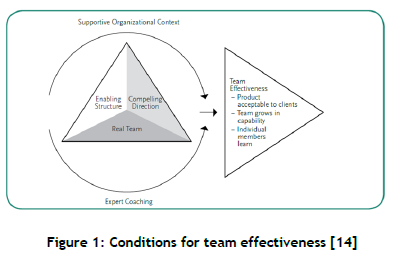
The model in Figure 1 shows that team effectiveness is defined and based on three different criteria [14].
Criterion 1 - Team viability: Product acceptable to clients - the degree to which the service or product meets the standards for quality and quantity for those that review, receive, and use it.
Criterion 2 - Team processes: Team grows in capability - the extent to which the team's internal social processes enhance the ability of the team to work together and become more competent over time.
Criterion 3 - Quality of group experience: Individual members learn - the degree to which the experience of the team satisfies each member's needs and increases each member's satisfaction, development, and well-being.
2.2. Leadership and leadership styles
Leadership plays an important role in bringing about the necessary changes for effective management, and can be conceptualised as a process and as the ability of certain individuals to inspire teams with their vision in order to accomplish a certain goal [27]. Leadership styles have been classified and categorised in a variety of ways, and different styles have been shown to be more effective in different situations. These styles influence the employees' motivation and thriving in the workplace [28]. Organisations can thrive under the leadership of individuals whose style best fits the situation. The environment and organisation culture must be considered to best match the MTM conditions and leadership style.
Each leader has a unique style that characterises their approach to leading in an organisation [29]. These styles have been classified and categorised in the literature in several ways; and each style is effective in different situations. In this research, four leadership style were considered: directive, transformational, transactional, and laissez-faire [30].
Directive leader - A leadership style that clearly sets the defined objectives and rules for team members; it relies on legitimate or coercive power. This leadership style is also called the authoritarian leadership
style.
Transactional leader - A leadership style that relies on reward and punishments in order to achieve the required performance from the followers.
Transformational leader - A leadership style that motivates and inspire followers to innovate and create.
Laissez-faire leadership - A leadership style that is passive and lets followers have liberty in decisionmaking. The name is derived from the French term meaning 'allow to do' [31].
An important perspective is offered by behavioural theories in leadership research. Jago [32] indicated that leadership could be viewed as an observable process and that leaders can be judged on the basis of their behaviour when interacting with their followers or potential followers. The personality traits that influence leadership styles are important, as they ultimately affect team effectiveness [33].
2.3. Relationships between leadership styles and team effectiveness
An effective leadership style is a source of an organisation's competitiveness; teams grow and perform well if the style of leadership is effective [34]. Many styles are used by leaders and in different settings.
2.3.1. Transformational leadership style and team effectiveness
Many studies have indicated that team effectiveness is the result of the motivation and inspiration provided by the leader's transformational leadership [35, 36, 37]. Podsakoff et al. [38] showed that the transformational leader has six core behaviours: vision identification and articulation; implementing appropriate models; encouraging followers to accept team goals; expecting high levels of performance; intellectual stimulation; and individualised staff support. Carless et al. [39] distinguished between behaviours that encourage individual development and those that provide support to staff. Their model described the transformational leader's behaviours as communicating the vision, providing support, empowering staff, developing staff, innovativeness, charisma, and leading by example. These behaviours have a strong impact on team effectiveness according to Paolucci et al. [40]. According to Boies and Howell [41], there is a positive relationship between transformational leadership and team viability, which is the capacity of the team to adapt and cope with changes. Other studies have revealed a positive and direct relationship between innovative work behaviours and transformational leadership [42]. Van Dierendonck [43] also found that transformational leadership is positively related to followers' well-being. As a result, transformational leadership is expected to be positively related to the three criteria for team effectiveness.
2.3.2. Directive leadership style and team effectiveness
Directive leaders expect high standards from their members. Researchers have claimed that the directive leadership style has important and essential benefits for a team's circumstances. It develops and provides clear rules for the team, producing a high level of performance and stimulating team members to develop effective work processes and systems [44, 45, 46]. Nobile [47] suggested that the directive leader shows a strong sense of inner direction and purpose, providing a clear goal for the team. This motivates team members to take actions that supports this leader's strategy for the organisation. Ceri-Booms et al. [46] added that the work commitment and involvement of the team members is increased by a directive leader. The strategies of this leadership behaviour help to gain and distribute knowledge among the team members, thus increasing the team's efficiency [47,48]. Somech [44] and Gelfand et al. [49] found that the motivational factor associated with this leadership style is shown through the willingness of followers to expend more effort on work, leading to goal attainment.
2.3.3. Transactional leadership style and team effectiveness
Judge and Piccolo [50] found a positive relationship between effectiveness and contingent rewards, and showed that contingent rewards are related to followers' motivation. Some studies showed low correlations between management by exception and effectiveness [51]. Hoandra [52] indicated that there is a positive relationship between this leadership style and team performance, because such leaders provide rewards and punishment in order to motivate the team to achieve the agreed targets. Obiwuru et al. [53] showed that the transactional leadership style had a significant and positive relationship with employee performance: leaders of this style displayed both constructive (entails contingent rewards) and corrective (uses management by exception) behaviours.
2.3.4. Laissez-faire leadership style and team effectiveness
Laissez-faire leadership is seen as destructive, as it may be a precursor to interpersonal conflict in the team owing to the creation of frustration and stress by the leader [54]. Once that perception is created, the leader may struggle to motivate the team [31]. Judge and Piccolo [50] also found that this leadership style is negatively associated with employees' motivation. Baucus et al. [55] also note that, when leaders do not take timely action, it affects the effectiveness of the team.
2.4. Multiple team memberships
In many contemporary organisations with knowledge workers, being part of more than one team is the norm rather than the exception [56]. In these circumstances, employees are frequently engaged in multiple projects at the same time in any given period. This is conceptualised as 'multiple team membership' (MTM) [2]. O'Leary et al. [22] proposed a positive relationship between the number of MTMs and teams' productivity, but that this does not occur indefinitely: as the number of teams increases, the relationship becomes negative. With respect to learning, they proposed that MTM tends to have a negative impact on learning because of the variety. This learning can be further undermined in the MTM context by a reduced focus on new information and a reduced time to process and integrate knowledge as the number of teams increases [57].
2.5. Leadership in the MTM context
Participation in MTM is largely a strategic management decision about how human resources are allocated [3]. Furukawa [58] used a case study approach to conclude that the autonomy of team leaders to assign team members across teams that include diversity and stimulation enables team members to broaden their understanding and transactive memory systems to facilitate knowledge integration. Chen et al. [4] demonstrated that empowering leadership in MTM has an independent effect on individuals' empowerment, but that, if the focal team's empowering leadership is high, then the secondary team's empowering leader has less effect. Leaders in an MTM context have a large influence on the implementation of MTM, and their actions cascade across teams. Thus leaders must be able to discern which contexts allow for the potential benefits of MTM, such as instances where there is an opportunity to schedule the team members such that the flow of information is supported and they are able to support this structure actively [57].
3. CONCEPTUAL MODEL
In order to derive a model of team effectiveness, an input-process-output model is proposed. Inputs can be behaviours, attributes, and so on; processes include interaction among team members; and outputs include products yielded by the group [59]. In the proposed model, the main input variable is leadership styles; the processes are the conditions to be met for team effectiveness; [14] and the output is perceptions of team effectiveness. In line with Hackman's team effectiveness model, there are three criteria for team effectiveness. In this study the context of the model is an MTM environment. The model is shown in Figure 2.
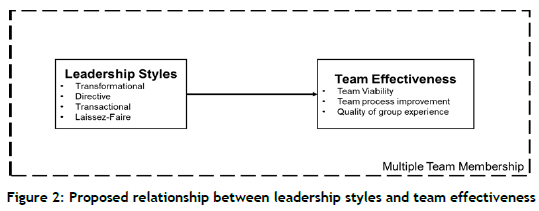
It is predicted that leadership styles a direct impact on team effectiveness. Drawing on the literature review, it could be expected that the directive and laissez-faire leadership styles would have a negative impact on team effectiveness. Laissez-faire leaders would provide less direction and strategic focus for team members; and, with a directive leader, the team would be less likely to be coherent. In contrast, the transactional and transformational leadership styles might be expected to have a positive impact. Transactional leaders might lead to real and cohesive teams through the process of social exchange, while transformational leaders, through continually motivating and inspiring teams, could promote team effectiveness [60]. The following three hypotheses are posited:
Hypothesis 1: The leadership style is expected to have a direct impact on team viability.
Hypothesis 2: The leadership style is expected to have a direct impact on team process improvement.
Hypothesis 3: The leadership style is expected to have a direct impact on the quality of the group experience.
4. RESEARCH METHOD
In this study, the quantitative approach was used in accordance with positivist research, which aims to quantify and measure constructs. The predetermined and structured procedures were used for the data collection that was required to measure the cause-and-effects relationships between the variables [61]. In the quantitative approach, the instrument that was used was questionnaires for collecting data on the concepts presented in the conceptual model.
In order to analyse team effectiveness, the models of Lencioni [62] and of Hackman [14] were used to guide the questions. The overall team effectiveness model was supported by a team effectiveness questionnaire created by Larson and LaFasto [63]. To evaluate the leadership styles, the focus was on leaders' behaviour to simplify the evaluation. The displayed behaviours were measured by the team members, who also evaluated the team's performance.
The research was conducted at one of South Africa's mining organisations, which had various business units as well as clients or business partners who engaged in the MTM context. The study used the teams in place at the mine that were structured for MTM.
4.1. Measurement of variables1
The first part of the questionnaire consisted of the control variables that related to the MTM context. This was to identify eligible participants who met the sample selection criteria. The criteria were: (1) members with more than one project occurring at the same time; (2) the team leader's willingness to encourage staff to participate in the survey; (3) members' tenure in the MTM environment; and (4) the number of projects that a team member had been extensively involved in during the previous six months. Participants who did not meet the above criteria were not able to continue with the rest of the questionnaire.
Once there was a valid outcome from the control variables (i.e., the respondents were in an MTM context) they continued with the rest of the questionnaire, starting with the identification of the leadership styles operating in their teams. In order to identify the leadership style, a multifactor leadership questionnaire (MLQ) [64] was used.
The survey of the teams followed Hackman's team effectiveness survey, which looks at the conditions of team effectiveness (CCTE) [19]. The first dimension looked at team viability, team processes improvement, and the quality of the group experience [19]. This was the group team effectiveness measure.
5. RESULTS
An online based survey was first pre-tested, and then sent to team members working in a context of multiple team memberships in a mining company. They were also asked to forward it to their contacts in the organisation. A total of 70 responses was received, of which 53 had been completed by members of MTMs. The participants were engineers (66.04%), managers (15.1%), accountants (5.66%), and specialists (13.2%).2
5.1. Independent variables
The study had four independent variables: the directive, laissez-faire, transactional, and transformational leadership styles. These leadership styles were assessed as described in the conceptual model in Figure 2. The independent variables were assessed in the context of MTMs, as ensured during the survey. These variables were obtained by providing the respondents with a series of statements and asking them to use a Likert scale to rate their experience.
A reliability test was conducted on the variables to produce Cronbach's alpha. The minimum acceptable level for Cronbach's alpha is 0.6 [65]. Based on the individual style's contribution to the dependent variable, the analysis was done for each leadership style. The results are presented in Table 1, and indicate that the scale was internally consistent and reliable to measure the leadership styles.
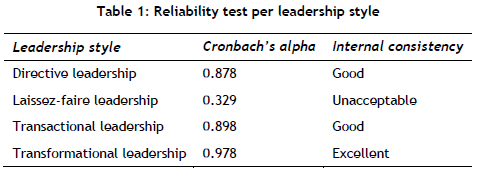
The laissez-faire internal consistency results were poor; the number of elements associated with this leadership style were the lowest in number. The reliability of this variable could not be confirmed. No substantial increases in Cronbach's alpha could be achieved by removing any of the items. Therefore further analysis of the laissez-faire leadership style did not form part of the research results. The descriptive statistics of each leadership style are summarised in Table 2 below.
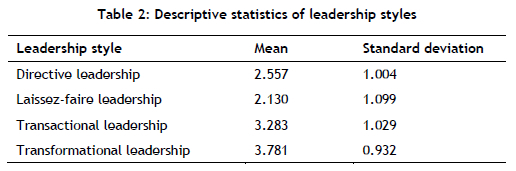
The standard deviation for all items was lower than their means, indicating that the data was clustered around the mean for all the items. Most of the respondents indicated the high presence of transformational leadership in their teams, as the transformational leadership average was 3.78 with a standard deviation of 0.93. On average, all the respondents showed less-than-average results for the directive leadership style, as the directive leadership average was 2.56 with a standard deviation of 1. On average, all the respondents showed a less-than-average result for the laissez-faire leadership style, as the laissez-faire leadership average was 2.13 with a standard deviation of 1.10.
5.2. Dependent variables
The study had three dependent variables: team viability, team processes, and quality of group experience. These team effectiveness measures were assessed as described in the conceptual model in Figure 2. These variables were obtained by providing the respondents with a series of statements and asking them to use a Likert scale to rate their agreement with these statements.
A reliability test was conducted for the team effectiveness measure; the result is shown in Table 3. The result indicated that the scale was internally consistent and reliable to measure team effectiveness. Cronbach's alphas for all items were acceptable.

The descriptive statistics of each of the team effectiveness measures are summarised in Table 4.
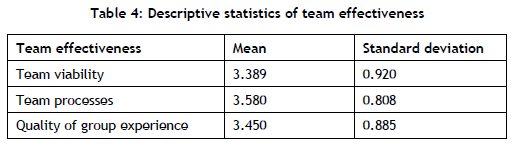
Similarly to the leadership statistics, the standard deviation of all the items was lower than their means, indicating that the data was clustered around the mean for all the items. On average there was a degree of team effectiveness in the different teams to which the respondents belonged, as the overall result was 3.53 and the standard deviation was 0.88. Most of the team effectiveness measure averages were above 3, showing a positive indication of team effectiveness.
5.3. Hypothesis testing
The hypotheses formulated in Figure 2 were investigated using correlation analysis and multiple regression analysis.
5.3.1. Correlation analysis
Table 5 below shows the results of the correlation analysis of the key variables in the study. From the results in Table 5 it should be noted that directive leadership had a significant and negative moderate relationship with team viability (r = -0.303; p<0.05). The transactional leadership style had a significant and positive relationship with all the variables relating to team effectiveness: team viability (r = 0.503; p<0.01); team process (r = 0.378; p<0.01); and quality of group experience (r = 0.502; p<0.01). The transformational leadership style had a significant and positive relationship with all the variables relating to team effectiveness: team viability (r = 0.419; p<0.01); team process (r = 0.567; p<0.01 ); and quality of group experience (r = 0.565; p<0.01). There was no significant relationship between the dependent variables with the variable number of the MTM on the one hand, and experience in MTM on the other.
5.3.2. Multiple linear regression analysis
A multiple linear regression analysis was performed on the three dependent variables in this team effectiveness study: team viability, team processes, and quality of group experience. Tables 6 to 8 present the results of the multiple regression analysis for team viability, team processes, and quality of group experience respectively as dependent variables.
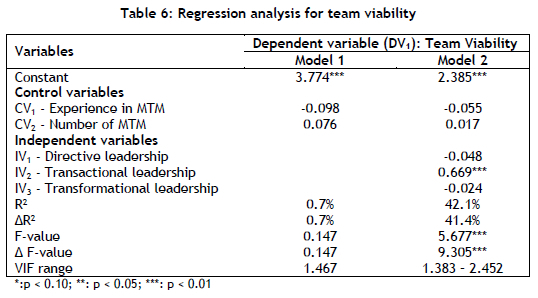
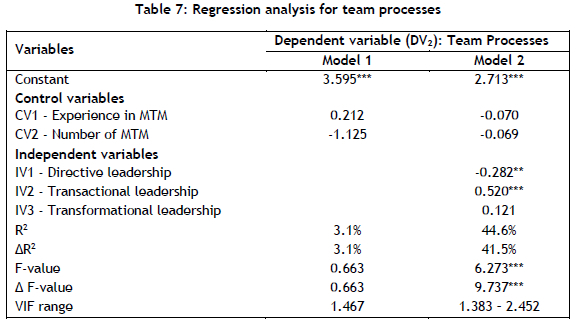
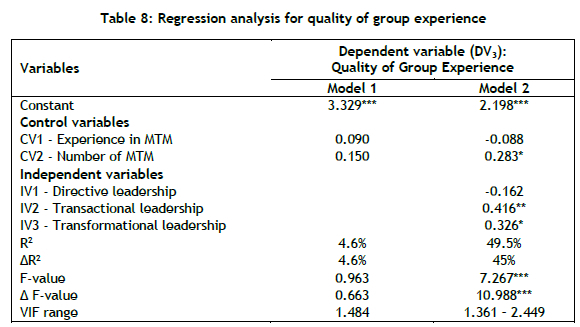
Model 1 analysed the direct linear relationship between:
• The control variables (CV): experience in MTM (CV1) and number of MTM (CV2); and
• The dependent variables (DV): team viability (DV1), team processing (DV2), and quality of group experience (DV3).

Model 2 analysed the direct and linear relationship between:
• The independent variables (IV): directive leadership (IV1), transactional leadership (IV2), and transformational leadership (IV3); and
• The dependent variables (DV): team viability (DV1), team processing (DV2), and quality of group experience (DV3).

The laissez-faire leadership variable was not added to Model 2 because of the unacceptable reliability test.
From Table 6, Model 1 displayed the results of the analysis of the control variables. The control variables accounted for 0.7% of the variance in team viability. None of these variables had a significant impact on team viability. Model 2 assessed the additional impacts of the leadership styles. The model was highly significant (F-value = 5.677; p<0.01), with the additional variables accounting for 41.4% of the variance in team viability. The ΔR2 was also significant (F-value = 9.305; p<0.01), indicating that the variance was a result of transactional leadership. Transactional leadership had a significant and positive impact on team viability (6 = 0.669; p<0.01). There was no significant impact of transformational leadership and directive leadership on team viability.
Based on Table 7, Model 1 displayed the results from the analysis of the control variables. The control variables accounted for 3.1% of the variance in the team processes. Again, none of the control variables was significant. Model 2 assessed the additional impact of the leadership styles. The model was highly significant (F-value = 6.273; p<0.01), with the additional variables accounting for 41.5% of the variance in the team processes. The ΔR2 was also significant (F-value = 9.737; p<0.01), indicating that the variance was a result of the leadership styles. Transactional leadership still showed a significant and positive impact on team processes (6 = 0.520; p<0.01), while directive leadership showed a significant and negative impact on team processes (6 = -0.282; p<0.05). There is no significant impact of transformational leadership on the team processes.
From Table 8, Model 1 displayed the results from the analysis of the control variables. The data showed a significant and constant value = 3.329; p<0.01 ). The control variables accounted for 4.6% of the variance in the quality of group experience. Model 2 assessed the additional impact of the leadership styles. The model was very significant (F-value = 7.267; p<0.01), with the additional variables accounting for 45% of the variance in the quality of the group experience. The ΔR2 was also significant, indicating that the variance was a result of leadership. The transactional and transformational leadership styles showed a significant and positive impact on the quality of the group experience (6 = 0.416; p<0.01; and 6 = 0.326; p<0.1 respectively). The number of MTM also showed a significant and positive impact on the quality of the group experience (6 = 0.283; p<0.1). There was no significant impact of directive leadership on the quality of the group experience.
5.4. Discussion of results
The study was concerned with investigating the effects of leadership styles on team effectiveness. The conceptual model showed a direct relationship between leadership styles and team effectiveness. The transactional and transformational leadership styles were hypothesised to have a positive relationship with team effectiveness, while the directive and laissez-faire leadership styles were hypothesised to have a negative relationship with team effectiveness.
Figure 3 summarises the results of the study. H1c, H2b, H2c, H3a and H3c were supported by the study, whereas H1a, H1b, H2a, H3b were rejected by the study. The transactional leadership style was found to be positively related to the three criteria for team effectiveness: team viability, team processes, and quality of group experience. The transformational leadership style's results had a positive and significant relationship with only one variable, team effectiveness. The directive leadership results supported the hypothesis that this leadership style had a negative impact on team processes. There was no significant relationship to be noted for the laissez-faire leadership style, as the analysis failed the reliability test. Experience and the number of MTM were found to have no correlation with team effectiveness. However, the number of MTM had a positive impact when the transactional and transformational leadership styles were introduced.
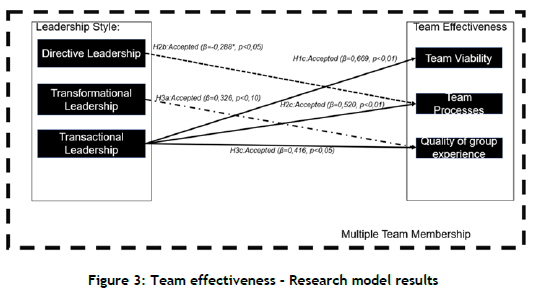
5.4.1. Transformational leadership and team effectiveness
Hypotheses 1a and 2a predicted that transformational leadership was positively related to team effectiveness; but when tested it showed an unexpected lack of relationship. Tourish [66] argued that transformational leadership has two sides, "the bright side and the dark side". Eisenberg et al. [67] showed through their empirical study of 53 innovation teams that there were unexpected negative effects of transformational leadership on team performance when teams were geographically dispersed. Their study showed that this type of leadership style was less effective because the leader was ineffective in establishing personal relationships with the team members. It also indicated that, if communication was reduced, this leadership style would not be implemented well. Different researchers have indicated that, under certain conditions, transformational leadership may be difficult in its associated benefits.
Hypothesis 3a was supported in this study: there was a significant and positive relationship with the quality of group experience (6 = 0.462, p<0.05). This was consistent with Flood et al. [59], who also found that transformational leadership had a substantial influence on team effectiveness. Several earlier studies had also shown that transformational leadership had a significant and positive impact on team effectiveness. The finding of this research agrees with Paoluccia et al. [40], who also reported a strong relationship between transformational leadership and quality of group experience.
5.4.2. Directive leadership and team effectiveness
Hypotheses 1b, 2b, and 3b, which suggested that directive leadership was negatively related to team effectiveness, were supported in this study. This was consistent with the study of Flood et al. [59], who reported that directive leaders might reduce collaboration among the team and so reduce the co-operative behaviour required for team effectiveness. The correlation analysis results showed an insignificant correlation between this leadership style and team effectiveness. The expected relationship was not achieved, which could be explained in two ways. First, this leadership style works best in times of crisis [68], which might not have been the case during the survey. Second, past studies have produced mixed findings. For example, Flood et al. [59] found a negative relationship for executive teams reporting to CEOs; but this was inconsistent with studies by Ceri-Booms et al. [46] and Nobile [47], who indicated that the work commitment and involvement of team members was increased by a directive leader. A further investigation of the domains in which this leadership style could have a positive or a negative impact on team effectiveness would be needed. The context of this study of MTM should also be considered, as it adds a dimension that studies have lacked. More data would be required to understand the effects of this leadership style in the MTM context.
5.4.3. Transactional leadership and team effectiveness
The findings of this study supported Hypotheses 1c, 2c, and 3c, showing a significant and positive impact of transactional leadership on team effectiveness in comparison with the other leadership styles. This finding was in line with those of other studies. Bromley [52] and Obiwuru et al. [53] indicated that there was a strong relationship between this leadership style and team performance. This could be attributed to the contingent reward that is expected by team members when the team is effective. Judge and Piccolo [50] found that the contingent reward was related to follower motivation, while a study by Bezuidenhout et al. [69] indicated that transactional leadership was prevalent in a mining organisation, and that it motivated employees through incentives.
6. CONCLUSION AND RECOMMENDATIONS
This research's main goal was to evaluate the impact that leadership styles have on team effectiveness in the context of MTM. The four leadership styles that were assessed were directive, transactional, transformational, and laissez-faire. Team effectiveness was assessed on the basis of the team effectiveness criteria proposed by Hackman [14].
It was hypothesised that the leadership styles would have direct relationships with team effectiveness. The conceptual model was created for the context of MTM. The transactional and transformational leadership styles were hypothesised to have a positive relationship with team effectiveness, while the laissez-faire and directive leadership styles were hypothesised to have a negative relationship with team effectiveness. The hypotheses were tested using correlation and multiple regression analysis.
Transactional leadership was found to be positively related to team effectiveness. This result confirmed the literature about leadership styles that promote team effectiveness. The results for a directive leadership style supported the hypothesis that this leadership style did not have a positive impact on team processes. No significant relationship was noted for the laissez-faire leadership style, as that variable failed the reliability test. Experience of MTM and the number of MTMs were found to have no correlation with team effectiveness.
This paper studied the effect of leadership styles on team effectiveness in the context of MTM. Organisations should endeavour to find tools that would encourage the desired leadership style to ensure team effectiveness in an MTM context.
This research was conducted primarily with teams in a mining company. Future research could broaden the types of team to include organisations with a majority of knowledge workers in order to understand team leaders and their interactions with teams better. Complexity and uncertainty in different organisations might produce different outcomes from those of this study. Moreover, different MTM situations could require certain skills for both the team leader and the members [70]. Thus an enlargement of this study would be desirable.
Self-reporting questionnaires were used as a method of investigation in this study. Future research could consider using other methods to measure team effectiveness objectively, such as case studies, with which team effectiveness could be qualitatively measured without the risk of under- or overstating certain variables.
REFERENCES
[1] J. E. Mathieu, J. R. Hollenbeck, D. van Knippenberg, and D. R. Ilgen, "A century of work teams in the Journal of Applied Psychology," Journal of Applied Psychology, vol. 102, no. 3, pp. 452-467, 2017. [ Links ]
[2] M. B. O'Leary, M. Mortensen, and A. W. Woolley, "Multiple team membership: A theoretical model of its effects on productivity and learning for individuals and teams," The Academy of Management Review, vol. 36, no. 3, pp. 461-478, 2011. [ Links ]
[3] J. Margolis, "Multiple team membership: An integrative review," Small Group Research, vol. 51, no. 1, pp. 48-86, 2020. [ Links ]
[4] G. Chen, T. A. Smith, B. L. Kirkman, P. Zhang, G. J. Lemoine, and J. L. Farh, "Multiple team membership and empowerment spillover effects: Can empowerment processes cross team boundaries?" The Journal of Applied Psychology, vol. 104, no. 3, pp. 321-340, 2019. [ Links ]
[5] C. Manhas, and A. Bakhshi, "Relating occupational self efficacy to team effectiveness," European Journal of Business & Management, vol. 3, no. 2, pp. 165-172, 2011. [ Links ]
[6] T. C. Lacerda, "Crisis leadership in economic recession: A three-barrier approach to offset external constraints," Business Horizons, vol. 62, no. 2, pp. 185-197, 2019. [ Links ]
[7] K. Bell, G. Dyer, C. Hoopes, and S. Harris, "Toward a model of effective knowledge management and directions for future research: Culture, leadership, and CKOs," Journal of Leadership and Organization Studies, vol. 10, no. 4, pp. 26-43, 2004. [ Links ]
[8] I. C. Makaske, "The effect of leadership behavior on work climate and team effectiveness," Bachelor's thesis, University of Twente, 2015. [ Links ]
[9] R. House, M. Javidan, P. Hanges, and P. Dorfman, "Understanding cultures and implicit leadership theories across the globe: An introduction to project GLOBE," Journal of World Business, vol. 37, pp. 3-10, 2002. [ Links ]
[10] L. T. Lu, and Y. H. Lee, "The effect of culture on the management style and performance of international joint ventures in China: The perspective of foreign parent firms," International Journal of Management, vol. 22, no. 3, pp. 452-462, 2005. [ Links ]
[11] B. Bass, "Does the transactional-transformational leadership paradigm transcend organisational and national boundaries?" American Psychologist, vol. 52, pp. 130-139, 1997. [ Links ]
[12] J. French, W. Morrison, and G. Leoinger, "Coercive power and forces affecting conformity," Journal of Abnormal and Social Psychology, vol. 61, pp. 93-101, 1960. [ Links ]
[13] D. L. Kirmeyer, and T. Lin, "Social support: Its relationship to observed communication with peers and supervisors," Academy of Management Journal, vol. 30, pp. 138-151, 1987. [ Links ]
[14] J. R. Hackman, Leading teams: Setting the stage for great performances, Harvard Business Press, 2002. [ Links ]
[15] J. E. Mathieu, M. T. Maynard, T. Rapp, and L. Gilson, "leam effectiveness 1997-2007: A review of recent advancements and a glimpse into the future," Journal of Management, vol. 34, no. 3, pp. 410-476, 2008. [ Links ]
[16] R. Arora, S. Gajendragadkar, and N. Neelam, "Team effectiveness: A key to success in 'IT organizations'," Australasian Accounting, Business and Finance Journal, vol. 17, no. 1, pp. 97-110, 2023. [ Links ]
[17] E. D. Sundstrom, Supporting work team effectiveness: Best management practices for fostering high performance, Jossey-Bass, 1990. [ Links ]
[18] G. S. van der Vegt, and J. S. Bunderson, "Learning and performance in multidisciplinary teams: The importance of collective team identification," Academy of Management Journal, vol. 48, no. 3, pp. 532-547, 2005. [ Links ]
[19] K. J. Cavanaugh, J. M. Logan, S. A. Zajac, and C. L. Holladay, "Core conditions of team effectiveness: Development of a survey measuring Hackman's framework," Journal of Interprofessional Care, vol. 35, no. 6, pp. 914-919, 2021. [ Links ]
[20] A. Bandura, Self-efficacy: The exercise of control, W.H. Freeman, 1997. [ Links ]
[21] S. Sathasivam, "Multiple team membership: The effect of leadership styles on team performance," Master's thesis, Tilburg University, 2016. [ Links ]
[22] N. Azmy, "The role of team effectiveness in construction project teams and project performance," PhD thesis, Iowa State University, 2012. [ Links ]
[23] J. E. Mathieu, and L. Gilson, "Criteria issues and team effectiveness," in The Oxford handbook of organizational psychology, S. W. J. Kozlowski (Ed.), MIT Press, 2012, pp. 910-930. [ Links ]
[24] S. W. J. Kozlowski, and B. S. Bell, "Work groups and teams in organizations," in Handbook of psychology: Industrial and organizational psychology, 12, W. C. Borman, D. R. Ilgen, and R. Klimoski (Eds.), Wiley, 2003, pp. 333-375. [ Links ]
[25] D. J. Beal, R. R. Cohen, M. J. Burke, and C. L. McLendon, "Cohesion and performance in groups: A meta-analytic clarification of construct relations," The Journal of Applied Psychology, vol. 88, no. 6, pp. 989-1004, 2003. [ Links ]
[26] J. E. McGrath, Leadership behavior: Some requirements for leadership training. US Civil Service Commission, Office of Career Development, 1962. [ Links ]
[27] R. Andriukaitiené, V. Voronkova, O. Kyvliuk, M. Maksimenyuk, and A. Sakun, "Theoretical insights into expression of leadership competencies in the process of management," Problems and Perspectives in Management, vol. 15, no. 1, pp. 220-226, 2017. [ Links ]
[28] M. Arshad, G. Abid, and F. V. C. Torres, "Impact of prosocial motivation on organizational citizenship behavior: The mediating role of ethical leadership and leader-member exchange," Quality & Quantity, vol. 55, no. 1, pp. 133-150, 2020. [ Links ]
[29] M. R. Bowers, J. R. Hall, and M. M. Srinivasan, "Organizational culture and leadership style: The missing combination for selecting the right leader for effective crisis management," Business Horizons, vol. 60, no. 4, pp. 551-563, 2017. [ Links ]
[30] J. M. Burns, Leadership, Harper & Row, 1978. [ Links ]
[31] A. H. Eagly, M. C. Johannesen-Schmidt, and M. L. van Engen, "Transformational, transactional, and laissez-faire leadership styles: A meta-analysis comparing women and men," Psychological Bulletin, vol. 129, no. 4, pp. 569-591, 2003. [ Links ]
[32] A.G. Jago, "Leadership: Perspectives in theory and research," Management Science, vol. 28, no. 3, pp. 315-336, 1982. [ Links ]
[33] B. de Raad, The big five personality factors: The psychological approach to personality, Hogrefe & Huber Publishers, 2000. [ Links ]
[34] D. Skansi, "Relation of managerial efficiency and leadership styles: Empirical study in Hrvatska Elektroprivreda d.d. management," Journal of Contemporary Management, vol. 5, no. 2, pp. 51-67, 2000. [ Links ]
[35] C. Niessen, I. Mader, C. Stride, and N. L. Jimmieson, "Thriving when exhausted: The role of perceived transformational leadership," Journal of Vocational Behavior, vol. 103, pp. 41-51, 2017. [ Links ]
[36] A. Mortier, P. Vlerick, and E. Clays, "Authentic leadership and thriving among nurses: The mediating role of empathy," Journal of Nursing Management, vol. 24, no. 3, pp. 357-365, 2016. [ Links ]
[37] C. O. Joe-Akunne, E. I. Stephen, and C. I. Nnaebue, "Leader-member exchange and transformational leadership style: A prediction to thriving at work," Asian Journal of Advanced Research and Reports, vol. 12, no. 3, pp. 37-43, 2020. [ Links ]
[38] P. M. Podsakoff, S. B. MacKenzie, R. H. Moorman, and R. Fetter, "Transformational leader behaviors and their effects on followers' trust in leader, satisfaction, and organizational citizenship behaviors," The Leadership Quarterly, vol. 1, no. 2, pp. 107-142, 1990. [ Links ]
[39] S. A. Carless, A. J. Wearing, and L. Mann, "A short measure of transformational leadership," Journal of Business and Psychology, vol. 14, pp. 389-405, 2000. [ Links ]
[40] N. Paolucci, I. D. Dimas, S. Zappalà, P. R. Lourenço, and T. Rebelo, "Transformational leadership and team effectiveness: The mediating role of affective team commitment," Journal of Work and Organizational Psychology, vol. 34, no. 3, pp. 135-144, 2018. [ Links ]
[41] K. P. D. Boies, and J. M. Howell, "Leading military teams to think and feel: Exploring the relations between leadership, soldiers' cognitive and affective processes, and team effectiveness," Military Psychology, vol. 21, no. 2, pp. 216-232, 2009. [ Links ]
[42] M. Reuvers, M. L. van Engen, C. J. Vinkenburg, and E. Wilson-Evered, "Transformational leadership and innovative work behaviour: Exploring the relevance of gender differences," Creativity and Innovation Management, vol. 17, no. 3, pp. 227-244, 2008. [ Links ]
[43] D. van Dierendonck, C. Haynes, C. Borrill, and C. Stride, "Leadership behavior and subordinate well-being," Journal of Occupational Health Psychology, vol. 9, no. 2, pp. 165-175, 2004. [ Links ]
[44] A. Somech, "The effects of leadership style and team process on performance and innovation in functionally heterogeneous teams," Journal of Management, vol. 32, no. 1, pp. 132-157, 2006. [ Links ]
[45] A. Sagie, N. Zaidman, Y. Amichai-Hamburger, D. Te'eni, and S. Schwartz, "An empirical assessment of the loose-tight leadership model: Quantitative and qualitative analyses," The International Journal of Industrial, Occupational and Organizational Psychology and Behavior, vol. 23, no. 3, pp. 303-320, 2002. [ Links ]
[46] M. Ceri-Booms, P. L. Cureu, and L. A. G. Oerlemans, "Task and person-focused leadership behaviours and team performance: A meta-analysis," Human Resources Management Review, vol. 27, no. 1, pp. 178-192, 2017. [ Links ]
[47] J. De Nobile, "The directive communication of Australian primary school principals," International Journal Leader in Education, vol. 18, no. 2, pp. 239-258, 2015. [ Links ]
[48] C. S. Burke, K. C. Stagl, C. Klein, G. F. Goodwin, and E. Salas, "What type of leadership behaviours are functional in teams? A meta-analysis," The Leadership Quarterly, vol. 17, pp. 288-307, 2006. [ Links ]
[49] M. J. Gelfand, M. Erez, and Z. Aycan, "Cross-cultural organizational behavior," Annual Review of Psychology, vol. 58, pp. 479-514, 2007. [ Links ]
[50] T. A. Judge, and R. F. Piccolo, "Transformational and transactional leadership: A meta-analytic test of their relative validity," Journal of Applied Psychology, vol. 89, no. 5, pp. 755-768, 2004. [ Links ]
[51] K. B. Lowe, K. G. Kroeck, and N. Sivasubramaniam, "Effectiveness correlates of transformational and transactional leadership: A meta-analytic review of the MLQ literature," The Leadership Quarterly, vol. 7, no. 3, pp. 385-425, 1996. [ Links ]
[52] M. G. Hoandra, "The mediating role of task conflict and cross-understanding in the relation between transactional leadership and team adaptive performance," Psihologia Resurselor Umane, vol. 15, no. 1, pp. 56-69, 2017. [ Links ]
[53] T. C. Obiwuru, A. T. Okwu, V. O. Akpa, and I. A. Nwankwere, "Effects of leadership style on organizational performance: A survey of selected small scale enterprises in Ikosi-Ketu council development area of Lagos State, Nigeria," Australian Journal of Business and Management Research, vol. 1, no. 7, pp. 100-111, 2011. [ Links ]
[54] A. Skogstad, S. Einarsen, T. Torsheim, M. S. Aasland, and H. Hetland, "The destructiveness of laissez-faire leadership behavior," Journal of Occupational Health Psychology, vol. 12, no. 1, pp. 80-92, 2007. [ Links ]
[55] M. S. Baucus, and C. L. Beck-Dudley, "Designing ethical organizations: Avoiding the long-term negative effects of rewards and punishments," Journal of Business Ethics, vol. 56, no. 4, pp. 355370, 2005. [ Links ]
[56] H. J. van de Brake, F. Walter, F. A. Rink, P. J. M. D. Essens, and G. S. van der Vegt, "The dynamic relationship between multiple team membership and individual job performance in knowledge-intensive work," Journal of Organizational Behavior, vol. 39, no. 9, pp. 1219-1231, 2018. [ Links ]
[57] E. R. Crawford, C. J. Reeves, G. L. Stewart, and S. L. Astrove, "To link or not to link? Multiple team membership and unit performance," Journal of Applied Psychology, vol. 104, no. 3, pp. 341-365, 2019. [ Links ]
[58] C. Furukawa, "Dynamics of a critical problem-solving project team and creativity in a multiple-project environment," Team Performance Management, vol. 22, no. 1/2, pp. 92-110, 2016. [ Links ]
[59] R.A. Guzzo, and G.P. Shea, "Group performance and intergroup relations in organizations," in Handbook of industrial and organisational psychology, 2nd ed., vol. 3, L. Hough and M. D. Dunnette (Eds.), Consulting Psychologists Press, 1992, pp. 269-313. [ Links ]
[60] P. C. Flood, E. Hannan, K. G. Smith, T. Turner, M. A. West, and J. Dawson, "Chief executive leadership style, consensus decision making, and top management team effectiveness," European Journal of Work and Organizational Psychology, vol. 9, no. 3, pp. 401-420, 2000. [ Links ]
[61] M. Saunders, P. Lewis, and A. Thornhill, Research methods for business students, 7th ed., Pearson Education, 2015. [ Links ]
[62] P. Lencioni, The five dysfunctions of a team: A leadership fable. Jossey-Bass, 2002. [ Links ]
[63] C. E. Larson, and F. M. J. LaFasto, "The team effectiveness questionnaire," in Leadership: Theory and practice, 2nd ed., P. G. Northouse (Ed.), SAGE, pp. 184-185, 2001. [ Links ]
[64] B. M. Bass, and B. J. Avolio, Multifactor leadership questionnaire, Mind Garden, 2000. [ Links ]
[65] J. F. Hair, Multivariate data analysis, 8th ed., Pearson Education, 2018. [ Links ]
[66] D. Tourish, The dark side of transformational leadership: A critical perspective. Routledge, 2013. [ Links ]
[67] J. Eisenberg, C. Post, and N. DiTomaso, "Team dispersion and performance: The role of team communication and transformational leadership," Small Group Research, vol. 50, no. 3, pp. 348380, 2019. [ Links ]
[68] G. A. Yukl, Leadership in organizations, 8th ed., Prentice Hall, 2012. [ Links ]
[69] A. Bezuidenhout, E. Mclaggan, and C. T. Botha, "Leadership style and organisational commitment in the mining industry in Mpumalanga," South African Journal of Human Resource Management, vol. 11, no. 1, pp. 1-9, 2013. [ Links ]
[70] K.-Y. Chan, "Multiple project team membership and performance: Empirical evidence from engineering project team," South African Journal of Economic and Management Sciences, vol. 17, no. 1, pp. 76-90, 2014. [ Links ]
Available online 29 Nov 2024
* Corresponding author: alice.chan@up.ac.za
ORCID® identifiers
N.B. Mntambo: https://orcid.org/0009-0008-2051-4603
K.-Y. Chan: https://orcid.org/0000-0001-5809-5215
1 The measurements for each variable can be obtained from the authors.
2 Ethics clearance was obtained from the University of Pretoria (protocol number EBIT/162/2023) prior to the data collection.

