




Services on Demand
Journal

Article
 English (pdf)
 Article in xml format
 Article references
 Automatic translation
 Send this article by e-mail
Indicators
Related links
-
 Cited by Google
 -
 Similars in Google
Share

 Permalink
Scientia Militaria: South African Journal of Military Studies
On-line version ISSN 2224-0020Print version ISSN 1022-8136
SM vol.52 n.3 Cape Town 2024
https://doi.org/10.5787/52-3-1485
ARTICLES
Illegal Fishing and Maritime Security: Historical and Contemporary Challenges in Namibia
Richard Obinna Iroanya; Charlene Bwiza Simataa
School of Military Science, Department of Military Studies, University of Namibia, Windhoek, Namibia
ABSTRACT
The study on which this article reports argued that illegal fishing activities in the Namibian territorial waters and exclusive economic zones have implications for maritime security. The study traced the problem of illegal fishing in the country back to colonial times and linked it directly to foreign vessels. The intrusion of foreign vessels into Namibian waters received little interest - or if at all - in terms of the protection of ocean resources by the colonial administration coupled with a lack of regulatory frameworks. It was noted that the pattern of illegal fishing established during colonial times has continued into the present with several consequences. Illegal fishing affects maritime security in Namibia in five main dimensions, namely projection of military power at sea, protection of the marine environment, economic growth, development, and human security. These dimensions of maritime security are integrally linked and mutually reinforcing. It was thus shown that the limitation of sea patrols by the Namibian Navy and the Ministry of Fisheries and Marine Resources due to financial constraints caused by illegal fishing activities has a negative influence on the marine environment in terms of destruction and depletion of fish resources. Depletion of fish stocks results in loss of revenue and loss of jobs for coastal community dwellers. Combating illegal fishing is necessary if the marine resources are to be protected and make a significant contribution to the Namibian state. To combat the challenge of illegal fishing, improvement and strengthening of existing mechanisms, international collaboration, cooperation, and coordination between maritime security agencies, and continued engagement with neighbouring states were considered necessary.
Keywords: EEZ, Fisheries, Illegal Fishing, Maritime Security, Namibia
Introduction
The vast Namibian territorial waters and exclusive economic zone (EEZ) have historically attracted foreign vessels that operate legally and, in some cases, illegally in the area. Historical records show that fishing vessels from Europe, Asia, and Central America dominated the Namibian fisheries sector during colonial times (Sumaila & Vasconcellos, 2000). Patterns of illegal fishing established during colonial times have however continued into the present with serious consequences. The reasons for the presence of foreign vessels in Namibian territorial waters and EEZ are not far-fetched. Namibia is synonymous with rich marine biodiversity and a booming fishing industry. Its geostrategic location along the flow path of the Benguela Current makes its marine ecosystem abundantly rich in diverse fish species (Sell et al., 2024). These natural endowments are unique in many respects but have negative and positive implications for the Namibian state. The positivity of these natural endowments comes from a thriving fishing industry while the negativity manifests in the form of attraction to illegalities, especially illegal unreported and unregulated (IUU) fishing. The 2001 International Plan of Action to Prevent, Deter and Eliminate Illegal, Unreported, and Unregulated Fishing (IPOA-IUU) defines IUU fishing as vessels from member states violating regulations by fishing in the waters of another country without authorisation or on the high seas without a flag (Green & Rudyk, 2020; Miller & Sumaila, 2016). The occurrence of these fishing activities within the territorial waters and EEZ of Namibia is widespread (Mbathera, 2022; Ministry of Fisheries and Marine Resources [MFMR], 2021).
Interestingly, illegal fishing is carried out by vessels of countries that are parties to fisheries organisation; yet, they operate in violation of the rules of the organisation (MFMR, 2021; Shigwedha, 2022). These illegal fishing vessels operate in most cases without permission, or on the high seas without flying a flag or showing other markings (Green & Rudyk, 2020; Miller & Sumaila, 2016). Illegal fishing operations also entail situations in which bycatches are not reported to relevant authorities by fishing vessels or flag states, irrespective of whether they belong to fisheries organisation or not (Tessnow-Von Wysocki, Belhabib & Le Billon, 2022). Unreported catches encompass failure to report illegal activities, misreporting, and underreporting of catches. As Mickiewicz, Wolos and Trella (2020) indicate, IUU fishing leads to the non-achievement of management goals and the sustainability of fisheries. Falling under this category would also be corruptly awarded fishing quotas to foreign fishing companies without following due processes, which tends to result in overfishing ofNamibian maritime waters (Coetzee, 2021; Grynberg, Immanuel & Amupadhi, 2023; Warikandwa, 2023).
The extent of occurrence, probability of occurrence, and historical antecedents thus make illegal fisheries activities a significant threat to Namibian maritime security. It has been shown by Chiripanhura and Teweldemedhin (2016) as well as Sumaila (2000) that the fisheries sector has the potential to make more significant contributions to the Namibian economy and workforce than it currently does. This will only be possible if recurrent illegal fisheries activities in Namibian territorial waters and EEZ are prevented effectively, allowing for an increase in fish stocks and revenue generation to the Namibian fisheries industry and government (Campling et al., 2024; Neethling & Goedhals-Gerber, 2023). A steady decline in fish stocks however contributes to the worsening of food security problems in Namibia (Kainge et al., 2020; Ye, Ndiaye & Al-Husaini, 2024).
The severity of illegal fishing activities and the foreseeable potential of the fisheries sector for the Namibian economy, politics, and society are the motivating factors behind this qualitative study. The study utilised a systematic review to explore the challenge of illegal fishing in the territorial waters and EEZ of Namibia to show the consequences of such fishing for maritime security. Maritime security implies a wide range of issues within the maritime space - ocean, sea, territorial waters, rivers, and ports - which have a significant bearing on the national and human security of a country as well as its marine ecosystem. Among other things, maritime security relates to the prevention and combating of unlawful activities, such as illegal, unreported, and unregulated fishing, smuggling, transloading, bunkering, trafficking of narcotic drugs, and piracy in the territorial waters and EEZ of a country by national and international criminal syndicates (see Okafor-Yarwood, 2020). Illegal fisheries activities constitute a violation of Namibian maritime space and therefore a direct threat to its maritime security.
This discussion is subdivided into six sections, starting with the introduction. In the second section, a detailed explanation of the methods used to gather materials for the study is provided. The third section provides a discussion of illegal fishing in Namibian waters from a historical perspective. This entails tracing the problem of illegal fishing in Namibian waters from colonial times and providing reasons why the problem has persisted, as well as its consequences for the marine ecosystem and security. The fourth section focuses on post-independence efforts aimed at monitoring, controlling, and protecting the Namibian maritime space. The discussion then considers the link between illegal fishing, and maritime security is addressed in the fifth section. This fifth section entails looking at the main domains of maritime security and identifying domains that are mostly affected by illegal fishing activities in the country. The discussion is concluded in the sixth section, where the main challenges to combating illegal fishing in the territorial waters and EEZ of Namibia are highlighted, and recommendations are made on ways to deal with the problem. In addressing the problem of illegal fishing and its impact on maritime security, the criticality of international and regional co-operation, coordination, and collaboration are emphasised.
Methodology
Relying strongly on a systematic literature review, the study on which this article reports, examined the challenge of illegal fishing and maritime security in Namibia, bringing the historical antecedents and contemporary manifestations to the fore. The choice of systematic literature as a method of inquiry was informed by two main reasons. Firstly, data on critical issues about the fisheries sector, such as fish stocks, are often old and, in some cases, incomplete because surveys are not carried out regularly. Secondly, much has been written about the fisheries sector in Namibia, making data available for meta-analysis of a recurrent problem. The review therefore focused on published materials by national and international fisheries organisations as well as academic journal articles by seasoned scholars in the field of fisheries, marine resources, and maritime security.
Moreover, annual reports by the MFMR and Namibian government policies on fisheries, marine, and maritime resources were extensively consulted. Relevant newspaper articles dealing with issues about the fisheries sector as well as new items on the industry were equally relied upon in providing an analysis. A search was undertaken for materials dating back to colonial times since the approach of the article was historical. Particular attention was paid to information relating to illegal fisheries activities and their implications for the economy, the marine ecosystem, and maritime security. While the search returned many published materials on illegal fisheries and maritime security, efforts were made to sort out diligently the most relevant using the following key words and phrases:
"maritime security"; "maritime security implications"; IUU; "illegal, unregulated, and unreported"; "history of IUU"; "illegal fisheries"; "environmental implications"; "social implications", "Namibia".
The search was carried out in academic journals (SCOPUS and Google Scholar indexed); non-academic publications, such as MFMR annual reports; speeches; newsletters; reports of international fisheries organisations; and local newspaper reports.
The returned academic journals sources (n = 751); non-academic sources returned (n = 30) materials and newspaper sources comprising news items and articles returned (n = 50); bringing the number of materials screened to n = 831. The titles of selected materials were screened for relevance to the subject of the study, and some materials were excluded (n = 501). Selected materials were sought for retrieval (n = 330), but not all were retrieved (n = 245); therefore, the material comprised selected materials retrieved and that were relevant (n = 85), and selected and retrieved material not meeting set criteria for inclusion (n = 34). These materials were excluded for being too old in terms of data; were draft government reports; or were opinion pieces that did not specifically address maritime security and illegal fisheries activities in Namibia. Selected materials retrieved (n = 51) were assessed for relevance. The final 51 sources considered relevant to the study were thoroughly examined to ensure that they -
• Addressed the issue of illegal fisheries activities;
• Referred to maritime security in Namibia; and
• Referred to implications of illegal fisheries for economic, social, and environmental well-being.
Historical Context of Illegal Fishing in Namibian Waters
The Namibian colonial experience was unique. The country was colonised by two different countries at different times in its political and economic history. Firstly, Namibia (formerly South West Africa) was colonised by Germany between 1884 and 1914. From 1914, the country was occupied by South African armed forces following the defeat of the German colonial army during World War I (1914-1918). Namibia then officially became a mandate territory of the League of Nations under the direct administration of the Union of South Africa with certain conditions until 1990. The unique colonial experience of Namibia is widely reflected in the domination of its economy by foreign investments, especially South African and European businesses (Gammage, 2017). The pattern of foreign investment was such that foreign companies made considerable profits from their investments in the country to the detriment of the well-being of Namibian citizens and the Namibian national economy. The domination of the Namibian economy by foreign interests - both in the past and in the present - is exemplified by the fishing industry. This sector of the Namibian economy is now controlled by Namibians (Carver, 2020).
To this end, Sumaila and Vasconcellos (2000) posit that Spanish fishing vessels and those of the defunct Soviet Union were among the first to arrive and harvest marine resources in Namibian waters. Importantly, these vessels arrived in Namibian waters around 1964 (Sumaila & Vasconcellos, 2000). They were followed by fishing vessels from Japan, Bulgaria, and Israel in 1965. Vessels from countries, such as Belgium and Germany, appeared in 1966, and those from France were noticed in Namibian waters around 1967. Not to be left out in the scramble for Namibian marine resources, Cuban fishing vessels appeared in Namibian waters around 1969. Romanian and Portuguese fishing vessels joined the intense competition for Namibian marine resources around 1970, while Polish and Italian vessels joined the scramble in 1972 and 1974 respectively. Fishing vessels from Middle Eastern countries, such as Iraq were noticed in 1979, while those of Asian countries - mainly the Republic of China (Taiwan) and South Korea - came in 1981 and 1982 respectively (Sumaila & Vasconcellos, 2000).
Carver (2020) observed that, during colonial times, the presence of commercial fishing vessels from different countries around the world was an indication of an unregulated fisheries sector. According to Ganger et al. (2019), the largely unregulated fishing in Namibian waters in colonial times contributed immeasurably to a drastic depletion in fish stocks in Namibian waters. Chiripanhura and Teweldemedhin (2016), as well as Mbaimbai (2021), support this assertion by noting that stocks of fish species, such as southern African pilchard (Sardinops ocellatus) and Cape hakes (Merluccius capensis, M. paradoxus and M. pollis), were depleted by the 1980s following consistent catches in tons of the species since the 1960s. Providing a reason for the historical neglect of the Namibian fisheries sector, Melber (2022) avers that the colonial administration of the territory failed to provide sufficient scientific monitoring of fish stocks in Namibian waters. Belhabib, Sumaila and Le Billon (2019) support this conclusion by noting that before independence, the territorial waters and EEZ of Namibia were sites of intense and disorderly fishing activities, involving vessels from different parts of the world. Similarly, Warikandwa (2023) claims that lUU fishing occurred not only on the high seas but also within the Namibian EEZ due to inadequate regulations.
Tracing the intensification of competition for Namibian marine resources by distant water fishing fleets (DWFs) to the 1960s, Finke, Gee, Kreiner, Amunyela and Braby (2020) blame the phenomenon on the absence of sufficient oversight of fisheries activities in Namibian waters. Without disagreeing with the argument of other scholars on the pre-independence lack of adequate oversight of the fisheries sector, Kwiatkowska, Molenaar, Elferink and Soons (1999) add that many state signatories to the Convention of Plenipotentiaries of 1969 - which led to the establishment of the International Commission for South East Atlantic Fisheries (ICSEAF) - misapplied their provisions to engage in overfishing in Namibian waters.
The consequences of unregulated fishing activities in the territorial waters and EEZ of Namibia were the overexploitation of Namibian marine resources and the degradation of its marine ecosystem (Belhabib et al., 2019). Sumaila and Vasconcellos (2000) note that this intense, unregulated competition for Namibian marine resources by foreign vessels left the country at independence in 1990 with a changed ecology as well as a significantly lower potential for fisheries productivity. The reason behind these conclusions is that, during colonial times, there was relatively little or no reporting on catches by foreign fishing vessels. Similarly, monitoring and control of fisheries activities in the territorial waters and EEZ of a country by the colonial administration were lacking. Anyone could thus fish without permission (Sjöstedt & Sundström, 2015). The 'free for all' condition favoured foreign vessels intent on engaging in IUU fishing operations.
Colonised Namibians had little to no control over the monitoring and sustainability of their fisheries resources, resulting in the receipt of little or no benefits from fisheries resources. From the above the absence or poor implementation of fisheries policy; a lack of monitoring, control, and surveillance of resources; or an interest in marine resources by the colonial administration might have contributed to the persistence of the problem in the past.
Post-Independence Efforts to Regulate the Fisheries Sector
The recurrent problem of illegal fishing in Namibian waters is not necessarily due to the abundance of fish in Namibian waters but can rather be ascribed to the rise in global demand for certain fish species due to limited sources of these fish. The rise in global demand results in an escalation of fisheries activities in marine areas beyond the national jurisdictions of many fishing vessels keen on good catches and making huge profits (Cochrane, 2021). In this regard, the fisheries sector remains significant to Namibia regarding job creation and food sources. Based on its historical development, the sector is export-oriented; however, a lack of financing at the time of independence resulted in the Namibian government inviting back international fishing companies that had fished in Namibian waters before independence. Under the 'Namibianisation' drive, these firms were required to form joint ventures with Namibian counterparts to receive fishing quotas (Armstrong, Sumaila, Erastus & Msiska, 2004:203). It has been observed, however, that only a minority of Indigenous firms benefited from these quotas, with little investment in infrastructure or equipment purchases (Armstrong et al., 2004:203; Melber, 2022).
Since independence in 1990, Namibia has committed to rebuilding its fisheries sector through the implementation of stringent conservation measures as well as a commitment to protect its marine ecosystems and maintain a balance between conservation and exploitation to secure the future of the Namibian fisheries industry and coastal communities. The historical facts about the fisheries sector and the need to protect marine resources prompted Namibian post-independence adoption of several pieces of national and international legislation. These measures were taken given that combating illegal fishing requires strict measures. These measures include the adoption of legislation, strengthening of existing legal frameworks, monitoring, control, surveillance as well as law enforcement capabilities. These include fines and imprisonment for those found guilty of contravening the law. Enforcement equally entails the monitoring of fisheries activities within the maritime space by air surveillance and sea patrols as well as using a vessel monitoring system (VMS) to track the movement of vessels in territorial waters to identify those engaged in illegal fishing activities. By law, all vessels are required to report their entry and exit from Namibian waters. In addition, fishing vessels that operate in Namibian waters are legally required to have an observer on board to ensure compliance with existing regulatory frameworks and to collect scientific data (Iitembu, Mafwila, Ndara & Erasmus, 2023). Furthermore, partnership with international organisations, such as the United Nations Food and Agriculture Organization (FAO, 2001) and Interpol forms an integral part of efforts to enhance capacity to combat illegal fishing (Warikandwa, 2023).
In Namibia, these efforts are led by the Ministry of Fisheries and Marine Resources (MFMR). To address the problem of illegal fishing in the territorial waters and EEZ of Namibia, it is necessary to correct the mistakes of the past. Namibia therefore adopted a few legislative measures immediately after independence in 1990. The first of these legislative measures was the proclamation of the 200 nm EEZ in the Territorial Sea and Exclusive Economic Zone of Namibia Act (No. 3 of 1990) following the United Nations Law of the Sea, 1982. Section 2 of Act 3 of 1990 outlines the determination and definition of the territorial sea, internal waters, contiguous zone, exclusive economic zone (EEZ), and the continental shelf of Namibia (Republic of Namibia, 1990). The determination and proclamation of the Namibian territorial sea meant that the Namibian government could exercise direct control over its marine resources, including fish and other offshore natural resources. Act 3 of 1990 provides the legal framework for managing Namibian marine resources more profitably and sustainably. Discussions around sustainable management of Namibian marine resources and maritime space have become more frequent in recent years because of the perceived potential contribution of the fisheries sector to Namibian economic growth and the need to protect the environment.
Since the intention of the Namibian government policy after independence was to rebuild fish stocks to their full potential, various management approaches, such as increased monitoring, total allowable catch adjustment, and seasonal or spatial fishery closures were introduced (Iitembu et al., 2021). Act No. 3 of 1990 further provides for matters incidental to the management of these areas. The legislation and its proclamation demonstrate the importance attached to the EEZ by the government of Namibia, and its willingness to ensure responsible management of Namibian marine resources. The establishment in 1991 of the MFMR was meant to ensure responsible utilisation and management of aquatic living resources, as well as the sustainable development of aquaculture. Since its establishment, the MFMR has been providing leadership in fisheries research and management in Namibia. In December 1991, a white paper entitled 'Towards Responsible Development of the Fisheries Sector' outlining the fisheries policies for responsible development of the sector was released. Proposed policies were subsequently translated into legislation by the Marine Fisheries Act. The Marine Resources Act (No. 27 of 2000) strengthened the commitment by the government to conserve the marine ecosystem and to promote the responsible utilisation, conservation, protection, and promotion of marine resources on a rights-based and scientific approach to fisheries management (MFMR, 2000). The Marine Resources Act (No. 27 of 2000) also gives the government the authority to exercise control over marine resources and address other related matters (MFMR, 2000).
The adoption of the Marine Resources Act of 2000 was quickly followed by the Regulations relating to the Exploitation of Marine Resources, 2001, which was specifically aimed at regulating the exploitation of marine resources in the country to rebuild depleted fish stocks caused by overfishing as previously pointed out. The regulations relating to the Exploitation of Marine Resources, 2001 were aimed at establishing a monitoring, control, and surveillance infrastructure to manage marine resources sustainably. Consolidation of efforts at improving fish stocks and responsible development and management of the marine resources sector led to the development of the Marine Resources Policy in August 2004. This policy was developed to support existing regulations and to provide guidance on responsible development and management of the marine resources sector for the sector to make a significant contribution to the Namibian development agenda. To help enforce the regulations and policy, Namibia invested in monitoring, control, and surveillance systems (MCS) for fisheries activities. The MCS ensures compliance with regulations and management measures during the harvesting, handling, and processing of marine resources. This means that the country can monitor and regulate fishing activities better, thereby helping to prevent overfishing and protect the marine ecosystem. In addition, Namibia placed restrictions on fishing activities to allow these only in water depths above 200 meters to protect juvenile fish.
Existing legislation guiding the fishing industry in Namibia further provides that, to access and exploit any living marine resources, an individual or a group of individuals or a company must possess a fishing right or license (Zongwe, 2019). The granting of a fishing right is a strategy to regulate fishing operations within the EEZ of a sovereign state. The fishing license permits a holder to engage in fishing at a particular time and place under specific conditions (Zongwe, 2022). More specifically, the Marine Resources Act (No. 27 of 2000) (MFMR, 2000), provides that 'no person shall in Namibia or Namibian waters harvest any marine resources for commercial purposes, except under a right, an exploratory right or a fisheries agreement'. Different parts of the Marine Resources Act No.27 of 2000 contain various rights and circumstances associated with resource exploitation in Namibian waters (MFMR, 2000). All commercial exploitations of living marine resources in Namibia are based on rights, which are renewed every four to twenty years (Carver, 2020; MFMR, 2000).
Moreover, the country has placed some restrictions on fishing activities in the Namibian territorial waters and EEZ. In this regard, fisheries management is based on quota allocations to rightsholders, and the right is non-transferable. Belhabib et al. (2019) observed that the goal of limiting fishing in Namibian waters to authorised persons only has been fully achieved; however, the country is still struggling to attain the goal of ensuring that fishing activities are carried out under administrative and legal guidelines.
Despite strict measures in place to end illegal fishing in the territorial waters and EEZ of Namibia, cases of illegal fishing by mostly foreign vessels are still being reported. In 2023, for example, several news outlets in Namibia reported that tens of thousands of tons of fish, mostly horse mackerel, were being stolen out of Namibian waters by licensed foreign-flagged vessels operating in Angolan waters (Matthys, 2023; 2024). This caused Namibia to lose revenue because the market was being flooded with horse mackerel; hence, forcing operators to sell fish cheaper locally and internationally (Chiripanhura & Teweldemedhin, 2016). Illegal fishing in Namibian waters and EEZ has serious implications for the maritime security of the country. The implications of illegal fishing for Namibian maritime security are discussed next.
Illegal Fishing and Maritime Security
Illegal fishing poses a serious threat to Namibian maritime security. Security as employed in this discussion connotes the guarantee of freedom from threats because of the capacity of the state to preserve its sovereign identity, defend its territorial integrity, and protect its citizens against real or perceived adversaries (Iroanya, 2018). Threats to the security of a state can emanate from several sources and can be direct or indirect (Iroanya, 2018). Illegal fishing, for example, is a direct or objective threat to Namibian security because it is explicit, and targets marine resources, particularly fish species, the revenue-generating capacity of the Namibian state, its environmental stability, and the livelihood of its coastal populations. Like other coastal states, Namibia therefore places a strong emphasis on security on its development agenda. This is reflected in several pieces of national legislation and multisectoral strategies adopted for monitoring, control, and surveillance of its fisheries and other marine resources. Maritime security is an integral part of the national security of a country. The African Charter on Maritime Security and Safety and Development in Africa (Lomé Charter) defines maritime security as the 'prevention of and fight against all acts of threats against a ship, its crew, and its passengers or against the port facilities, maritime infrastructure, maritime facilities, and maritime environment' (African Union, 2016:10).
In the current study, maritime security was considered an integral part of national security discourse and was discussed from five main dimensions.
Firstly, from the dimension of military power or national power projection at sea, maritime security refers to, among others, control of the sea, as seen through regular patrol of territorial waters and EEZ by naval warships and the patrol vessels of the coastal guards of the country. These patrols are aimed at preventing illegal activities by vessels; deterrence of criminality and territorial violation by adversary forces; and protection of key international trading routes (Bateman, 2016). While sea patrols by the Namibian Navy are not regularly carried out because of several factors, such as insufficient resources, costs of operations and maintenance of vessels, and the vastness of the EEZ, illegal fishing does not directly threaten Namibian military power projection at sea as an aspect of maritime security. Indirectly, however, the frequency of illegal fishing activities in Namibian waters and the EEZ places a strong burden on the Namibian Navy. The Namibian Navy, like other ministries and agencies of the Namibian state, is currently confronted with budget constraints as it grapples with the serious challenge of increasing costs due to escalating expenses of its operations. The institution carries out a patrol of the Namibian territorial waters and EEZ against the background of global economic uncertainty, an unprecedented rise in the price of diesel fuel, a steady rise in the cost of maintenance of patrol vessels, a shortage of specialised skilled personnel, and costly parts necessary for the maintenance of vessels. Illegal fisheries activities exasperate these challenges, which could affect the efficiency of sea patrol operations of the Namibian Navy.
These patrols would require an increase in the military budget. The challenge faced by the military is made clear by the report of the MFMR (Mbathera, 2022; The Namibian, 2022). According to the MFMR, about N$70 million was spent in the fight against IUU fishing activities within the Namibian territorial waters and EEZ (Mbathera, 2022; The Namibian, 2022). The MFMR (2021) further stated it would need an additional N$58 million to carry out the MCS as part of efforts to combat IUU fishing activities in Namibian EEZ and inland water bodies. From a national security perspective, persistent illegal fishing activities pose a serious threat to Namibian territorial (maritime) sovereignty and could facilitate transnational organised crime, including drug and human trafficking (Adewumi, 2021). Addressing these issues requires robust international co-operation, effective enforcement mechanisms, and sustainable fisheries management strategies (Bell, Odell, Kirchner & Lomonico, 2020).
Secondly, from the dimension of the marine environment, maritime security involves the prevention of marine pollution, the safety of ships and crew at sea, the enforcement of regulations, the capacity for search and rescue, and a healthy and sustainable ecosystem (Fransas, Nieminen, Salokorpi & Rytkönen, 2021). The territorial waters and EEZ of Namibia are generally used for commercial fishing. Illegal fishing in restricted areas and at all times of the year results in the catching of young fish, which has a detrimental effect on fish stocks. Other manifestations of maritime security are amelioration of the effects of climate change on marine resources in collaboration, co-operation, and co-ordination with intergovernmental organisations, such as the International Maritime Organisation (IMO) and United Nations Oceans (UN-Oceans). In line with this, it has been shown that, in parts of the Namibian Islands Marine Protected Area (NIMPA), purse seining is prohibited. According to Montgomerie (2022), purse seining is a fishing method that uses a large net to encircle schools of fish at the surface and close to the sea bottom. At the same time, recreational fishing takes place mainly along the central part of the Namibian coast, with seasonal and permanent closure of sites throughout the coastline (Finke et al., 2020).
It is further shown that the Namibian marine fisheries sector is mainly commercial species, such as hake (Cape hake or shallow-water hake) (Merluccius capensis), while deep-water hake (Merluccius paradoxus) are often caught in trawls (Wilhelm et al., 2015). Kingklip (Genypterus capensis), snoek (Thyrsites atun), monkfish (Lophius vomerinus), and West Coast sole (Austroglossus microlepsis) are additional species that are also collected in Namibian mid-water trawls, but as bycatch to the hake business (Kainge et al., 2020). Without adequate monitoring, control, and surveillance of the fisheries sector, the stocks of these fish species would drastically deplete, causing a ripple effect on employment, food sources, and revenue of the state. Table 1 highlights the depletion of fish species populations over the years in Namibian waters.
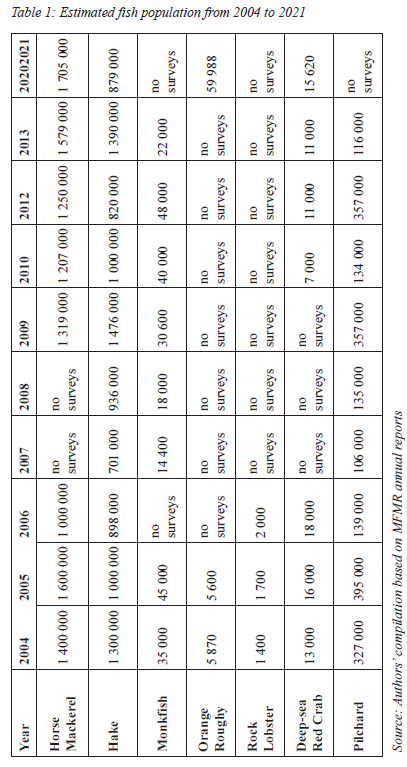
The table indicates no consistency in the survey of fish species populations in Namibia. From the available data shown in Table 1, fish species' populations have fluctuated over the years. For instance, the hake species population was 1.39 million in 2013 but decreased to less than a million (879 000) or by 37 per cent in 2021. In 2012, the monk fish population was 48 000 but decreased to 22 000 or by 54 per cent in 2013. In 2012, the pilchard population was 357 000 but decreased to 116 000 or by 68 per cent in 2013. Fluctuations in fish species can be attributed to commercial fishing, illegal fishing, and inconsistency in surveys.
Illegal fishing activities are linked to maritime security in other ways. They not only result in overexploitation of marine resources and depletion of fish stocks but also degrade the marine environment. The phenomenon has also been shown to have the capacity to lead to other environmental problems, such as the loss of biodiversity in semi-arid states, such as Namibia (Ruppel-Schlichting, 2022). Similarly, maritime security emphasises the location of vessels, especially fishing vessels, as this is necessary for search and rescue operations in cases of emergency at sea. Reports however show that some fishing vessels turn off their video management system (VMS) to hide their locations at sea. Criminal activities such as these can make these vessels targets of terrorist attacks, sea robbery, and piracy. Such acts may also facilitate the illicit movement of contraband goods and weapons through the sea. In 2022, aerial surveillance flights by the MFMR resulted in the sighting and arrest of 33 vessels illegally fishing in the Namibian EEZ (Justinu, 2022). The implications this has for maritime security in Namibia are obvious, as this could result in the decline of fish stocks and the degradation of the marine ecosystem. The loss of unquantifiable fish tonnage annually due to IUU fishing activities means the loss of millions of Namibian dollars in revenue accruable to the Namibian state.
Thirdly, maritime security as an integral component of the national security of Namibia relates to economic growth and development. The persistent problem of illegal fishing activities may hinder economic growth and development if adequate measures are not in place. Currently, the contribution of the fisheries sector to the Namibian gross domestic product (GDP) has remained relatively stable at 4,0 per cent over the years as shown in Table 2.
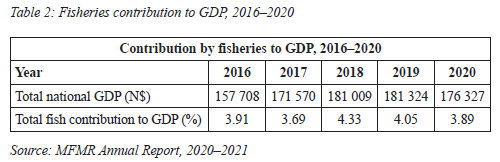
Currently, the Namibian maritime fishing industry is the third-largest contributor to its GDP (Namibia Statistics Agency [NSA], 2022). The fisheries sector plays a key role in production, employment, foreign exchange earnings, and the revenue-generating capacity of the government. Existing reports show that the fisheries sector contributes approximately 4.0 per cent to the GDP in Namibia (MFMR, 2021), and it is the largest employer of all marine industries with approximately 16 000 (or 1.8 per cent of the total Namibian workforce) direct jobs in the industry (Iitembu et al., 2021). Importantly, about 97 per cent of all fishery products are exported to other countries. The fisheries sector contributes about 15 per cent of all Namibian exports to the outside world (Chiripanhura & Teweldemedhin, 2016).
The IUU fishing activities threaten marine resources and undermine government efforts geared toward ensuring the long-term viability of the industry (Shigwedha, 2022; The Namibian, 2022). More so, unchecked illegal fisheries activities in violation of Namibian maritime sovereignty may lead to an increase in other criminal activities, such as piracy and sea robbery, which have a significant influence on global trade (Mbathera, 2022). The importance of the Namibian Sea to international trade cannot be over-emphasised. Global trade is heavily dependent on efficient control and management of sea routes.
The fourth dimension of maritime security concern is the human security of the population of coastal communities. In 2022, for example, the Namibian Police confirmed the discovery of about 60 human trafficking victims in a commercial fishing vessel in Namibian waters (Mbathera, 2022). While most of the suspected victims were Filipinos, others were Angolan, Indonesian, Mozambican, Namibian, and Vietnamese nationals (Mbathera, 2022).
The major means of livelihood in coastal communities is fishing. By protecting marine resources and ensuring sustainable healthy fish stocks, the livelihood of coastal communities is preserved. It has also been shown that coastal communities are among the most vulnerable people in terms of the adverse effects of climate change and criminal activities, which take place at sea (Mendenhall et al., 2020). Transloading at high seas may, for instance, lead to oil spillage and other types of pollution, which in turn pollutes other water sources on which coastal communities depend for drinking water (Whear, 2023). Although Namibian coastal areas are sparsely populated, it has been shown in other studies (Iitembu et al., 2023; Sjöstedt & Sundström, 2015) that environmental degradation caused by illegal fishing, dumping, and other marine crimes, can stir up protests among coastal populations, resulting in maritime security instability because of the emergence of piracy (De Coning et al., 2022).
The fifth dimension of maritime security which can be threatened by illegal fishing activities is diplomatic relations. Illegal fishing activities can lead to the rupturing of diplomatic relations between Namibia and its neighbouring countries. Evidence of this possibility can be drawn from the December 2023 arrest of an Angolan vessel in Namibian waters (Shigwedha, 2022; The Namibian, 2022). In 2021, the Namibian government, for example, accused the Angolan government of ignoring several reports, which showed that Angolan vessels sneak into Namibian waters at night to steal fish. Furthermore, the MFMR also revealed that, since 2017, it has detected about 23 Angolan fishermen carrying out illegal fishing activities in Namibian waters (Shigwedha, 2022; The Namibian, 2022). Again, in 2023, the MFMR - in collaboration, co-operation, and co-ordination with the Namibian Navy - seized and detained an Angolan vessel for allegedly fishing in Namibian waters illegally (Matthys, 2023). The vessel was detected fishing at approximately 24 km or 13 knots within Namibian territorial waters without the necessary authorisation (Matthys, 2024). Before this event, Namibian authorities had accused Angola authorities on several occasions of being uncooperative in the fight against IUU (Matthys, 2024). The Namibian authorities further alleged that their Angolan counterparts do not honour the terms of bilateral agreements between the two Southern African states. Consequently, foreign vessels illegally fishing in Namibian waters tend to escape to Angolan waters when detected by the Namibian Navy or the MFMR coastal patrol vessels and ordered to stop (Matthys, 2024). Since neither the Namibian Navy nor the MFMR coastal patrol vessels have the right by international law to chase these fishing vessels into Angolan waters, the vessels always go unpunished and return again and again to continue their illegal fishing activities in Namibian waters (MFMR, 2021).
From the above, it is obvious that combating illegal fishing is necessary if marine resources are to be protected. This necessity emanates from the fact that the phenomenon poses several threats to maritime security, encompassing economic, environmental, social, and national security dimensions. The undermining of the livelihoods of genuine fishermen, depletion of fish stocks, and saturation of markets with unregulated catches have significant consequences for food security, particularly in coastal communities reliant on fish as a primary source of protein. Similarly, the destruction of marine habitat and biodiversity loss through practices, such as bottom trawling and bycatch, fosters conflict between legal and illegal operators over access to resources, thereby disrupting the peace and stability of coastal communities.
Conclusion
The current study examined the seriousness of illegal fishing in Namibia from its historical roots in colonial times. In this article, it was argued that the persistence of illegal fishing, shaped by history, threatens Namibian maritime security. Maritime security has been discussed as encompassing a wide range of issues across oceans, seas, territorial waters, rivers, and ports, which seriously affect the marine ecosystem, the economy, and people's livelihood. Illegal fisheries activities result in the depletion of fish stocks, disruption of marine ecosystems, the contribution of fisheries to the Namibian GDP, and loss of jobs for coastal dwellers. To unlock the full economic potential of the Namibian fisheries sector, illegal fisheries activities need to be curbed significantly through international cooperation, effective enforcement, and sustainable management strategies. Improved collaboration, co-operation, and coordination between maritime security agencies are required to ensure effective monitoring and control of fisheries activities in the territorial waters and EEZ of the country.
Addressing the problem of illegal fishing activities and improving maritime security would require significant investment in innovative monitoring, control, and surveillance technologies across different agencies. For the Namibian Navy, for example, it would be necessary to acquire unmanned aerial vehicles (UAVs) to complement traditional methods of air surveillance and sea patrols. Drone technologies (UAVs) equipped with infrared camera systems would help by quick detection and hot pursuit with an element of surprise in apprehending vessels illegally fishing in Namibian waters. These measures would help provide effective protection of the valuable marine ecosystem.
The distance from shore, where the naval and MEMR facilities are in Walvis Bay to the Namibian EEZ, is quite long and constitutes a serious challenge to rapid response and effective monitoring, control, and surveillance of the area. For this reason, Namibia needs to emphasise the criticality of not only reinforcing national legislation and law enforcement capabilities but also the criticality of international co-operation and co-ordination as well. As a coastal state, Namibia can enhance its maritime security by joining maritime security arrangements in Africa, such as the Yaoundé Code (Gulf of Guinea Architecture) and the Djibouti Code. By working together with international partners and strengthening national legal frameworks and law enforcement capabilities, the country can combat illegal fishing effectively and protect its valuable marine ecosystem.
REFERENCES
Adewumi, I.J. 2021. Exploring the nexus and utilities between regional and global ocean governance architecture. Frontiers in Marine Science, 8:3-9. [ Links ]
African Union. 2016. African charter on maritime security and safety and development in Africa (Lomé Charter). Retrieved from https://au.int/sites/default/files/treaties/37286-treatyafrican_charter_on_maritime_security.pdf [28 November 2024]. [ Links ]
Armstrong, C.W., Sumaila, U.R., Erastus, A. & Msiska, O. (Eds.). 2004. Namibia's fisheries: Ecological, economic and social aspects. Windhoek: Namibia Fisheries Press. [ Links ]
Bateman, S. 2016. Managing maritime affairs: The contribution of maritime security forces. In J. Bekkevold & G. Till (eds.). International order at sea. London: Palgrave Macmillan, 261-282. https://doi.org/10.1057/978-1-137-58663-6_12 [ Links ]
Belhabib, D., Sumaila, U.R. & Le Billon, P. 2019. The fisheries of Africa: Exploitation, policy, and maritime security trends. Marine Policy, 101:80-92. [ Links ]
Bell, R.J., Odell, J., Kirchner, G. & Lomonico, S. 2020. Actions to promote and achieve climate-ready fisheries: Summary of current practice. Marine and Coastal Fisheries, 12(3):166-190. [ Links ]
Campling, L., Havice, E., Gorez, B., Standing, A., Kim, S. & Hetherington, D. 2024. Institutional and economic perspectives on distant-water fisheries access arrangements. Rome: FAO. https://doi.org/10.4060/cd1243en [ Links ]
Carver, R. 2020. Lessons for blue degrowth from Namibia's emerging blue economy. Sustainability Science, 15(1):131-143. [ Links ]
Chiripanhura, B. & Teweldemedhin, M. 2016. An analysis of the fishing industry in Namibia: The structure, performance, challenges, and prospects for growth and diversification. AGRODEP working paper no. 0021. Washington, DC: International Food Policy Research Institute. Retrieved from https://hdl.handle.net/10568/146325 [Accessed 6 November 2024]. [ Links ]
Cochrane, K.L. 2021. Reconciling sustainability, economic efficiency and equity in marine fisheries: Has there been progress in the last 20 years? Fish and Fisheries, 22(2):298-323. [ Links ]
Coetzee, J. 2021. An analysis of the depth of corruption in Namibia's political system, with reference to the fishing industry scandal known as 'Fishrot'. Journal of Namibian Studies: History Politics Culture, 30:131-152. [ Links ]
De Coning, C., Busby, J., Eklöw, K., Hegazi, F., Krampe, F., Lanteigne, M., David, D., Pattison, C., Ray, C., Smith, E., Alvarado, J., Galaz, V., Lako, J., Norström, A., Queiroz, C., Salas Alfaro, E. & Schwartzstein, P. 2022. Security risks of environmental crises: Environment of peace (Part 2). Stockholm: Stockholm International Peace Research Institute. https://doi.org/10.55163/VZI07863 [ Links ]
Finke, G., Gee, K., Kreiner, A., Amunyela, M. & Braby, R. 2020. Namibia's way to marine spatial planning: Using existing practices or instigating its own approach? Marine Policy, 121: art. 104107. [ Links ]
Fransas, A., Nieminen, E., Salokorpi, M. & Rytkönen, J. 2012. Maritime safety and security: Literature review. University of Applied Sciences. Retrieved from https://www.theseus.fi/bitstream/handle/10024/46235/B77_raportti_2.pdf?sequence=3&isAllowed=y [Accessed 22 November 2024]. [ Links ]
Gammage, C. 2017. North-South regional trade agreements as legal regimes: A critical assessment of the EU-SADC economic partnership agreement. Cheltenham: Edward Elgar. https://doi.org/10.4337/9781784719623.00012 [ Links ]
Ganger, S., Bollig, M., LeCain, T.J., Lane, P.J., Córdoba, L., Pettier, J.B., Widlok, T. & Aisher, A. 2019. Commodifying the "wild": Anxiety, ecology and authenticity in the late modern era. Environmental History, 24(4):665-735. https://doi.org/10.1093/envhis/emz033 [ Links ]
Green, J.F. & Rudyk, B. 2020. Closing the high seas to fishing: A club approach. Marine Policy, 115: art. 103855. [ Links ]
Grynberg, R., Immanuel, S. & Amupadhi, T. 2023. Fishrot: Fisheries and corruption in Namibia. Cape Town: UCT Press. [ Links ]
Guerreiro, J. 2022. Africa Integrated Maritime Policy, blue growth and new ocean governance: Case studies from the Atlantic and the Indian Ocean. Western Indian Ocean Journal of Marine Science, (1/2022):33-46. [ Links ]
litembu, J.A., Erasmus, V.N., Uanivi, U., Nakwaya, D., Horaeb, R.R., Nangolo, E., Nashima, F.P., lita, T.K. & Mwandemele, O. 2021. The hits and misses of Namibia's attempt to implement the Ecosystem Approach to Fisheries (EAF) management. Ecosystem Health and Sustainability, 7(1): art. 1920340. [ Links ]
litembu, J.A., Mafwila, S.K., Ndara, S. & Erasmus, V.N. 2023. Observed fishery regulatory violations in Namibia and their possible implications for the sustainable management of fishery resources. Regional Studies in Marine Science, 63: art. 103004. [ Links ]
Iroanya, R.O. 2018. Human trafficking and security in southern Africa: The South African and Mozambican experience. Cham: Palgrave Macmillan. [ Links ]
Justinu, A.N. 2022. An investigation into the effectiveness of maritime security in combating illegal, unreported and unregulated fishing in Namibian waters: A case study of the Kunene River mouth. Doctoral dissertation, University of Namibia. [ Links ]
Kainge, P., Kirkman, S.P., Estevâo, V., Van der Lingen, C.D., Uanivi, U., Kathena, J.N., Van der Plas, A., Githaiga-Mwicigi, J., Makhado, A., Nghimwatya, L. & Endjambi, T. 2020. Fisheries yields, climate change, and ecosystem-based management of the Benguela Current Large Marine Ecosystem. Environmental Development, 36: art. 100567. [ Links ]
Kwiatkowska, B., Molenaar, E., Elferink, A.O. & Soons, A. 1999. Food and Agriculture Organization (FAO). In B. Kwiatkowska, E.J. Molenaar, A.G. Oude Elferink & A.H.A. Soons (eds.). International organizations and the Law of the Sea 1996. Brill: Nijhoff, 507-644. https://doi.org/10.1163/9789004634251_015 [ Links ]
Matthys, D. 2023. Angolan vessel apprehended for illegal fishing in Namibian waters. The Namibian, 30 December. Retrieved from https://www.namibian.com.na/angolan-vessel-apprehended-for-illegal-fishing-in-namibian-waters/ [Accessed 18 November 2024]. [ Links ]
Matthys, D. 2024. Capture of Angolan vessel a stern warning. The Namibian, 5 January. Retrieved from https://www.namibian.com.na/fisheries-ministry-needs-n584m-for-marine-policing-2/ [Accessed 18 November 2024]. [ Links ]
Mbaimbai, G.L. 2021. Assessment of bycatch species in the Namibia hake directed bottom trawl fishery (1997-2014). Doctoral dissertation, University of Namibia. [ Links ]
Mbathera, E. 2022. 60 locals, foreigners 'trafficked' to Namibian waters. The Namibian, 5 September. Retrieved from https://www.namibian.com.na/60-locals-foreigners-trafficked-to-namibian-waters/ [Accessed 18 November 2024]. [ Links ]
Melber, H. 2022. Namibia since independence. In T. Spear (ed.). Oxford research encyclopedia of African history. Oxford: Oxford University Press, 286-287. https://doi.org/10.1093/acrefore/9780190277734.013.1127 [ Links ]
Mendenhall, E., Hendrix, C., Nyman, E., Roberts, P.M., Hoopes, J.R., Watson, J.R., Lam, V.W. & Sumaila, U.R. 2020. Climate change increases the risk of fisheries conflict. Marine Policy, 117: art. 103954. [ Links ]
MFMR (Ministry of Fisheries and Marine Resources). 2000. Marine Resources Act, 2000 (Act 27 of 2000). Government Gazette, 2458, 27 December. [ Links ]
MFMR (Ministry of Fisheries and Marine Resources). 2021. Honorable Minister's statement in Parliament with respect to Angola alleged illegal fishing in Namibian Waters. Windhoek: Namibia. [ Links ]
Mickiewicz, M., Wolos, A. & Trella, M. 2020. Human dimensions: The fishery guards versus illegal fishermen in three regions of Central-Eastern Europe. Fisheries & Aquatic Life, 28(1):39-47. [ Links ]
Miller, D.D. & Sumaila, U.R. 2016. IUU fishing and impact on the seafood industry. In A.M. Naaum & R.H. Hanner (eds.). Seafood authenticity and traceability. London: Elsevier, 83-95. https://doi.org/10.1016/B978-0-12-801592-6.00004-8 [ Links ]
Neethling, C. & Goedhals-Gerber, L.L. 2023. Identifying temperature deviations in the hake cold chain from Namibia to Spain. Journal of Transport and Supply Chain Management, 17(1): art. 923. https://doi.org/10.4102/itscm.v17i0.923 [ Links ]
Nnaemeka, A.N. 2020. Environmental pollution and associated health hazards to host communities (case study: Niger delta region of Nigeria). Central Asian Journal of Environmental Science and Technology Innovation, 1(1):30-42. [ Links ]
NSA (Namibia Statistics Agency). 2022. Gross domestic product second quarter. Retrieved from https://nsa.org.na/document/gross-domestic-product-gdp-second-quarter-2022/ [Accessed 4 November 2024]. [ Links ]
Okafor-Yarwood, I. 2020. The cyclical nature of maritime security threats: Illegal, unreported, and unregulated fishing as a threat to human and national security in the Gulf of Guinea. African Security, 13(2):116-146. [ Links ]
Republic of Namibia. 1990. Territorial Sea and Exclusive Economic Zone of Namibia Act 3 of 1990. Windhoek. [ Links ]
Ruppel-Schlichting, K. 2022. Namibia and its environment. In O.C. Ruppel & K. Ruppel-Schlichting (eds.). Environmental law and policy in Namibia. Baden-Baden: Nomos Verlagsgesellschaft, 65-74. [ Links ]
Sell, A.F., Von Maltitz, G.P., Auel, H., Biastoch, A., Bode-Dalby, M., Brandt, P., Duncan, S.E., Ekau, W., Fock, H.O., Hagen, W., Huggett, J.A., Koppelmann, R., Körner, M., Lahajnar, N., Martin, B., Midgley, G.F., Rixen, T., Van der Lingen, C.D., Verheye, H.M. & Wilhelm, M.R. 2024. Unique southern African terrestrial and oceanic biomes and their relation to steep environmental gradients. In G.R von Maltitz, G.F. Midgley, J. Veitch, C. Brümmer, R.R Rötter, F.A. Viehberg & M. Veste (eds.). Sustainability of southern African ecosystems under global change (Vol. 248). Cham: Springer International, 23-88. https://doi.org/10.1007/978-3-031-10948-5_2 [ Links ]
Shigwedha, A. 2022. Namibia conducting 'regular patrols' to combat illegal fishing. The Namibian, 20 October. Retrieved from https://www.namibian.com.na/namibia-conducting-regular-patrols-to-combat-illegal-fishing/ [Accessed 5 November 2024]. [ Links ]
Shriver, A.L., Yeo, B.H., Ting, K.O., Garcia, M. & Ahmed, M. 2006. Annotated bibliography on the economic effects of global climate change on fisheries. S.l.: The World Fish Center. [ Links ]
Sjöstedt, M. & Sundström, A. 2015. Coping with illegal fishing: An institutional account of success and failure in Namibia and South Africa. Biological Conservation, 189:78-85. [ Links ]
Sumaila, U.R. & Vasconcellos, M. 2000. Simulation of ecological and economic impacts of distant water fleets on Namibian fisheries. Ecological Economics, 32(3):457-464. [ Links ]
Tessnow-von Wysocki, I., Belhabib, D. & Le Billon, P. 2022. Undercurrents: Illegal fishing and European Union markets. In D. Brombacher, G. Maihold, M. Müller & J. Vorrath (eds.). Geopolitics of the illicit. Baden-Baden: Nomos Verlagsgesellschaft, 239-274. https://doi.org/10.5771/9783748935940-239 [ Links ]
The Namibian. 2022. Fisheries ministry needs N$58,4m for marine policing, 26 April. Retrieved from https://www.namibian.com.na/fisheries-ministry-needs-n584m-for-marine-policing-2/ [Accessed 18 November 2024]. [ Links ]
Warikandwa, T.V. 2023. Fighting fisheries crimes in the fisheries industry: Practical training reflections of the efficacy of Namibia's fisheries law enforcement. Cogent Social Sciences, 9(2): art. 2286043. [ Links ]
Whear, J., 2023. Containment: Logistics, environmental conflict, and the legal geography of inland ports. Doctoral dissertation, Syracuse University. [ Links ]
Wilhelm, M.R., Kirchner, C.H., Roux, J.P., Jarre, A., Iitembu, J.A., Kathena, J.N. & Kainge, P. 2015. Biology and fisheries of the shallow-water hake (Merluccius capensis) and the deep-water hake (Merluccius paradoxus) in Namibia. In H. Arancibia (ed.). Hakes. Hoboken, NJ: Wiley, 70-100. https://doi.org/10.1002/9781118568262.ch3 [ Links ]
Ye, Y., Ndiaye, P.G. & Al-Husaini, M. 2024. Increasing the contribution of Africa's fisheries to food security through improved management. Food Security, 16(2):455-470. [ Links ]
Zongwe, D. 2022. Namibia. International Review of Constitutional Reform, 3:237-241. http://dx.doi.org/10.2139/ssm.4183990 [ Links ]
Zongwe, D.P. 2019. International law in Namibia. Cameroon: Langaa RPCIG. [ Links ]
1 Dr. Iroanya Richard Obinna teaches Security and Strategic Studies at the School of Military Science, University of Namibia, Windhoek. He served as Associate Dean of the School between 2018 and 2021. Served as Senior Research Specialist at the Africa Institute of South Africa (AISA), Pretoria (now a unit of the Human Sciences Research Council, HSRC), South Africa and as a guest lecturer at the SA National Defence College and Senior Staff and Command College, Okhandja, Namibia. He has published extensively on issues of security in Africa in accredited journals; contributed several book chapters and he is the author of the book: Human trafficking and security in Southern Africa: the South African and Mozambican experience (Palgrave McMillan 2018); co-editor with Korwa Adar and Francis Nwonwu of the book: Towards Africa-oriented Risk analysis models: a contextual and methodological approach (AISA 2008); Co-editor with Pilisan Masake of the following books: African Perspectives on Global Pandemics and the Challenges of Peace and Securit (Lexington Publishers, 2023); Social and Ethical Issues of Global Pandemics: a Southern African Perspective (Lexington Publishers, 2023).
2 Charlene Bwiza Simataa is a lecturer at the School of Military Science, University of Namibia, specializing in GIS, remote sensing, and geography. She served as Head of Department from 2019 to 2021. Currently pursuing a PhD in Geography, her research focuses on developing a framework to monitor fisheries activities in Namibia's Exclusive Economic Zone (EEZ), aiming to enhance marine resource management. In 2022, she participated in a training program on polymetallic nodule exploration by the International Seabed Authority (ISA) and Deep Ocean Resources Development (DORD), furthering her expertise in marine resources.
