




Services on Demand
Journal

Article
 English (pdf)
 Article in xml format
 Article references
 Automatic translation
 Send this article by e-mail
Indicators
Related links
-
 Cited by Google
 -
 Similars in Google
Share

 Permalink
Scientia Militaria: South African Journal of Military Studies
On-line version ISSN 2224-0020Print version ISSN 1022-8136
SM vol.52 n.3 Cape Town 2024
https://doi.org/10.5787/52-3-1480
ARTICLES
Operation Observant Compass and the Hunt for Joseph Kony: The Use of Special Operations Forces in Humanitarian Interventions
Daniel Moriarty
United States Military Academy, West Point, New York, USA
ABSTRACT
Operation Observant Compass, the United States 2011-2017 military intervention in Central Africa to defeat Joseph Kony's Lord's Resistance Army, offers several lessons for students and practitioners of military geography. As opposed to previous humanitarian interventions, Operation Observant Compass featured a notably small force of roughly 100 special operations forces and support personnel. This special operations forces element, deployed to the tri-border region between the Democratic Republic of the Congo, South Sudan, and the Central African Republic, confronted an elusive enemy force in an operational area roughly 200 000 square kilometres in size. Using a mixed-methods approach, the study, on which this this article is based, argued that Operation Observant Compass resulted in a net positive humanitarian outcome despite failing to kill or capture Kony.
First, using datasets on Lord's Resistance Army attacks and Operation Observant Compass troop positions, this article presents a geospatial analysis of potential deterrence effects created by the deployment of special operations forces, such as the United States Special Forces or "Green Berets". Second, using primary research conducted by the former psychological operations commander of Operation Observant Compass and the Ugandan People's Defence Force counterpart, analysis is presented on the efficacy of psychological operations campaigns that sought to weaken the Lord's Resistance Army through defections to regional security forces. The study also considered ancillary effects received through United States military medical personnel deployed in support of special operations forces, as well as a counterfactual argument in which United States forces were not directly deployed into the tri-border region.
This article contributes to the existing literature by expanding understanding of a little-studied chapter in foreign military deployments in sub-Saharan Africa, considering the nexus between use of special operations forces and humanitarian interventions. Methodologically, the use of a geographic information system argues for a consideration of geographical proximity between forces in creating a deterrent effect in "low-intensity" or irregular conflicts.
Keywords: Special Operations, Humanitarian Intervention, Joseph Kony, Special Forces, Psychological Operations, Civil Affairs
Introduction
Operation Observant Compass (OOC), the name given to the United States (US) direct military intervention in Central Africa to defeat Joseph Kony's Lord's Resistance Army (LRA) between 2011 and 2017, represents a unique case in American military history for several reasons. First, amidst ongoing combat operations at the time in Iraq, Afghanistan, and elsewhere, the deployment of approximately 100 special operations forces (SOF) and support personnel for a distinctly separate mission represents a rare use of military force for an objective that some argued was not directly in support of US national security (Arieff & Ploch, 2012:15-16). While the Obama administration argued that assisting the US regional allies in the pursuit of Joseph Kony and the LRA was indeed in line with the National Security Strategy, it was a noted departure from what at the time was the dominant threat of the "War on Terror" (Arieff & Ploch, 2012:16). Additionally, the small number of US personnel deployed represents a key difference from previous humanitarian interventions.
US Lawmakers have long questioned the utility of deploying small numbers of troops to remote parts of the African continent, from the aftermath of Operation Gothic Serpent's "Black Hawk Down" incident (Hirsch, 2011) to the more recent Tongo Tongo ambush in Niger that left four US SOF personnel dead (VOA News, 2017). On the other hand, given the well-studied struggle to generate political will for third-party military humanitarian interventions, understanding small-scale deployments, such as OOC, could offer lessons for potential responses to future crises (MacFarlane, Thielking & Weiss, 2004:977-978).
The findings of the study reported on in this article argue that, despite the incredibly small size of the intervention force, OOC indeed had a positive humanitarian outcome. The intervention succeeded in improving the humanitarian situation despite the failure to achieve the primary objective of capturing or killing Joseph Kony as a result of -
• The deterrent effect of American occupation of remote population centres;
• The localised provision of medical attention by support personnel; and
• The American-led psychological operations (PsyOp) campaign that contributed to an increased defection of LRA fighters and leaders.
This article consists of four sections. First, a brief historical overview provides context on Joseph Kony and the rise and resilience of the LRA, as well as the political factors that led President Obama to authorise the deployment of 100 personnel to aid Ugandan forces. Second, I discuss the methodology and sources used for assessing the net humanitarian outcome of OOC, including datasets on LRA operations, civilian deaths, and US military operations. Third, the main findings as previously discussed are presented, including a counterfactual example of the outcome if the US had not deployed forces. This counterfactual African Union-led operation, I argue, would likely have led to a short-term decrease in LRA attacks with the potential for a renewed campaign of LRA retribution. The article concludes with a discussion of the lessons learned from OOC, including implications for future use of SOF in humanitarian interventions as well as for ongoing small-scale SOF deployments across sub-Saharan Africa.
While acknowledging concern regarding potential bias due to the reliance on US military sources, I believe the unique access I had to first-hand accounts from key participants in OOC provides invaluable insight that complements the existing data. These first-hand interviews with US SOF personnel and participants in the operation offer a comprehensive and balanced perspective, which would have been difficult to obtain from secondary sources alone. Additionally, I have taken care to incorporate independent data from nongovernmental organisations (NGOs), including Invisible Children's Crisis Tracker and Armed Conflict Location and Event Data (ACLED), ensuring that the analysis reflects a broader range of perspectives beyond those of US military personnel. This integration of multiple sources strengthened the objectivity of the findings, while the first-hand accounts provide critical context that would otherwise be unavailable.
Historical Overview
The roots of Joseph Kony and the origins of the LRA lie with the Acholi people of Northern Uganda and their relationship to the brutal regime of Idi Amin. Amin, who ruled Uganda from 1971 until his 1979 defeat at the hands of former president Milton Obote (who had himself been deposed by Amin in 1971), had incorporated many Acholi into his security apparatus, providing various positions of power to them and other northern ethnic groups (Easter & Hatangimana, 2017:7-10). This trend of northern prevalence in Ugandan security forces continued through Obote's second regime, lasting from 1979 until his second ousting in 1985, this time by the Acholi General Tito Okello. During this same time, the country was confronted with what is now known as the Ugandan Bush War, which lasted from 1981 to 1986 and ended with Yoweri Museveni consolidating political control and installing his own National Resistance Movement (NRM) as the ruling faction, comprising primarily Ugandans from the southern provinces (Easter & Hatangimana, 2017:7). Following Museveni's victory in 1986, large factions of the Acholi formed the Ugandan People's Democratic Army (UPDA) as a response to aggression by Museveni's National Resistance Army (NRA). Exploiting deeply held religious beliefs, Joseph Kony emerged as a leader within the UPDA and formed his own faction of loyal fighters, eventually rising to prominence as the head of an Acholi insurgency that aimed to deny NRM control over northern Uganda. Kony's forces would continue conduct raids against Ugandan government forces, make and break alliances with other rebel factions, and shift names until settling on Lord's Resistance Army (LRA) in 1993 (Day, 2019:971-973).
The next phase of prolonged LRA violence would last for over a decade, when Kony justified using Sudanese aims against Museveni to gain the support of Khartoum. Forced to withdraw from northern Uganda by increased attacks from the Ugandan People's Defence Forces (UPDF), the LRA utilised safe areas across the border in southern Sudan, and active support from the Sudanese Armed Forces (SAF) to continue its operations (Lewis, 2020:69-80). By this time, the operations consisted largely of cross-border raids into Acholi population centres, where the LRA would stage brutal attacks on civilians, abducting children to bolster their ranks, and intimidate civil society actors who had chosen to cooperate with the Museveni regime. This campaign would continue until 2005, when diplomatic improvements between Sudan and Uganda ended support by Khartoum for Kony and effectively removed the Sudanese safe havens, making attacks into Acholi regions of Uganda nearly impossible (Day, 2019:975-976).
From 2005 onwards, the LRA has been largely reduced to what Day (2019:971) calls 'roving banditry'. A lack of official foreign support, reliable sources of income or resources, and repeated attempts by the UPDF and other forces to capture or kill Kony led the LRA to rely on the under-governed and densely vegetated regions of the Democratic Republic of Congo (DRC), the Central African Republic (CAR), and South Sudan to survive and evade capture. While the numbers of the LRA (estimated at around 250-500 core fighters) and operations declined, it still posed a threat to civilian populations in affected areas. By the 2010s, millions of people had been displaced and close to 60 000 had been abducted for use as fighters, sex slaves, or forced labour (International Displacement Monitoring Centre [IDMC], 2013:4-6).
Counter-LRA operations by the UPDF continued with increased intensity, culminating in Operation Lightning Thunder (OLT) in late 2008. The UPDF, supported by American intelligence and logistical support and in coordination with Sudanese and Congolese forces, launched a major offensive with the aim of capturing Kony. Although the operation succeeded in destroying multiple LRA bases in the tri-border area between the DRC, the CAR, and South Sudan, Kony and his forces were able to evade capture again, responding with reprisal attacks on villages in north-eastern DRC, causing an estimated 500-1 000 casualties (Forest, 2014:19-21).
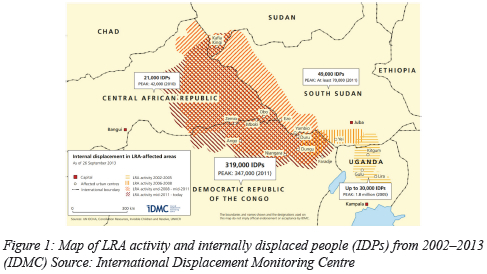
Following the mixed results of OLT, increased international awareness and political pressure grew in Washington. Several NGOs, led by the group Invisible Children, lobbied the White House to increase its role in the effort to capture Kony and permanently disband the LRA, motivated by a humanitarian objective of ending the group's reign of violence (Easter & Hatangimana, 2017:36-38). The lobbying campaign succeeded, and in 2010, President Obama signed the Lord's Resistance Army Disarmament and Northern Uganda Recovery Act. In October 2011, Obama further authorised the deployment of 100 personnel (later, in 2014, expanded to 250) under the auspices of OOC with the stated goal of more directly training and assisting the UPDF in their counter-LRA efforts (Demmers & Gould, 2018:371).
Methodology and Sources
In order to conduct an accurate analysis of the humanitarian impact of OOC, a number of both quantitative and qualitative sources have been assembled from a variety of communities, namely relevant NGOs, academia, and military organisations directly involved in the operation.
In the current research, Quantitatively, analysis was driven by -
• data gathered by NGOs, such as Invisible Children, whose Crisis Tracker has recorded LRA activity in Uganda, South Sudan, the DRC, and the CAR;
• additional data on LRA activity provided by the ACLED project (see Raleigh, Linke, Hegre & Karlsen, 2010) and the Internal Displacement Monitoring Centre (IDMC, n.d.);
• metrics derived from ACLED, which included numbers of deaths, dates, and locations of the corresponding events, and associated actors;
• metrics gathered by Invisible Children, which included numbers and locations of LRA attacks and abductions since 2008 (Invisible Children, n.d.); and
• IDMC datasets, which included total numbers of IDPs and new displacements in the affected areas from 2009 to 2017 after the withdrawal of US forces.
In terms of location-specific data, geospatial proximity and temporal correlation analysis was conducted using previous military reporting on the specific locations of SOF positions. Analysis was done using ArcGIS. By examining the temporal and geographical patterns of LRA activity before, during, and after OOC, I measured the correlation between the operations of the group and the American intervention.
Given the organisational devolution of the LRA from a politically motivated insurgent group to an isolated group of bandits, new recruits were gained through attacks on villages and abducting civilians to be forced into service. Measuring abductions in addition to attacks provided further insight into the LRA response to attrition caused through military casualties or fighters defecting.
Additionally, data gathered on LRA defections by Major Jonathan Easter, the former US Psychological Operations (PsyOp) commander of OCC, and Major Benon Hatangimana of the UPDF shed light on the efficacy of American SOF efforts to disrupt the ranks of the LRA (Easter & Hatangimana, 2017:69-82). Due to the long-practiced LRA tactic of abducting civilians for forced service, defections can be viewed as another potentially positive humanitarian outcome of OOC or other counter-LRA operations, as civilians can return to their homes for a resumption of their normal lives after being forced into combat by their kidnappers. As Khasalamwa-Mwandha (2019) however notes, for these former soldiers, the reintroduction into Ugandan society has been noted as a difficult process. Access to data from Special Operations Command Africa (SOCAF) (the US military organisation charged with conducting special operations on the continent) by both Easter and Hatangimana (2017) and Easter (2019) also served as a valuable source of data on the intervening force. Using the statistics of PsyOp missions conducted (such as pamphlet drops or loudspeaker flights over LRA territory) and numbers of LRA fighters who defected to African Union-led Regional Task Force (AU-RTF) forces, this data further support a potential causation between US SOF and a decrease in LRA effectiveness.
Qualitative content analysis of historical records, including interviews with OOC participants and LRA defectors, provided evidence on the causal relationship between American military involvement and LRA activity. In particular, military academic research on the composition and disposition of the US SOF deployed to support the operation shed light on from where counter-LRA efforts were supported. Additionally, research by scholars and experts on conflict studies supplemented the analysis of shifts in LRA activity and the unintended consequences of OOC. By conducting analysis of the entire affected region, the current study also sought to determine whether the American intervention prevented loss of life or simply displaced the violence. Finally, an interview with a Civil Affairs (CA) officer who had served in Uganda as part of OOC shed insight into the role of additional SOF units deployed, as well as the potential for expanded coordination between military and civilian entities.
Findings
Before addressing the outcome of OOC, it is important to examine the decline in LRA attacks that occurred prior to the arrival of American personnel. Using data recorded by Invisible Children's LRA Crisis Tracker, it became clear that LRA activity (classified as attacks, abductions, and civilians killed) went through a surge from 2008 to mid-2010, as seen in Figure 2 below.
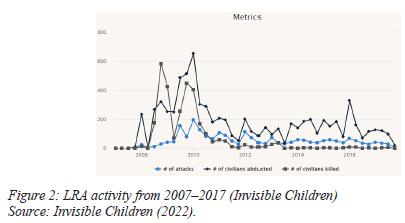
As noted in the historical overview, many of these attacks were the result of LRA retribution for OLT in late 2008. The spike in abductions through 2009 has been attributed largely to the post-Lighting Thunder splintering of the LRA into smaller bands, which, in turn, spread through the region and kidnapped more civilians to replenish the ranks of child soldiers, forced labourers, and sex slaves (Rice, 2009). The decline in activity beginning in 2010 (more than a year before the authorisation and deployment of US personnel) was such that, by 2011, only 170 deaths across the affected area had been attributed to the LRA (Branch, 2012:161-162). While the immediate effects of OLT were criticised as leading to the spike in LRA attacks and deaths of civilians, its fracture of the group into smaller (and therefore more difficult to track) bands is a likely reason behind the longer-term decline in activity. With this increased autonomy, LRA splinter groups have been observed to pursue tactics more consistent with petty gangs, resorting to looting, illicit trades, and other subsistence activities, as opposed to an organised insurgent group with unified political aims (Day, 2019:978). Nevertheless, despite the decline, regional powers, such as Uganda along with the United States and the United Nations, continued to frame the LRA as a threat to civilians and to see continued military pressure as the only viable way of capturing Kony and finally dismantling the group (Branch, 2012:169-171).
Following the authorisation by the White House, US Africa Command (AFRICOM) assembled what would be known as the "AFRICOM Counter-LRA Control Element" (ACCE), the task force charged with executing OOC. The ACCE was headquartered in Entebbe, Uganda for its logistical advantage in coordinating the influx of military aid. Additional outposts, referred to as "Combined Operations Fusion Centres" (COFCs) were also established in Uganda, the CAR, the DRC, and South Sudan. These COFCs served as additional logistics hubs (with valuable airstrips in an area otherwise lacking in infrastructure) and as centres of coordination between US forces and the AU-RTF. This was authorised shortly after the announcement of OOC, and comprised troops from Uganda (the primary force provider), South Sudan, the CAR, and the DRC (Easter & Hatangimana, 2017:35-38). As the mission grew, the need for additional troops and support led to the eventual delegation of the mission entirely to SOCAF, with the ACCE being redesignated as Special Operations Command Forward - Central Africa (SOCFWD-CA) (Easter & Hatangimana, 2017:39-41).
From the COFCs, elements of SOCFWD-CA supported the four objectives of the operation:
• Increase the protection of civilians;
• Apprehend or remove Joseph Kony and his senior commanders from the battlefield;
• Promote the defection, disarmament, demobilisation, and reintegration of remaining LRA fighters; and
• Increase humanitarian access and provide continued relief to affected communities (White House Office of the Press Secretary, 2012).
Deterrence Effect of Green Berets
These objectives were primarily pursued through local training and intelligence sharing conducted by Operational Detachment Alphas (ODAs) from the 10th Special Forces Group, which aimed to improve the capabilities of AU-RTF forces. Despite the assistance provided by the ODAs, the AU-RTF was however still unable to kill or capture Kony or make major progress towards rooting out the LRA. Analysis from scholars at the Joint Special Operations University points to many tactical-level frictions between the ODAs and AU-RTF partners, including language and cultural barriers, and a lack of understanding of AU-RTF operating procedures or needs. The same analysis however noted the deterrent effect that the deployment of the ODAs to remote COFCs had, as indicated by civilians' reports of intense LRA questioning over US troop locations (Forest, 2014:49-52).
The deterrent effect of US presence at the COFCs is seen in data collected by ACLED and visualised in Figure 3 and Table 1. Figure 3 shows the location of the COFCs within the SOCFWD-CA area of operations, while Table 1 presents data on LRA attacks before, during, and after OOC. Using a one-year span before and after the 14 October 2011 troop authorisation of the White House, removed the surge in LRA retribution attacks following OLT conclusion in March 2009. It further controlled for any marked improvements in AU-RTF forces as a result of SOCFWD-CA (given the initial logistical challenges of establishing the COFCs and forming new partnerships, major operational improvements from American training were unlikely within the first year). From the data, we see that, while there was a 32% decrease in annual LRA acts of violence against civilians across the entire region, areas within a 30-mile radius (i.e. 48-kilometre radius) of the COFCs saw a 63% decrease during the same period.2
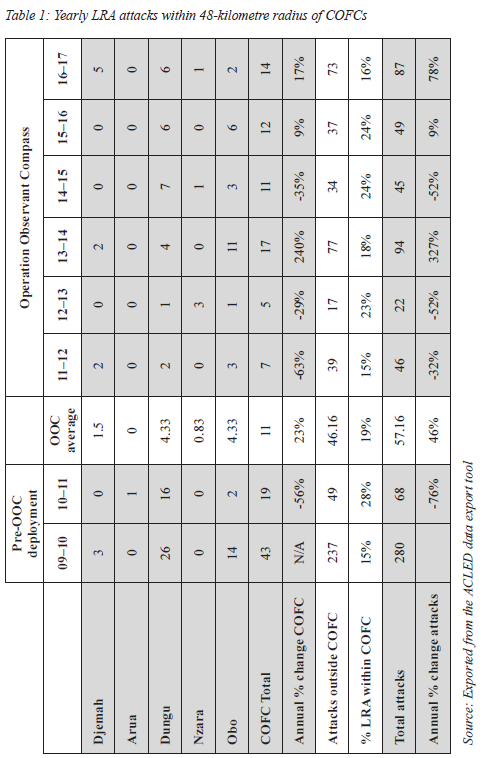
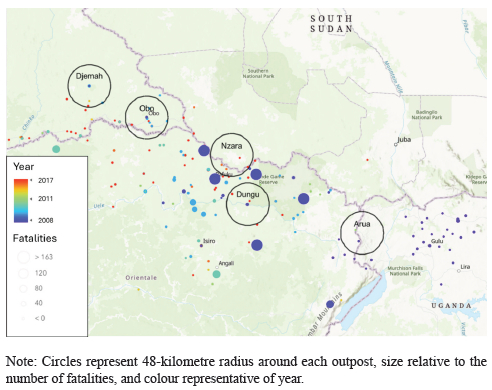
Examining the potential deterrent at each COFC, however, provides additional detail. While 2011-2012 saw a major decrease in LRA activity near Dungu, DRC, the COFCs in the CAR at Obo and Djemah saw increases in LRA activity. It is important to note that these increases were small in number: Obo saw an increase from two attacks to three, and Djemah only experienced two attacks during the first year of OOC. Adding weight to the argument of the deterrent effect of the ODAs is the fact that all COFCs had a similar mix of UPDF or AU-RTF forces. The expeditionary deployment of UPDF troops outside Uganda has been noted both for the relatively capable nature of the forces as well as the tensions exacerbated with other AU-RTF partners whose territory the UPDF occupied (Forest, 2014:28). While the COFCs themselves served as important military nodes for AU-RTF troops to launch operations from - and might themselves eventually have served as deterrents - the introduction of US SOF to these locations seems to have affected LRA decision-making of where to launch raids. Additionally, the outposts in the CAR had already been hosting 1 500 UPDF troops. Analysts, such as Shepherd, Davis and Jowell (2015), have pointed out that, in reality the authorisation of the AU-RTF was in some cases a "re-hatting" of already deployed troops. The levels of LRA violence in these areas were therefore probably not affected by the presence of AU member troops.
These trends continued throughout the duration of OOC. As seen in Table 1, COFCs had a stronger decline in LRA violence year-over-year than areas outside the 48-kilometre radius "security bubble". Even in years where LRA attacks saw a rise, the COFCs had a dampening effect that led to a much smaller increase. For instance, while 2013-2014 saw a 327% increase in reported LRA attacks, areas inside the security area of the COFCs suffered a 240% increase. Additionally, 2016-2017, the final year of the American deployment, saw a 78% increase in attacks across the overall area of operations, with only a 17% increase in areas within 48 kilometres of COFCs.
PsyOp Campaigns
Despite the efforts of SOCFWD-CA and the AU-RTF to capture Joseph Kony and to protect local civilians, LRA attacks continued at a low level throughout the six years of OOC (2011-2017). While annual deaths did sharply decline (from 127 in 2011 to a low of 22 in 2014, and an average of 45 deaths per year by 2017), LRA attacks and abductions did not see a significant drop during the time of US troop presence. Abductions, in particular, saw a rise from 2014 to a peak in 2016, when 792 civilians were reported as kidnapped or abducted by the LRA for service as soldiers, forced labour, or sex slavery (Invisible Children, n.d.). This divergence was probably a result of the LRA prioritising reconstitution operations as opposed to punitive raids. Such a need for rebuilding its ranks could be attributed to the decline in LRA troop numbers, which was at least partially a result of the OOC defection campaign. The ACCE (and later SOCFWD-CA) implemented a robust defection campaign through its PsyOp specialists. This campaign was organised under five lines of effort:
• Broad messaging to LRA fighters to promote defection;
• Broad messaging to surrounding civilian populations to promote the peaceful acceptance of LRA defectors;
• Tailored messaging to promote internal divisions within the LRA;
• Targeted messaging to promote the defection or surrender of specific members of the LRA; and
• The development of improved dissemination channels and methods appropriate for the target audiences and the operational environment (Easter, 2019:35-36)
The execution of these lines of effort involved notable levels of coordination between PsyOp teams, the AU-RTF, UN agencies, and NGOs, such as Invisible Children and the Enough Project. While previous UPDF operations also featured attempts at encouraging LRA defection, this renewed effort during OOC represented a much stronger emphasis on both interagency collaboration and information operations. Interviews with veterans of the operation reflected the collaborative process that involved such partners in designing leaflets, audio messages, and specific messaging campaigns to resource and execute (Easter & Hatangimana, 2017:42-43). However, restrictions on troop numbers and a lack of SOF CA specialists resulted in these PsyOp teams dividing their efforts between the defection campaign and a continuing role of interagency liaison. During interviews with the author, some participants (e.g. Anonymous SOF CA officer, 2023; Easter, 2022) indicated this double tasking ("dual-hatting") as a constraint. Participants argued that a SOF CA component would have both freed PsyOp teams to focus on their primary mission. It would also have increased the ability of SOCFWD-CA greatly to conduct interagency coordination and support NGOs addressing humanitarian needs in the area of operations. SOCFWD-CA eventually did incorporate SOF CA into its operations, improving the awareness of the command of NGO efforts and local tribal dynamics that affected the OOC area of responsibility.
Messaging was conducted through various means, such as leaflets dropped from aircraft, audio recordings played from helicopter-borne loudspeakers, and shortwave radio broadcasts. The logistical hurdle in conducting these operations was mitigated through contracted civilian aircraft, such as Cessna 208s (Tracy, 2021:41). The coordination between American special forces and these civilian air services was seen as a major boost to the movement of troops and material into the area of operations. These SOF elements brought considerable experience in "non-standard logistics", conducting rapid assessments of transportation infrastructure and managing the complex terrain in a way that allowed for OOC to be efficiently sustained (Tangeman & Lindsley, 2013:28-31).
Eventually, SOCFWD-CA also improved radio infrastructure by building several radio stations. Improved shortwave radio reception allowed for an increased broadcast range in LRA-dominated areas. Also critical to these efforts were the coordination and establishment of eight UN-run Safe Reporting Sites (SRS) and five locally run Community Defection Centres (CDCs). Locations of both SRS and CDC were broadcast and publicised via leaflet drops, to ease the process and facilitate the reintegration of LRA defectors (Tracy, 2021:36-37). Figure 5, compiled by military researchers, provides spatial awareness of the SRS and CDC locations in relation to COFCs.
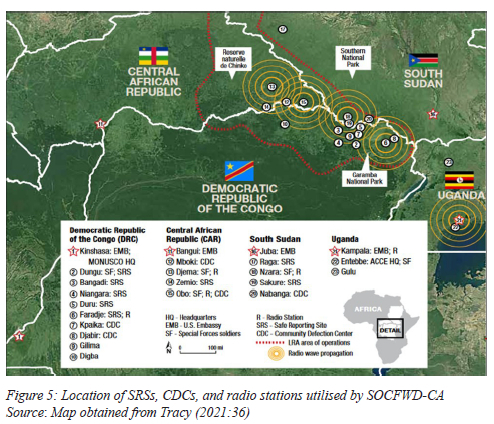
Utilising the data compiled by Easter and Hatangimana from SOCAF, the humanitarian effects of the robust PsyOp campaign can be understood. However, as the officers noted, limitations exist within the data based on operational constraints and local nuance, for instance, distinctions between LRA "defectors" and "returnees" were difficult to assess. It was also not easy to determine how long individuals had to have been with the LRA to qualify as a combatant who could then defect. Additionally, analysing trends across a variety of reporting sources presented challenges to create a clear picture of any causal relationship between PsyOp efforts and LRA defection rates (Easter & Hatangimana, 2017:53-58).
Still, even taking these limitations into account, the analysis provided several insights into the humanitarian outcome of the PsyOp efforts of SOCFWD-CA. At base level, the data gathered from SOCAF and NGOs showed a net decrease in the number of civilian captives over the 77 months of American involvement (3 482 returnees and 1 801 abductions) when compared with pre-OOC data. Easter and Hatangimana's (2017:62-63) analysis shows a positive correlation between monthly totals of LRA defectors and the influence of leaflet drops, radio broadcasts, conducted via airborne loudspeakers throughout the area of operations. Data on the PsyOp messaging source came from interviews conducted with LRA defectors at the SRS or CDC locations. The authors contend that the data suggest:
[T]hese media were effective in promoting defection, or at least in targeting populations capable of escape [...] our data analysis indicates that OOC was at least partially successful with an increase in the defection of LRA fighters and a decrease in civilian casualties (Easter & Hatangimana, 2017:6365).
Interviews with LRA defectors provided additional evidence towards the efficacy of the campaign, with multiple anecdotal accounts testifying to the influence that collecting leaflets or hearing helicopter-borne messages had on their decision to flee the LRA (Easter, 2019:36). The possible effects of the PsyOp campaign are also supported by related research on LRA defectors. An interview during a 2017 study (see Riley, Pearson, Schneider & Stimeling, 2017), with 85 former LRA members indicated that the greatest common factor (62,4%) expressed for leaving was that life in the group had become too hard. While this represents more of a push from the LRA than a pull to the SRS or CDC sites, additional questions showed that between 32% and 45% of respondents feared some form of retribution from the UPDF after surrendering (Riley et al., 2017:88-91). These fears were understood by SOCFWD-CA and incorporated into a diverse array of PsyOp products. Numerous examples of leaflets exist that feature former LRA members enjoying life away from the LRA and without worry of punishment from the UPDF (Easter & Hatangimana, 2017:89-98). More definitive evidence is available on the effect that messaging had on defection of LRA leadership, the fourth line of effort of the campaign. After conducting intensive research on known LRA leaders, American PsyOp specialists developed messages using individual family histories, known attributes or motivations. Such personalised messaging led to the defection of several high-profile leaders, including Joseph Kony's communications chief, who specifically credited the contents of the message with driving him to abandon the LRA (Easter, 2019:36).
In total, it is estimated that, from 2012 to the completion of the mission in 2017, the number of LRA fighters declined from roughly 500 to fewer than one hundred (Tracy, 2021:41-43). While the "push" of poor living conditions for LRA fighters clearly played a role, the "pull" of the SOCFWD-CA defection campaign makes a compelling case for the positive humanitarian outcome of OOC, given the decrease in the number of active fighters harming civilians as well as the influence such defections had on returnees' new lives after reintegration. This return to society was not without challenges. Macdonald and Kerali (2021:766-790) documented the continued struggle of returning LRA defectors reintegrating into civil society. Interviews with OOC participants (see Easter, 2022) also considered the demobilisation, disarmament, and reintegration (DDR) efforts an afterthought, pointing to evidence of former LRA fighters being employed as mercenaries by armed groups in South Sudan. Still, previously cited interviews with former LRA combatants suggested that the change in lifestyle was positive. Assessing the causal relationship between the influence of the PsyOp efforts and LRA defections remains difficult. Qualitative interviews (e.g. Anonymous SOF CA officer, 2023) however support the idea that the American expertise in crafting and delivering messages played a significant role in LRA attrition. The interviewees also applauded the United States Agency for International Development (USAID) for sponsored construction of radio stations that expanded a community early-warning system.
As an unintended consequence, SOCFWD-CA also benefited from the deployment of a Special Operations Resuscitation Team (SORT) from the 528th Sustainment Brigade, the dedicated special operations support unit of the US Army. Typically comprising eight medical specialists, the SORTs deployed were limited to five due to the strict cap on force size. Due to the vast size of the SOCFWD-CA area of operations and the lack of medical infrastructure, SOCAF planners recognised the need for increased medical treatment capabilities closer to the ODAs and AU-RTF troops. The COFC at Nzara, South Sudan was identified as an ideal location for the SORT in order to provide the most centralised "Role-2" medical coverage to US or AU-RTF troops (Howard, 2018:46-50). While the deployment of the SORT to Nzara was designed to improve the survivability of the ODAs and AU-RTF troops operating across the region, it also had a humanitarian outcome within the immediate area. Due to a lack of casualties sustained during operations, SORT members regularly trained AU-RTF forces at the COFC in Nzara, as well as civilian medical staff at the local hospital. SORT members interviewed after multiple tours of OOC reported an observed increase in the medical capabilities of both allied security forces and the local medical staff in Nzara. Additionally, many local civilians (including both LRA defectors and unrelated civilian injuries) were treated by SORT members, with 298 patients being seen during one six-month deployment (Howard, 2018:53-55). SOF CA medics were also deployed to Nzara in what one interviewee (Anonymous SOF CA officer, 2023) called 'probably the most humanitarian-focused mission of my team'.
Based on the lack of medical equipment and personnel in the area before the establishment of the Nzara COFC, the deployment of the SORT and SOF CA, medical personnel had a small but notable humanitarian outcome, advancing the OOC goals of providing continued relief to LRA-affected areas.
Other Causal Factors for LRA Decline
Before concluding on a potential causal relationship between the LRA decline and US intervention, other factors have to be considered. One possible explanation could be local weather patterns. The effects of abnormal rainfall have been shown to have some effect in generating new communal conflicts within sub-Saharan Africa, especially in dry years, as added stress on agriculture strains social systems and can spark new disputes (Fjelde & Von Uexkull, 2012:449-452). The case of the LRA is however likely to be different from such findings, as opposed to a sedentary population reliant on weather for agriculture. For years, the LRA had been acting as a roving gang of bandits, relying on raids for resupply. Similar work, specifically on the LRA and UPDF from 1997-2011 within Uganda, has made a compelling case for the dampening effect that precipitation has, arguing that such weather not only prevents military action on that specific day but also creates added pressure to execute weather-delayed operations once conditions improve (Carter & Veale, 2015:385-386). Given annual rainfall patterns remain largely the same, such factors would however probably not be able to explain changes in LRA attacks year over year.
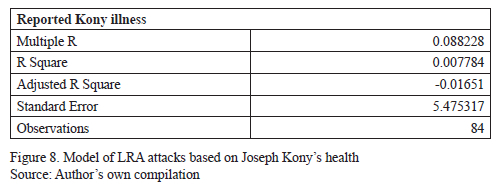
An additional factor to be considered is the personal health of Joseph Kony. Given the small number of fighters thought to be active in the LRA, and Kony's charisma and mystic style of quasi-religious leadership, one might expect that illnesses would prevent Kony from directing attacks or applying pressure on subordinates to carry out raids. Historical examples of leader illnesses affecting military operational tempo include George Washington's struggles with smallpox during the Revolutionary War (Becker, 2004:381^30) and Adolf Hitler's argued struggle with Parkinson's disease (Gupta, Kim, Agarwal, Lieber & Monaco, 2015: 1447-1452). Searches for unique reporting identified two instances when defectors and local defence officials indicated knowledge of Kony being afflicted by various illnesses by late 2013 and again by mid-2015 (Reuters, 2013; Robie, 2015). Using these reports, I created dummy variables of Sick and Healthy, set for seven-month windows around the supposed time of Kony falling ill (three months before, the month of publication, and three months after). Again, regression analysis of these variables and the same ACLED data showed no significant relationship between potential times of illness and the level of LRA attacks in the region. Again, a lack of reliable information regarding Kony's health limits the true usefulness of this new proposed method for this case study. Figure 8 below summarises Joseph Kony's health dummy variable, temporally aligned with local reporting of illnesses affecting the LRA leader's ability to direct operations.
Counter/actual - AU-RTF goes it alone?
With these findings now considered, a counterfactual argument should also be presented, namely would the UPDF and the other AU-RTF members have had the same effect on the humanitarian situation in the tri-border region if the United States had not committed its small contingent of SOF and support personnel?
The best source of information for what such an operation would look like is the previous attempt by the UPDF to kill or capture Kony, Operation Lightning Thunder (OLT). As mentioned, at the time, this offensive involved thousands of Ugandan troops as the only military in the affected region that could conduct sustained operations. Many observers noted not only the military failure to kill Kony but also the heavy-handedness of the UPDF that caused the displacement of many civilians throughout the area of operations. Despite the provision of American assistance through intelligence on compound locations, the UPDF was unable to capture or kill any meaningful LRA leaders, and distanced itself from the large numbers of civilians displaced or killed as a result of the violent response by the LRA. The exacerbation of the humanitarian situation by the UPDF was called by some an 'unmitigated disaster' (see Atkinson, 2009:15); however, the likelihood of such mistakes being repeated to such a large degree in a renewed offensive is arguably low.
Through its history of operations against the UPDA and LRA in northern Uganda, the UPDF has demonstrated the capability to practice effective counterinsurgency tactics when directed to do so. Such was observed in the previously discussed infrastructure projects pursued during OOC in areas near UPDF bases. With increased pressure by the United States for an emphasis on protecting civilian populations following OLT, a UPDF-led AU-RTF could probably have pursued a wider campaign of aid and reconstruction for affected communities in addition to expanded combat operations. It should be stated, though, that the marginal gains made by UPDF attacks do not indicate that a counterfactual operation would be any more successful than OOC, and indeed may have led to more revenge-style LRA attacks and abductions.
Summary of Findings
To review, the overall humanitarian outcome of OOC was positive in its direction and relatively substantial given the incredibly small number of American troops deployed to support the intervention.
The deployment of several ODAs of Special Forces to remote outposts across the LRA-affected areas of South Sudan, the DRC, and the CAR served not only as a boost to African Union troops through the advisory efforts of the green berets (observed through the absence of collateral damage or casualties previously seen during efforts, such as OLT), but also as an effective deterrent to LRA attacks. While trends in LRA activity declined before the arrival of the American troops and continued throughout the entire area of operations, attacks within 30 miles (48 kilometres) of these outposts saw a steeper decline once the ODAs had established themselves, indicating some degree of deterrent effect from the presence of American SOF. A positive outcome was also assessed from the PsyOp campaigns designed to facilitate defections of LRA fighters. Using specialised training and access to messaging resources, the American PsyOp specialists led the planning and execution of campaigns that saw an increase in the number of both rank-and-file and high-profile LRA defections, when compared to previous efforts by the UPDF. Lastly, an unintended but noted humanitarian outcome was delivered through the presence of the SORT in Nzara, South Sudan. Originally deployed to treat American casualties, the SORT (and CA medical specialists) eventually performed limited medical training and services in the immediate area.
A review of two potential alternative explanations - weather effects and Joseph Kony's personal health - supports the argument that the decline in attacks and the continued absence of any major resurgence by the LRA was due in part to the multi-pronged efforts of SOCFWD-CA and the AU-RTF.
Conclusion
While the counter-LRA efforts are most remembered by the viral "Kony 2012" video campaign that gained millions of views and renewed global interest in the hunt for the warlord, the fact remains that the American intervention into Central Africa was a success in its attrition of the ranks of the group and prevention of the escalation of violence against civilians. Noted for its incredibly small size - given the geographic area for which it was responsible - SOCFWD-CA demonstrated the ability of US SOF to produce outsized results, and stands out as a relatively unique case of a SOF-driven humanitarian intervention. Thanks in large part to the presence of a well-developed NGO network and US-supported partner forces in the AU-RTF, the ODAs and PsyOp teams were able to maximise their ability to disrupt the LRA both directly and indirectly, and to achieve several OOC objectives. As a result, OOC offers many potential lessons for both the United States and the conduct of humanitarian interventions.
As a case study in the application of a "cross-functional team" approach by US Army SOF, OOC represents both successes and missteps. The inclusion of PsyOp from an early stage as a fundamental component of SOCFWD-CA reflected not just a realisation of the difficulty in locating Kony and the LRA, but also an appreciation of the potential that "non-kinetic" special operations had in such scenarios (Tracy, 2021:43-44). The absence of civil affairs early in the operation however prevented SOCFWD-CA from representing what today would be called a true cross-functional team. Had such CA forces been deployed, SOCFWD-CA would undoubtedly have benefited from an improved ability to coordinate interagency efforts and to engage with civil society actors in the affected areas. Interviews with veterans of the operation (e.g. Anonymous SOF CA officer, 2023) reflect such, pointing to a gap in SOCFWD-CA understanding of tribal dynamics that might have otherwise improved OOC knowledge of local political geographies. Additionally, while the direct provision of humanitarian aid was outside the scope of OOC, deploying CA specialists with experience in such operations would probably have improved ongoing efforts by NGOs and civil society organisations to provide humanitarian aid directly (Easter, 2022). Still, the close coordination between American special forces and PsyOp teams under SOCFWD-CA represents a positive lesson in special operations. Additionally, the deployment of the SORT to Nzara and the ability to obtain civilian aircraft to reach the remote COFCs serves as a successful model of overcoming intense logistical hurdles in order to project power over an extended time. The unique nature of OOC and the LRA may however limit the applications of the operation to future humanitarian interventions. For one, the small size of the LRA compared to the numbers of AU-RTF troops makes OOC stand out from other potential or ongoing interventions against larger non-state armed groups, such as the Islamic State, Al-Shabaab, or Boko Haram. Moreover, the use by the LRA of abduction and child soldiers to fill its ranks probably contributed to the willingness of said fighters to defect. A similar PsyOp campaign targeting an armed group, such as Boko Haram, with more motivated members and many more who volunteered to join the organisation, might have struggled to elicit the same number of defectors. Such hypothetical interventions would however undoubtedly have benefited from the close interagency coordination and development of leaflets designed for target populations in areas of low literacy.
Future research may benefit from increased study of the deterrent effect of Western advisors. In 2018, the US Army established a new unit specifically designed for advising conventional forces, the Security Force Assistance Brigade (SFAB). This SFAB has since deployed to several countries to train and advise regular forces, as opposed to the historical focus of US Special Forces on training irregular or guerrilla forces (Feickert, 2020). While the primary focus of these "brown berets" has been the improvement of partner forces, conducting similar research on trends in non-state armed group activity during SFAB presence may illuminate the authority that the reputations of Western troops carry. Meanwhile, special forces continue to deploy worldwide to train and support other allied militaries. Similar research could provide insight into security changes caused not just by improvements in units trained by special forces but by the very presence of the "green berets". Similarly, the recent growth in the Russian military footprint in the region presents several opportunities for studying the influence of military advisors. Deployments of Wagner mercenaries into the CAR and Sudan (in addition to several countries in West Africa) have garnered media attention for the brutal tactics being used either by Russian-trained security forces or directly by members of the ostensibly private military company (Pokalova, 2023:1-23). With respect to the scope of this research, recent reporting (Bishop, 2024) has even suggested that Wagner mercenaries deployed to the CAR are directly engaging in a campaign to locate and eliminate Joseph Kony. A study of similar scope might offer insight into the effects of American and Russian approaches to expeditionary operations.
Lastly, while directly addressing the IDP situation was outside the scope of OOC, future research might also benefit from examining the secondary effects the American intervention may have had on the humanitarian situation of these populations. The emphasis on interagency coordination placed by the US government for the support of OOC may well have led to the increased efficiency of development organisations and other NGOs working directly on humanitarian aid. Further research on the role that CA personnel played in facilitating this coordination would shed light on the value added, which is more difficult to quantify than numbers of fighters killed; yet, would be inherently valuable. Critically, analysis on the humanitarian state of the tri-border region since the conclusion of OOC would offer insight into the longer-term effects of American involvement in the region.
Overall, OOC serves as an example of a somewhat unique style of humanitarian intervention. Small in size and comprising mainly SOF, SOCFWD-CA utilised specialised training, unique capabilities, and the support of regional allies to disrupt the LRA to the point of irrelevance, preventing the escalation of violence against civilians and improving the humanitarian situation, despite failing to capture or kill Kony.
REFERENCES
Anonymous SOF Civil Affairs officer. 2023. Personal interview, 20 November, digital correspondence. [ Links ]
Arieff, A. & Ploch, L. 2012 The Lord's Resistance Army: The U.S. response. The Library of Congress, Congressional Research Service. Retrieved from https://apps.dtic.mil/sti/pdfs/ADA584570.pdf [Accessed 17 February 2022]. [ Links ]
Atkinson, R.R. 2009. From Uganda to the Congo and beyond. International Peace Institute. Retrieved from https://www.files.ethz.ch/isn/126886/uganda_to_congo_11_2009.pdf [Accessed 20 April 2022]. [ Links ]
Becker, A. 2004. Smallpox in Washington's Army: Strategic implications of the disease during the American Revolutionary War. The Journal ofMilitary History, 68(2):381-430. [ Links ]
Bishop, M.W. 2024. Russian mercenaries hunt the African warlord America couldn't catch. Rolling Stone, 27 April. Retrieved from https://www.rollingstone.com/politics/politics-features/russian-mercenaries-wagner-joseph-kony-warlord-1235011454 [Accessed 30 September 2024]. [ Links ]
Branch, A. 2012. The paradoxes of protection: Aligning against the Lord's Resistance Army. African Security, 5(3/4):160-178. https://doi.org/10.1080/19392206.2012.732887 [ Links ]
Carter, T.A. & Veale, D.J. 2015. The timing of conflict violence: Hydraulic behavior in the Ugandan civil war. Conflict Management and Peace Science, 32(4):370-394. https://doi.org/10.1177/0738894214559674 [ Links ]
Day, C.R. 2019 "Survival mode": Rebel resilience and the Lord's Resistance Army. Terrorism and Political Violence, 31(5):966-986. https://doi.org/10.1080/09546553.2017.1300580 [ Links ]
Demmers, J. & Gould, L. 2018. An assemblage approach to liquid warfare: AFRICOM and the "hunt" for Joseph Kony. Security Dialogue, 49(5):364-381. https://doi.org/10.1177/0967010618777890 [ Links ]
Easter, J. 2019. A mission of attrition: The 7th Psychological Operations Battalion's PSYOP campaign against the Lord's Resistance Army. Special Warfare, 32(1):32-38. [ Links ]
Easter, J. 2022. Personal interview, 20 April, digital correspondence. [ Links ]
Easter, J.R. & Hatangimana, B.M. 2017. Bending the spear: The campaign against the Lord's Resistance Army. Master's thesis, Naval Postgraduate School. [ Links ]
Feickert, A. 2020. Army Security Force Assistance Brigades (SFABs). Congressional Research Service. Retrieved from https://crsreports.congress.gov/product/pdf/IF/IF10675/11 [Accessed 27 April 2022]. [ Links ]
Fjelde, H. & Von Uexkull, N. 2012. Climate triggers: Rainfall anomalies, vulnerability and communal conflict in sub-Saharan Africa. Political Geography, 31(7):444-453. https://doi.org/10.1016/j.polgeo.2012.08.004 [ Links ]
Forest, J.J.F. 2014. U.S. Military deployments to Africa: Lessons from the hunt for Joseph Kony and the Lord's Resistance Army. Joint Special Operations University. Retrieved from https://apps.dtic.mil/sti/pdfs/ADA617136.pdf [Accessed 20 March 2022]. [ Links ]
Gupta, R., Kim, C., Agarwal, N., Lieber, B. & Monaco, E. 2015. Understanding the influence of Parkinson disease on Adolf Hitler's decision-making during World War II. World Neurosurgery, 84(5):1447-1452. [ Links ]
Howard, C. 2018. A different SORT of mission: Special Operations Resuscitation Teams in Operation OBSERVANT COMPASS. Veritas, 14(3):44-56. [ Links ]
Hirsch, J.L. 2011. The Black Hawk Down Effect. Foreign Policy, 12 August. Retrieved from https://foreignpolicv.com/2011/08/12/the-black-hawk-down-effect/#:~:text=The%20denouement%20began%20on%20Oct.%203%2C%201993%2C%20with.nightmare%20that%20has%20engulfed%20the%20countrv%20ever%20since [Accessed 8 November 2024]. [ Links ]
Internal Displacement Monitoring Centre. N.d. Global internal displacement database. Retrieved from https://www.intemal-displacement.org/database/displacement-data [Accessed 8 March 2022]. [ Links ]
Internal Displacement Monitoring Centre. 2013. LRA-related displacement in central Africa. Norwegian Refugee Council. Retrieved from https://www.intemal-displacement.org/sites/default/files/publications/documents/201309-af-lra-overview-en.pdf [Accessed 20 February 2022]. [ Links ]
Invisible Children. N.d. LRA Crisis Tracker. Retrieved from https://lracrisistracker.com [Accessed 20 February 2022]. [ Links ]
Invisible Children. 2021. Crisis Tracker: An overview of the crisis tracker's mapping methodology and database codebook. Retrieved from https://crisistracker.org/codebook.pdf [Accessed 20 February 2022]. [ Links ]
Khasalamwa-Mwandha. S. 2019. Geographical versus social displacement: The politics of return and post-war recovery in Northern Uganda. Development in Practice, 29(3):314-325. https://doi.org/10.1080/09614524.2018.1549652 [ Links ]
Lewis. J.I. 2020. How insurgency begins: Rebel group formation in Uganda and beyond. Cambridge: Cambridge University Press. [ Links ]
Macdonald. A. & Kerali. R. 2021. Being normal: Stigmatization of Lord's Resistance Army returnees as "moral experience" in post-war Northern Uganda. Journal of Refugee Studies. 33(4):766-790. https://doi.org/10.1093/irs/fez117 [ Links ]
MacFarlane. S.N.. Thielking. C.J. & Weiss. T.G. 2004. The responsibility to protect: Is anyone interested in humanitarian intervention? Third World Quarterly, 25(5):977-992. https://doi.org/10.1080/0143659042000232063 [ Links ]
Pokalova. E. 2023. The Wagner Group in Africa: Russia's quasi-state agent of influence. Studies in Conflict & Terrorism, 1-23. https://doi.org/10.1080/1057610X.2023.2231642 [ Links ]
Raleigh. C.. Linke. A.. Hegre. H. & Karlsen J. 2010. Introducing ACLED-armed conflict location and event data. Journal of Peace Research. 47(5):651-660. [ Links ]
Reuters. 2013. Joseph Kony. Ugandan war lord. may be suffering from serious illness. HuffPost, 20 November. Retrieved from https://www.huffpost.com/entrv/ioseph-konv-ill_n_4312316 [Accessed 22 April 2022]. [ Links ]
Rice. X. 2009. Lord's Resistance Army terrorises Congo after Ugandan crackdown. The Guardian, 14 September. Retrieved from https://www.theguardian.com/world/2009/sep/14/lords-resistance-armv-terrorises-congo [Accessed 13 April 2022]. [ Links ]
Riley. J.. Pearson K.. Schneider M.K.. Stimeling L. 2017. Escaping the LRA: Examining the decision to disengage from militarized dissident groups. African Security. 10(2):80-102. https://doi.org/10.1080/19392206.2017.1305859 [ Links ]
Robie. A. 2015. 7 long-term LRA escapees report that Kony's health isfailing. Invisible Children. Retrieved from https://invisiblechildren.com/blog/2015/07/07/7long-term-lra-escapees-report-that-konys-health-is-failing/ [Accessed 22 April 2022]. [ Links ]
Shepherd, B., Davis, L. & Jowell, M. 2015. In new light: Protection of civilians, the Lord's Resistance Army and the African Union Regional Task Force. Conciliation Resources. Retrieved from https://rc-services-assets.s3.eu-west-1.amazonaws.com/s3fs-public/InNewLight_AURTF%20and%20POC_May2015.pdf [Accessed 14 April 2022]. [ Links ]
Tangeman, D. & Lindsley, J. 2013. Counter-Lord's Resistance Army: Logistics in Central Africa. Special Warfare, 26(1):28-31. [ Links ]
Office of the Spokesperson, U.S. Department of State. 2012. The Lord's Resistance Army. Retrieved from https://2009-2017.state.gov/r/pa/prs/ps/2012/03/186734.htm [Accessed 17 February 2022]. [ Links ]
Tracy, J.M. 2021. A team approach: PSYOP & LRA defection in 2012. Veritas, 17(1):22-45. [ Links ]
U.S. Department of the Army. 2020. ATP 3-90.98jungle operations. Retrieved from https://armypubs.army.mil/epubs/DR_pubs/DR_a/ARN30806-ATP_3-90.98-000-WEB-1.pdf [Accessed 1 April 2022]. [ Links ]
VOA News. 2017. Lawmakers: Lots of unanswered questions remain about Niger ambush. VOA, 26 October. Retrieved from https://www.voanews.com/a/us-defense-officials-briefing-senators-on-niger-attack/4087217.html [Accessed 5 April 2022]. [ Links ]
White House Office of the Press Secretary. 2012. Fact sheet: Mitigating and eliminating the threat to civilians posed by the Lord's Resistance Army. Retrieved from https://obamawhitehouse.archives.gov/the-press-office/2012/04/23/fact-sheet-mitigating-and-eliminating-threat-civilians-posed-lord-s-resi [Accessed 13 April 2022]. [ Links ]
1 Major Daniel Moriarty serves as an instructor in the Department of Geography and Environmental Engineering at the United States Military Academy, at West Point, New York. Daniel graduated from West Point in 2013, earning Bachelor of Science degrees - one in Human Geography and another in Defence Studies. In 2023, he obtained a master's degree in Geography from the University of Texas at Austin, studying the role of social media in organising Uganda's People Power movement. He has completed multiple deployments to the Middle East, and continues to focus his research on civil resistance and the role of nonviolent means of support to irregular warfare campaigns.
2 The distance of 30 miles (48 kilometres) was chosen based on an average two-day walking distance, assuming an LRA fighter would be capable of 12 hours of daily movement. The distance rate was determined using the American Army Techniques Publication 3-90.98, Jungle Operations (Washington, D.C.: Department of the Army, 2020:156).
