Eating disorders and substance use at a South African tertiary hospital over a 21-year period
Abstract
BACKGROUND: Eating disorders (EDs) and substance-related disorders pose a challenge when they co-occur and have implications for patient management. Clinical information on EDs and substance-related disorders as independent disorders is fairly well established in South Africa, but our understanding of the coexistence of these disorders is limited. AIM: To determine the prevalence, the concurrent nature and the possible trends of substance use among patients diagnosed with EDs at a South African tertiary hospital over a 21-year period. SETTING: The ED unit at Tygerberg Hospital, Cape Town, South Africa. METHODS: We performed a retrospective chart review of 162 patients who were treated for EDs between January 1993 and December 2014. RESULTS: The prevalence of ED subtypes was 40.1% bulimia nervosa (BN), 33.3% EDs not otherwise specified (EDNOS) and 26.5% anorexia nervosa. Most participants (71.0%) used at least one substance. Alcohol was the most prevalent substance of choice (54.8%). Most patients had an additional psychiatric disorder (62.3%), of which major depressive disorder was the most prevalent (46.3%). Apart from the use of alcohol and cannabis, which remained consistent, the use of most other substances as well as the prevalence of BN declined during the study period. CONCLUSION: Understanding the prevalence and trends of EDs and the corresponding patterns of substance misuse is essential to improve service provision. This study emphasises the need to better understand the ongoing and changing behavioural trends in EDs to improve patient management.
eating disorders; bulimia nervosa; anorexia nervosa; eating disorder not otherwise specified; substance use; South Africa
Introduction
The global burden of disease study 2013 has found the significant burden of eating disorders (EDs), specifically in young women living in high-income countries. However, between 1990 and 2013, the relative ranking of burden of EDs in low- and middle-income countries increased.112
Although a substance use disorder (SUD) can occur alongside any of the ED subtypes, which include AN, BN, binge eating disorder (BED) and EDs not otherwise specified (EDNOS),34,5,676,8,9,10
Some substances of abuse, especially alcohol, are more highly associated with EDs than others. In one clinical study, 26.9% of ED patients met the criteria for alcohol dependence.11121314
It remains unclear as to why EDs and SUDs frequently coexist. Pearlstein suggested different models of shared and separate vulnerabilities regarding aetiology, namely addiction, genetic/familial, biological, personality/temperament and developmental models.15165,17
Although the precise mechanisms are unclear, the overall impression is that of separate vulnerabilities and also partial sharing of risk factors.
Eating disorders and SUDs pose a formidable challenge when they co-occur and have important implications for treatment and management of patients. Both disorders present with complex physical, emotional and social challenges and are independently associated with the highest mortality rates of all psychiatric disorders.1819,20215,22
Understanding the prevalence and trends of EDs and the corresponding patterns of substance misuse is essential to improve service provision. This is particularly important in the South African context where the advent of democracy in 1994 was characterised by rapid urbanisation and increased exposure of the South African population to Western culture in which self-worth is inordinately pegged on physical appearance,2324
Much information concerning prevalence of EDs is available in international literature, especially for high income countries.
However, a recent review of the epidemiology of EDs on the African continent found only four studies that formally assessed ED patient populations, and information on the comorbidity of EDs and SUDs was not included.2526,27
Methods
Study design
In 2016, we performed a retrospective chart review of patients who were treated at the ED unit at Tygerberg Hospital between January 1993 and December 2014.
Setting
The ED unit at Tygerberg Hospital was established in 1993, which coincides with the advent of democracy in South Africa. The unit provides services for patients with EDs who are referred from primary-, secondary- and tertiary-level care, as well as from private practices. Tygerberg Hospital serves a low- to middle-income population, which is considered 'at risk' for mental disorders, especially owing to poverty, social adversity and high rates of unemployment in the catchment area. All patients are thoroughly evaluated by the multidisciplinary team.
Sample
A total of 190 in- and outpatients were seen at the unit during the study period. We excluded 17 patients with ED related to medical conditions, as well as 11 patients with incomplete records (missing information relating to psychiatric diagnosis, age and gender). The final sample comprised a total of 162 patients, of which 119 were adults (≥18 years of age) and 43 were children or adolescents (10-18 years of age).
Data collection
Patients' age, gender, primary psychiatric diagnosis, as well as medical and/or psychiatric comorbidities were extracted by the principal investigator and subsequently collated on an anonymised Microsoft Excel spreadsheet. Other information collected included patterns of SU, as well as family history of EDs and SU. Because of the retrospective and clinically descriptive nature of this study, it was not possible to distinguish between SU and SUDs consistently. Therefore, all entries relating to SU were included. Psychiatric diagnoses were made based on criteria described in the Diagnostic and Statistical Manual of Mental Disorders3 at the time of assessment. In cases where there were multiple admissions during the study period, demographic and clinical variables at first assessment were reported.
Data analysis
Continuous variables were summarised as mean ± standard deviation (SD), or median and 25th-75th percentiles and SD. Nominal variables were summarised as counts and percentages. We used appropriate parametric or non-parametric methods to test for differences between continuous variables, while Pearson's chi-square test was used to test for differences between categorical variables. Predictors of SU in women were evaluated using logistic regression. All analyses were performed using SPSS, version 24, and statistically significant differences were established at p < 0.05.
Ethical consideration
The study was approved by the Health Research Ethics Committee of Stellenbosch University (S15/09/204), as well as the Western Cape Health Research Committee. The study was granted a waiver of informed consent.
Results
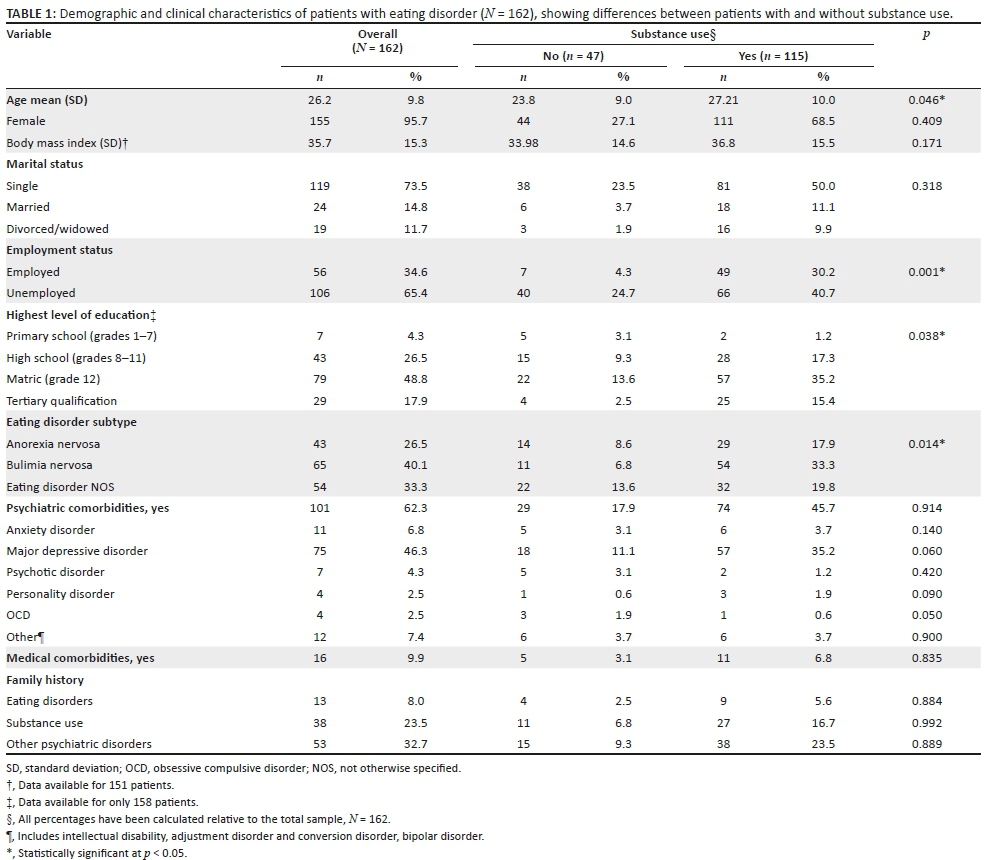
The demographic and clinical characteristics of 162 patients with EDs are summarised in Table 1.
The mean age of the participants was 26.2 years (SD, 9.8; range 10-61 years). The majority of the population were female (n = 155, 95.7%), single (n = 119, 73.5%), unemployed (n = 106, 65.4%) and educated up to a matric level (n = 79, 48.8%). The overall prevalence of ED subtypes was 40.1% BN, 33.3% EDNOS and 26.5% AN.
There were no significant differences in demographic characteristics, except for the highest level of education (p = 0.009), between patients with different ED subtypes. Most patients had an additional psychiatric disorder (n = 101, 62.3%), of which major depressive disorder was the most prevalent (46.3%). Multiple comorbidities were common in this sample. Family histories included the presence of EDs (8%), SU (23.5%) and other psychiatric disorders (32.7%), such as major depressive disorder and anxiety disorders.
The majority (n = 115, 71.0%) of the participants used at least one substance (Table 1). There was no significant difference in age or body mass index between patients who used substances and those who did not. Substance use was most prevalent among patients with BN (n = 54, 33.3%). Results of the chi-square test showed that there were significant differences in employment status, education level and ED subtypes between patients who used substances and those who did not. The results of logistic regression revealed that being employed (odds ratio [OR] 3.99; confidence interval [CI]: 1.25-12.8) or having BN (OR 4.81; CI: 1.55-14.9) were significant predictors of SU in women.
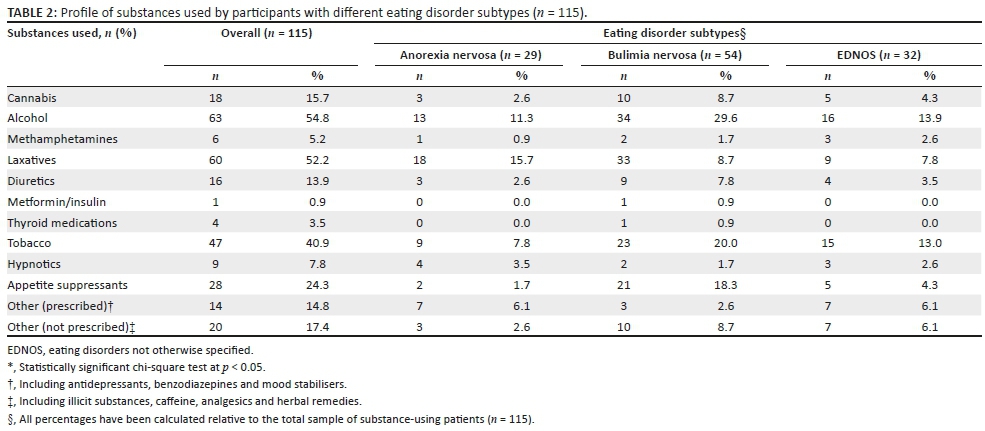
Amongst patients who used at least one substance (n = 115, 71.0%), alcohol was the most prevalent substance of choice (54.8%), followed by laxatives (52.2%), tobacco (40.9%) and appetite suppressants (24.3%) (Table 2). The use of multiple substances was common in this sample. The use of cannabis, alcohol, laxatives, diuretics, tobacco, appetite suppressants and non-prescribed drugs was most prevalent amongst patients with BN.
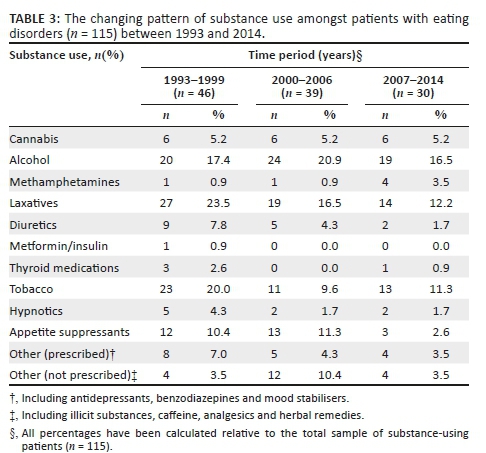
Apart from the use of alcohol and cannabis, which remained consistent, the use of most other substances declined during the study period (Table 3). The sample was too small to assess possible statistically significant changes in the patterns of SU during the study period.
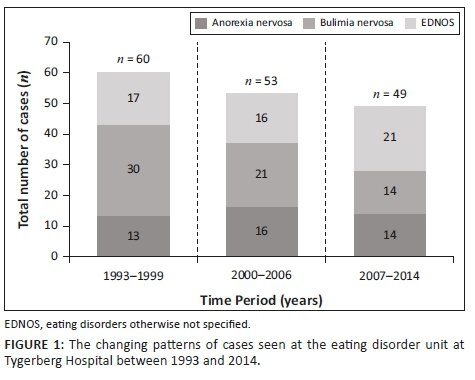
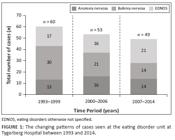
The prevalence of ED cases treated at the ED unit changed during the study period (Figure 1). Overall, the total number of cases treated at the ED unit at Tygerberg Hospital declined from 60 cases between 1993 and 1999 to 49 cases between 2007 and 2014. Bulimia nervosa was the most prevalent ED between 1993 and 2006, while EDNOS was most prevalent between 2007 and 2014. The number of AN cases remained constant throughout the entire study period. The sample was too small to assess possible statistically significant changes in the prevalence of different EDs during the study period.
Discussion
This study profiled ED subtypes and concurrent SU in ED patients treated at a South African tertiary hospital between 1993 and 2014. To our knowledge, this is the first of its kind in South Africa, which we feel is interesting given that we found the rate of SU to be high. This burden of concurrent disorders may have significant clinical implications in terms of patient management and care. This report, therefore, alerts clinicians to a high index of suspicion and the need for early identification of comorbidities in South African ED populations.
Individuals with BN had the highest rates of consumption for most of the substances assessed, significantly alcohol, laxatives and appetite suppressants. Together with being employed, possibly reflecting purchasing ability, a diagnosis of BN was significantly associated with concurrent SU. Several studies have also reported higher rates of SU including amphetamines among patients with BN relative to those with AN.7,28
Findings between ED patients with SU and ED patients without SU are consistent with previous reports.29
This study also demonstrated the comorbidity of major depressive disorder in patients with EDs only (46.3%), and in those with EDs and SU (35.2%). Although the trend suggests that mood disorders were more prevalent in patients with EDs and SU, the difference was not statistically significant (p < 0.06). This association, however, requires further investigation, especially to determine the relationship between mood disorders and SU in patients with EDs (e.g. between cause and effect). Similarly, clinical awareness and early detection of mood disorders could improve outcomes in these subgroups of patients with EDs. Not having a third comparison group (SU without an ED) by the same criteria limits the final interpretation of our results.
In the 1990s, BN was the most common ED subtype in the unit but had declined twofold by 2014 relative to the other diagnoses both in proportion and absolute numbers. The number of AN patients remained relatively stable over the entire period, but rates of EDNOS almost doubled, becoming the predominant subtype by 2014.
Of every 10 patients at the unit in the 1990s, BN accounted for six, compared to two each for AN and EDNOS. However, by the 2007-2014 period, the ratio had changed to three, two and nearly five, respectively, thus showing a clear decline in relative BN rates. It is unclear whether this finding reflects trends in community ED prevalence. The pattern, however, consistent with observations that rather than a true increase in community incidence, peaks of newly diagnosed ED cases in the mid- to late 1990s may have resulted from increased awareness and detection of a relatively 'new disorder', which subsequently stabilised at a true level.303030,31,32
Thus, EDNOS was not only the most frequent but also the only proportionally increasing ED in our sample supporting other studies that have identified it as the most prevalent subtype in clinical and epidemiological samples.32,33,342536
Although only four patients (8.0%) indicated using methamphetamine by 2014, this was still a notable rise, compared to the previous 15 years. This rate is very consistent with the life-time prevalence of 9% reported in adolescents in Cape Town,3738
The use of cannabis and alcohol remained stable throughout the study period at approximately 10% and 45%, respectively. Cigarette smoking, however, plummeted from 38% in the 1990s to 21% in 2000/2006 before rising to 27% in the last period. This paralleled trend in national smoking prevalence rates fell from 32% in 1994 to 16.4% in 201139
This study was limited by its retrospective nature, and the information collected was constrained by the incompleteness and inaccuracy of the original data source, especially regarding SU, where reliance was solely on self-report data. As such, a distinction between abuse and dependence could not be made. Patient numbers in the three diagnostic categories were also too low to allow statistical significant comparisons over the study period. In addition, data on ethnicity were not uniformly documented (and was unusable) in spite of the importance of establishing multiethnic data for EDs40,4127
Conclusion
This study showed that BN was the most common ED subtype in our clinic in the 1990s but has declined proportionally, compared to EDNOS at the end of the study period. Finally, the overall use of substance among patients with ED, especially BN, was high but seems to be on the decline in this study sample in recent years. It would be useful for future prospective research to assess the possible changing trends and prevalence of EDs and SU behaviour using the more recent DSM-5 criteria with a view of also distinguishing between SU and SUDs. It is anticipated that a better understanding of ongoing and changing behavioural trends in EDs would contribute to improved future patient management.
Competing interests
The authors have declared that no competing interests exist.
Authors' contributions
All authors contributed equally to this work.
Funding information
This research received no specific grant from any funding agency in the public, commercial or not-for-profit sectors.
Data availability statement
Data are available upon request from the corresponding author.
Disclaimer
The views and opinions expressed in this article are those of the authors and do not necessarily reflect the official policy or position of any affiliated agency of the authors.
Acknowledgements
The authors would like to thank Ms Maritha Greeff (registered nurse therapist) and Ms Elizabeth Layman (administrative clerk) at the ED Unit for their invaluable support in updating and collecting data.
References
-
1.Erskine HE, Whiteford HA, Pike KM. The global burden of eating disorders. Curr Opin Psychiatry. 2016;29(6):346-353. https://doi.org/10.1097/YCO.0000000000000276
» https://doi.org/10.1097/YCO.0000000000000276 -
2.The National Center on Addiction and Substance Abuse (CASA) at Columbia University. Food for thought: Substance abuse and eating disorders [homepage on the Internet]. New York, NY: The National Center on Addiction and Substance Abuse (CASA) Columbia University; 2003 [cited 2019 Jun 03]. Available from: https://www.centeronaddiction.org/addiction-research/reports/food-thought-substance-abuse-and-eating-disorders
» https://www.centeronaddiction.org/addiction-research/reports/food-thought-substance-abuse-and-eating-disorders - 3.American Psychiatric Association. Diagnostic and statistical manual of mental disorders: DSM-IV-TR. Washington, DC: American Psychiatric Association; 2000.
-
4.Gadalla T, Piran N. Eating disorders and substance abuse in Canadian men and women: A national study. Eat Disord. 2007;15(3):189-203. https://doi.org/10.1080/10640260701323458
» https://doi.org/10.1080/10640260701323458 -
5.Harrop EN, Marlatt GA. The comorbidity of substance use disorders and eating disorders in women: Prevalence, etiology, and treatment. Addict Behav. 2010;35(5):392-398. https://doi.org/10.1016/j.addbeh.2009.12.016
» https://doi.org/10.1016/j.addbeh.2009.12.016 -
6.Holderness CC, Brooks-Gunn J, Warren MP. Co-morbidity of eating disorders and substance abuse review of the literature. Int J Eat Disord. 1994;16(1):1-34. https://doi.org/10.1002/1098-108X(199407)16:1%3C1::AID-EAT2260160102%3E3.0.CO;2-T
» https://doi.org/10.1002/1098-108X(199407)16:1%3C1::AID-EAT2260160102%3E3.0.CO;2-T - 7.Root TL, Pinheiro AP, Thornton L, et al. Substance use disorders in women with anorexia nervosa. Int J Eat Disord. 2010;43(1):14-21.
-
8.Braun DL, Sunday SR, Halmi KA. Psychiatric comorbidity in patients with eating disorders. Psychol Med. 1994;24(4):859-867. https://doi.org/10.1017/S0033291700028956
» https://doi.org/10.1017/S0033291700028956 -
9.Garcia-Vilches I, Badia-Casanovas A, Fernández-Aranda F, et al. Characteristics of bulimic patients whose parents do or do not abuse alcohol. Eat Weight Disord. 2002;7(3):232-238. https://doi.org/10.1007/BF03327461
» https://doi.org/10.1007/BF03327461 -
10.Jordan J, Joyce PR, Carter FA, et al. Anxiety and psychoactive substance use disorder comorbidity in anorexia nervosa or depression. Int J Eat Disord. 2003;34(2):211-219. https://doi.org/10.1002/eat.10177
» https://doi.org/10.1002/eat.10177 -
11.Goldbloom DS, Naranjo CA, Bremner KE, Hicks LK. Eating disorders and alcohol abuse in women. Br J Addict. 1992;87(6):913-920. https://doi.org/10.1111/j.1360-0443.1992.tb01986.x
» https://doi.org/10.1111/j.1360-0443.1992.tb01986.x -
12.Bulik CM. Alcohol use and depression in women with bulimia. Am J Drug Alcohol Abuse. 1987;13(3):343-355. https://doi.org/10.3109/00952998709001518
» https://doi.org/10.3109/00952998709001518 -
13.Fouladi F, Mitchell JE, Crosby RD, et al. Prevalence of alcohol and other substance use in patients with eating disorders. Eur Eat Disord Rev. 2015;23(6):531-536. https://doi.org/10.1002/erv.2410
» https://doi.org/10.1002/erv.2410 -
14.Gordon SM, Hagan TA, Beyer E, Snyderman R. Eating disorders prevalent for female chemical dependence patients. J Addict Nurs. 2001;13(3-4):209-214. https://doi.org/10.3109/10884600109052655
» https://doi.org/10.3109/10884600109052655 -
15.Pearlstein T. Eating disorders and comorbidity. Arch Women Ment Health. 2002;4(3):67-78. https://doi.org/10.1007/s007370200002
» https://doi.org/10.1007/s007370200002 -
16.Cooper SE. Chemical dependency and eating disorders: Are they really so different? J Couns Dev. 1989;68(1):102-105. https://doi.org/10.1002/j.1556-6676.1989.tb02503.x
» https://doi.org/10.1002/j.1556-6676.1989.tb02503.x -
17.Von Ranson KM, McGue M, Iacono WG. Disordered eating and substance use in an epidemiological sample: II. Associations within families. Psychol Addict Behav. 2003;17(3):193. https://doi.org/10.1037/0893-164X.17.3.193
» https://doi.org/10.1037/0893-164X.17.3.193 -
18.Harris C, Barraclough B. Excess mortality of mental disorder. Br J Psychiatry. 1998;173(1):11-53. https://doi.org/10.1192/bjp.173.1.11
» https://doi.org/10.1192/bjp.173.1.11 -
19.Bulik CM, Sullivan PF, Joyce PR, Carter FA, McIntosh VV. Predictors of 1-year treatment outcome in bulimia nervosa. Compr Psychiatry. 1998;39(4):206-214. https://doi.org/10.1016/S0010-440X(98)90062-1
» https://doi.org/10.1016/S0010-440X(98)90062-1 -
20.Keel PK, Mitchell JE, Miller KB, Davis TL, Crow SJ. Long-term outcome of bulimia nervosa. Arch Gen Psychiatry. 1999;56(1):63-69. https://doi.org/10.1001/archpsyc.56.1.63
» https://doi.org/10.1001/archpsyc.56.1.63 - 21.Blinder BJ, Chaitin BF, Goldstein RS, editors. The eating disorders: Medical and psychological bases of diagnosis and treatment. New York: PMA Publishing Corporation; 1988.
-
22.Gregorowski C, Seedat S, Jordaan GP. A clinical approach to the assessment and management of co-morbid eating disorders and substance use disorders. BMC Psychiatry. 2013;13(1):289. https://doi.org/10.1186/1471-244X-13-289
» https://doi.org/10.1186/1471-244X-13-289 -
23.Freedman RJ. Reflections on beauty as it relates to health in adolescent females. Women Health. 1984;9(2-3):29-45. https://doi.org/10.1300/J013v09n02_03
» https://doi.org/10.1300/J013v09n02_03 -
24.Peltzer K, Ramlagan S, Johnson BD, Phaswana-Mafuya N. Illicit drug use and treatment in South Africa: A review. Subst Use Misuse. 2010;45(13):2221-2243. https://doi.org/10.3109/10826084.2010.481594
» https://doi.org/10.3109/10826084.2010.481594 -
25.Van Hoeken D, Burns JK, Hoek HW. Epidemiology of eating disorders in Africa. Curr Opin Psychiatry. 2016;29(6):372-377. https://doi.org/10.1097/YCO.0000000000000274
» https://doi.org/10.1097/YCO.0000000000000274 - 26.Van Heerden MS, Grimsrud AT, Seedat S, Myer L, Williams DR, Stein DJ. Patterns of substance use in South Africa: Results from the South African Stress and Health study. SAMJ. 2009;99(5 Pt 2):358-366.
- 27.Szabo CP, Allwood CW. A cross-cultural study of eating attitudes in adolescent South African females. World Psychiatry. 2004;3(1):41-44.
-
28.Wiederman MW, Pryor T. Substance use among women with eating disorders. Int J Eat Disord. 1996;20(2):163-168. https://doi.org/10.1002/(SICI)1098-108X(199609)20:2%3C163::AID-EAT6%3E3.0.CO;2-E
» https://doi.org/10.1002/(SICI)1098-108X(199609)20:2%3C163::AID-EAT6%3E3.0.CO;2-E -
29.Grilo CM, Becker DF, Levy KN, Walker ML, Edell WS, McGlashan TH. Eating disorders with and without substance use disorders: A comparative study of inpatients. Compr Psychiatry. 1995;36(4):312-317. https://doi.org/10.1016/S0010-440X(95)90077-2
» https://doi.org/10.1016/S0010-440X(95)90077-2 -
30.Currin L, Schmidt U, Treasure J, Jick H. Time trends in eating disorder incidence. Br J Psychiatry. 2005;186(2):132-135. https://doi.org/10.1192/bjp.186.2.132
» https://doi.org/10.1192/bjp.186.2.132 -
31.Hoek HW, Van Hoeken D. Review of the prevalence and incidence of eating disorders. Int J Eat Disord. 2003;34(4):383-396. https://doi.org/10.1002/eat.10222
» https://doi.org/10.1002/eat.10222 -
32.Micali N, Hagberg KW, Petersen I, Treasure JL. The incidence of eating disorders in the UK in 2000-2009: Findings from the General Practice Research Database. BMJ Open. 2013;3(5):e002646. https://doi.org/10.1136/bmjopen-2013-002646
» https://doi.org/10.1136/bmjopen-2013-002646 -
33.Fairburn CG, Cooper Z, Bohn K, O'Connor ME, Doll HA, Palmer RL. The severity and status of eating disorder NOS: Implications for DSM-V. Behav Res Ther. 2007;45(8):1705-1715. https://doi.org/10.1016/j.brat.2007.01.010
» https://doi.org/10.1016/j.brat.2007.01.010 -
34.Nicholls DE, Lynn R, Viner RM. Childhood eating disorders: British National Surveillance Study. Br J Psychiatry. 2011;198(4):295-301. https://doi.org/10.1192/bjp.bp.110.081356
» https://doi.org/10.1192/bjp.bp.110.081356 -
35.Swanson SA, Crow SJ, Le Grange D, Swendsen J, Merikangas KR. Prevalence and correlates of eating disorders in adolescents: Results from the national comorbidity survey replication adolescent supplement. Arch Gen Psychiatry. 2011;68(7):714-723. https://doi.org/10.1001/archgenpsychiatry.2011.22
» https://doi.org/10.1001/archgenpsychiatry.2011.22 -
36.Ng M, Fleming T, Robinson M, et al. Global, regional, and national prevalence of overweight and obesity in children and adults during 1980-2013: A systematic analysis for the Global Burden of Disease Study 2013. Lancet. 2014;384(9945):766-781. https://doi.org/10.1016/S0140-6736(14)60460-8
» https://doi.org/10.1016/S0140-6736(14)60460-8 -
37.Plüddemann A, Flisher AJ, McKetin R, Parry C, Lombard C. Methamphetamine use, aggressive behavior and other mental health issues among high-school students in Cape Town, South Africa. Drug Alcohol Depend. 2010;109(1-3):14-19. https://doi.org/10.1016/j.drugalcdep.2009.11.021
» https://doi.org/10.1016/j.drugalcdep.2009.11.021 -
38.Vos PJ, Cloete KJ, Le Roux A, Kidd M, Jordaan GP. A retrospective review of trends and clinical characteristics of methamphetamine-related acute psychiatric admissions in a South African context. Afr J Psychiatry. 2010;13(5):390-394. https://doi.org/10.4314/ajpsy.v13i5.63105
» https://doi.org/10.4314/ajpsy.v13i5.63105 -
39.Shisana O, Labadarios D, Rehle T, et al. The South African National Health and Nutrition Examination Survey, 2012: SANHANES-1: The health and nutritional status of the nation [homepage on the Internet]. HSRC Press; 2014 [cited 2019 Jun 03]. Available from: http://www.hsrc.ac.za/uploads/pageNews/72/SANHANES-launch%20edition%20(online%20version).pdf
» http://www.hsrc.ac.za/uploads/pageNews/72/SANHANES-launch%20edition%20(online%20version).pdf -
40.Franko DL. Race, ethnicity, and eating disorders: Considerations for DSM-V. Int J Eat Disord. 2007;40:S31-S34. https://doi.org/10.1002/eat.20455
» https://doi.org/10.1002/eat.20455 -
41.Gluck ME, Geliebter A. Racial/ethnic differences in body image and eating behaviors. Eat Behav. 2002;3(2):143-151. https://doi.org/10.1016/S1471-0153(01)00052-6
» https://doi.org/10.1016/S1471-0153(01)00052-6

Accepted: 05 Mar. 2020
Published: 24 June 2020