Hypothyroidism and hip pain
Santosh KumarI; Jasninder SinghII
ISenior resident, Department of Pediatrics, Mata Gujri Memorial Medical College and Lions Seva Kendra Hospital, Kishanganj,Bihar, India
IIMD student (Pediatrics), Mata Gujri Memorial Medical College and Lions Seva Kendra Hospital, Kishanganj,Bihar, India
To the Editor: Slipped capital femoral epiphysis (SCFE) is the most common hip disorder affecting adolescents and has multifactorial aetiology.[1] Hypothyroidism may present as SCFE.[2] We introduce a patient with such a presentation to highlight the association.
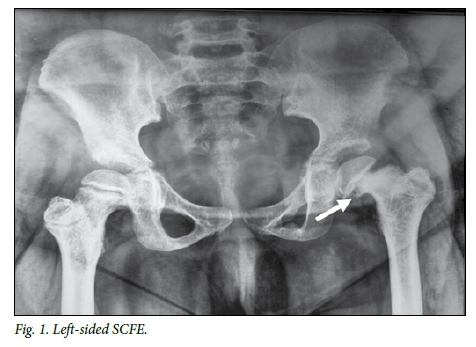
A 14-year-old female child visited our outpatient department with a presenting complaint of left-sided hip pain for the last 6 months, after a trivial trauma, associated with restriction of mobility. She had history of developmental delay and mental retardation. She was the product of non-consanguineous marriage with no significant antenatal/perinatal events and a negative family history for hypothyroidism. She had attained menarche 6 months prior to admission. She did not have goiter, polydactyly, facial dysmorphism or opthalamological issues. Her weight was 65 kg and height 142 cm, with a z-score of 1.2 and -2.8 for her age, respectively. Her body mass index was 32 kg/m2Fig. 1).
She was started on Eltroxin; her hip pain settled and there was an improvement in mobility. Further orthopaedic management of the SCFE is being sought.
SCFE is characterised by displacement of the capital femoral epiphysis from the metaphysis through the physis. In a study of association of endocrinal disorders with SCFE, hypothyroidism was found in 40% of all the cases studied.[3] A high serum TSH level causes abnormal skeletal development in hypothyroidism via its suppressive effects on the growth plate.[4] The delay in diagnosis - as in our case - severely affected the skeleton and mental development.[5] Through this letter, we highlight the importance of early diagnosis of hypothyroidism and the need for a high index of suspicion in obese children with hip pain.
References
-
1. Gholve PA, Cameron DB, Millis MB. Slipped capital femoral epiphysis update. Curr Opin Pediatr 2009;21(1):39-45. http://dx.doi.org/10.1097/MOP.0b013e328320acea
» http://dx.doi.org/10.1097/MOP.0b013e328320acea - 2. Heyerman W, Weiner D. Slipped epiphysis associated with hypothyroidism. J Pediatr Orthop 1984;4(5):569-573.
- 3. Loder RT, Wittenberg B, DeSilva G. Slipped capital femoral epiphysis associated with endocrine disorder. J Pediatr Orthop 1995;15(3):349-356.
-
4. Endo T, Kobayashi T. Excess TSH causes abnormal skeletal development in young mice with hypothyroidism via suppressive effects on the growth plate. Am J Physiol Endocrinol Metab 2013;305(5):E660-E666. http://dx.doi.org/10.1152/ajpendo.00067.2013
» http://dx.doi.org/10.1152/ajpendo.00067.2013 -
5. Schoenmakers N, Moran C, Peeters RP, Visser T, Gurnell M, Chatterjee K. Resistance to thyroid hormone mediated by defective thyroid hormone receptor alpha. Biochim Biophys Acta 2013;1830(7):4004-4008. http://dx.doi.org/10.1016/j.bbagen.2013.03.018
» http://dx.doi.org/10.1016/j.bbagen.2013.03.018