




Services on Demand
Journal

Article
 English (pdf)
 Article in xml format
 Article references
 Automatic translation
 Send this article by e-mail
Indicators
Related links
-
 Cited by Google
 -
 Similars in Google
Share

 Permalink
Southern African Business Review
On-line version ISSN 1998-8125Print version ISSN 1561-896X
SABR vol.28 Pretoria 2024
https://doi.org/10.25159/1998-8125/15927
ARTICLE
Selected Psychological Factors Predicting Customer Citizenship Behaviours: An Environmentally Friendly Context
Estelle van TonderI; Sam FullertonII; Daniel J. PetzerIII
IUniversity of South Africa, Pretoria, South Africa. estellevantonder4@gmail.com; https://orcid.org/0000-0002-6285-7582
IIEastern Michigan University, United States, and North-West University, South Africa. sfullerto@emich.edu; https://orcid.org/0000-0003-2885-6049
IIIHenley Business School Africa Johannesburg, and University of Pretoria, South Africa. daniep@henleysa.ac.za; https://orcid.org/0000-0003-2049-6472
ABSTRACT
PURPOSE: Viable business opportunities may be lost when customers revert to unsuitable brands owing to the misreading of brand label information or a lack of understanding of the quality and value of the focal business's green product offering. Accordingly, this research seeks to advance understanding of selected psychological factors influencing customer citizenship advocacy and personal initiative behaviours in an environmentally friendly context that may aid fellow customers in making more informed and responsible purchase decisions
DESIGN/METHODOLOGY/APPROACH: A research model was examined, assessing the influence of green attitude, consumer self-confidence, and self-control against criticism on customer citizenship advocacy and personal initiative behaviours in an environmentally friendly context. Survey research was conducted among customers in South Africa who had previously advised others to avoid products that may be harmful to society. Structural equation modelling was applied in the assessment of the research data and to conclude on the hypotheses formulated
FINDINGS: All hypothesised relationships were supported, except for the relationship between self-control against criticism and personal initiative behaviours
ORIGINALITY: Novel insight is provided into the extent to which green attitude, as well as psychological factors relating to how customers perceive and regulate themselves during their interactions with other customers, may influence customer citizenship advocacy and personal initiative behaviours in an environmentally friendly context. Accordingly, the model offers a starting point for green manufacturing businesses and policymakers to develop programmes that may facilitate the desired customer citizenship behaviours, which could contribute to fellow customers purchasing quality green products
Keywords: customer citizenship; green; product quality; self-control; sustainability
Introduction
Manufacturing businesses are increasingly expected to reflect on their business activities and how they may affect nature. Greater customer awareness, as well as country-specific and international policies promoting environmental sustainability, have forced businesses to concentrate on sustainable business practices (Abbas 2020, 1). There is a need for businesses to implement diverse eco-friendly activities to address matters, including global warming, energy reserves, and product quality (Huma, Ahmed, and Zaman 2023). Businesses need to produce high-quality products and ensure the preservation of the earth's natural resources through their processes (Abbas 2020, 1).
Of further importance are the strategies customers employ in acquiring information about green products. Previous research has shown that some customers mainly rely on individual communication messages from brands to gain insight into product compliance with sustainable standards (Gouda et al. 2019, 53). Accordingly, several studies have been conducted to gain further insight into green brand communication and the extent to which it may influence customers' green awareness (Alamsyah, Othman, and Mohammed 2020), advertising effect (Kao and Du 2020), perceived green quality and green brand associations (Effah and Hinson 2022), as well as purchase intentions (Alamsyah et al. 2020). Scholars similarly have addressed eco-label credibility and its influence on green brand credibility (Kumar et al. 2021), as well as green product purchasing intentions (Cai, Xie, and Aguilar 2017). Unfortunately, however, research has also shown that customers do not always interpret green brand communications correctly (Iovino, Testa, and Iraldo 2024; Struwig and Adendorff 2018). This is of great concern, since viable business opportunities may be lost when less proactive customers revert to unsuitable brands owing to the misreading of product information or a lack of understanding of the quality and value of a business's green product offering. Further exploration of measures that can be employed to ensure customers have better green product knowledge and avoid purchasing harmful products, is therefore much needed.
Customer citizenship behaviour theory provides valuable guidance on this matter. Customer citizenship behaviours refer to "the voluntary behaviors outside of the customer's required role for service delivery, which aim to provide help and assistance, and are conducive to effective organizational functioning" (Bove et al. 2009, 699). Customer citizenship behaviours may include activities such as advocacy and personal initiative (Mpinganjira 2016; Yi and Gong 2013). Advocacy involves guiding other customers and making recommendations about product purchases (Hwang and Lyu 2020, 442). Personal initiative is proactive in nature and focuses on taking advantage of opportunities, swiftly solving problems, taking action in advance, and going out of one's way when performing a given behaviour (Solesvik 2017). Accordingly, customers engaging in advocacy or personal initiative behaviours are seen as important, as they could be helpful to manufacturing businesses. The help customers provide to others in making responsible product choices (through advocacy or proactive personal initiative behaviours) could aid in ensuring that more informed purchase decisions are made and customers avoid purchasing products that may be harmful to society.
Earlier research further indicates that green attitude, as a psychological factor, is a likely antecedent of customer citizenship behaviours in an environmentally friendly context (Van Tonder, Fullerton, and De Beer 2020). However, since customer citizenship behaviours manifest within social settings (Van Tonder et al. 2023), further understanding is also needed of the potential influencing role of psychological factors relating to how customers perceive and regulate themselves during their interactions with other customers. Previous research suggests a significant link between consumer self-confidence and information-sharing intentions (Utkarsh and Agarwal 2019). Consumer self-confidence addresses perceived capability in relation to own decisions and behaviours (Bearden, Hardesty, and Rose 2001, 122). Moreover, self-control against criticism is a key dimension of emotional intelligence (Rego et al. 2010). Emotionally intelligent individuals are characterised by a sense of self-awareness, an ability to grasp social rules where the display of emotions is concerned and, consequently, the ability to adjust their own behaviour aligned with these rules (Prati et al. 2003). Earlier research established a connection between emotional intelligence and social support and caring behaviours (Nightingale et al. 2018). Self-control allows societal fit and to navigate one's path through the opportunities that one is exposed to (Baumeister and Alquist 2009, 117).
In view of the above, the objective of the current study is, therefore, to develop a customer citizenship behaviour model, advancing understanding of the influence of a selected set of psychological factors (green attitudes, consumer self-confidence, and self-control against criticism) on customer citizenship advocacy and personal initiative behaviours, as applied in an environmentally friendly context. Survey research was conducted among customers in South Africa who had previously advised others about avoiding products that may be harmful to society. Structural equation modelling was applied in the assessment of the research data and to conclude on the hypotheses formulated for the study.
Overall, the proposed model provides novel insight into the role and importance of selected psychological factors influencing customer citizenship behaviours in an environmentally friendly context. The model further offers a starting point for green manufacturing businesses in developing programmes that could facilitate the desired customer citizenship behaviours that may contribute to customers purchasing quality green products.
Theoretical Framework
The Role of Customer Citizenship Behaviours
Customer citizenship behaviour refers to voluntary extra-role behaviours customers engage in, such as advocacy and personal initiative (Groth 2005; Mpinganjira 2016; Natarajan, Ramanan, and Jayapal 2023; Yi and Gong 2013). Customers are not expected to perform these behaviours when conducting business with the organisation, although organisations may benefit from these events (Bove et al. 2009; Groth 2005). Customers voluntarily engaging in advocacy and personal initiative citizenship (extra-role) behaviours contribute to the value creation of the business in a number of ways, as further explained below.
Advocacy
Advocacy has been denoted as an important tool for value co-creation in the firm (Yi and Gong 2013). However, given earlier contributions, it seems that the value that can be derived from advocacy behaviours is largely dependent on the message being advocated by the customer. Specifically, extant research addresses two different types of advocacy behaviours. Yi and Gong (2013) operationalised advocacy from a positive perspective as the extent to which a customer says something positive about the business, recommends the business, and persuades others to patronise the business. This approach has also been supported by other scholars who measured advocacy as customers' willingness to endorse a given business offering (Le et al. 2022). From a positive perspective, value is co-created when customers assist a business by promoting its products to other customers. Alternatively, some scholars perceive advocacy as "a generalised tendency to share market information to warn consumers so they can avoid negative marketplace experiences" (Chelminski and Coulter 2011, 362). From this point of view, advocacy might entail expressing criticisms or negative opinions about a particular product or brand (Jayasimha and Billore 2016, 362), and hence value is created for the competing brand.
Our study supported the latter approach, considering the interest being in customers advising other customers about making responsible product choices. We operationalised advocacy to relate to customers saying negative things about a brand that may be harmful to society, and discouraging other customers from purchasing the brand. These types of advocacy behaviours could aid in ensuring that greater informed green purchase decisions are made and value is co-created for the brand selling quality green products.
Personal Initiative
Personal initiative can be defined as the behaviour an individual engages in that involves taking the initiative, and that is self-starting in nature in order to surmount obstacles to achieve an objective (Frese and Fay 2001). Stroppa and Spieβ (2011) state that the efforts of those who exhibit personal initiative go beyond what is considered the norm. In other words, the individual is doing more than what is expected (Wollny, Fay, and Urbach 2016). Subsequently, it can be argued that personal initiative is also an activity that can create value for a firm. In relation to value co-creation, extant literature denotes that the objective of taking personal initiative is to better oneself or the situation at hand (Wollny et al. 2016). Personal initiative may involve suggesting solutions to solve problems upsetting stakeholders in the community (Mpinganjira 2016, 6).
In this study, personal initiative is based on the items developed by Solesvik (2017). The construct was measured from the perspective of assisting other customers to avoid brands that may be harmful to society. Therefore, similar to the advocacy construct, customers engaging in personal initiatives to help other customers avoid brands that could be harmful to society may further aid in co-creating value for brands selling quality green products, since the latter may receive greater support.
Green Attitude
According to Weigel (1983), an attitude is best described as a set of persistent beliefs individuals hold towards an object, which influences them to act in a specific manner in relation to the object concerned. Moreover, an attitude can be expressed as a positive or a negative assertion or "inner feeling" towards the object (Beck and Ajzen 1991; Zaremohzzabieh et al. 2021).
In an environmental context, contrasting perspectives exist regarding the measurement of attitude. Attitudes have been labelled as general or specific. A general environmental attitude concerns the judgement of individuals performing a given action. A specific environmental attitude concerns the judgement of specific products or behaviours, such as the purchasing of organic food (Çavuşoğlu et al. 2020, 1514). Priyashantha and Priyangaa (2022) describe a green attitude as "an individual's specific principles, insights, and goals related to eco-friendly procedures." In their study on green attitude, Sohaib et al. (2022) operationalised green attitude as the belief that supporting an environmentally friendly establishment is good, desirable, pleasant, and wise, based upon the work of Huang, Yang, and Wang (2014) and Teng, Wu, and Liu (2015). Van Tonder et al. (2020) suggest that green attitudes are influenced by green consumption values and emotional affinity towards nature. They operationalise green attitudes as customers' perceptions that the consumption of green products is worthwhile, delightful, and sensible.
Considering this study's interest in customers assisting other customers with harmful products they should avoid, we focused on green attitudes relating to the consumption of green products. Customers may assist other customers with responsible product decisions if they have a favourable attitude towards green consumption themselves. Consequently, for the purpose of this study, a green attitude was operationalised as the belief that the consumption of green or environmentally friendly products is "valuable, wise, and rewarding" (Van Tonder et al. 2020).
Consumer Self-confidence
Consumer self-confidence refers to the degree to which individuals experience feelings of self-assurance and competence with their behaviour and decision-making when purchasing goods and services (Adelmann 1987). There are several self-confidence factors, including the confidence one has in acquiring information, confidence in the knowledge one has about the marketing strategies of marketers, confidence to identify possible alternatives in the marketplace, confidence to be able to express oneself when interacting in the marketplace, and confidence to meet goals related to purchasing goods or services in the marketplace (Bearden et al. 2001; Blair, Gala, and Lunde 2022; Campos, Costa, and Costa 2023). Accordingly, given these perspectives, at a broader level, it can be argued that those with consumer self-confidence exhibit a degree of security in their judgement and ability to make decisions and behave in a secure way in the marketplace (Campos et al. 2023; Jamil et al. 2022). Therefore, overall, consumer self-confidence addresses "the extent to which an individual feels capable and assured with respect to his or her marketplace decisions and behaviours" (Bearden et al. 2001, 122).
Aligned with these perspectives, this study measured consumer self-confidence as the degree to which consumers feel capable and assured of their behaviours. The scale provided by Wien and Olsen (2017) was adapted to the context of giving advice to others.
Self-control against Criticism
As addressed earlier, self-control against criticism is a dimension of emotional intelligence. Individuals with high emotional intelligence understand their own emotions as well as those of others and use this ability to shape the decision-making process (Camplisson and Cormican 2023). These individuals manage their emotions and understand emotions as well as how they interrelate with reasoning, not only for themselves but also for others (Zhou and George 2003). Furthermore, older individuals seem to have advanced levels of emotional intelligence, which may be attributed to lifelong learning and accumulated knowledge (Chaouali, Souiden, and Ringle 2021, 66).
At a deeper level, self-control is focal to individuals' actions, whether they are ethical and desirable or not (Baumeister and Exline 1999). This is affirmed by Arli and Leo (2017), who found that the extent of self-control individuals exhibit explains their unethical behaviours (benefitting from unlawful undertakings) to a significant extent.
In addition, self-control was found to mediate the relationships between certain dispositional characteristics of consumers and their tendencies to engage in impulse buying (Kakkar, Dugar, and Gupta 2022). Accordingly, it can be argued that self-control asserts as individuals' competence to adjust and monitor their emotions and impulses (Koman and Wolff 2008). These perspectives are shared by other scholars, such as Melbye and Helland (2018, 1736), who denote that from a consumer behaviour perspective, self-control is "the ability to resist temptations and impulses."
Aligned with the above views, Rego and Fernandes (2005) and Rego et al. (2007; 2010) operationalise self-control against criticism as the extent to which individuals possess the ability not to lose control when defeated, when individuals find it easy to interact with others holding divergent views, when individuals avoid anger when being criticised, and when individuals are able to accept criticism from others. For this study, self-control against criticism was operationalised in the same way as Rego et al. (2010), but again, we contextualised the construct in a setting where advice is given to others.
Hypotheses Development
Çavuşoğlu et al. (2020) denote that the attitude phenomenon has constantly been stressed as a required antecedent of actual behaviour. The influence of a green attitude on behavioural response has also been confirmed in other investigations (Wang et al. 2022). Opposing views signify that customers' attitudes may not always translate into behaviours. Consumers may exhibit upbeat attitudes towards a product or service, but contrary to this, they steadily buy other options (Antonetti and Maklan 2015).
Nonetheless, within the customer citizenship behaviour domain, previous research established positive and significant relationships between green attitudes and customer citizenship behaviours, such as advocacy and feedback to providers (Van Tonder et al. 2020). Positive and significant relationships have also been found between consumer attitudes towards environmentally friendly airlines and various customer citizenship behaviours, including advocacy, helping other customers, being tolerant of mistakes, and giving feedback to the provider (Hwang and Lyu 2020). It seems that customers' favourable environmental attitudes serve as motivation for them to engage in customer citizenship activities and provide assistance to others in an environmentally friendly context. Accordingly, it was expected that within the context of the current investigation, customers having favourable green attitudes about green consumption would engage in customer citizenship advocacy and personal initiative behaviours that would aid other customers in making greater informed purchase decisions and avoiding brands that may be harmful to society. Therefore, it was hypothesised that:
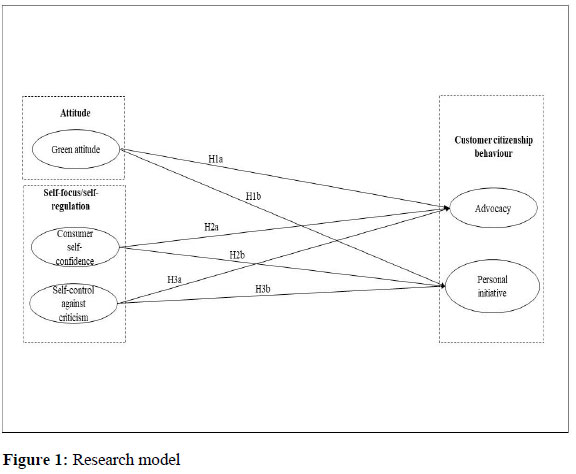
• H1. Green attitude positively and significantly influences (a) advocacy and (b) personal initiative behaviours.
Furthermore, it is likely that consumer self-confidence may influence customer citizenship behaviours and the assistance customers provide to other customers in purchasing products. Consumer self-confidence optimises consumers' confidence levels and shapes their attitudes with respect to their buying intentions (Tiep et al. 2021). Wien and Olsen (2017) highlight that consumer self-confidence is dependent on the object involved. When consumers exhibit self-confidence, the results of consumer behaviour will be promising and desirable (Ha and Lee 2011). In instances where consumers exhibit reduced levels of self-confidence, a deprivation of self-belief may be present, resulting in consumers allowing themselves to be influenced by stout opinions of others or impactful external cues, even if these are against their better judgement (Veale 2008).
Additionally, previous research established a significant link between consumer self-confidence and information-sharing intentions (Utkarsh and Agarwal 2019). It is also believed that confidence may contribute to individuals proactively challenging the status quo (Peariasamy et al. 2020, 450).
In relation to self-control against criticism (an emotional intelligence factor), previous research established that emotional intelligence can assist in managing "feelings of disappointment" and in recovering one's confidence to deal with these feelings (Rodrigues et al. 2019, 876). Emotional intelligence allows individuals to keep their emotions intact, with highly productive activities and meaningful relations as a possible outcome (Kumari et al. 2022, 3).
Guided by the above perspectives, it was also hypothesised in this study that:
• H2. Consumer self-confidence positively and significantly influences (a) advocacy and (b) personal initiative.
• H3. Self-control against criticism positively and significantly influences (a) advocacy and (b) personal initiative.
The research model is summarised in figure 1 below.
Methodology
Measurement
All research constructs examined in this study were informed by previous research, as addressed in the literature review. The construct scale items employed were adapted to the context of the study and are presented in Annexure A. The seven-item personal initiative scale by Solesvik (2017) was shortened to increase internal consistency within the scale (Merle et al. 2010, 507). A pre-test was conducted, including 175 respondents. Subsequently, only items 3 to 6 of the original scale were maintained. These items presented consistently higher correct item-total correlations (0.79-0.85) than the three scale items that were deleted (Merle et al. 2010, 508; Stanton et al. 2002). The construct items were all measured by a six-point Likert scale that ranged from "strong disagreement" at the lowest point to "strong agreement" at the highest scale end.
Sampling, Data Collection Procedure, and Analysis
The study was executed in South Africa. Access to the respondents was gained through survey research and purposive sampling. Purposive sampling is formally described as a "technique where the researcher selects only those subjects that satisfy the objectives of the study based on the researcher's conviction" (Obilor 2023, 4). The study was specifically interested in surveying respondents who adhered to the criteria as set out in the definition of the target population. The study targeted a population of (1) adult customers in South Africa who had (2) previously advised others about avoiding products that could be harmful to society. It was expected that these respondents would likely engage in customer citizenship advocacy and personal initiative behaviours that were of interest to this study, and would be in a position to contribute to the survey in a meaningful way. Accordingly, given the purposive sampling approach, the survey included two screening questions that were phrased according to the criteria as set out in the study population, and only respondents who passed the screening questions were able to complete the rest of the online survey. The survey was managed by a research agency in South Africa. Respondents on the agency's consumer panel were approached via email. The study's purpose and benefit to industry were explained in the cover letter that accompanied the email. Overall, 256 respondents completed the self-administered questionnaire online. The agency ensured that the respondent data file did not include any personal information.
A slightly higher percentage of male (53.3%) than female (45.9%) respondents participated in the survey, while two respondents did not select a gender option. Most respondents who participated in the study were aged 26-75 years (94.2%) and worked full time (64.6%). The respondents who participated in the study were also fairly well educated, with a majority having completed high school and achieved some postgraduate qualification (84.9%).
The survey data were analysed using Mplus version 8.5. Measurement model factor reliability and validity were established through confirmatory factor analysis and the assessment of composite reliability (CR) scores. The research model was examined using structural equation modelling and the maximum likelihood procedure. All regression relationships assessed were deemed significant at p < 0.001, p < 0.01 or p < 0.05 levels (Byrne 2001; Hair et al. 2019).
Results
Reliability and Validity Assessment
The statistical analysis commenced with confirmatory factor analysis and assessment of the measurement model that included all five constructs under investigation, namely green attitude, consumer self-confidence, self-control against criticism, advocacy, and personal initiative. After accounting for covariance between the second and third items of the scale that measured self-control against criticism, acceptable fit statistics were obtained: (Hair et al. 2019): χ2(141) = 330.62; (χ2/df = 2.34); comparative fit index (CFI) = 0.93; Tucker-Lewis index (TLI) = 0.91; and root mean square error of approximation (RMSEA) = 0.072.
The internal reliability of the measurement model was examined using CR measures. Table 1 denotes that the CR scores for each latent variable exceed the recommended threshold level of 0.7. Subsequently, the data set did not present any reliability concerns (Hair et al. 2019). Acceptable factor loadings exceeded 0.5 and loaded significantly onto their respective constructs. Table 1 indicates that the minimum criteria for acceptable factor loadings were met (Hair et al. 2019).
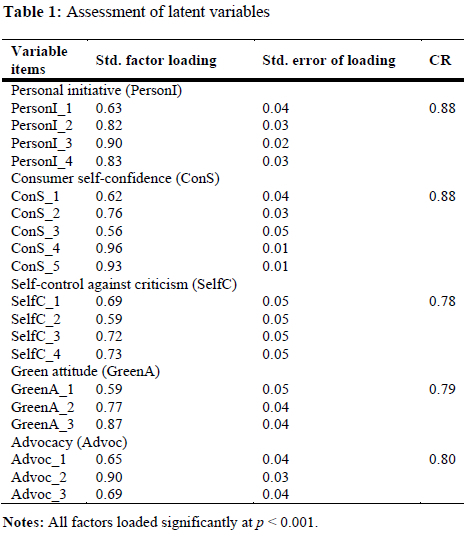
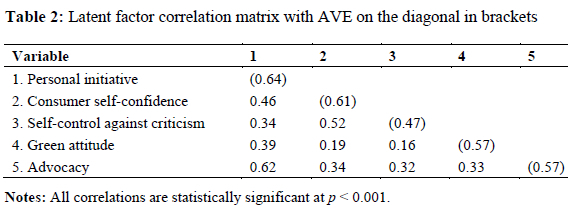
Table 2 reflects the average variance extracted (AVE) values obtained. The values for the first two and last two constructs exceeded the recommended threshold of 0.5, subsequently confirming that the items of these constructs accurately represented the individual constructs measured (Fornell and Larcker 1981). The slightly lower value that was obtained for self-control against criticism (0.47) was tolerated, given that it was close to 0.5 and the CR value exceeded 0.7. A construct may still be regarded as having convergent validity if the AVE value is lower than 0.5, but the CR value exceeds 0.6 (Fornell and Larcker 1981; Shrestha 2021, 6). Discriminant validity is established when the average amount of variance in any latent variable's associated indicator variables (AVE) is greater than the given latent variable's shared variance with any other construct in the model. Consequently, table 2 provides evidence that discriminant validity was established for all constructs examined (Fornell and Larcker 1981).
Hypotheses Testing
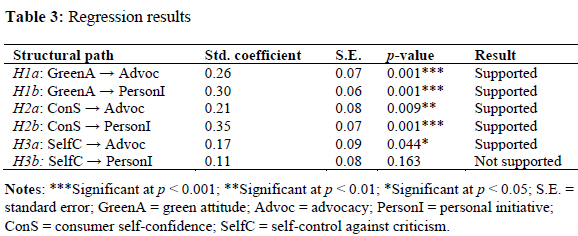
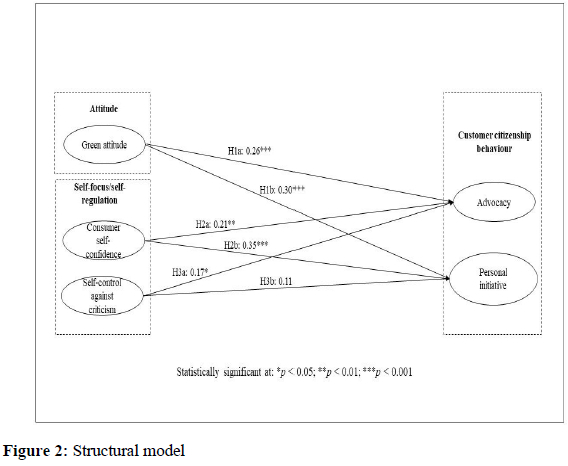
As per table 3, all regression relationships are positive and range between 0.11 and 0.35. The table shows that the effect of a green attitude on personal initiative is larger than a green attitude's impact on advocacy. Similarly, the influence of consumer self-confidence on personal initiative was larger than the effect of consumer self-confidence on advocacy. Self-control against criticism only seems to significantly influence advocacy (coefficient = 0.17,p < 0.05). Therefore, H1a, H1b, H2a, H2b, and H3a were supported. Overall, table 3 indicates that green attitude has the largest impact on advocacy, followed by consumer self-confidence and self-control against criticism. Consumer self-confidence has the largest impact on personal initiative, followed by a green attitude.
The structural model results are summarised in figure 2 below.
Theoretical Implications
This study explains that there is a need for businesses to implement diverse eco-friendly activities to address matters, including global warming, energy reserves, and product quality (Huma et al. 2023). Accordingly, of concern to the current investigation is that some customers are less proactive than others and only rely on messages from brands to verify product compliance with sustainable standards (Gouda et al. 2019, 53). These behaviours may contribute to customers incorrectly supporting unsuitable brands when product information is misinterpreted or misunderstood. Customer citizenship behaviours may be helpful in this regard. Accordingly, the current research identified a novel set of psychological factors that may contribute to customer citizenship advocacy and personal initiative behaviours in an environmentally friendly context.
The findings in relation to H1 are important as they offer confirmation that when customers perceive the practising of environmentally friendly green consumption as valuable, rewarding, and wise, they are likely to engage in customer citizenship advocacy and personal initiative behaviours, and assist other customers in avoiding brands that may be harmful to society. The findings are further of interest since green attitudes address favourable perceptions about practising green consumption, while advocacy and personal initiative in the context of this study address negative views about harmful brands that should rather be avoided. Accordingly, the findings are demonstrative that favourable attitudes do lead to behaviour (Wang et al. 2022), but that it is plausible that value could be created for the competing brand.
Support for H2a and H3a offers confirmation that besides the effect of attitude, advocacy is influenced by both consumer self-confidence and self-control against criticism. However, interestingly, in relation to personal initiative when both consumer self-confidence and self-control against criticism are considered, only consumer self-confidence seems to have an influencing role (H2b and H3b). Accordingly, these findings shed further light on psychological factors relating to how customers perceive and regulate themselves during their interactions with others (Rodrigues et al. 2019, 876; Utkarsh and Agarwal 2019), and that may be of particular relevance in influencing citizenship behaviours. It is suggested that how customers perceive themselves may be a greater predictor of customer citizenship behaviours than their emotional intelligence skills, as measured by self-control against criticism. Also, when they demonstrate a higher level of involvement (showing personal initiative, as opposed to mere advocacy behaviours), their emotional thoughts do not seem to be of concern, only the extent to which they believe in the advice they give to others.
Managerial Implications
Overall, it seems that manufacturing businesses could benefit from strengthening customers' green attitude perceptions and self-confidence in relation to advice-giving behaviours. To a lesser extent, self-control against criticism may also be of relevance.
Attitudes that practising environmentally friendly green consumption is valuable, rewarding, and wise could be reinforced and strengthened through green advertising, social norms, and newsletters, as well as the creation of greater awareness, such as through green incentive programmes. Information and statistics about natural disasters that are attributed to unsustainable manufacturing practices could be communicated and support should be given for social causes, inviting others to follow similar practices.
Informational websites, discussion forums, and editorial videos could assist in building consumer self-confidence in relation to advice-giving behaviours in an environmentally friendly context. Finally, self-control against criticism, when advice is being provided, could prevail when customers have a sound understanding of the true effect of supporting products that may be harmful to society. Customers should be aware of how their past actions have contributed to current climate change problems and the extent to which these problems could worsen if action is not immediately taken. Again, marketing communication practices, such as newsletters, green advertising, social media and other appropriate websites, may assist in this regard.
Limitations and Suggestions for Further Research
Customer citizenship behaviours manifest within social settings. Accordingly, this research provides novel insight into the extent to which green attitudes, as well as psychological factors relating to how customers perceive and regulate themselves during their interactions with other customers, may influence customer citizenship advocacy and personal initiative behaviours.
Future research may want to extend this model by obtaining further insight into factors influencing customers' self-confidence in relation to advice-giving in an environmentally friendly context. While self-control against criticism did not have a large effect on customer citizenship behaviours, it may be interesting to assess if other dimensions of emotional intelligence, including "use of emotions," "emotional self-control," "understanding of other people's emotions," "empathy and emotional contagion," and "understanding of one's emotions" (Rego et al. 2010), could have an effect. These relationships could have some relevance in view of previous research denoting that emotional intelligence allows individuals to keep their emotions intact, with highly productive activities and meaningful relations as a possible outcome (Kumari et al. 2022, 3). The proposed model also needs further testing and validation among diverse samples. The model could be extended by examining other psychological factors that may be relevant and influence customer citizenship advocacy and personal initiative behaviours in an environmentally friendly context.
Author Biographies
Prof. E. van Tonder (corresponding author): Department of Marketing and Retail Management, University of South Africa, Pretoria, South Africa, estellevantonder4@gmail.com.
Prof. D. J. Petzer: Henley Business School Africa, Johannesburg, South Africa, and Department of Marketing Management, University of Pretoria, South Africa.
Prof. S. Fullerton: Eastern Michigan University, Michigan, United States, and NorthWest University, Potchefstroom, South Africa.
Disclaimer
This work is based on research supported in part by the National Research Foundation of South Africa (Grant No. 127148). Any opinion, finding and conclusion or recommendation expressed in this material is that of the authors, and the National Research Foundation of South Africa does not accept any liability in this regard. Additionally, data collection was supported in part by the North-West University, Henley Business School and Eastern Michigan University.
References
Abbas, Jawad. 2020. "Impact of Total Quality Management on Corporate Green Performance through the Mediating Role of Corporate Social Responsibility." Journal of Cleaner Production 242: 118458. https://doi.org/10.1016/j.jclepro.2019.118458 [ Links ]
Adelmann, Pamela K. 1987. "Occupational Complexity, Control, and Personal Income: Their Relation to Psychological Well-being in Men and Women." Journal of Applied Psychology 72 (4): 529-537. https://doi.org/10.1037/0021-9010.72.4.529 [ Links ]
Alamsyah, D., N. Othman, and H. Mohammed. 2020. "The Awareness of Environmentally Friendly Products: The Impact of Green Advertising and Green Brand Image." Management Science Letters10 (9): 1961 -1968. [ Links ]
Antonetti, Paolo, and Stan Maklan. 2015. "How Categorisation Shapes the Attitude-behaviour Gap in Responsible Consumption." International Journal of Market Research 57 (1): 5172. https://doi.org/10.2501/UMR-2015-005 [ Links ]
Arli, Denni, and Cheryl Leo. 2017. "Why Do Good People Do Bad Things? The Effect of Ethical Ideology, Guilt Proneness, and Self-control on Consumer Ethics." Asia Pacific Journal of Marketing and Logistics 29 (5): 1055-1078. https://doi.org/10.1108/APJMIL-11-2016-0218 [ Links ]
Baumeister, Roy F., and Jessica L. Alquist. 2009. "Is There a Downside to Good Self-control?" Self and Identity 8 (2-3): 115-130. https://doi.org/10.1080/15298860802501474 [ Links ]
Baumeister, Roy F., and Julie Juola Exline. 1999. "Virtue, Personality, and Social Relations: Self-control as the Moral Muscle." Journal of Personality 67 (6): 1165-1194. https://doi.org/10.1111/1467-6494.00086 [ Links ]
Bearden, William O., David M. Hardesty, and Randall L. Rose. 2001. "Consumer Self-confidence: Refinements in Conceptualization and Measurement." Journal of Consumer Research 28 (1): 121-134. https://doi.org/10.1086/321951 [ Links ]
Beck, Lisa, and Icek Ajzen. 1991. "Predicting Dishonest Actions Using the Theory of Planned Behavior." Journal of Research in Personality 25 (3): 285-301. https://doi.org/10.1016/0092-6566(91)90021-H [ Links ]
Blair, James Robert, Prachi Gala, and Matthew Lunde. 2022. "Dark Triad-consumer Behavior Relationship: The Mediating Role of Consumer Self-confidence and Aggressive Interpersonal Orientation." Journal of Consumer Marketing 39 (2): 145-165. https://doi.org/10.1108/JCM-07-2020-3981 [ Links ]
Bove, Liliana L., Simon J. Pervan, Sharon E. Beatty, and Edward Shiu. 2009. "Service Worker Role in Encouraging Customer Organizational Citizenship Behaviors." Journal of Business Research 62 (7): 698-705. https://doi.org/10.1016/j.jbusres.2008.07.003 [ Links ]
Byrne, Barbara M. 2001. Structural Equation Modeling with AMOS: Basic Concepts, Applications, and Programming. Mahwah, NJ: Lawrence Erlbaum, Mahwah. [ Links ]
Cai, Z., Y. Xie, and F. X. Aguilar. 2017. "Eco-label Credibility and Retailer Effects on Green Product Purchasing Intentions." Forest Policy and Economics 80: 200-208. [ Links ]
Camplisson, Cian, and Kathryn Cormican. 2023. "Analysis of Emotional Intelligence in Project Managers: Scale Development and Validation." Procedia Computer Science 219: 1777-1784. https://doi.org/10.1016/j.procs.2023.01.473 [ Links ]
Campos, Patrícia de Oliveira, Cristiane Salomé Ribeiro Costa, and Marconi Freitas da Costa. 2023. "Relationship between Personality Traits and Consumer Rationality Regarding the Intention to Purchase Collaborative Fashion." Journal of Fashion Marketing and Management 27 (1): 42-60. https://doi.org/10.1108/JFMM-02-2021-0049 [ Links ]
Çavuşoğlu, Sinan, Bülent Demirag, Eddy Jusuf, and Ardi Gunardi. 2020, "The Effect of Attitudes toward Green Behaviors on Green Image, Green Customer Satisfaction and Green Customer Loyalty." GeoJournal of Tourism and Geosites 33 (4): 1513-1519. https://doi.org/10.30892/gtg.334spl10-601 [ Links ]
Chaouali, Walid, Nizar Souiden, and Christian M. Ringle. 2021. "Elderly Customers' Reactions to Service Failures: The Role of Future Time Perspective, Wisdom and Emotional Intelligence." Journal of Services Marketing 35 (1): 65-77. https://doi.org/10.1108/JSM-08-2019-0318 [ Links ]
Chelminski, Piotr, and Robin A. Coulter. 2011. "An Examination of Consumer Advocacy and Complaining Behavior in the Context of Service Failure." Journal of Services Marketing 25 (5): 361-370. https://doi.org/10.1108/08876041111149711 [ Links ]
Effah, Ebenezer Asare, and Robert E. Hinson. 2022. "Green Brand Equity in an Emerging Economy: Ghana in Perspective." Green Marketing in Emerging Economies: A Communications Perspective, 193-224. [ Links ]
Fornell, Claes, and David F. Larcker. 1981. "Evaluating Structural Equation Models with Unobservable Variables and Measurement Error." Journal of Marketing Research 18 (1): 39-50. https://doi.org/10.2307/3151312 [ Links ]
Frese, Michael, and Doris Fay. 2001. "Personal Initiative: An Active Performance Concept for Work in the 21st Century." Research in Organizational Behavior 23: 133-187. https://doi.org/10.1016/S0191-3085(01)23005-6 [ Links ]
Gouda, Sirish Kumar, Prakash Awasthy, Krishnan T. S., and Sreedevi R. 2019. "What Does 'Green Quality' Really Mean?" The TQM Journal 31 (1): 52-69. https://doi.org/10.1108/TQM-06-2018-0080 [ Links ]
Groth, Markus. 2005. "Customers as Good Soldiers: Examining Citizenship Behaviors in Internet Service Deliveries." Journal of Management 31 (1): 7-27. https://doi.org/10.1177/0149206304271375 [ Links ]
Ha, Sejin, and Yun Jung Lee. 2011. "Determinants of Consumer-Driven Healthcare: Self-Confidence in Information Search, Health Literacy, and Trust in Information Sources." International Journal of Pharmaceutical and Healthcare Marketing 5 (1): 8-24. https://doi.org/10.1108/17506121111121550 [ Links ]
Hair, Joseph F., Jr., William C. Black, Barry J. Babin, and Rolph E. Anderson. 2019. Multivariate Data Analysis. 8th edition. Andover, Hampshire: Cengage. [ Links ]
Huang, Yi-Chun, Minli Yang, and Yu-Chun Wang. 2014. "Effects of Green Brand on Green Purchase Intention." Marketing Intelligence and Planning 32 (3): 250-268. https://doi.org/10.1108/MIP-10-2012-0105 [ Links ]
Huma, Sehrish, Waqar Ahmed, and Sohaib Uz Zaman. 2023. "The Impact of Supply Chain Quality Integration on a Firm's Sustainable Performance." The TQM Journal. https://doi.org/10.1108/TQM-05-2022-0167 [ Links ]
Hwang, Jinsoo, and Seong Ok Lyu. 2020. "Relationships among Green Image, Consumer Attitudes, Desire, and Customer Citizenship Behavior in the Airline Industry." International Journal of Sustainable Transportation 14 (6): 437-447. https://doi.org/10.1080/15568318.2019.1573280 [ Links ]
Iovino, R., F. Testa, and F. Iraldo. 2024. "Do Consumers Understand what Different Green Claims actually Mean? An Experimental Approach in Italy." Journal of Advertising 53 (2): 200-214. [ Links ]
Jamil, Khalid, Zahid Hussain, Rana Faizan Gul, Muhammad Asim Shahzad, and Ahsan Zubair. 2022. "The Effect of Consumer Self-confidence on Information Search and Share Intention." Information Discovery and Delivery 50 (3): 260-274. https://doi.org/10.1108/IDD-12-2020-0155 [ Links ]
Jayasimha, K. R., and Aditya Billore. 2016. "I Complain for Your Good? Re-examining Consumer Advocacy." Journal of Strategic Marketing 24 (5): 360-376. https://doi.org/10.1080/0965254X.2015.1011204 [ Links ]
Kakkar, Shiva, Anurag Dugar, and Rajneesh Gupta. 2022. "Decoding the Sustainable Consumer: What Yoga Psychology Tells Us About Self-control and Impulsive Buying?" South Asian Journal of Business Studies 11 (3): 276-294. https://doi.org/10.1108/SAJBS-03-2020-0083 [ Links ]
Kao, T. F., and Y. Z. Du. 2020. "A Study on the Influence of Green Advertising Design and Environmental Emotion on Advertising Effect." Journal of Cleaner Production 242: 118294. [ Links ]
Koman, Elizabeth Stubbs, and Steven B. Wolff. 2008. "Emotional Intelligence Competencies in the Team and Team Leader: A Multi-level Examination of the Impact of Emotional Intelligence on Team Performance." Journal of Management Development 27 (1): 55-75. https://doi.org/10.1108/02621710810840767 [ Links ]
Kumar, P., M. Polonsky, Y. K. Dwivedi, and A. Kar. 2021. "Green Information Quality and Green Brand Evaluation: The Moderating Effects of Eco-label Credibility and Consumer Knowledge." European Journal of Marketing 55 (7): 2037-2071. https://doi.org/10.1108/EJM-10-2019-0808 [ Links ]
Kumari, Kalpina, Jawad Abbas, Jinsoo Hwang, and Lucian Ionel Cioca. 2022. "Does Servant Leadership Promote Emotional Intelligence and Organizational Citizenship Behavior among Employees? A Structural Analysis." Sustainability 14 (9): 5231. https://doi.org/10.3390/su14095231 [ Links ]
Le, Andrea, Kim-Lim Tan, Siew-Siew Yong, Pichsinee Soonsap, Caple Jun Lipa, and Hiram Ting. 2022. "Perceptions Towards Green Image of Trendy Coffee Cafés and Intention to Re-patronage: The Mediating Role of Customer Citizenship Behavior." Young Consumers 23 (2): 165-178. https://doi.org/10.1108/YC-03-2021-1291 [ Links ]
Melbye, Elisabeth Lind, and Merete Hagen Helland. 2018. "Soft Drinks for Lunch? Self-control, Intentions and Social Influences." British Food Journal 120 (8): 1735-1748. https://doi.org/10.1108/BFJ-11-2017-0605 [ Links ]
Merle, Aurélie, Jean-Louis Chandon, Elyette Roux, and Fabrice Alizon. 2010. "Perceived Value of the Mass-Customized Product and Mass Customization Experience for Individual Consumers." Production and Operations Management 19 (5): 503-514. https://doi.org/10.1111/j.1937-5956.2010.01131.x [ Links ]
Mpinganjira, Mercy. 2016. "Antecedents of Citizenship Behaviour in Online Customer Communities: An Empirical Investigation." South African Journal of Information Management 18 (2): a725. https://doi.org/10.4102/sajim.v18i2.725 [ Links ]
Natarajan, Thamaraiselvan, Deepak V. Ramanan, and Jegan Jayapal. 2023. "Does Pickup Service Quality Explain Buy Online Pickup In-store Service User's Citizenship Behavior? Moderating Role of Product Categories and Gender." The TQM Journal 35 (8): 25472571. https://doi.org/10.1108/TQM-10-2022-0297 [ Links ]
Nightingale, Suzanne, Helen Spiby, Kayleigh Sheen, and Pauline Slade. 2018. "The Impact of Emotional Intelligence in Health Care Professionals on Caring Behaviour towards Patients in Clinical and Long-term Care Settings: Findings from an Integrative Review." International Journal of Nursing Studies 80: 106-117. https://doi.org/10.1016/j.ijnurstu.2018.01.006 [ Links ]
Obilor, E. I. 2023. "Convenience and Purposive Sampling Techniques: Are they the same." International Journal ofInnovative Social and Science Education Research 11 (1): 1-7. [ Links ]
Peariasamy, Suguna Devi, Zoharah Omar, Ramli Basri, and Siti Noormi Alias. 2020. "Magnitude of Role-breadth Self-efficacy in Teacher Proactive Work Behaviour." International Journal of Academic Research in Business and Social Sciences 10 (7): 446459. http://dx.doi.org/10.6007/IJARBSS/v10-i7/7434 [ Links ]
Prati, L. Melita, Ceasar Douglas, Gerald R. Ferris, Anthony P. Ammeter, and M. Ronald Buckley. 2003. "Emotional Intelligence, Leadership Effectiveness, and Team Outcomes." The International Journal of Organizational Analysis 11 (1): 21-40. https://doi.org/10.1108/eb028961 [ Links ]
Priyashantha, K. G., and Yogendran Priyangaa. 2022. "Impact of Green Human Resource Management on Employee Green Behavior: The Mediating Role of Green Attitude." Indonesian Journal of Sustainable Accounting and Management 6 (2): 378-389. https://doi.org/10.28992/ijsam.v6i2.674 [ Links ]
Rego, Arménio, and Cláudia Fernandes. 2005. "Inteligência Emocional: Contributos Adicionais para a Validação de um Instrumento de Medida" [Emotional Intelligence: Further Contributions for Validating a Measurement Instrument]. Psicologia 19 (1/2): 139-167. https://doi.org/10.17575/rpsicol.v19i1/2.401 [ Links ]
Rego, Arménio, Filipa Sousa, Miguel Pinha e Cunha, Anabela Correia, and Irina Saur-Amaral. 2007. "Leader Self-reported Emotional Intelligence and Perceived Employee Creativity: An Exploratory Study." Creativity and Innovation Management Journal 16 (3): 250-264. https://doi.org/10.1111/j.1467-8691.2007.00435.x [ Links ]
Rego, Arménio, Lucinda Godinho, Anne McQueen, and Miguel P. Cunha. 2010. "Emotional Intelligence and Caring Behaviour in Nursing." The Service Industries Journal 30 (9): 1419-1437. https://doi.org/10.1080/02642060802621486 [ Links ]
Rodrigues, Ana Paula, Filipa Eira Jorge, Carlos André Pires, and Patrícia António. 2019. "The Contribution of Emotional Intelligence and Spirituality in Understanding Creativity and Entrepreneurial Intention of Higher Education Students." Education + Training 61 (7/8): 870-894. https://doi.org/10.1108/ET-01-2018-0026 [ Links ]
Shrestha, Noora. 2021. "Factor Analysis as a Tool for Survey Analysis." American Journal of Applied Mathematics and Statistics 9 (1): 4-11. https://doi.org/10.12691/ajams-9-1-2 [ Links ]
Sohaib, Muhammad, Yan Wang, Kashif Iqbal, and Heesup Han. 2022. "Nature-based Solutions, Mental Health, Well-being, Price Fairness, Attitude, Loyalty, and Evangelism for Green Brands in the Hotel Context." International Journal of Hospitality Management 101: 103126. https://doi.org/10.1016/j.ijhm.2021.103126 [ Links ]
Solesvik, Marina Z. 2017. "A Cross-national Study of Personal Initiative as a Mediator between Self-efficacy and Entrepreneurial Intentions." Journal of East-West Business 23 (3): 215-237. https://doi.org/10.1080/10669868.2017.1306821 [ Links ]
Stanton, Jeffrey M., Evan F. Sinar, William K. Balzer, and Patricia C. Smith. 2002. "Issues and Strategies for Reducing the Length of Self-report Scales." Personnel Psychology 55 (1): 167-194. https://doi.org/10.1111/j.1744-6570.2002.tb00108.x [ Links ]
Stroppa, Christina, and Erika Spieβ. 2011. "International Assignments: The Role of Social Support and Personal Initiative." International Journal of Intercultural Relations 35 (2): 234-245. https://doi.org/10.1016/j.ijintrel.2010.09.008 [ Links ]
Struwig, Miemie, and Chris Adendorff. 2018. "Consumers' Perception of Eco-labels in South Africa." Athens Journal of Business and Economics 4 (2): 163-177. https://doi.org/10.30958/ajbe.4.2.3 [ Links ]
Teng, Yi-Man, Kun-Shan Wu, and Hsiao-Hui Liu. 2015. "Integrating Altruism and the Theory of Planned Behavior to Predict Patronage Intention of a Green Hotel." Journal of Hospitality and Tourism Research 39 (3): 299-315. https://doi.org/10.1177/1096348012471383 [ Links ]
Tiep, Nguyen Cong, Mengqi Wang, Muhammad Mohsin, Hafiz Waqas Kamran, and Farzaneh Ahmadian Yazdi. 2021. "An Assessment of Power Sector Reforms and Utility Performance to Strengthen Consumer Self-confidence towards Private Investment." Economic Analysis and Policy 69: 676-689. https://doi.org/10.1016/j.eap.2021.01.005 [ Links ]
Utkarsh, Sunanda Sangwan, and Pallavi Agarwal. 2019. "Effect of Consumer Self-Confidence on Information Search and Dissemination: Mediating Role of Subjective Knowledge." International Journal of Consumer Studies 43 (1): 46-57. https://doi.org/10.1111/ijcs.12482 [ Links ]
Van Tonder, Estelle, Sam Fullerton, and Leon T. de Beer. 2020. "Cognitive and Emotional Factors Contributing to Green Customer Citizenship Behaviours: A Moderated Mediation Model." Journal of Consumer Marketing 37 (6): 639-650. https://doi.org/10.1108/JCM-06-2019-3268 [ Links ]
Van Tonder, E., S. Fullerton, L. T. de Beer, and S. G. Saunders. 2023. "Social and Personal Factors Influencing Green Customer Citizenship Behaviours: The Role of Subjective Norm, Internal Values and Attitudes." Journal of Retailing and Consumer Services 71: 103190. https://doi.org/10.1016/j.jretconser.2022.103190 [ Links ]
Veale, Roberta. 2008. "Sensing or Knowing? Investigating the Influence of Knowledge and Self-confidence on Consumer Beliefs Regarding the Effect of Extrinsic Cues on Wine Quality." International Journal of Wine Business Research 20 (4): 352-366. https://doi.org/10.1108/1751106081091452 [ Links ]
Wang, Xiaomei, Yangli Gu, Haohang Xin, Peiling Qiu, and Jia Wang. 2022. "The Role of Product Cues and Regulatory Focus in the Consumers' Response to Green Products: The Mediation Effects of Green Attitudes." Frontiers in Psychology 13: 918248. https://doi.org/10.3389/fpsyg.2022.918248 [ Links ]
Weigel, R. H. 1983. "Environmental Attitudes and the Prediction of Behavior." In Environmental Psychology: Directions and Perspectives, edited by Nickolaus R. Feimer, and E. Scott. Geller, 257-287. New York, NY: Praeger. [ Links ]
Wien, Anders Hauge, and Svein Ottar Olsen. 2017. "Producing Word of Mouth: A Matter of Self-confidence? Investigating a Dual Effect of Consumer Self-confidence on WOM." Australasian Marketing Journal 25 (1): 38-45. https://doi.org/10.1016/j.ausmj.2017.01.005 [ Links ]
Wollny, Anna, Doris Fay, and Tina Urbach. 2016. "Personal Initiative in Middle Childhood: Conceptualization and Measurement Development." Learning and Individual Differences 49: 59-73. https://doi.org/10.1016/j.lindif.2016.05.004 [ Links ]
Yi, Youjae and Taeshik Gong. 2013. "Customer Value Co-creation Behavior: Scale Development and Validation." Journal of Business Research 66 (9): 1279-1284. https://doi.org/10.1016/j.jbusres.2012.02.026 [ Links ]
Zaremohzzabieh, Zeinab, Normala Ismail, Seyedali Ahrari, and Asnarulkhadi Abu Samah 2021. "The Effects of Consumer Attitude on Green Purchase Intention: A Meta-analytic Path Analysis." Journal of Business Research 132: 732-743. https://doi.org/10.1016/j.jbusres.2020.10.053 [ Links ]
Zhou, Jing, and Jennifer M. George. 2003. "Awakening Employee Creativity: The Role of Leader Emotional Intelligence." The Leadership Quarterly 14 (4-5): 545-568. https://doi.org/10.1016/S1048-9843(03)00051-1 [ Links ]
Annexure A
Green attitude (Van Tonder, Fullerton, and De Beer 2020)
• I think practicing environmentally-friendly green consumption is valuable.
• I think practicing environmentally-friendly green consumption is rewarding.
• I think it is wise to practice environmentally-friendly green consumption.
Consumer self-confidence (Wien and Olsen 2017)
• I never second-guess the advice I give to others.
• I am always sure about the advice I give to others.
• I never wonder if I gave others the right advice.
• I always feel I manage to give the right advice to others.
• I am always content with the advice I give to others.
Self-control against criticism (Rego et al. 2010)
• I do not lose control when others criticise the advice I give.
• It is not difficult for me to talk with others who have viewpoints that differ from my own.
• I do not become angry when others criticise my advice.
• It is not difficult for me to accept a critique from others about my advice.
Advocacy (Yi and Gong 2013)
• Considering a brand that may be harmful to society, I have said negative things about the brand to others.
• I have advised others against brands that may be harmful to society.
• Considering a brand that may be harmful to society, I have discouraged friends and relatives to buy products from that brand.
Personal initiative (Solesvik 2017)
• Whenever there is a chance to get actively involved in helping others avoid brands that may be harmful to society, I take it.
• I take initiative immediately in helping others avoid brands that may be harmful to society, even when other people don't.
• I make rapid use of opportunities to help others avoid brands that may be harmful to society.
• Usually I do more than I am asked to do to help others avoid brands that may be harmful to society.
