A retrospective cohort study investigating the epidemiology of bacterial hand infections at a tertiary hospital in the Western Cape of South Africa
Abstract
BACKGROUND: Hand infections can cause serious morbidity and financial implications to patients and healthcare systems. This retrospective cohort study investigates the epidemiology of bacterial hand infections at a tertiary institution over a year, with a secondary objective of investigating factors that modify risk for complications METHOD: Patient demographics, clinical information, microbacterial spectrum, timeframes of patient's pathway, and risk factors for complication development were investigated. Data related to antibiotic cover and any resistance to commonly used antibiotic therapy, specifically co-amoxiclav (Augmentin) and cloxacillin, was also captured. Relationships between risk factors and complications were investigated with a chi-squared or Fisher's exact test at an alpha-level of 0.05 RESULTS: Overall, 529 patients (mean age of 33.0 ± 15.6 years; 73% male) were included. A delay of a median of 6.0 (IQR 3.0-9.0) days between onset of symptoms and admission occurred. Complications were experienced by 23% (n = 124) patients. These patients required soft tissue cover (55%, n = 69), relook-debridement alone (34%, n = 42), or an amputation (10%, n = 13). Methicillin-sensitive Staphylococcus aureus (MSSA) was most frequently cultured, at 79% (n = 281) of all cultured organisms. More of the cultured organisms were sensitive to co-amoxiclav (86%, n = 305) than they were to cloxacillin (78%, n = 278). Patients with necrotising fasciitis and co-amoxiclav resistance had a statistically significant increase in complications CONCLUSION: The findings of this study highlight a high burden of hand infections as well as a high rate of complications following treatment. Furthermore, co-amoxiclav was an appropriate choice of antibiotic cover in this population. Finally, patients with necrotising fasciitis and those with co-amoxiclav-resistant infections are more at risk of complications. These findings should be taken into consideration when treating patients with hand infections LEVEL OF EVIDENCE: 3
epidemiology; bacterial; hand; infections
Introduction
A hand infection can be defined as the presence of an infective organism within a hand, with or without spontaneous purulent discharge from a hand wound or surgical site.12,3 The populations at greatest risk for developing hand infections include those who are immunocompromised, diabetics, from lower socioeconomic backgrounds, and manual labourers who work with their hands and do not use protective equipment.4 Staphylococcus aureus is a well-known and common causal organism of hand infections, with methicillin-sensitive Staphylococcus aureus (MSSA) being most prevalent.1,4-6 However, methicillin-resistant Staphylococcus aureus (MRSA) has recently been reported to occur more frequently in developed and urban settings, such as found in a study conducted in San Francisco which showed a high incidence of community-acquired MRSA infections, with 46% of their culture results positive for MRSA.7
The mainstay of treatment for hand infections includes both the use of antibiotics as well as surgical management in the majority of cases.18 6,8 However, the use and sensitivity of cloxacillin as well as co-amoxiclav have neither been investigated in the majority of studies, nor in the setting of our tertiary institution, in the Western Cape. Co-amoxiclav also remains widely used in the other provinces and settings, as noted in a South African study where co-amoxiclav was shown to be the most effective antibiotic, especially in mixed organism cultures.4
Most patients with hand infections require operative treatment,9 28
Factors related to complications include poorly controlled diabetes, immunocompromised hosts, those from lower socioeconomic backgrounds, those who present late, and cases with antimicrobial-resistant infections, as noted in two South African studies,8,10 as well as a study in similar low- to middle-income countries (LMICs).11
Demographics and patient populations may differ from province to province in South Africa, and potential differences may exist due to many factors, including cultural and geographical differences.1213
This study, therefore, aimed to explore the epidemiology of bacterial hand infections at a tertiary hospital in South Africa. Specific objectives include to describe the patient and clinical demographic, describe the microbiological profile including sensitivities to two commonly used antibiotics (co-amoxiclav and cloxacillin), describe the treatment process, evaluate the presence of complications following treatment, describe the timing of presentation of hand infections to the hospital, and timing to first surgical debridement. A secondary objective was to investigate potential risk factors associated with increased complications following hand infections.
Methods
Study design
The study followed a retrospective cohort design, investigating the epidemiology of bacterial hand infections managed at the orthopaedic surgery department of a tertiary hospital in the Western Cape of South Africa over a one-year period.
The Strengthening the Reporting of Observational Studies in Epidemiology (STROBE) guidelines for reporting observational studies was used.14
Study population
All patients who were referred with bacterial hand infections at a tertiary hospital in the Western Cape province of South Africa who required admission were considered for inclusion. Specific inclusion criteria included patients with either acute and chronic bacterial infection involving the forearm, wrist or hand up to and including the fingertips, between 1 January 2022 and 31 December 2022 who had been admitted to the hospital. A hand infection was defined as infection with the presence of a pus collection or drainage from any area of the hand from the tips of fingers up to and including the forearm.
Patients who did not require admission, those with minimal to no information on file, and those who had absconded from the emergency department prior to being admitted to the hospital ward were excluded. Those who did not have a clinically palpable or visible collection or pus drainage were also excluded from the study.
Demographic characteristics, brief medical history and baseline clinical information of all included patients were collected from the relevant hospital files by the principal investigator, thereby reducing the potential risk of bias. Patient information was deidentified at the point of data collection. Time delays between the onset of the symptoms of infection and time to presentation, as well as total duration of treatment and length of hospital stay was calculated using the information of times and dates recorded in the patients' files. Any missing data was recorded as unknown.
Types of hand infections were subcategorised according to the anatomical location of the infection. All information regarding treatment procedures, including the number of surgical procedures, need for soft tissue cover or amputation, as well as all microscopy, culture and sensitivity results were recorded as potential exposures that could alter risk for complications. All surgical procedures for hand infections were performed as a major surgical procedure either under a local block or under general anaesthesia. Surgeries performed were exclusively debridement, soft tissue cover, or an amputation.
The presence of complications was recorded as the main outcome of interest for the secondary objective. Complications were defined as requiring 1) amputation, or 2) more than one surgical procedure, or 3) soft tissue cover due to soft tissue loss. Requiring a second procedure was always regarded as being a complication whether it was planned at the initial procedure/setting or not. While an important outcome to consider, stiffness as a complication was not included in the present study as there was not sufficient information recorded in the patient files to accurately comment on this outcome. Presence or absence of systemic involvement, defined as the presence of pyrexia, tachycardia or septic shock (mean arterial pressure < 65 mmHg in the presence of fever) was also recorded.
Data analysis plan
Data was analysed using Statistica (v. 18, TIBCO software). Continuous data is described as means ± standard deviations, with 95% confidence intervals as appropriate, or medians (interquartile ranges, IQR), depending on the distribution. Categorical data are described as frequencies and counts. Associations between potential risk factors and the presence of complications were investigated using chi-squared or Fisher's exact tests as appropriate. Potential risk factors included comorbidities (smoking, substance abuse and diabetes), aetiology, injury location, complex microbiological findings or time delays to treatment (categorised as < 5 vs > 5 days from onset to treatment). Power to detect an association between the potential risk factors and the presence of complications ranged from 10-100% in this finite sample, at a preset alpha-level of 0.05.
Results
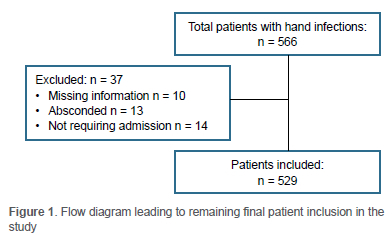
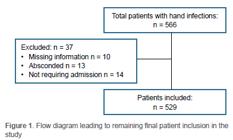
A total of 566 patients were considered for inclusion. Of these, 37 patients were excluded due to either not requiring admission for surgery (n = 14), having incomplete medical records (n = 10) or due to having absconded (n = 13) (Figure 1).
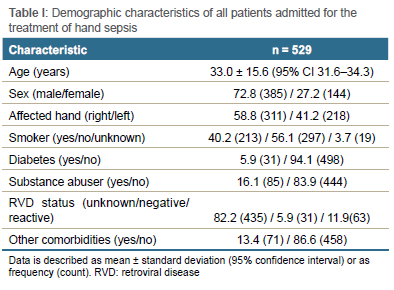
The final sample, therefore, included 529 patients with a mean age of 33.0 ± 15.6 years (95% CI 31.6-34.3) (Table I), the majority being males (79%, n = 385), and the right hand being mostly involved (59%, n = 312). The most common comorbidity was smoking (40%, n = 213). A total of 16% (n = 85) of patients were substance abusers, which included either methamphetamines, methaqualone, marijuana, heroin and/or cocaine. Retroviral disease (RVD) status was unknown in the majority of cases, given that testing was not routinely performed.
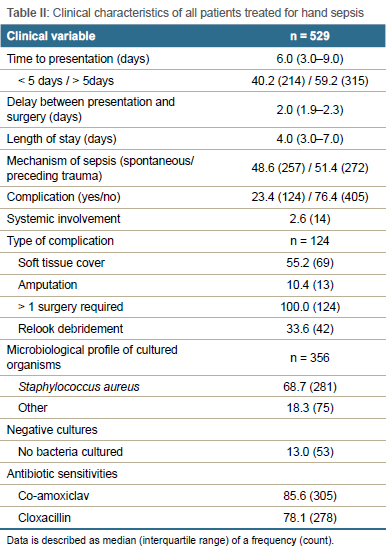
There was a slightly higher frequency of having a history of preceding trauma than spontaneous onset hand sepsis. The median number of days from onset of symptoms to presentation to admission to hospital was 6.0 (IQR 3.0-9.0) days, with a further delay of 2.0 (IQR 1.9-2.3) days to surgery. The median length of stay was 4.0 (IQR 3.0-7.0) days (Table II).
A total of 23% (n = 124) of cases experienced at least one complication (Table II), and a small number of patients 3% (n = 14) had documented evidence of systemic involvement. All patients with complications required more than one surgery, which finally resulted in the need for an amputation 10% (n = 13), requiring soft tissue cover 55% (n = 69), or the need for relook debridement alone 34% (n = 42).
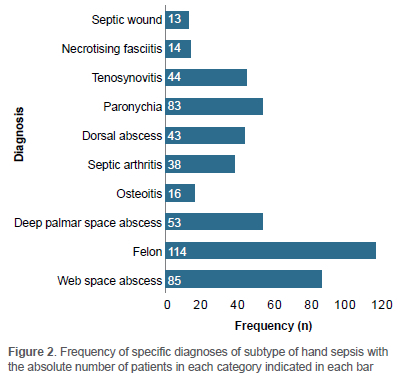
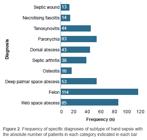
The most common types of hand infections were felon (22%, n = 114) and web space abscesses (16%, n = 85) (Figure 2).
A total of 412 patients had specimens sent for microbiological culture at the first debridement. Of these, an organism was successfully cultured in 86% (n = 356) of samples, and MSSA was cultured in 79% (n = 281) of specimens. Another organism, different from MSSA, was observed in 18% (n = 75) of all specimens, and MRSA was cultured in less than 1% (n = 3) of samples.
Of a total of 356 cases which had a positive culture, the majority of cases (86%, n = 305) were sensitive to co-amoxiclav. Following closely behind in sensitivity was cloxacillin, with 78% (n = 278) cases being sensitive, and the remainder of positive cultures being resistant (Table II).
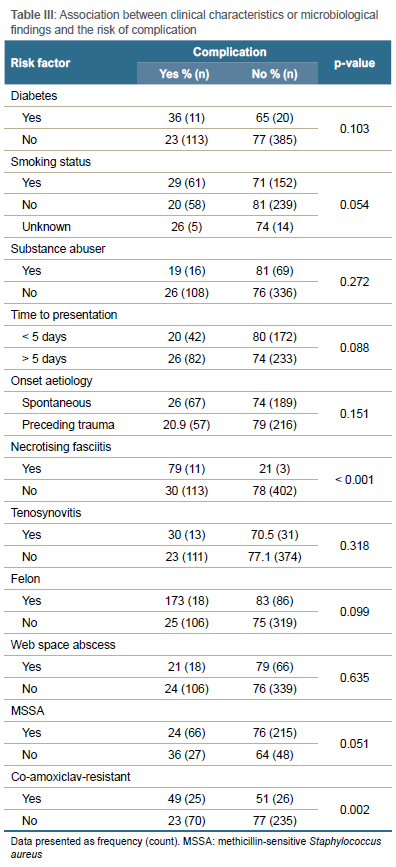
No difference in the risk of developing complications was observed in diabetic patients (p = 0.103), smokers (p = 0.054), those with spontaneous onset hand infections (p = 0.151), substance users (p = 0.272) or those who presented to the hospital at > 5 days from the first onset of symptoms (p = 0.088) (Table III). Similarly, the location of the infection, and causal bacteria had no association with the risk of developing complications (Table III).
An increased risk for developing complications (p < 0.001) was observed in patients with necrotising fasciitis (79%, n = 11) versus those without (30%, n = 113). Similarly, patients with co-amoxiclav-resistant infections had a higher risk (p = 0.002) of developing complications (49%, n = 25) compared to those with co-amoxiclav-sensitive infections (23%, n = 70) (Table III). More of the cultured organisms were sensitive to co-amoxiclav (86%, n = 305) than they were to cloxacillin (78%, n = 278) (Table III).
Discussion
The aim of this study was to explore the epidemiology of bacterial hand infections at a tertiary hospital in South Africa. This hospital serves a patient population from both urban and rural areas in the Western Cape of South Africa, including regional and district referral hospitals. The majority of the patients served in this institution are from a low- to middle-socioeconomic status group.11 412
The first main finding of this study, set within the Western Cape province of South Africa, a province with an unemployment rate of 25.6% as published in 2024 by Statistics South Africa,13108 611177
In the present study, hand infections were found to be more common in males, even though the Western Cape has a larger proportion of females than males,138,15 A possible explanation for this observation could be that more men may be involved in manual activities, risking hand injuries. Certain diagnoses of hand infection such as felon, web space abscess and paronychia were also more common, compared to less common, but more severe, types of hand infection such as necrotising fasciitis. Similar distributions were previously observed in other South African investigations,6,8 other LMICs,111,3,5
In keeping with the majority of other studies on hand infection,1,5 the most common organism cultured in the present study was MSSA, with less than 1% of cultures positive for MRSA.1,5 Similar distributions were observed in different South African studies, with a study performed in KwaZulu-Natal finding 82% being MSSA, while a Kimberley study reported MSSA as being present in 91% of patients.4,6 In the latter two studies, less than 1% and approximately 6% of samples, respectively, cultured for MRSA.4,6 In contrast, a ten-year longitudinal investigation from the USA reported MRSA to be most commonly cultured from hand infections in urban centres.7 6
A large proportion of the study participants were smokers (40%). However, no significant association between smoking and increased risk of developing complications was observed in the present study. This finding could imply that smoking may not be involved in the risk of developing early complications following hand infections. However, smoking is known to slow down tissue healing,1617 168,10
Similar to smoking, the presence of diabetes is also known to delay wound healing and has also previously been associated with the presence of severe infections, especially when blood glucose is not effectively controlled.85
Just over 23% of patients in the present study experienced one or more complication from their hand infection, which is slightly lower than what was observed in the KwaZulu-Natal study published in in 2020,81118 18 19 820
Co-amoxiclav was routinely used in the present study setting as the empiric antibiotic cover for all patients who present to the institution. Patients presenting with organisms sensitive to co-amoxiclav were less likely to experience complications, which is expected, given that the treatment is effective against the organism causing the infection. There are many alternatives to the antibiotic choice that would have good coverage for MSSA, such as cloxacillin, erythromycin/azithromycin, clindamycin and vancomycin, which could be potential treatment considerations.6
As in any clinical environment, complications result in increased morbidity as well as increased cost to the healthcare system. Indeed, a previous investigation quantifying the average cost of hand infections to the healthcare system concluded that the cost of treatment increases drastically, as expected, with any surgical interventions needing to be performed.15
A limitation of the study was the HIV status of patients not being readily available, which limits the conclusions that can be drawn from causal organisms in hand infections from HIV-positive compared to HIV-negative patients. Smoking and diabetes, two known risk factors for complications, were measured only as binary variables, which limits the depth of the conclusion that can be drawn from the findings. In addition, the present study reported only on early complications measured in hospital, and important long-term outcomes, such as stiffness, were not measured. This study, with an arguably large sample size and high number of complications, remained underpowered to detect many expected risk factors that might predispose to risk. This highlights that collaborative work should be undertaken to truly investigate, in large enough samples, the effect of many risk factors on hand infections. The present study provides direction for these future investigations.
Conclusion
In conclusion, we report a high burden of hand infections with a high number of early complications, over a 12-month period. Clinicians should be aware of an increased risk of complications, especially in patients with necrotising fasciitis and those infections which are resistant to the treating antibiotic. Co-amoxiclav was the most appropriate antibiotic for this population group, which is contrary to many other institutions, and thus highlights the fact that different institutions should examine their own populations to determine whether their antibiotic protocol is appropriate.
Ethics statement
The authors declare that this submission is in accordance with the principles laid down by the Responsible Research Publication Position Statements as developed at the 2nd World Conference on Research Integrity in Singapore, 2010. Prior to commencement of the study, ethical approval was obtained from Stellenbosch University Health Research Ethics Committee (HREC): HREC Ref: S22/10/220. Given the retrospective nature of this work, a waiver of informed consent was obtained. All procedures were in accordance with the ethical standards of the responsible committee on human experimentation (institutional and national) and with the Helsinki Declaration of 1975, as revised in 2008.
Declaration
The authors declare authorship of this article and that they have followed sound scientific research practice. This research is original and does not transgress plagiarism policies.
Author contributions
RA: conceptualisation of the research question, study design, methodology, data collection, manuscript preparation, editing and finalisation of manuscript, approval of final version
HvZ: study design, methodology, manuscript editing, approval of final version
MCB: study design, methodology, statistical analysis, manuscript preparation and editing, approval of final version
ORCID
Aboobaker R https://orcid.org/0009-0002-9314-9711
van Zyl H https://orcid.org/0000-0002-1479-0854
Burger MC https://orcid.org/0000-0003-2831-4960
References
- 1. Houshian S, Seyedipour S, Wedderkopp N, et al. Epidemiology of bacterial hand infections. Int J Infect Dis. 2006;10:315-19.
- 2. Gundlach BK, Sasor SE, Chung KC. Hand infections: epidemiology and public health burden. Hand Clin. 2020 Aug 1;36(3):275-83.
- 3. Wilkes R. A social and occupational study of the causes, cost, and prevention of infections of the hand. Br J Ind Med. 1954 Oct;11(4):269-78.
- 4. Van der Vyver M, Maderee A. Factors affecting bacteriology of hand sepsis in South Africa. S Afr J Surg. 2021 Sep 1;59(3):129A-129E.
- 5. Hayden AJ, Shah NV, Stroud SG, et al. Characterizing hand infections in an underserved population: the role of diabetic status in antibiotic choice and infection location. J Hand Microsurg. 2020;12(1):13-18.
- 6. Weideman L, Scheepers W, Fletcher L, Elliot E. The epidemiology and antibiotic choice In hand infections requiring surgical drainage - a retrospective study of 414 cases. SA Orthop J. 2024;23(2):76-81.
- 7. Kistler JM, Thoder JJ, Ilyas AM. MRSA incidence and antibiotic trends in urban hand infections: a 10-year longitudinal study. Hand. 2019 Jul 1;14(4):449-54.
- 8. Marais LC, Verhoef H, Ryan PV, et al. 2309 The risk of early complications in patients with hand infections. SA Orthop J. 2020;19(2):97-102.
- 9. Schwalfenberg N, Richter M. Indications for and limits of conservative treatment in hand infections. Handchir Mikrochir Plast Chir. 2021 Jun 1;53(3):231-36.
- 10. Botma N, McGuire D, Koller I, Solomons M. Factors affecting suboptimal outcomes in hand infections. J Hand Surg Eur Vol. 2021 Dec 3;46(5):544-45.
- 11. Shaikh U, Zulfiqar B, Ali Khan FA, et al. Epidemiology of operative hand infections presenting at the emergency care services of Civil Hospital Karachi. Pak Armed Forces Med J. 2024 Jun 28;74(3):829-34.
-
12. Facundo Cuevas P. Poverty and equity brief - Africa Eastern and Southern: South Africa. 2023 Apr [cited 2024 Nov 2]. Available from: https://databankfiles.worldbank.org/public/ddpext_download/poverty/33EF03BB-9722-4AE2-ABC7-AA2972D68AFE/Global_POVEQ_ZAF.pdf
» https://databankfiles.worldbank.org/public/ddpext_download/poverty/33EF03BB-9722-4AE2-ABC7-AA2972D68AFE/Global_POVEQ_ZAF.pdf -
13. Stats SA. Statistics for business. Statistics South Africa, Republic of South Africa. 2024 [cited 2024 Nov 2]. Available from: https://www.statssa.gov.za/wp-content/uploads/2024/03/StatsBiz_February2024.pdf
» https://www.statssa.gov.za/wp-content/uploads/2024/03/StatsBiz_February2024.pdf - 14. Von Elm E, Altman DG, Egger M, et al. The Strengthening the Reporting of Observational Studies in Epidemiology (STROBE). Lancet. 2007;370(9596):1453-57.
- 15. Greyling JF, Visser E, Elliot E. Bacteriology and epidemiology of hand infections. SA Orthop J. 2012;11(1):57-61.
- 16. Silverstein P. Smoking and wound healing. Am J Med. 1992;93(1A):22S-24S.
- 17. Smolle MA, Leitner L, Böhler N, et al. Fracture, nonunion and postoperative infection risk in the smoking orthopaedic patient: A systematic review and meta-analysis. EFORT Open Rev. 2021 Nov 1;6(11):1006-19
- 18. Arsalan-Werner A, Grisar P, Sauerbier M. Risk factors for reoperation in primary hand infections: a multivariate analysis. Arch Orthop Trauma Surg. 2020 Feb 1;140(2):283-88.
- 19. Dailiana ZH, Rigopoulos N, Varitimidis S, et al. Purulent flexor tenosynovitis: Factors influencing the functional outcome. J Hand Surg Eur Vol. 2008 Jun. 1;33(3):280-85.
- 20. Badenhorst DHS, van der Westhuizen CA, Britz E, et al. Lost to follow-up: challenges to conducting orthopaedic research in South Africa. SAMJ. 2018 Nov 1;108(11):917-21.
Accepted: May 2025
Published: March 2026
Editor: Dr Megan O'Connor, University of KwaZulu-Natal, Durban, South Africa
Funding: No funding was received for this study.
Conflict of interest: The authors declare they have no conflicts of interest that are directly or indirectly related to the research.