




Services on Demand
Journal

Article
 English (pdf)
 Article in xml format
 Article references
 Automatic translation
 Send this article by e-mail
Indicators
Related links
-
 Cited by Google
 -
 Similars in Google
Share

 Permalink
Acta Theologica
On-line version ISSN 2309-9089Print version ISSN 1015-8758
Acta theol. vol.45 n.1 Bloemfontein 2025
https://doi.org/10.38140/at.v45i1.7859
ARTICLES
Instilling values through literature: Analysing Everyman, a medieval morality play
U. Ozen Baykent
English Language Teaching Department, Faculty of Education, Bursa Uludag University, Bursa, Turkey, E-mail: ufukozen@uludag.edu.tr; ORCID: https://orcid.org/0000-0001-9496-7922
ABSTRACT
War, poverty, hunger, misery, prejudice, loneliness, and intolerance have been the problems of the world throughout history and the sufferings due to these problems have always been deep. In an ever-changing world, characterised by rapid technological advancements, shifting cultural landscapes, and complex global challenges, values education holds paramount importance. This article aims to integrate moral instruction into higher education literature courses, by examining the use of the medieval morality play Everyman as a pedagogical tool. With a growing emphasis on values education and character development, educators are seeking innovative approaches to instil moral principles in learners. The allegorical representation of virtues and vices, the protagonist's existential journey, and the play's cultural and historical context contribute to its significance as a catalyst for values education. By delving into the complex moral choices faced by the central character, learners are prompted to contemplate the implications of their own decisions and values.
Keywords: Everyman, Values education, Medieval English drama
Trefwoorde: Everyman, Waardes opvoeding, Middeleeuse Engelse drama
1. INTRODUCTION
In the current state of the world, individuals are enduring conditions such as poverty, hunger, suffering, bias, isolation, and intolerance, all of which coexist with wars. During the official launch of UN Human Rights' 2025 Annual Appeal in Geneva, Switzerland, UN Human Rights Chief Volker Türk stated that
[t]he solutions to today's endless wars, to the climate crisis, to our troubled relationship with technology, lie in more respect for human rights, not less (United Nations 2025:4).
However, respect for human rights coexists with values. Qualities such as generosity, affection, consideration, and empathy are truly essential. Therefore, it becomes imperative for us to uphold and adhere to these virtues, striving to both acquire and impart moral principles. The education of values, both for young students and adults, emerges as a crucial and indispensable field of study. Instilling values in the younger generation and reinforcing them while raising consciousness within higher education present challenging areas of investigation. Research indicates that values education plays a crucial role in promoting ethical behaviour and social responsibility among students. Duban and Aydogdu (2016) highlight that many teachers do not receive sufficient training in values education, hindering their ability to effectively teach these important principles. This article seeks to explore the feasibility of values education, by analysing literary works. The primary objective of this article is to uncover and elucidate the connection between the examination, analysis, and interpretation of literary texts and the imparting of moral lessons. The article aims to provide an example of the integration of moral education into literature courses at higher education level. It centres on the analysis of Everyman (2007), a renowned medieval morality play in English literature and intends to illustrate how it can effectively cultivate moral awareness and facilitate moral instruction.
Conducting direct and evident values education for young students is feasible. Nevertheless, it is essential to recognise that, in higher education, there are methods of imparting and evoking values indirectly and subtly. Research indicates the potential for simultaneously conveying values and knowledge from various domains. Hermansen (2020) explores how coherence in professional education emerges through the interaction between knowledge discourses and the professional field. Rather than being a fixed trait, this coherence develops dynamically, reflecting the values embedded in the educational environment. By examining how knowledge is conveyed within specific educational contexts, educators can more effectively integrate the teaching of both values and subject knowledge. Yang (2016) examines how storytelling and cultural narratives contribute to the transmission of knowledge and values. As an effective educational tool, storytelling enables the integration of personal and cultural values into learning environments, fostering both engagement and a deeper comprehension of the subject matter. This approach highlights how values can enhance the process of acquiring knowledge. It is most fitting to introduce ethical principles to adult learners alongside their pursuit of other subjects. This is the rationale behind emphasising an amalgamated approach to values instruction through the analysis of literature. This article delves into the utilisation of a morality play from the medieval English literary canon, specifically Everyman, as a means of instilling moral values within higher education, particularly within the context of literature courses.
This article strives to introduce a fresh perspective on the incorporation of values education within higher education, specifically when teaching literature to adult learners (interchangeably used with students). This approach holds significance, due in part to the underexplored nature of values education in higher education and its overarching goal of seamlessly integrating moral instruction into literature teaching. The article initially focuses on delineating the notion of values and elucidating the nuances of values education. Subsequently, it delves into exploring Everyman (2007) as a significant exemplar of medieval drama. Lastly, the article examines the potential application of Everyman in the context of teaching moral values. The inherent values suggested and communicated through Everyman are outlined to demonstrate how this literary work can effectively facilitate the teaching of national, ethical, cultural, and compassionate values within literature courses.
2. THE FIELD OF VALUES EDUCATION
The values stand for standards to evaluate our actions, to justify the rightness of those actions, to plan them, and to provide justifications for them. The organisation of values is known as values system. The values systems can vary among individuals, societies, and cultures. Even though it is closely associated with attitude, social norms, need or concern, the concept of value has a transcendental and covering nature. Cevizci (2005:73) argues that values carry actions, attitudes, judgements, and momentary aims to upper levels and guide the comparisons among various objects and situations. Values stand at the centre of the individual's identity and transcend all particular situations. They constitute a standard for the individual's actions and deeds. An individual possesses values that are equal to all the behaviours he or she has acquired. The values might go through slight changes in time, but they never really change completely and are thus permanent. Values are beliefs that are commanding or forbidding for the individual. Value is a choice made by the individual for a preferable one among the others. The individual, who acquires values, has obtained the knowledge of the standards that will guide him through his or her actions.
Values can be recognised as the dependent variables because they are the result of cultural, institutional, and personal forces that affect a person throughout his/her life. However, they are also independent variables, as they have advanced implications for every human-related field that is constantly at the focus of social scientists (Cevizci 2005:76).
The fact that disciplines such as philosophy, psychology, sociology, history, and religious sciences have investigated the concept of value has made it difficult to define the concept and describe its nature. The concept of value "is the belief about whether something is desirable or undesirable" (Güngör 1993). Çaglar (2005) describes value as the cultural elements that direct the individual's thoughts, attitudes, and actions. Erdem (2003) maintains that value is the tendency to prefer one situation to another. No matter how they are defined, values are the standards for knowing right, thinking right, making right judgments, and acting right.
As a result of examining the concept of value in different fields, the classification of values has also come to the fore. Topçuoglu (1999) classifies values into six groups such as aesthetic, scientific, economic, political, social, and religious values. While some of the values such as inner peace or well-being are related to the inner aspect of the individual, values such as brotherhood, peace, and understanding are interpersonal values. One of the leading studies in social psychology was presented by Rokeach in 1973, in the book entitled The nature of human values, in which Rokeach classifies values as "goal values" and "instrumental values". Happiness, peace, respect, friendship, or freedom were given as examples of goal values, while values such as responsibility awareness, honesty, kindness, courage, and helpfulness were given as examples of instrumental values (Rokeach 1973:28). Dilmaç (1999:16, 17) argues that values such as loving people, being harmonious, controlling ambitions, desire for the happiness of others, self-control, being a good person, believing in spiritual values, being helpful, being experienced and knowledgeable, making friends, raising children, and creating works are the most important values for people.
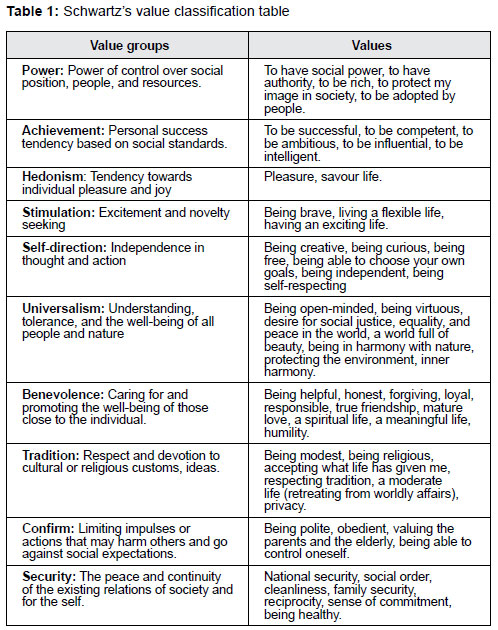
The above table (Kuşdil & Kağitçibaşi 2000:61; Yigittir 2012:4) is a scholarly accepted classification of values in values education contexts. The value groups and values are given to enlighten and inspire academics from different disciplines in their preparation of syllabi and course designs.
Zajda and Daun (2009) assert that values education is a fundamental aspect of school pedagogy, as it promotes moral development and equips students for active participation in democratic and global citizenship. Their view supports the idea that education should go beyond knowledge transmission to encompass the development of ethical and civic values. They argue that a holistic approach to values education can deepen students' awareness of their responsibilities within society. Wright (2005) advocates for the inherent significance of religious education, asserting that it cultivates moral reasoning and ethical conduct in students. This viewpoint underscores the broader impact of values education, proposing that it supports the overall development of individuals, by fostering their moral and spiritual growth. Incorporating values into adult education is essential for promoting responsible citizenship and sustainability. Ahrens et al. (2024) emphasise the need to integrate sustainability values into adult education frameworks. Their study reveals that adult education can advance environmental and social sustainability, by fostering values that inspire individuals to take meaningful action. This suggests that values education is vital in addressing modern global challenges, as it equips individuals with the knowledge and motivation to make informed decisions that benefit both their communities and the environment. The research indicates why values should be at the heart of our education system. Values education can be realised with an explicit and direct explanation as well as implicit and indirect ways and exemplification of the values, or it can be integrated into the teaching of other lessons. At present, the purpose of education is not regarded as only teaching mathematics, language, social studies, and science.
Ethical values are fundamental principles that influence individuals and organisations in both decision-making and assessing actions as morally right or wrong. These values form the basis of ethical conduct, shaping personal character and fostering social harmony. They can originate from diverse sources, including cultural traditions, religious beliefs, philosophical perspectives, or personal convictions. Ethical values can be understood as the moral standards that shape an individual's behaviour and decision-making processes. Literature reveals the critical importance of ethical values across various domains, including healthcare, education, business, and social work. Wulanditya et al. (2022) emphasise the significant impact of ethical values on employee behaviour, especially regarding fraud in the banking sector. Their research indicates that ethical values can either curb or contribute to unethical conduct, highlighting the necessity of a strong ethical framework to promote integrity in professional environments. This view reinforces the importance of embedding ethical values within organisational cultures to deter misconduct. Hassanian and Shayan (2017) emphasise that ethical values are essential for patient care, as they inform the ethical climate within healthcare organisations. Coпoвa (2022) discusses the regulatory, normative, educational, and axiological components of professional-ethical culture, which collectively shape the ethical values of social educators. Kule (2023) investigates the relationship between integrity, ethical values, and financial performance in savings and credit cooperatives. The study finds that organisations with strong ethical values tend to experience better financial outcomes, reinforcing the idea that ethical behaviour is not only a moral imperative, but also a business necessity. Research in various fields shows the importance of teaching ethical values to students to enable them to use the education they have received in other disciplines in the best way. Realising the importance of the contribution of values to the education process, researchers have increased their research on values education in recent years. In their book, Packham et al. (2024) highlight the essential role of values education in supporting both student and teacher well-being. They contend that incorporating values into the educational system helps create a positive school atmosphere while tackling issues such as student disengagement and teacher burnout. The authors present practical methods for applying the education in human values (EHV) approach, emphasising its effectiveness in promoting holistic development and enhancing educational success. Lovat (2010) emphasise that values education is essential for creating optimal and harmonious learning and social environments for both students and teachers. They argue that integrating values into the educational framework not only enhances academic success, but also promotes the holistic development of students, encompassing social, emotional, moral, and spiritual growth.
The concepts of globalisation, urbanism, human rights, nature, being scientific, and so on are frequently uttered nowadays. This brought education, which aims to raise individuals who live respectfully, according to nature and human rights in the globalising world, and adopt scientific principles. This opened up a field for values education for the individual to use the knowledge and skills the individual has gained in every field most accurately and efficiently. Post-2000s, values education congresses1 have been organised and academic journals that include current articles on values education2have begun to be published. Considering all these, the education of religious values, the role of values in social studies teaching, family-supported values education models, media, and values education relations are frequently on the agenda (Akin & Öztürk 2021; Arslan & Ulaş 2021).
Education sets out the affective goals that the individual will gain as well as his/her cognitive development. Education, which aims to provide the individual with knowledge and skills in areas such as arithmetic, science, history, and foreign language, also aims to teach concepts such as justice, honesty, respect, love, and patriotism. While the character of the individual who learns the values develops in a positive way, this also equips the individual morally. Research on values education indicates four approaches to values education, namely value realisation, value clarification, value analysis, and moral reasoning (Akbaş 2008; Brady 2010; Çubukçu 2014).
The value realisation approach emphasises that the individual becomes aware of his/her values and makes decisions that will suit him/her. Within the framework of this approach, while the teacher helps the student to understand the meaning of life, the student is guided to think creatively and critically.
While the value clarification approach focuses on the process of becoming aware of the student's values, it emphasises that the student is exposed to many examples such as television, the virtual world, the print media, and peers. The propaganda of these models also plays a role in the acquisition of values. This approach, which questions how individuals can make the right choices in their lives, expresses the necessity of clarifying the values that individuals had in this process initially. It is essential to guide students through the process of realising their values; only in this way can students establish their own values systems. Raths et al. (1978) emphasise that students gain values in three main stages within the framework of this approach. The first stage is the selection stage, where students freely choose from among the alternatives. They make a choice as a result of careful evaluation of the options and reflection. In the second stage, rewarding, students share their satisfaction with their choice with their own consent. The last stage is action, where student are expected to act one or more times in line with their choice.
The third approach, value analysis, aims to reach rational, systematic, and logical solutions, by starting off with problems containing value. In this way, the student will think and decide how to act in accordance with the values, based on an important event that contains value. In these analysis stages, first, the problem in the sample issue is defined and alternative ways are determined. Evidence about each alternative is collected, evaluated, and possible outcomes are tried to be predicted. The situations that may arise as a result of each alternative are evaluated and the appropriate course of action is selected among the alternatives (Ryan 1991).
The fourth approach to values education is moral reasoning which aims to support the moral development of the individual and thus society. Emphasising the concepts of justice, equality, and democracy, this approach aims to teach students to develop moral principles that will guide them on how to behave, by encouraging them to think, discuss, and defend how to act in the presented situations.
Brady (2010) evaluates these four approaches in his study, stating that a single values education method does not seem possible, because all of them are based on different theoretical points for values education. The trait approach emphasises the development of already established values or qualities in behaviour through direct instruction. The value clarification approach aims to create students' awareness of their own values, by giving many different explanation tasks in the process guided by the teacher's inquiries. The cognitive developmental approach is based on the development of moral reasoning and claims that this will happen at different levels through discussion groups directed to resolve conflicts presented by moral dilemmas. The role play approach claims that it will be possible for the student to reach the awareness of him-/herself and others, by discovering the solutions in the scenarios given through instant verbal dialogues.
Moral values are the virtues of reason and values education supports the acquisition of these values. Values education enables the individual to become a more honest, more tolerant, more impartial, and morally better person. For this reason, values education has to be a part of general education. Supporting the moral development of the individual is possible, by supporting his/her moral autonomy. An individual, who is morally autonomous, can judge independently. This individual can think for him-/herself and does not leave the act of thinking for oneself to others. A morally autonomous individual can make his/her own choices morally. It can thus be said that values education helps an individual make morally correct choices. The organised form of the individual's values constitutes the character of the individual. An individual with a good moral character has values, makes choices, and acts according to values. Therefore, part of the aim of education is to educate students with a moral character and train them with values. Literature courses include reading, analysing, and commenting on poems, novels, short stories, and drama. In this way, moral education would be integrated into literature courses.
As for the concern of this study, the next section shows how a morality play can be used to teach values in a literature course.
3. EVERYMAN AND THE MORALITY PLAY
In the preceding section, I emphasised that the goal of education extends beyond merely developing cognitive abilities. It should also nurture individuals characterised by integrity, equity, dependability, altruism, patriotism, industriousness, affection, and reverence - ultimately, those aspiring to embody the qualities of a "virtuous individual". As stated at the outset, this article seeks to explore how the examination of literary works of drama influences the instillation of moral principles in the endeavour to cultivate "virtuous individuals". I focus on a widely recognised medieval morality play titled Everyman (2007).
English drama's inception can be traced back to the medieval period, marked by the emergence of miracle plays and morality plays. Both genres share a crucial commonality: they carry didactic intent. Miracle plays seek to elucidate enigmatic events in Christian belief, while morality plays strive to impart moral lessons and inculcate ethical values. In morality plays, one observes the human struggle to make choices between sinfulness and salvation. These plays predominantly aim to convey the playwright's perspectives on social, political, religious, and moral issues. According to Richardson and Johnston (1991:97), morality plays can be defined as a genre crafted by modern critics to encompass those plays that instruct on moral concepts through the use of personified characters. The medium of drama serves as the vehicle for moral instruction. A defining characteristic of morality plays is their allegorical nature; the characters in the play behave and communicate like ordinary human beings, but their actions and words symbolise abstract concepts.
Everyman is the best-known 15th-century morality play. It is the story of the end of Everyman's life when death comes to take him to give account of his life in the presence of God. Messenger, Everyman, God, Death, Fellowship, Kindred and Cousin, Goods, Good-Deeds, Knowledge, Confession, Beauty, Strength, Five-Wits, Discretion, Doctor, and Angel are the characters, most of which are Everyman's friends. Richardson and Johnston (1991:98) explain the allegory in Everyman as personification as
a means of endowing qualities and ideas with an animate existence. ... When Everyman is called 'Everyman' that is precisely what he presents. Similarly with Fellowship, Kindred and so on. Allegory is metaphorical in its basis...
In the play, the character Everyman stands for all humanity.
The relationship between Everyman, a well-known medieval morality play, and values education highlights the potential for literature to effectively convey and impart moral lessons to learners. The play's allegorical nature and its exploration of the journey of the protagonist, Everyman, symbolise universal human experiences, ethical dilemmas, and the inherent struggle to confront one's mortality. Few studies have been carried out about teaching values through Everyman. Makutoane and Naude (2004) show how the adaptation of Everyman into Southern Sotho revitalises values education through drama. The interactive and performative nature of morality plays makes them effective tools for teaching ethical behaviour, religious values, and social responsibility. Higher education institutions can incorporate drama into values education courses, ensuring greater engagement, deeper reflection, and cultural adaptability in teaching moral lessons. Makutoane (2023) provides a compelling case for adapting religious and literary texts to fit local cultural and theological contexts. It highlights the importance of translation as a dynamic, interactive process that considers both linguistic accuracy and audience reception. The successful adaptation of Everyman into Sesotho serves as a model for future translations of religious and moral texts, promoting values-based teachings through drama.
The medieval morality play Everyman serves as an effective tool for teaching morals, as it presents timeless ethical and spiritual lessons through allegory. The play, written in the late 15th century, follows the journey of Everyman, a character who represents all of humanity, as he faces death and reflects on his life. His interactions with personified concepts such as Fellowship, Goods, Knowledge, and Good Deeds reveal crucial moral insights that remain relevant nowadays. The following are some examples of quotes from the play together with ideas about teaching of values while discussing them.
O wretched man, whither shall I flee?
Who shall me succor but to thee, my Good Deeds?
This quote from Everyman is related to personal accountability and moral responsibility. It can be used to discuss and teach that individuals are ultimately accountable for their own actions. It emphasises that good deeds, rather than material wealth or superficial relationships, define a person's moral worth.
For, when thou art dead, this is my guise,
Another to deceive in the same wise
As I have done thee, and all to his soul's reprieve.
This quote is about the fleeting nature of worldly possessions. It is spoken by Goods (representing wealth and material possessions) and highlights that material things are temporary and unreliable in the face of death. It teaches the importance of prioritising moral and spiritual values over material success.
All earthly things is but vanity:
Beauty, Strength, and Discretion do man forsake,
Foolish friends and kinsmen that fair spake-
All fleeth save Good Deeds, and that am I.
This quote on the value of Good Deeds reinforces the idea that external attributes such as beauty, strength, and even friendships may fade, but good deeds remain meaningful. It encourages students to cultivate kindness and integrity, as these are the lasting marks of a virtuous life.
Take example, all ye that this do hear or see,
How they that I loved best do forsake me,
Except my Good Deeds that bideth truly.
This quote is on seeking redemption and self-reflection and can be used to encourage students to reflect on the importance of ethical living. It serves as a reminder that, ultimately, moral character and good deeds are the most valuable aspects of life.
Fear not, I will speak for thee;
Though all the world be against thee.
This quote, spoken by Knowledge to Everyman, is on the importance of knowledge and confession. Knowledge, representing self-awareness and moral understanding, assures Everyman that personal growth and repentance are possible. This can be used to teach students that learning from mistakes and striving for ethical improvement is a lifelong process.
As a morality play, Everyman effectively conveys moral and ethical lessons that remain relevant at present, making them valuable tools in values education. Literature courses in higher education offer a unique and effective platform for teaching values, by exposing students to diverse perspectives, ethical dilemmas, and moral lessons embedded in literary works. Through critical analysis, discussion, and reflection, students can explore fundamental human experiences and ethical principles that shape personal and societal values. In higher education, the original forms of literary texts such as Everyman can be included in the syllabus in which the courses are designed to focus on the values represented in them. In this way, the study, discussion, and analysis of literary texts will be accompanied by the teaching of values. The following narrative framework provides a rich platform for values education in higher education contexts.
3.1 Allegorical representation of values
Everyman presents characters that personify various abstract qualities and attributes such as Beauty, Confession, Discretion, Five-Wits, Knowledge, Good-Deeds, Goods, Fellowship, Kindred and Cousin, and Strength. Each character represents a distinct value or aspect of human nature. This allows for a direct exploration of different values and their significance in human life, making it conducive for educators to initiate discussions about values and their implications. When Everyman discloses that he is about to confront God's judgment and seeks companionship for this journey, Fellowship hesitates, aware that accompanying Everyman means facing his own mortality. Everyman appears to wish that Fellowship could save him from his destiny, yet Fellowship's reluctance to embark on the pilgrimage demonstrates that, while friendships may be cherished, they do not hold the ultimate key to salvation. Much like Fellowship, Cousin and Kindred decline to assist Everyman or join him on his journey. This reluctance of different characters in the play to make the ultimate sacrifice serves as an implicit counterpoint to the example of Jesus Christ, who did sacrifice himself to save the souls of humanity. The passage portrays a very good example of a discussion of values.
3.2 Reflection of human experience
The play's central theme of Everyman's journey from worldly attachment to spiritual awakening reflects a common human trajectory. This journey can be interpreted as a process of recognising the transience of material possessions and the ultimate importance of values such as morality, accountability, and spirituality. This reflection can stimulate discussions about the meaning of values in one's life. At the beginning of the play, the messenger sets the tone that the focal point will be on death, serving as a moment for introspection about one's own existence. God introduces a contrast between goodness and material success, a theme that will recur in the play. Characters embodying different worldly temptations will surface, with the aim of diverting Everyman from the righteous path. This theme remains deeply relevant nowadays, as people navigate moral choices, materialism, personal growth, and spiritual awakening. Whether through business ethics, celebrity transformations, the pursuit of minimalism, or redemption stories, the modern world reflects Everyman's timeless lessons on the impermanence of wealth and the enduring value of morality and self-reflection.
3.3 Cultural and historical context
Everyman is rooted in the cultural and moral context of its time. Studying and analysing the play can provide insights into the values and beliefs of the medieval era. Comparing these values with contemporary ones encourages critical thinking and helps students evaluate how societal values have evolved. Everyman provides a window into the religious, social, and cultural concerns of its historical context, offering moral guidance and spiritual contemplation in the face of mortality. The play is firmly grounded in Christian doctrine, mirroring the devout religious sentiment of its time. It underscores the significance of leading a righteous life and getting ready for the inescapable reckoning with God's judgment. Allegory and morality plays were popular literary forms in the medieval period (Abrams 1993). Everyman embodies the allegorical tradition, where characters represent abstract concepts (e.g. Fellowship representing worldly companionship). The play serves as a didactic tool, imparting moral lessons to the audience.
3.4 Complex moral choices
Throughout the play, Everyman encounters moral choices and dilemmas, prompting learners to consider the consequences of those choices. This encourages students to reflect on their own values and ethical principles, fostering a deeper understanding of personal and societal values. Everyman is a representation of "every individual". He embodies humanity as a whole, emphasising that, within the context of the play, all people are marked by sinfulness. The passage depicts Everyman as profoundly focused on material possessions, implying that the play presents a broader commentary on humanity's materialistic and vain tendencies. The harshness exhibited by Goods, one of Everyman's companions, underscores that worldly possessions can be the most insidious diversion from virtuous pursuits and other meaningful goals. There are many examples that demonstrate the complex moral dilemmas and choices faced by characters in Everyman, highlighting the play's emphasis on the spiritual journey and the importance of moral reflection. For example, Fellowship encounters a moral dilemma when Everyman requests his company on the journey to confront God's judgment. Fellowship pauses, because he understands that this journey entails facing mortality. Everyman's ultimate decision to take Good Deeds with him to face God's judgment, along with his realisation of the value of Knowledge, underlines the moral journey of self-reflection, repentance, and choosing virtuous companionship.
3.5 Engagement and empathy
The emotional engagement generated by literary works such as Everyman can lead to increased empathy and perspective-taking. This emotional connection with the characters' struggles and choices can enhance the effectiveness of values education, as learners are more likely to internalise lessons that resonate with them emotionally. Students can connect emotionally with Everyman's existential predicament. His journey to face mortality and judgment is a universal theme, evoking empathy for the human condition. The play addresses the inescapable truth of mortality, a subject that deeply touches its audience. This can prompt individuals to reflect on their own finitude, establishing a poignant emotional bond. Everyman's eventual choice to take Good Deeds with him to face God's judgment can evoke a sense of triumph and resolution. Readers may feel a surge of satisfaction in witnessing Everyman's moral growth.
3.6 Multidimensional values
The play addresses a range of values, including spiritual, ethical, interpersonal, and societal values. This multidimensionality allows educators to explore a broad spectrum of values within a single narrative, providing a comprehensive approach to values education. By presenting these multidimensional values through allegorical characters and their interactions with Everyman, the play encourages contemplation of various aspects of human existence, ethics, and spiritual growth. This complexity contributes to the enduring relevance and resonance of Everyman across different cultural and historical contexts. Everyman addresses multidimensional values through its portrayal of various allegorical characters and their interactions with the protagonist. For example, Goods personifies material belongings, emphasising the clash between earthly affluence and spiritual abundance. Everyman seeks companionship on his journey, but his friends (Fellowship, Cousin and Kindred) hesitate or refuse. This raises questions about the value of earthly friendships compared to spiritual bonds. Knowledge serves as a guide to Everyman, emphasising the value of wisdom in navigating life's challenges and preparing for the afterlife.
The medieval morality play Everyman remains a powerful tool for teaching values, as it presents timeless ethical dilemmas through a dramatic narrative that mirrors contemporary moral struggles. The play's central theme - Everyman's journey from material attachment to spiritual awakening -parallels modern concerns about ethical decision-making, personal integrity, and social responsibility. Currently, some people give away their billion-dollar company to fight climate change, embody the lesson that material wealth is fleeting, much like how Everyman realises that his riches (Goods) cannot accompany him after death. Similarly, the downfall of some business leaders reflects how unethical choices in pursuit of success lead to moral reckoning, just as Everyman initially seeks help from false friends such as Fellowship and Kindred but ultimately learns that only Good Deeds endure. The play also intersects with personal redemption stories of transition from a troubled past to a life of faith and service, echoing Everyman's realisation that confession and repentance lead to spiritual salvation. In addition, the COVID-19 pandemic prompted a global reassessment of values, with millions prioritising mental health, family, and meaningful work over material gain - a real-world reflection of Everyman's realisation that only ethical and virtuous living holds true significance. By staging Everyman in contemporary settings, literature and drama can serve as a compelling medium for values education, allowing audiences to engage emotionally with moral dilemmas and fostering deep reflection on ethical choices. Students become active participants in exploring integrity, responsibility, and the consequences of their actions, making drama an invaluable tool in cultivating ethical awareness in contemporary society.
4. CONCLUSION
Literary texts such as poems, drama, novels or short stories offer a fictional field of experience, even if they are sometimes based on real events and people. While literary texts convey plots with characters and describe with words, actions, thoughts, and choices, they drag the readers to imagine the fictional world and visualise it in their minds. While the characters are sometimes portrayed in a moral dilemma, at a crossroads, or at a decision stage, the reader is confronted with the question, "What would I do?". The varying approaches in the field of values education focus on students' realisation of their own values, deciding how to act in problematic situations, or finding morally correct starting points, by analysing given situations. In fact, all of these approaches can be applied through reading, examining, interpreting, and criticising literary texts. Based on this proposition, it can be said that this study will evoke a new practice in values education. Some studies on the relationship between literature and values education (see Çubukçu 2014; Pantic 2006; Aslan 2010) were carried out at primary and secondary education level. However, drama, in its original forms such as Greek tragedies, medieval morality plays, Elizabethan drama, and modernist theatre, is a fundamental part of higher education curricula in literature, theatre studies, and cultural studies. The inclusion of these foundational dramatic works serves academic, artistic, and ethical purposes, ensuring that students engage with the historical, philosophical, and moral dimensions of drama. This study will bring a novelty to the literature as it investigated the teaching of values via literature at the higher education level.
Incorporating Everyman into values education within literature courses enables the integration of literature courses with values education. Students can explore connections between literature, history, philosophy, and psychology, enriching their understanding of values and their multifaceted implications. In summary, Everyman offers a powerful vehicle for values education, by presenting allegorical characters, reflecting human experiences, and fostering discussions about cultural and historical contexts. Its exploration of complex moral choices, emotional engagement, and multidimensional values makes it a valuable resource for educators seeking to integrate moral instruction into higher education literature courses.
A combined approach to value education (value clarification, value analysis, value realisation, and moral reasoning) is essential for developing well-rounded ethical individuals. Value clarification helps students identify their personal values. However, without value analysis, they may accept values without questioning them. Moral reasoning ensures that they apply values to real-life dilemmas. However, without value realisation, ethical learning may remain abstract rather than shape behaviour. For example, a student may clarify that s/he values honesty, analyses why it matters, reasons through ethical dilemmas, and then commits to practising honesty in daily life. Together, these approaches ensure critical thinking, personal engagement, and ethical application, making value education more meaningful and impactful. This article contends that integrating Everyman into literature courses within higher education offers a multidimensional platform for discussing ethical, spiritual, interpersonal, and societal values. As education increasingly prioritises holistic development, this exploration of Everyman as a tool for teaching values provides educators with valuable insights into leveraging literary analysis for meaningful and impactful values education. The literature courses will provide contexts for holistic development through a combination of four approaches.
BIBLIOGRAPHY
Abrams, M.H. 1993. A glossary of literary terms. Sixth edition. New York: Holt, Rinehart and Winston, Inc. [ Links ]
Arslan, A. & Ulaş, A.H. 2021. Değer Odakli Aile Eğitim Programina Yönelik Ebeveynlerin Çocuklarinin Kazanmalarini istedikleri Kök Değerlerin Belirlenmesi. International Journal of New Approaches in Social Studies 5(1):63-78. https://doi.org/10.38015/sbyy.857482 [ Links ]
Ahrens, A., Dzerviniks, J., Skrgmüle, I., Ušča, S., Blazüligniene, S., Zaščerinska, J. & Hggnadottir, A. 2024. Sustainability values: A comprehensive framework for adult education. Society Integration. Education Proceedings of the International Scientific Conference, Vol. 2: 129-139. https://doi.org/10.17770/sie2024vol2.7799 [ Links ]
Akbaş, O. 2008. Değer Eğitimi Akimlarina Genel bir Bakiş. Değerler Eğitimi Dergisi 6(16):9-27. [ Links ]
Akin, Z. & Öztürk, E. 2021. Değer eğitimi sürecinde okul - aile işbirliği: Bir nitel çalişma. Değerler Eğitimi Dergisi 19(42):73-112. https://doi.org/10.34234/ded.912583 [ Links ]
Aslan, Z.Ş. 2010. Değerler Eğitiminde Bir Yöntem Önerisi: Edebiyat Metinlerinden Yararlanma. Değerler Eğitimi Uluslararasi Konferansi. istanbul: Damla Yayinlari, pp. 47-55. [ Links ]
Brady, L. 2010. Classroom-based practice in values education. International research handbook on values education and student wellbeing. London: Springer. https://doi.org/10.1007/978-90-481-8675-4_13 [ Links ]
Çağlar, A. 2005. Okul Öncesi Döneminde Değerler Eğitimi. Erken Çocuklukta Gelişim ve Eğitimde Yeni Yaklaşimlar. M. Sevinç (ed.). Istanbul: Morpa Kültür Yayinlari.
Cevizci, A. 2005. Felsefe Ansiklopedisi. Istanbul: Ebabil Yayincilik. [ Links ]
Coпoвa, Д. 2022. Ethical principles of social educator activity. The Modern Higher Education Review 7:90-98. https://doi.org/10.28925/2518-7635.2022.77 [ Links ]
Çubukçu, F. 2014. Values education through literature in English classes. Procedia - Social and Behavioral Sciences 116:265-269. https://doi.org/10.1016/j.sbspro.2014.01.206 [ Links ]
DiLMAÇ, B. 1999. Ilköğretim Öğrencilerine Insani Değerler Eğitimi Verilmesi ve Ahlaki Olgunluk Ölçeği ile Eğitimin Sinanmasi. PhD dissertation. Marmara Üniversitesi. Eğitim Bilimleri Enstitüsü [ Links ].
Duban, N. & Aydoğdu, B. 2016. Values education from perspectives of classroom teachers. European Journal of Social Sciences Education and Research 7(1): 59-72. https://doi.org/10.26417/ejser.v7i1.p80-88 [ Links ]
Erdem, A.R. 2003. Üniversite Kültüründe Önemli bir Unsur: Değerler. Değerler Eğitim Dergisi 1(4):55-72. [ Links ]
Güngör, E. 1993. Değerler Psikolojisi. Amsterdam: Hollanda Türk Akademisyenler Birliği Vakfi Yayinlari. [ Links ]
Hassanian, Z. & Shayan, A. 2017. The mediatingeffectofethicalclimateonreligiousorientationandethicalbehavior. Nursing Ethics 26(4):1114-1127. https://doi.org/10.1177/0969733017738133 [ Links ]
Hermansen, H. 2020. Knowledge discourses and coherence in professional education. Professions and Professionalism 10(3): 3713. https://doi.org/10.7577/pp.3717 [ Links ]
Kule, D. 2023. Integrity and ethical values, and financial performance of savings and credit cooperatives (saccos) in mid-western Uganda. American Journal of Accounting 5(1):49-60. https://doi.org/10.47672/ajacc.1470 [ Links ]
Kuşdil, M.E. & Kağitçibaşi, Ç. 2000. Türk Öğretmenlerin Değerler Yönelimi ve Schwartz Değer Kurami. Türk Psikoloji Dergisi 15(45):59-76. [ Links ]
Lovat, T. 2010. The new values education: A pedagogical imperative for student wellbeing. In: T. Lovat, R. Toomey, R., Clement, N. (eds) International research handbook on values education and student wellbeing. (Springer, Dordrecht) pp. 3-18. https://doi.org/10.1007/978-90-481-8675-4_1. CA: Springer. [ Links ]
Makutoane, T.J. 2023. Adaptive translation of medieval morality plays for contemporary African audiences: A case study of the morality play Everyman in Sesotho. Acta Theologica 43(2):92-109. https://doi.org/10.38140/at.v43i2.7790 [ Links ]
Makutoane, T.J. & Naudé, J.A. 2004. Reanimating orality: The morality play Everyman/Elkerlijk in Southern Sotho. Journal for Semitics 13(2): 159-185. https://hdl.handle.net/10520/EJC101033 [ Links ]
Packham, R., Taplin, M. and Francis, K. (Eds) 2024. How values education can improve student and teacher wellbeing: A simple guide to the "education in human values" approach. London: Routledge. https://doi.org/10.4324/9781003478607 [ Links ]
Pantic, N. 2006. Moral education through literature. Journal of the Institute for Education Research 38(2):401-414. https://doi.org/10.2298/ZIPI0602401P [ Links ]
Raths, L.E., Harmin, M. & Simon, S.B. 1978. Values and teaching: Working with values in the classroom. Columbus, OH: J. Merrill Publishing. [ Links ]
Richardson, C. & Johnston, J. 1991. Medieval drama. New York: MacMillan. https://doi.org/10.1007/978-1-349-21180-7 [ Links ]
Rokeach, M. 1973. The nature of human values. New York: Free Press. [ Links ]
Ryan, K. 1991. Moral values and education. In: A. Lewy (ed.), The international encyclopedia of the curriculum. Advances in education (Oxford: Pergamon Press), pp. 739-742. [ Links ]
Topçuoğlu, A. 1999. Üniversite Gençliğinin Değerleri. Ankara: Vadi Yayinlari. [ Links ]
United Nations Human Rights Office of the High Commissioner . 2025. UN Human Rights appeal 2025. United Nations. [Online.] Retrieved from https://www.ohchr.org/ [30 April2025] [ Links ]
Wright, A. 2005. On the intrinsic value of religious education. British Journal of Religious Education 27(1):25-28. https://doi.org/10.1080/0141620052000290332 [ Links ]
Wulanditya, P., Ardianto, H. & Sistiyarini, E. 2022. Relationship among ethical value and fraud diamond in banking industry during pandemic. International Journal of Environmental Sustainability and Social Science 3(2):343-350. https://doi.org/10.38142/ijesss.v3i2.218 [ Links ]
Yang, C. 2016. The role of storytelling in personal knowledge convey. Journalism and Mass Communication 6(2): 53-59. https://doi.org/10.17265/2160-6579/2016.02.001 [ Links ]
Yiğittir, S. 2012. ilköğretim 5.sinif Öğrencilerinin Değer Yönelimlerinin Rokeach ve Schwartz Değer Siniflandirmasina Göre Değerlendirilmesi. Dicle Üniversitesi Ziya Gökalp Eğitim Fakültesi Dergisi 19:1-15. [ Links ]
Zajda, J. & Daun, H. 2009. Global values education. New York: Springer Ebooks. https://doi.org/10.1007/978-90-481-2510-4 [ Links ]
Date received: 6 January 2024
Date accepted: 25 January 2025
Date published: 30 June 2025
1 EdUHK Values Education Conference; International Conference on Strengthening Values Education.
2 Journal of Values Education; Journal of Social Science and Values Education; Journal of Culture and Values in Education.
