




Services on Demand
Journal

Article
 English (pdf)
 Article in xml format
 Article references
 Automatic translation
 Send this article by e-mail
Indicators
Related links
-
 Cited by Google
 -
 Similars in Google
Share

 Permalink
Acta Theologica
On-line version ISSN 2309-9089Print version ISSN 1015-8758
Acta theol. vol.44 n.1 Bloemfontein 2024
https://doi.org/10.38140/at.v44i1.7133
ARTICLES
Rethinking contending themes in indigenous and Christian religions in contemporary Africa
O.C. EzeI; L.I. UgbudianII; T.A. AdihikonIII; S.O.S. NnabuchiIV; J.U. EkeV; C.J. OkoloVI
IDepartment of History and Strategic Studies, Alex Ekwueme-Federal University, Ndufu Alike Ikwo, Ebonyi State, Nigeria. E-mail: okochriseze@gmail.com; ORCID: https://orcid.org/0000-0002-8885-7134
IIDepartment of History and Strategic Studies, Alex Ekwueme-Federal University, Ndufu Alike Ikwo, Ebonyi State, Nigeria. E-mail: liugbudian@gmail.com; ORCID: https://orcid.org/0000-0002-8370-7516
IIIDepartment of History and Diplomatic Studies, Federal University Wukari, Taraba State, Nigeria. E-mail: tankoadihikon@gmail.com; ORCID: https://orcid,org/0009-0004-1033-6488
IVDepartment of English and Literary Studies, University of Nigeria Nsukka, Enugu State, Nigeria. E-mail: samodozie@gmail.com; ORCID: https://orcid.org/0009-0001-1131-8802
VDepartment of History and Strategic Studies, Alex Ekwueme-Federal University Ndufu Alike Ikwo, Ebonyi State, Nigeria. E-mail: ekejude2000@yahoo.com; ORCID: https://orcid,org/0009-0007-1893-0985
VIDepartment of Foreign Languages, Alex Ekwueme-Federal University Ndufu Alike Ikwo, Ebonyi State, Nigeria. E-mail: chinweokolo@yahoo.com; ORCID: https://orcid,org/0000-0003-4215-5388
ABSTRACT
Despite myriad of studies on the interface between Christianity and African Indigenous Religion (AIR), there still is an unexplored lacuna in contending themes. In the vast majority of deficit-prone literature, such themes as symbolism, liturgy, sacrifice, saints, sinners, and ontology, among others, are far from balanced. The extant gap has further increased the befuddling perception of African traditional religion by indigenous Christians as belonging to the "Kingdom of Satan" that needs salvation through the instrumentality of Christianity. But irrespective of the waves of evangelism in the continent, many Africans have remained attached to their indigenous religious practices. There has been continuity in practice because the two religions' themes are similar in content, context, and teachings. This study intends to provide insightful knowledge and awareness about some of these themes and their meeting points. This knowledge will bridge the gap between the two religions and highlight Africa's contributions to human ideas and civilisation.
Keywords: Supreme Being, Deities, Spirits, Saints, Ancestors
Trefwoorde: Opperwese, Gode, Geeste, Heiliges, Voorvaders
1. INTRODUCTION
This study seeks to interrogate the reasons for the survival of the African Indigenous Religion (hereafter, AIR), notwithstanding the unprovoked anthropogenic and pathological attacks by Christians. The absence of Decalogue in AIR, as contained in the Bible, might have been the reason why early missionaries view AIR as primitive, backward, brute-like, illogical, and irrational, whereas Christianity was believed to possess the exact opposite attributes (Nwala 2007). Those attributes provided the basis on which the stereotype image of AIR was created; hence, its adherents were considered tabula rasa, upon which to write the Ten Commandments (Ogot 1972). Again, Christianity, apart from being a religion of the book, was also a missionary religion; hence, its penetration into Africa. Because a collapsing society dies from the top (De Kiewiet 1978), the Christian missionaries began their attack on Africans from their religion and civilisation that represented their identity.
Ifesieh (1989) dismissed the misleading report of the early Portuguese travellers to the southern coast of Africa. The report held that the indigenous Hottentots had no religion. Chidester (cited in McCutcheon 1999:73-76) opines that this Eurocentric view was one of the ways in which colonial systems trivialised African culture so as to subjugate Africans and legitimise foreign rule. In other words, denying the existence of indigenous religion in pre-colonial Africa was a ploy to perpetuate alien religion and its attendant colonialism in Africa. Naturally, Africans were so homo religiosus that whatever happened to them had spiritual connotations. In their argument, Masoga and Nicolaides (2021:18-30) posit that
Africans are profoundly religious people who view their faith as part of their way of life, strengthening their cultures and providing a moral compass for daily living.
In African traditional society, religion was, and still is, the moral compass of tradition, the dispenser of morality, the standard of reference, and the teacher of wisdom, and indeed, an energiser and lifegiver (Kasomo 2010). A balanced account of this all-important aspect of African culture could not have been written from outside without misinterpretations, misrepresentation, mistranslation, and distortions of historical concepts, values, and impositions of alien themes (Ele 2017a). It is fascinating to note that both faiths attempt to unravel God's mind about death and judgment.
In this era of Pentecostalism and Charismatic movements in Africa, the indigenous religion has been a subject of relentless and spirited attacks and bastardisation (Ndemanu 2018). Indigenous Christian pastors have been able to increase the number of their followers from only 9% of Africans in 1910 to 38.7% (143 million) in 1970, and 49.3% (631 million) in 2020 (Van Klinken 2015). A more recent study produced nearly 685 million Christians in Africa, with 760 million expected by 2025 out of 1.2 billion Africans (Masoga & Nicolaides 2021). Nowadays, indigenous pastors have unremittingly been committed to propagate foreign biases against African belief systems and indigenous religion, in order to draw many more converts to Christianity (Ekwunife 2011). Despite this development, many converts have continued to revert to AIR, a development which this study intends to cross-examine, in order to discover the rationale behind it.
2. RESEARCH PROBLEM
For many scholars with a Christian theological and educational background, AIR has been eclipsed by the wave of evangelism. Although Christian teachers introduced tremendous changes, AIR still gathers momentum in competing for followership. The reasons for this continued relevance have not been explored and adequately documented historically. The contending themes in the two faiths have for long been a neglected area of serious, in-depth investigation in historical scholarship. Many scholars who have written on either of the two religions appear to have glossed over very vital facts that have continued to draw adherents of Christianity back to AIR. Apart from some general statements, very little attention has been paid to the contributions of AIR in sustaining Christianity. Statements generated therefrom have provided the much-needed information for a more detailed account of this aspect of social history of Africa.
3. METHODOLOGY
This study adopted a descriptive and analytical methodology as well as triple data-gathering techniques, in order to accomplish a comprehensible and comprehensive result. To this end, much information was gathered through an interrogative inquiry conducted on primary and secondary sources of history. Nine persons participated in the group-focused discussion (FGD), comprising of five practising Christians, two of whom are converts. On the other hand, one out of the four AIR practitioners is a de-convert. In simpler terms, a convenience sampling technique was adopted, by approaching easily accessible and well-informed persons about the subject matter under study. The process also involved transcribing, interpreting, and reconciling the data with the audio-recorded version, in order to achieve a much more balanced account of the study. The secondary sources included books, journal articles, and internet materials copiously exploited to add flesh to sketchy facts derived from primary sources. However, both the primary and the secondary sources complemented each other in providing the required historical facts.
4. UNWAVERING BELIEF IN THE SUPREME BEING
Like the Israelites in the Old Testament, Africans have fervently believed in the existence of the Supreme God. However, this was unthinkable to the early missionaries because "one without history cannot have religion". In addition, "untutored Africans cannot know God since the idea of God is philosophical" (Adamo 2011:3). This would appear to have informed the opinion of Bishop Maples who, in 1882, argued that
Africans had never had the urge to know more about God than their own ignorance has taught or that it was ever possible in African religion in order to search out all the elements of truth that lurk in it and show their true place in the religion which alone is the Truth (Ranger 1972:228).
Such a position appears misleading because the concept of God or Supreme Being in Africa was not introduced by any external knowledge, philosophy, idea, or creed.
Contradicting this unverified notion, Adamo (2011:8) argues that "holiness, goodness, mercy, immutability, righteousness and other attributes of God are found in both religions". Atheism is such a far-fetched foreign concept in traditional sub-Saharan African societies because the nomenclature relating to God is so prevalent in every African language and culture that it is difficult to have a conversation that questions the existence of God (Ndemanu 2018). Africa had rich traditional metaphysics where every ethnic nationality derives a name for God and a type of religion whereby to worship God. In the African context, God was, and still is such a living fact in their religious consciousness to the extent that, in their thought patterns, the existence of a Supreme Being ranked far beyond themselves (Ele 2020). For Africans in the pre-Christian era, God was so highly revered that he had to be approached through intermediaries who formed the vehicle of divinity - a position reminiscent of Jesus Christ in Christendom.
Early European visitors to Africa had conflicting views about Africans' knowledge of God. While Ludwig, a German biographer, believed that Africans were too primitive and untutored to formulate the concept of God (Ugwu 2007), Bishop Maples contended that Africans regarded God as personal giver and sustainer of life; hence, their intellect told them that God is the creator, and they instinctively responded to his holiness (Ranger 1972). The inferiorisation of AIR and the indigenous culture by the European missionaries was a strategy to decimate and collapse African society. Omeke argues that Christianity appears grafted on certain residues of AIR following its debut into Africa before sojourning to Europe, and the latter's tolerance, accommodation, and lack of missionary agenda must have weakened AIR in the face of attacks from Christianity.1
De Kiewiet (1978:86) writes that
the process of Europeanizing the African by destroying all his institutions as a preliminary, deprives him of the sheet-anchor of self-confidence, and substitutes for it inferiority complex, engendered by the acquired belief that everything which is peculiarly his own is worthless and a hindrance in the path of progress.
Iroegbu (1995:85) contends that
all through history, over 99% of humanity has, via different religions, held tenaciously to God as explanatory of their existence and the existence of all other reality outside God.
Africans, too, acknowledge the existence of God as he is believed to have revealed himself to all mankind irrespective of race, but their varied attitude regarding his exact nature, worship, laws, and attributes could be attributed to different cultural environments. Nwaigbo (2010:58) also argues that
God has revealed Himself to the people of other nations, civilizations, cultures and religions outside the Judeo-Christian religion hence the doctrine of the divine revelation is related to God's revelation in AIR.
Arguably, it can be said that both Africans and the Christian missionaries have shared a common belief in fideism (blind faith): a theory that accepts God's existence and the veracity of faith not based on reason (Iroegbu 1995).
A further demonstration of Africans' steadfast belief in the existence of the Supreme Being is captured in the names and attributes ascribed to him by various ethnic nationalities in Africa. In Nigeria, God is referred to as Oloodumare, Chukwu or Chineke, Osanobua and Ubangiji by the Yoruba, the Igbo, the Edo, and the Hausa, respectively. The Akan of Ghana call Him Onyame, whereas the Lozi of Zambia, Nyambe or Mulimu, and Unkulunkulu is the Bantu name for God. Among the Bantu, God has such attributes as Muntu (force vitale), dijina dika-tampe (the great name), and Mukumo (the one who is stronger than others) (Iroegbu 1995:186).
In Igboland, people's names express the epistemology of the existence of God such as Chukwudi (God exists/lives), Chukwuma (Omniscience), Chukwuka (God is supreme), Ngozi Chukwuka (God's blessing is supreme), Ifeanyichukwu (Omnipotent), among others. These names reflect the philosophical or socio-religious inclination with which the bearer is spiritually associated in the thoughts and the cosmology of the parents or the circumstances surrounding the birth. It is discernible from the above that Africans had independently developed the concept of the Supreme God long before the disruptive, hegemonic influence of colonialism and Christianity.
5. LIFE AFTER DEATH
Some scholars suggest that the concept of "death-rebirth" derives from Christian teaching only (Ranger & Kimambo 1972:1-26). In African ontology, life and death are realities representing the visible and the invisible realms of existence, which translate to the abodes of the living and the dead, respectively. In other words, to Africans, "life is conceived as continuum" (Adamo 2011:1-10). Death, therefore, does not mean the end of life. It is a process of transcendence to a higher realm from where the dead would oversee the activities of the living. Similarly, Christianity, in its eschatology, teaches that change is an ordinance of nature and that life is transformed, not destroyed by death. Both AIR and Christianity believe in eschatological gratia - man has to return to God after his earthly sojourn. The soul of man is considered to live forever, like its creator, God, since the vision of God is everlasting (Iroegbu 1995).
Both religions believe that human beings outlive death as they have dual belongingness to this earth and another realm of existence. Among Africans, there is a deep-rooted belief in the continuity of life, a life after death, and a community of interests between the living and the dead and future generations (Ugwukah & Ohaja 2019). In other words,
there is an afterlife that has to do with the continuing relationship of the dead and the living, but not as the final end of humanity or the world (quoted in Adamo 2011;4).
The two religions appear to share some ontology, in this instance, as they believe that a human being who has lived a life of piety joins the living-dead or triumphant saints in a new realm whence he/she continues his/her familial solidarity with the living. Consequently, the dead still maintain a social relationship and communion with their descendants and survivors in the physical world. Death is, therefore, not a complete annihilation of a person's authentic self, but a mere departure from one state of life to the other world beyond (Onunwa 1990).
Even if Christians never expressed this belief openly, it remained latently and undoubtedly part of their inner life, given the tributes and funeral orations at the gravesides of dead Christians, a show of the mystical affinity the people had with their departed (Mbiti 1976). Furthermore, both AIR and Christianity still share the concept of rewards and punishment in the hereafter. This has accounted for the admonition of their adherents against misdemeanour and sins against God so as to have joie de vivre (joyous life) in heaven. Both have different promises, but they do not have mutually exclusive benefits. While AIR offers techniques for avoiding evils and attaining temporal blessings, Christianity proffers blessings in the world to come (Isichei 1977). It can be said that the two religions have anchored their teachings on the salvation of the human soul, as clarified by Vatican II:
Those also can attain to everlasting salvation who through no fault of their own do not know the gospel of Christ or His Church, yet sincerely seek God and, moved by grace, strive by their deeds to do His will as it is known to them through the dictates of conscience (cited in Adamo 2011:1-10).
The Christian teaching that God is not for the dead but for the living appears contradictory. The vast majority of Christian denominations conduct burial services for their dead - a function aimed at providing the dead with an unhindered passage to the world of the spirits beyond. Such wishes and requests could only be attained through the intervention of the Supreme Being without whom life after death would remain a mirage. For the Anglicans, deceased Christians have a home in heaven and need no further prayers by the living.2 Similarly, in African cosmology, the dead, especially those who lived a life of piety, are always endowed with bounteous life in the spiritual realm, while others reincarnate into the physical world later (Ndemanu 2018). This is possible because of God's concern for the dead. In the African context, God is viewed as caring for the dead and the living in the same way. Likewise, the adherents of the two faiths believe that whatever one does, awaits one after death. That is why traditional Africans live their lives in a most conscious and dignified manner. In practice, the principles underlying the actions and behaviour of Africans: African biases, beliefs, attitudes, thought processes, norms, and views are all encompassed in African literature (Obasikene et al. 2005).
One more area where there is conflict of interest is the burial and funeral rites of the dead. The death of an adult African requires two types of rites: the burial and the funeral rites. According to Ngwoke (2005), the burial rites are conducted for the deceased's peaceful passage to the spiritual world. Mbiti (1976) argues that, in African ontology, personal belongings of the dead, regarded as part of him, are buried with the body so that he does not find himself poor in the hereafter. This practice is at variance with what obtains among the Pentecostal Christians in Igboland, where burial and funeral ceremonies are low-key - a conduct stoutly resisted by the traditionalists.3Funeral ceremonies, which in the traditional religious theology were intended to introduce the dead with due honour to those who had gone before him/her to the spirit world also formed a subject of condemnation and rejection by the Christian missionaries. Funeral rites are rituals without which the dead would not enjoy full status among the dead and would not intercede for the living (Ngwoke 2005).
Such rites, which are believed to connect the living and their ancestors and which give meaning to their existence, are mistranslated, misconstrued, and misrepresented as second burial by the missionaries, and formed part of the Catholic doctrine called mortal sin. In African's world view, funeral ceremonies are rooted in the belief in a cyclical order of the universe (life after death), as symbolically demonstrated in the Christian concept of resurrection (John 11:26, Good News Bible). It is absurd and extra viam - out of the way - for the Christian missionaries to have hurriedly drawn a misleading conclusion on this practice as derailment.
6. STATUS OF ANCESTORS AND SAINTS
The Christian religion in Africa has, for some time now, been embroiled in theological contest with its indigenous counterpart. One area where Christianity has not met the expectations and fulfilment of African spirituality is the theology of ancestors (Kalu 1980). In Christendom, saints are Christian ancestors believed to be endowed with extra-human powers and are the guardians of public morality of the faithful. In Boaheng's opinion (2023:287), "[a]ncestors serve as the foundation for morality and social harmony by enforcing taboos and customs that control people's behavior" (sic). Likewise, ancestors are incorporated into the decision-making process just as they shield the living from vacillating in any of the issues that may prove disastrous for the community (Ngwoke 2005). Notwithstanding this similitude, Christianity has continued to assume some air of superiority, less sympathetic, and more triumphal; a demand to sponge away the slur on African religions and religiosity (Kalu 1980). Against this backdrop, Christian proselytisers took up the crusade that outside the Christian Church, there can be no salvation (Ozigboh 1989). In other words, Christianity is the authentic religion, while others derail in their spiritual quest.
According to Opata (2011:76), this attitude
can only emanate from a threatened institution, or one that is in search of ways to render the other non-Christian tradition irrelevant.
This is because Christians do not see AIR and whatever it represents as manifestation of that light expected of every religion in the world (Isichei 1977). It is interesting to note that, in both religions, ancestors and saints stress the ontological immortality of the dead, even though not all the dead attain that status. The communion of the Saints (Omnium Sanctorum), as practised by the Catholic Church, is not in any way different from that of the ATR, called Igo Nna in Igbo. On the sacrifices of the Yao of Tanzania to their ancestral spirits, Lucas argues that a great good may be done by linking the points of the people's sacrifices with the perfect Christian sacrifice as a way of deepening Christianity among the indigenous population (Ranger 1972). Again, people could find redemption through sacrifice because Christ's sacrifice has a resonance in sacrificial rites of traditional African religion (Masoga & Nicolaides 2021).
Anderson (in Okwoeze 2012) opines that often Christian doctrine is closer to the African belief system than the Western world view supporting the earlier argument that Christianity was grafted on some residues of AIR. Given this similarity, the reference to the African practice as fetish, atheism, or paganism by Christians appears prejudicial or stereotypical. This is because Africans believe that the spirits of the ancestors, just like those of saints, are nearest to God in the spiritual world (Iroegbu 1995). This implies that there is a hierarchy of forces, namely power and rank. While God is regarded as the ultimate in the hierarchy, the spirits of the ancestors and saints remain the causal agencies of life usually called upon to intercede on behalf of the people. Ancestors are divinities, since they are "near God", and minister to God as his messengers (Ele 2017b:23-32; Boaheng 2023:283-300). Consequently, ancestor veneration among Africans has some soteriological values, common characteristics, and qualities that are equated with saints in Christendom. This explains why
the aspiration of every African is to reach the spirit world of his ancestors to be venerated by his descendants as an ancestor and eventually be reincarnated (cited in Adamo 2011:4; Boaheng 2023:283-300).
Arguing further on the shared characteristics and proflling of ATR as derail, Nwafor (2017:36) remarks:
The evidence of the occidental prejudice was obvious in the question of the African veneration, worship or communion with the ancestors. These three cultic concepts are found everywhere in the doctrine of the communion of the saints prominently taught by the biggest Christian group, the Catholic Church. While this practice is seen as holy in Catholic religion, it is taken as an abomination and idolatry in African Traditional Religion.
Rather than assent to the ingenuity of Africans in developing the theological concept of ancestor veneration, which provided a prolific ground for the ecclesiastical teachings about saints, Africans are still stereotyped as belonging to "Satan's Empire". As posited by Ele (2017c), a theology of ancestors has aptly shown that the present experience and knowledge of the grace of God in the Gospel of Jesus Christ has earlier shaped African quest for and response to the transcendent as reflected in their lives.
The inter-denominational rivalry and unbridled competition among the various Christian groups to produce "perfect" adherents foreclosed their efforts to appreciate the meeting points between ATR and Christianity.4 African Christians, brought up in the structures and traditions of the new religion, took up the gauntlet to despise and renounce the indigenous religion as a failure. Regardless of this misleading attitude, the battered, and bruised AIR, with its numerical constituency badly depleted, still lingers on in the deeper recesses of the people's hearts and minds (Ozigboh 1999). In recent years, some African Christians have started to appreciate the African theology of ancestors as praeparatio evangelica (preparation for evangelisation) of the Gospel about saints. This is so, especially, as the death of Christ can best be understood in ancestor Christology as death proceeds the attainment of ancestorship (quoted in Boaheng 2023:283-300). To Okere (cited in Ele 2017), there would be no understanding of the Gospel except from the context of people's previous understanding of themselves. For African Christians to appreciate the concept of saints in Christendom, the veneration of ancestors as embedded in their culture has to be resonated. As has been argued,
The concept of ancestorship can make it easier for African Christians to appreciate the wonderful news that Christ died and rose from the dead (cited in Boaheng 2023:292).
On this, Omegoha (2006:129-130) posits:
The Saints are venerated in the Christian Communities to honour them for the life of altruism lived for the instructions of the living in virtues of life ... There is the need to integrate the African concept of the ancestors into Christian concept of Sainthood ... For the Africans to understand that fellow Africans lived virtuously to attain the status of a Saint will urge the living to aspire to Sainthood much more than when all the Saints are foreigners.
Christianity with its culture of superiority would hardly accommodate another it regards as inferior (Opata 2021).
7. CONCEPT OF DEITIES, ANGELS, SPIRITS/ SYMBOLS
African traditional theology believes that God, who created the human community, also created a set of supernatural and spiritual forces capable of intervening in life in the physical world. He, therefore, set up divine beings (divinities) to protect it (Ugwukah & Ohaja 2019). The divinities - les dieux - are represented in deities who act as intermediaries between the ultimate being and his human creatures. Africans, like other human beings, are symbol-making beings (Asogwa 2008). Deities are either carved or moulded as avatars; prayers and supplications to God are made through them. As Masoga and Nicolaides (2021:24) observe,
African Traditional Religion recognises a supreme being, and followers do not worship being directly as they often consider themselves to be unworthy.
For Catholics, this practice contravenes the first commandment of God: "I am the Lord thy God, thou shalt have no strange god before me." By implication, Christians smell out the devil in every conceivable element of African traditional religious culture (Ekwunife 2011:10). Such actions are recklessly undertaken, even when such African actions or observances have their equivalence in Christian practice.
Christian dogma also abhors sacrificing animals to African gods because Christ had paid the supreme sacrifice with his blood and died for all.5 The Christian Scripture states: "For Christ died for sins once for all, the righteous for the unrighteous in order to bring you to God" (1 Peter 3:18, Good News Bible).
For Africans, deities are representatives of God; sacrifices and supplications to them are justifiable.
This agrees with Eliade's Deus Otiosus theory of praying to God through deities and disciple gods to whom he had delegated the responsibility of taking care of his creatures and the world (cited in Ndemanu 2018). Africans' efforts to achieve contact with God through deities were regarded as an aspect of polytheism (Oloidi 1989). However, Christians are no less guilty of this practice, as they use "sacred emblems, graven images, cross or statues for protection against attack by evil spirits" (Mbiti 1976:90). Below are pictures of some of the images used by both faiths.
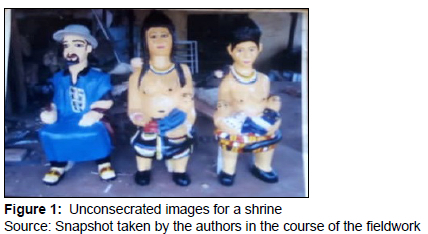
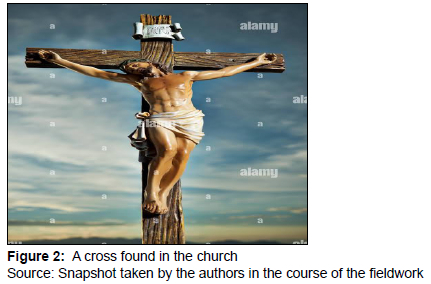
By way of analogy, since the two religions use graven images for worship and protection, one cannot be fetish and the other holy.
In traditional African society, in-kind propitiatory sacriflces and tithes are made for sins or in thanksgiving through deities to God with pleas for more blessings of good health, longevity, and protection from evil spirits. The traditionalists indeed covenant with numerous spiritual beings from whom they seek protection against evil forces of the unseen world (Okwoeze). Nowadays, both the Orthodox and the Pentecostal churches have not only outwitted the African traditionalists, but also abused their predisposition to believe in God's miracles (Ndemanu 2018). They emphasise prosperity over spirituality, demanding raw cash for virtually every matter in supplication to God through the Holy Spirit or angels. Given this, it can be said that Christianity is an African religion in a very real sense and in all ramifications (Ranger 1972). Consequently, any contrary view amounts to subjective conceptualisation which has made the Christian faith a non-living interpretation and fulfilment of African spirituality (Kalu 1980).
It is interesting to note that both adherents believe in the existence of evil spirits that constitute a threat to mankind. As corollary to the belief systems, African people are often inclined to use talisman, magic, and sangomas as means to control and protect their lives (cited in Masoga & Nicolaides 2021). In the same vein, Christians use sacramentals such as chaplets, holy water, scapular, and medals for the same purposes. In recent times, Pentecostal churches appear to align themselves with African consciousness of the realities of evil spirit through healing, exorcism, and deliverance in their service programmes (Van Klinken 2015). The practice of adorning homes and churches with crosses and crucifixes, as shown below, has been regarded as a form of idolatry in some Christian religious circles. Similarly, since God created human beings after his image and likeness (Gen. 1:27, Good News Bible), Africans perceive the universe as a forest of symbols where visible things stand for invisible things, with masks evoking and giving presents to the ancestral spirits. It boils down to hypocrisy and ironical for Christians to depict African religious beliefs and practices as borne out of ignorance, superstition, magic, childish, and pre-logical mentality (Ejizu 1986).
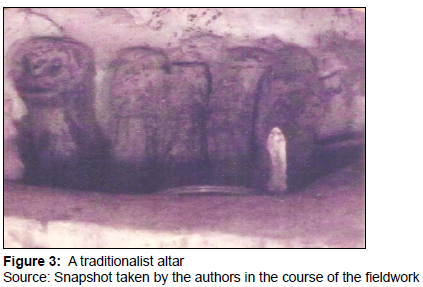
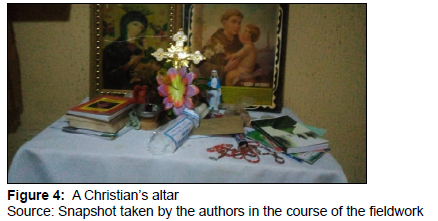
It would appear that Christianity derived its concept of Trinity from that of the indigenous religion that upholds father, deities, and ancestors as its own. In fact, to Padhola of Uganda and indeed all Africans, the Christian teaching of Trinity was merely restating what they had believed in all along (Ogot 1972). Nowadays, African Christians and traditionalists invoke the Holy Spirit/ ghost and archangels, and gods of thunder, war, sea, and even smallpox, respectively, during challenges. Understandably, each of these divinities has sufficient reasons for its being. Their derogation, therefore, amounts to a grave error in perception because all religions, without exception, are about the veneration of spirit entities in one way or another (Opata 2005:125-126).
8. OBSERVANCE OF SABBATH AND HOLY WEEK
Having consciously evolved the idea of God and attendant intermediaries, Africans also developed and earmarked specific holy days of obligation. In Igboland, for instance, the Eke day was regarded as the first day of the week and also a holy day of obligation, like the Jewish Sabbath (Okafor 2016:12). According to Catholic doctrine, the six chief commandments of the church enjoin Catholics "to keep the Sundays and holy days of obligation holy ... resting from servile work" (Igboanyika 1982:13). Among every other ethnic group in Africa, specific day(s) are meant for rest from servile labour, except essential services, as a way of offering latria (adoration) to God by the traditional clergy. The Ashanti of Ghana regard the earth as the female divinity that came after God, as a result of which Thursdays were always set aside in honour of and respect for it. Ridiculing such observances or virtues by Christians appears misplaced because, apart from the month of August named after Augustus Caesar, all other months of the year are names of Jewish deities (Metala 2019).
The unwarranted ridicule was created and heightened by the attitude of some missionaries who saw themselves in the image of angels with flaming swords to destroy African religious practices (Opata 2005). Christianity was interested in how to bolster its ego so as to eclipse the indigenous faith and drag Africans to the global North. This undoubtedly contradicts the biblical injunction that "thou shall not bear false witness against your neighbour" (Ex. 20:16, Good News Bible) - an injunction flagrantly abused by Christian teachers and pastors in Africa. In AIR, there were also holy seasons equivalent to those of Christianity such as Advent, Christmas, Lent, and Easter. In Christendom, the last three days before Easter, otherwise referred to as Triduum, remain free from social activities such as marriages or funerals (Ele 2017). Traditional African society also has holy weeks or days of religious observances. The altruism is that the theological idea of holy seasons or days has been part of African religion and not alien, as some votaries want us to believe.
It is also cause for concern that contemporary government functionaries observe public holidays during Christian holy seasons, but none for traditional festivals. Furthermore, the attempt to systematically whittle down the understanding between the indigenous and the Christian religions would appear to have been taken up by an "ex-slave clergy like Yao Cecil Majaliwa and Makua Hugh Mtoka in Masasi district of Tanzania" (Ranger 1972:231). These men were in the least prepared to juxtapose the Christian message and African traditional conceptions, probably because they were victims of social exclusion orchestrated by the indigenous system, as a result of which they treated every aspect of African religion and culture with disdain. On the extant similarities between the two faiths, Ozigboh (1989) argues that their religious world views and truth are not as divergent and conflicting as their votaries believe. The only difference is that, while Christianity is a religion of the book, AIR is the religion of the heart and character. In fact, they share practices and themes in common. Christianity has, therefore, not fully identified with Africa, the increasing number of its adherents, notwithstanding.
9. INITIATION AND RECOGNITION
Both AIR and Christianity have developed rites and titles with which to distinguish some of their adherents from the rest. The naming ceremony and baptism are identical concepts which are expressions of authority over a newborn child (Kanu 2019). The naming ceremony in African society translates to integration of the child not only with the community, but also with the ancestors who have been detailed by the Supreme God to protect and guide the child in the physical world. In Christendom, a Christian, through baptism, becomes part of the body of Christ, which is the Christian community (Ranzani 2012). Just as Africans give names suggestive of some characteristic traits, or some resemblance fancied in deceased members of revered families (Basden 1983), so Christians name their children after saints. Consequently, this rite connects the child with the ancestors and gives meaning to his/her existence (Ohaja & Anyim 2021); hence "the integration is not just a social reality as it has also ontological and religious foundation" (Ikwuagwu 2007:12). The naming ceremony in traditional African society makes it easier for Africans to understand and appreciate the importance of baptism (Kanu 2019).
In addition to knighthood or "elderhood" titles in some Christian denominations, many go about conferring Ezinna (good father), and Ezinne or Nneoma (good mother) titles on their male and female members, respectively. This practice would appear to be an adaptation of the indigenous titles of Oyima (friend of god) or Igweonyi (super ally) and Umumma (male disciples), respectively, in Nsukka Igbo religion and culture.6 Not only do these titles confer recognition on their holders, but they also distinguish them from others, thereby enhancing their rating and status. Pope John Paul 11, while reacting to this cultural heritage, once noted that the African continent
is endowed with a wealth of cultural values and priceless human qualities which it can offer to the Churches and to humanity as a whole (cited in Kanu 2019:25-52).
On the strength of this, it can be said that the indigenous religion has indirectly provided Christianity with the vehicle for its evangelisation and acceptance.
10. CONCLUSION AND RECOMMENDATIONS
This article argued that Christianity has been imperialistic, with the aim of destroying AIR. Christianity survived in Africa on account of similarities of its themes with those of AIR. These similarities are responsible for the survival of AIR, as exemplified in cases of apostasy by some Christians. However, the relentless attacks on and derision of the indigenous religious belief systems suggest that the proselytisers of the alien faith do not appreciate that the two faiths are derived from total belief in God. Nevertheless, they have continued to share some similitude in their central themes and teachings that seek God's intervention in the affairs of human beings, especially during times of crises.
The article recommends that, since the two religions share common beliefs, they stand to benefit from mutual trust devoid of superiority complex, prejudice, and combative attitude towards the more accommodating and hospitable indigenous religion. This is essential because the gains of one remain the pains of the other. The reconciliation of the contending themes is necessary in a way that they are either Christianised or Africanised or both. This will endow Christianity with an African contextual expression required for its growth and sustenance. In this way, the points of strengths and weaknesses of each of the faiths will be appreciated and accommodated. The article thus advocates a more dynamic Christianity fecundated by the richness of AIR for a healthy co-existence between them.
BIBLIOGRAPHY
Adamo, D.T. 2011. Christianity and the African traditional religion(s): The postcolonial round of engagement. Verbum et Ecclesia 32(1):1-10, Art#285 https://doi.org/10.4102/ve.v32i1.285 [ Links ]
Asogwa, O.T. 2008. Half Christian half "pagan": The dilemma of the Nigerian Christian. First edition. Enugu: Snaap Press. [ Links ]
Basden, G.T. 1983. Among the Ibos of Nigeria. First edition. Lagos: University Publishing Co. [ Links ]
Boaheng, I. 2023. An Akan appraisal of ancestor Christology. Social Sciences, Humanities and Education Journal (SHE Journal) 4(2):283-399. [Online.] Retrieved from: https://e-journal.unipma.ac.id/index.php/SHE [24 April 2024]. [ Links ]
De Kiewiet, C.W. 1978. A history of South Africa: Social and economic. First edition. Oxford: Oxford University Press. [ Links ]
Ejizu, C.I. 1986. Ofo: Igbo ritual symbol. First edition. Enugu: Forth Dimension Publishers. [ Links ]
Ekwunife, A.N.O. 2011. Christianity and the challenges of witchcraft in contemporary Africa. First edition. Enugu: Snaap Press. [ Links ]
Ele, C.O. 2017a. Egba Chukwu in Obukpa religion as praeparatio evangelica: A theological discourse. International Journal of Business and Social Sciences 8(5). [Online.] Retrieved from: www.ijbssnet.com>journals>index [3 June 2021]. [ Links ]
Ele, C.O. 2017b. Onunu festival in Obukpa and its prospects of inculturation. Online Journal of Arts, Management and Social Sciences (OJAMSS) 2(2). [Online.] Retrieved from: www.gojamass.net>article>view [3 June 2021]. [ Links ]
Ele, C.O. 2017c. The theological validity of ancestor worship in Igboland. Journal of Policy and Development Studies (JPDS) 11(1). [Online.] Retrieved from: www.arabianjbmr.com/JPDSindexphp [3 June 2021]. https://doi.org/10.12816/0040084 [ Links ]
Ele, C.O. 2020. African traditional religion in modern Africa. International Journal of Arts, Languages and Business Studies (IJALBS) 5(20). [Online.] Retrieved from: www.ijalbs.gojamass.net>view> [3 June 2021]. [ Links ]
Ifesieh, E.I. 1989. Religion at the grassroots: Studies in Igbo religion. Enugu: Fourth Dimension Publishers. [ Links ]
Igboanyika, S.U.N. 1982. Daily prayers and massbook with the new order of mass. Revised edition. Onitsha: New Life Press. [ Links ]
Ikwuagwu, O.A. 2007. Initiation in African traditional religion: A systematic symbolic analysis with special reference to Nigeria. Würzburg: Echter Verlag GmbH. [ Links ]
Iroegbu, p. 1995. Metaphysics: The kpim of philosophy. Owerri: International Press Ltd. [ Links ]
Isichei, E. 1977. A history of the Igbo people. First edition. London: The Macmillan Press. https://doi.org/10.1007/978-1-349-15621-4 [ Links ]
Kalu, O.U. 1980. The shattered cross: The church union movement in Nigeria, 1905-66. In: O.U. Kalu (ed.), The history of Christianity in West Africa (Lagos: Longman Group Ltd), pp. 340-364. [ Links ]
Kanu, I.A. 2019. An Igwebuike approach to the study of African traditional naming ceremony and baptism. International Journal of Religion and Human Relations 11(1):25-51. [Online.] Retrieved from: www.ajol.info>article>view [6 June 2021]. [ Links ]
Kasomo, D. 2010. The position of African traditional religion in conflict prevention. International Journal of Sociology and Anthropology 2(2). [Online.] Retrieved from: http://www.academicjournal.org/ijsa [2 June 2021]. [ Links ]
Masoga, M.A. & Nicolaides, A. 2021. Christianity and indigenisation in Africa. European Journal of Theology and Philosophy 1(4):18-30. [Online.] Retrieved from: http://www.ej-theology.org [1 July 2021]. https://doi.org/10.24018/theology.2021.1.4.33 [ Links ]
Mbiti, J.S. 1976. African religions and philosophy. First edition. London: Heinemann. https://doi.org/10.1017/S0084255900027625 [ Links ]
McCutghegn, R.T. 1999. Review work of David Chidester, Savage systems: Colonialism and comparative religion in Southern Africa. History of Religion 19(1):73-76. [Online.] Retrieved from: https://www.jstor.org/stable/3176647. https://doi.org/10.1086/463575 [ Links ]
Metala, A.C. 2019. Christianity and African culture in Nigeria. Journal of Religion and Theology 3(2): 26-33. https://doi.org/10.22259/2637-5907.0302003 [ Links ]
Ndemanu, M.T. 2018. Traditional African religions and their influences on the worldviews of Bangwa people of Cameroon: Expanding the cultural horizons of study abroad students and professionals. Frontiers: The Interdisciplinary Journal of Study Abroad 30(1):70-84. https://doi.org/10.36366/frontiers.v30i1.405 [ Links ]
Ngwoke, E. 2005. The Eucharist and social responsibility towards the poor. First edition. Enugu: Snaap Press. [ Links ]
Nwafor, M.I. 2017. The living-dead (ancestors) among the Igbo-African people: An interpretation of Catholic sainthood. International Journal of Sociology and Anthropology 35-42. [Online.] Retrieved from: http://www.academicjournalsorg/IJSA. DOI: 10.5897/IJSA2017.0719 [3 June 2021]. [ Links ]
Nwaigbo, F. 2010. Faith in the one God in Christian and African traditional religions: A theological appraisal. OGIRI: A New Journal of African Studies 7:56-68. [Online.] Retrieved from: https://www.ajol.info/index.php/org/article/view/57922 [3 June 2021]. https://doi.org/10.4314/og.v7i1.57922 [ Links ]
Nwala, T.U. 2007. The Otonti Nduka mandate: From tradition to modernity. Inaugural Lecture of the University of Nigeria, Nsukka, 15 March. [ Links ]
Obasikene, J.I., Agbg, B.O., Odg, S.S., Okwgr, S.O. & Ugwüagbg, W.O. 2005. Effective communication in English: A practical approach. First edition. Enugu: New Generation Books. [ Links ]
Oggt, B.A. 1972. On the making of a sanctuary: Being some thoughts on the history of religion in Padhola. In: T.O. Ranger & I.N. Kimambo (eds), The historical study of African religion (London: Heinemann), pp. 122-135. [ Links ]
Ohaja, M. & Anyim, C. 2021. Rituals and embodied cultural practices at the beginning of life: African perspectives. Religion 12(1024):1-12. https://doi.org/10.3390.rel12111024 [ Links ]
Okafgr, B.E. 2016. Understanding the Catholic faith. First edition. Owerri: Bon Publications. [ Links ]
Okwgeze, M.I. 2012. Religion: Indeed the "opium" of life. Inaugural lecture of the University of Nigeria, delivered on 31 May. [ Links ]
Oloidi, O. 1989. Art and nationalism in colonial Nigeria. Nsukka Journal of History 1(1):92-110. [ Links ]
Omegoha, F.I. 2006. Deities' enslavement, human dignity and freedom: A case of change in religious worldview in modern African society. Nsukka: The Christian Trumpet. [ Links ]
Onunwa, U. 1990. Studies in Igbo traditional religion. First edition. Uruowulu-Obosi: Pacific Publishers. [ Links ]
Opata, D.U. 2005. Ekwuensu in the Igbo imagination: A heroic deity or Christian devil. First edition. Nsukka: Great AP Express Publishers. [ Links ]
Opata, D.U. 2011. Faith, culture, and individual freedom: Notes and extrapolations from Lejja Catholic Parish, Nsukka Diocese. First edition. Nsukka: Great AP Express Publishers. [ Links ]
Opata, D.U. 2021. "O Buru Gi" (The standpoint of the other): Contending with differences in knowledge production in Africa, then and now. A valedictory lecture of the University of Nigeria, Nsukka, delivered on 2 July 2021. [ Links ]
Ozigboh, I.R.A. 1989. Religion in Nigeria's third republic: An essay in historical projection. Nsukka Journal of History 1(1): 60-77. [ Links ]
Ozigboh, I.R.A. 1999. A history of Igboland in the 20th century. First edition. Enugu: Snaap Press. [ Links ]
Ranger, T.O. 1972. Missionary adaptation of African religious institutions: The Masasi case. In: T.O. Ranger & I. Kimambo (eds), The historical study of African religion (London: Heinemann), pp. 221-251 [ Links ]
Ranger, T.O. & Kimambo, I.N. 1972. Introduction. In: T.O. Ranger & I.N. Kimambo (eds), The historical study of African religion. London: Heinemann. [ Links ]
Ranzani, R. 2012. The Catholic Sunday Missal. First edition. Nairobi: Paulines Publications Africa. [ Links ]
Ugwu, C.O.T. 2007. The eclipse of African identity: Religion on lens of the camera. Essence Interdisciplinary International Journal Globalization and African Identity 5. [Online.] Retrieved from: www.unn.edu.ng>2015/09 [2 June 2021]. [ Links ]
Ugwukah, A.C. & Ohaja, O.I. 2019. The impact of Christianity, Islam and colonialism on indigenous African religion and cultures. Journal of Philosophy, Culture and Religion 41:20-28. [Online.] Retrieved from: JPCR www.iiiste.org. DOI: 1071716/ [ Links ]
Van Klinken, A. 2015. African Christianity: Development and trends. In: H. Stephen (ed.), Handbook of global contemporary Christianity: Themes and development in culture, politics, and society (Boston: Koninklijke Brill NV, Brill Handbooks on Contemporary Religion Series, Vol. 10), pp. 129-151. https://doi.org/10.1163/9789004291027_008 [ Links ]
Date received: 9 March 2023
Date accepted: 20 April 2024
Date published: 28 June 2024
1 B.I. Omeke, personal communication, 5 December 2021.
2 P.A. Idakwo, personal communication, 20 November 2021.
3 J.E. Urama, personal communication, 10 July 2022.
4 S.E. Ogbu, personal communication, 3 July 2022.
5 H.O.I. Eze, personal communication, 12 July 2022.
6 T.C. Nwali, personal communication, 26 July 2022.
