




Services on Demand
Journal

Article
 English (pdf)
 Article in xml format
 Article references
 Automatic translation
 Send this article by e-mail
Indicators
Related links
-
 Cited by Google
 -
 Similars in Google
Share

 Permalink
Old Testament Essays
On-line version ISSN 2312-3621Print version ISSN 1010-9919
Old testam. essays vol.38 n.2 Pretoria 2025
https://doi.org/10.17159/2312-3621/2025/v38n2a5
ARTICLES
Bosadi on Justice: An African Liberationist Reading of Psalm 72 and the Song "Uhuru" in Addressing Poverty in Africa
Ndikho Mtshiselwa
UNISA
ABSTRACT
Old Testament scholars have proposed various interpretations of Psalm 72, viewing it as a coronation hymn, a reflection on geopolitical relations, or a commentary on poverty in ancient Israel. However, through the lens of African liberationist thought, particularly the Bosadi theoretical framework, this text explores whether Psalm 72 can offer liberating possibilities for the impoverished. The essay first outlines key aspects of the Bosadi framework and its relevance to discussions on poverty in South Africa and the Psalms. It then uses the song "Uhuru" as a hermeneutical tool to reflect on poverty in South Africa. Finally, it analyzes the grammatical and stylistic features of Psalm 72 in relation to the portrayal of poverty in "Uhuru," revealing both problematic and liberating elements of the psalm for those seeking socio-economic justice, celebrating Masenya's contributions to Old Testament scholarship.1
Keywords: African liberationist Paradigm, Bosadi, Jesus, Masenya (ngwan'a Mphahlele), Psalm 72, Poverty, Socio-Economic Justice, Uhuru
A INTRODUCTION
The core of Ps 72 (vv. 1-17) can be dated to the pre-exilic period, where it would have fittingly been used liturgically and likely in connection with the enthronement of Davidic kingship.2 However, some scholars argue for a post-exilic dating.3 Alternatively, the psalm may be a messianic poem which bears Aramaic influences, feasibility of royal figure and intercession for a Great Emperor as exemplified in Ezra 6:10 and Ps 61:6-7.4 Although, a post-exilic date has been criticised,5 a post-exilic dating during the Second Temple period for the shaping and inclusion of the psalm in the compilation of the Psalms remain plausible.6That observation may hold based on post-exilic literature such as Neh 5 that addresses the issues of oppression, injustice and poverty. Like Ps 72, the text of Nehemiah teases out the impact of poverty on children (Neh 5:5) and the contribution of political leaders to poverty (Neh 5:7). However, Ps 72 remains problematic as it ignores the poverty experienced by women.
The Primärfassung, that is, the primary version (vv. 1b-7, 12-14 and 16-17b) is dated seventh century BCE because of the influence of ancient Near Eastern and Egyptian conceptions of kingship on the royal and/as kingship ideology of the psalm.7 It seems then that the Neo-Assyrian and Egyptian kingship ideology is taken up and criticised in Ps 72.8 As Scheffler9 has opined, the "view on kingship based on compassion for the weak (v. 13) and on the king being a saviour is unique and different from views in Egypt and Mesopotamia where kingship was based on military power and the subjugation of the enemy."10 Since "kingship was not invented by the Israelites"11 and the kingship ideology in the Royal Psalms bears parallels and is inconsistent with the Neo-Assyrian and Egyptian kingship ideology, it is reasonable to date the psalm to a period later than the composition of the Mesopotamian and Egyptian inscriptions. The original layer, vv. 1b-7, 12-14 and 16-17b, presupposes anti-Assyrian tendencies, prophetic-social criticism of the eighth century BCE, hence, a pre-exilic date is plausible.12 The layer "emerges in direct dependence on the coronation hymn of Assurbanipal13 and has a literarische Vorbildfunktion for Psalm 72 not without motivation."14
For Arneth, Ps 72 originally was composed shortly after the enthronement of Assurbanipal in 669 BCE.15 Additionally, "in allusion to the middle-Assyrian royal rituals, a coronation hymn, which served as legitimisation for the king's reign, was dedicated to Assurbanipal."16 The word pair of קידצ (righteousness) and שָׁלוֹם (peace) in v. 7 (cf. v. 3) and the themes of "law and justice," "continuous domination" and "fertility" show correspondences between Ps 72 and the coronation hymn of Assurbanipal. Both texts allude to the king's receipt of gifts.
The psalm drew on the coronation hymn of Assurbanipal and was later liturgically used as a coronation hymn of other kings.
Two possible settings for the liturgical use of Ps 72 have been proposed. The psalm could have been used in the inauguration and/as coronation ceremony of the king17 or in "an annual celebration of the king's enthronement at a harvest feast or on a New Year festival."18 Arneth suggests that the psalm functioned as a coronation hymn of King Josiah in 639 BCE, whose reign was marked by anti-Assyrian inclinations that were triggered by the foreign politics of the Assyri-ans.19 As Human asserts,
[The] experiences like the fall of the Northern Kingdom, deportations under Shalmaneser V and Sargon II, the siege and conquest of Lachish, as well as the deportations of Sennacherib all constitute the situation of deprivation in the afflicted Israelite community, caused by the Assyrians.20
Deprivation, oppression, violence, socio-economic injustices and poverty fit the setting presupposed in Ps 72. The reference to oppression and violence in the psalm presupposes the context(s) proposed by Scheffler.21 For him, "like any war, the fall of Samaria in 721 BCE and Jerusalem in 586 BCE also caused poverty to increase, and many of the pronouncements on poverty in the Psalms can probably be interpreted within these contexts, addressing the situation."22 Verses 8-11, 15 and 17a/b constitute the first revision of the psalm which was probably done in the exilic and early post-exilic period through the insertion of political and socio-economic motives regarding the universal reign of the king.23 As asserted by Human,24 "a further single Bearbeitung of the text was the addition of verses 8-11, 15, and 17bc to the original psalm in approximately 300 BCE." It seems that a redactor who inserted the latter verses was also responsible for the doxology (vv. 18-19) and heading (v. 1a) of the psalm. Furthermore, the insertion of the doxology and heading in the psalm was integrated in larger corpi or canonical units of the Psalter around 300 BCE.25
No doubt, Ps 72 has been interpreted by various Old Testament scholars with the focus on the subjects of the dating, composition and redaction and the theme of poverty. As far as I am aware, the interpretation of Ps 72 ranges from the psalm being a hymn for the coronation of kings to its purpose to address issues of leadership and to the psalm being one that responds to geo-political relations. Recent scholarship reveals that the psalm reflects on poverty in various contexts in ancient Israel. Since biblical texts remain important in modern societies, could Ps 72 assist in the continued discourse on poverty in Africa? Posed differently, how can one address the issue of poverty in Africa based on the interpretation of Ps 72? As the psalm alludes to issues of justice and poverty that are also evident in the African context(s), how can we navigate an interpretation of the psalm by employing an African methodological and theoretical framework? The preceding questions lead to the main question of the present article: Could an interpretation of Ps 72 enthused by the Bosadi theoretical framework and the African liberationist paradigm in conversation with the song, Uhuru, address the issue of poverty and socio-economic justice in (South)Africa?26 The hypothesis of the present essay is that a conversation between the Bosadi approach and an African liberationist paradigm on Ps 72 and the song Uhuru could provide a refreshing contribution to the issue of socio-economic justice and poverty in the Hebrew Bible and (South)African literature.
B BOSADI THEORETICAL FRAMEWORK AND THE AFRICAN LIBERATIONIST PARADIGM
Remarks on the Bosadi conceptual framework and the African liberationist paradigm are in order at this point. Not only does Masenya employ lived experiences of black people such as the Marikana incident as a hermeneutical lens, but she also uses selected Northern Sotho/Pedi and Old Testament proverbs to show the indignity of living in poverty.27 She agrees with Mosala that, in our search to impact the contexts in which we are placed, particularly the contexts of the less fortunate, the starting point of our engagement with (biblical) texts should be the struggle of the exploited. Mosala says: "The social, cultural, political and economic world of the black working class and peasantry constitutes the only valid hermeneutical starting point for a black theology of liberation."28 Of course, Mosala employs a Marxist analysis to issues of class, black theology, materialist history of Israel and an African materialist history. Through Bosadi, Masenya creates a window for examining the phenomena of poverty and human dignity. For instance, Masenya writes:
In Proverbs 30:8-9 we read, "Remove from me falsehood and lying; give me neither poverty (rê'š) nor riches; feed me with the food that I need or I shall be full, and deny you, and say, "Who is the LORD?" Or I shall be poor (res), and steal, and profane the name of my God" (Prov. 30:8-9).29
It is therefore fitting to engage the issue of "identity" in dialogue with the idea of "tamed identities."30 The phrase triggers various thoughts in relation to the ecosystem such as wildlife/livestock and humans. In view of the above, both "white" livestock farmers and "black" emerging farmers are aware of the meaning of the word "tame." "Tame" or "taming" is associated with wild animals that have been domesticated to serve the purposes of the owner. It entails that the wildlife species lose its right to live in the natural habitat in order to fulfil the ambitions of the owner. One would surmise that Madipoane Masenya expressed an African liberationist thought in her Bosadi framework-the practices of patriarchy and systematic domestication of women. Probably, Masenya may later expound on this lest her inference be easily misunderstood. Masenya's reading inspired (even) an African liberationist reader of the Old Testament to navigate and tease out issues of identity in the biblical texts and their interpretation.31
Masenya highlights the Bosadi as an approach in which "the experiences (though varied) of African-South African women in their struggles, particularly their struggle against emptiness/poverty" function as a hermeneutical key to unlock the Naomi-Ruth story.32 While reading the Old Testament through the experiences of African women in South Africa, Masenya also considers the "relevant aspects of the world of the production of the texts," for instance, the Scroll of Ruth.33 Although certain biblical texts have nothing to do with poverty, especially as experienced by women, readers whose interest is also on the gender and class ideologies in texts and contexts of African women readers, easily notice the poverty/emptiness of women such as Ruth and Naomi.34 Therefore, for Masenya, a Bosadi reading of Ps 12 is worthwhile.
In casting her "African gaze at Psalm 12," which is foregrounded in the Bosadi theoretical framework, Masenya takes a cue from the views of Brueggemann and Adamo.35 On the one hand, Brueggemann argues that "...most of the Psalms can only be appropriately prayed by people who are living at the edge of their lives, sensitive to the raw hurts, the primitive passions and the naïve elations that are at the bottom of our life."36 On the other hand, Masenya agrees with Adamo that:
African Christians, especially those within the African Independent Churches feel drawn to the Psalter because of the perceived points of resemblances between the Israelite and African worldviews and the firm belief of the Psalms' capacity to address various challenges in believers' lives.37
Masenya considers the Psalter "part of protest literature," which unlike the book of Exodus, is hardly viewed as a protest document by some "Black and liberation theologians, especially here in South Africa."38 Of course, she examines the structure of Ps 12 and the Sitz im Leben of the psalm in post-exilic Yehud.39 However, her reading is unique because she employs African proverbs as a hermeneutical tool to tease out the plight of the poor and needy South Africans in the poetic text of the Psalter.40
Although elsewhere Masenya addresses the invisibility of women in the biblical texts and their interpretations, she turns overlooks the fact that women are part of the poor and needy in Ps 12. An allusion to women does not exist in her interpretation of the psalm (an African gaze at Ps 12). She notes "the connectedness between the words ani and anaw/anawim, ebyon and dal" and that "these words are used to depict those on the margins, the poor, the needy, the helpless and the downtrodden."41 The invisibility of women in Ps 12 is also noticeable in Ps 72. This observation underpins the problem that an African liberationist reader of the biblical texts would have with the patriarchal texts, which for centuries, have been regarded as normative to African Christians across the globe. If this invisibility of the plight of women remains unchallenged, then, the problem of interpreting the so-called "Word of God" to poor black people (especially women) in South Africa and elsewhere in the globe would also persist.
In a most recent writing, "Politically Freed, Yet Mentally Enslaved! Reflecting on Psalm 8 in View of Steve Biko's Notion of Black Beauty,"42Masenya (ngwan'a Mphahlele) considers the concept of blackness, rather than "African-South African." Indeed, black people in South Africa may be deemed politically freed, yet mentally enslaved.43 African cultural epistemology encounters politics, sociology and economics. At this point, one may appreciate Bosadi more as a theoretical framework, as it invites economic studies into the discourse of theology as well as many more important trajectories in the sciences and the production of knowledge. The liberation of the "mental" aspect of black people as Masenya advocates is probably not enough for the poor in rural places, townships, suburbs and cities.44 One can only hope that the Bosadi discourse would be granted more time to further engage "blackness," compared to "African-South African(ness)." Black people in South Africa are far from regarding themselves as African, hence, there is "Black twitter." That on its own stands as a protest that "blackness" exists in South Africa. Challenges in South Africa are by and large experiences of black people. It often puzzles me to identify myself as an African-South African, although I am black because the colonists probably conscientised my ancestors to identify themselves as black. At the advent of colonialism in (Africa) South Africa, the apartheid system disregarded Africans as humans. Hence, "white masters" (who were then regarded as "superior") would domesticate Africans by "forcing" them to perform menial jobs in order to sufficiently control them. It was meant to inculcate in them a sense of inferiority. Even today in post-apartheid South Africa, tasks such as those of gardener, housemaid and housecleaner characterise a black employee. In that sense, the so-called black people were oriented to never regard themselves as humans. From an ontological point of view which is enthused by Bosadi and by an African liberationist paradigm, one may retain the concept of being "black." After all, it is not a shame to be a black person.
Furthermore, Bosadi extends the discourse to political leadership in the field of political sciences. For instance, "drawing from the insight in the fields of the Old Testament, gender and social sciences studies as well as Indigenous Knowledge Systems (with particular focus on an African proverb), this article addresses the topic of the South African Female Presidential Leadership and the Deteuronomistic Athaliah the Bosadi way."45 Bosadi highlights the scarcity of women leaders, both in the Hebrew Bible and in the South African context and in turn dared to say that female leadership in political spaces may yield ethical leadership that would yield socio-economic justice for all of humanity. The persistence of the patriarchally entrenched invisibility of women is unhelpful in the problem of class, gender and politics as well as race. The male-centredness and patriarchy undergirded politics, which are often presented as a good story to tell and liberating to all humans, are not at all liberating to all humanity and especially the poor and needy black women.
Masenya (ngwan'a Mphahlele) also ventured into the discourse of environmental studies through her "Eco-Bosadi readings,"46 which centre on ecological and feminist discourse and, which for Masenya, are nuanced within the Bosadi theoretical framework. It is rather difficult to ignore socio-economic issues, especially considering her engagement with "gender theories" and "eco-feminist" and "Eco-Bosadi theoretical framework." Masenya's contribution to the discourse of ecology, gender studies and the South Africa context highlights the idea of "Mother Earth" (drawing from the Hebrew Bible and African proverbs) and places the term at the centre of the discourse. An African liberationist eye would seek to take the conversation further by stating that issues of socio-economic (in)justice are central to the discourse of environmental studies because texts, such as Job, which Masenya engages, also militate against the experiences of women in taking care of "Mother Earth." Eco-Bosadi also necessitates a location of "gender theories" in the discourses of socio-economic (in)justice, ecology, feminism and the interpretation of the ancient biblical text in South Africa and beyond. Noteworthy, Masenya proposes some critical aspects of the Eco-Bosadi approach, as pronounced in the following passage:47
Eco-Bosadi perspective can be defined as a perspective of the Bible that takes seriously, not only the experiences of an African-South African woman, but also of the earth itself which, like women, has been marginalised and oppressed for so long. This approach sees the Bible as having taken sides with the oppressed condition of earth and aims at its liberation.
In Eco-Bosadi, the struggle against patriarchy, poverty and all forms of social injustice as well as ecological crisis promotes fertility and economic prosperity of "Mother Earth," even in the era of westernisation with industrialisation, capitalism and resultant culture of consumerism.48
In the context of socio-economic justice, an African liberationist paradigm deliberately draws on the materialistic readings of the Old Testament (and partly on the New Testament) as well as building the sociological reading of the writings of Gottwald, Mosala, Nzimande and Farisani.49 An African liberationist paradigm is partly nuanced in the feminist readings of the ancient text through the window of Bosadi. The Bosadi theoretical framework and an African liberationist paradigm are therefore employed in reading "Uhuru" and Ps 72. The key issues, as one draws on the discipline of arts through a popular song to read the Hebrew Bible in South Africa, are teased out above. Applying a popular song to the reading of the ancient text for a liberative interpretation is far from being new to an African liberationist paradigm.50 As far as I am aware, the approach is rendered unique in South Africa by the African liberationist paradigm that is nuanced in Bosadi.
C NAVIGATION OF POVERTY IN THE POETIC ANALYSIS OF "UHURU"
The Swahili word, uhuru, which may be translated as "independence" or "freedom" in its origin context, refers to "freedom in the sense of a nation's political independence" in Kenya.51 The concept however extends to the issue of socioeconomic freedom. As Hobson puts it, "One's freedom rests on one's economic situation."52 That is, the idea of "not yet uhuru" alludes to the point that it is inconclusive to say one has attained freedom in the existence of socio-economic injustices, oppression and disparities. With its setting in Alexander Township in South Africa that is characterised by poverty, socio-economic injustice and economic disparities, compared to its neighbouring community, namely, Sandton, it is no wonder that Sanele Tresure Sithole and Makhosazana Masongo, composed the song, "Uhuru," in the post-apartheid South African context.
A reading that is focused on the population of the township called Alexander could help in navigating other locations in South Africa through the lens of Bosadi and African liberationist paradigm as well as the interpretation of the popular music. The location of Alexander Township is far from being unique and in the present article, it is viewed as one that reflects the socio-economic struggles of post-apartheid South Africa. Geographically, it is striking that Alexander is located opposite "Sandton," a suburban and commercial place identified with wealthy people, thus, glaringly depicting the economic disparities in South Africa. Based on the song, "Uhuru," as well as Ps 72, the focus is on Alexander and the Southern Levant. A popular music genre articulates various issues that affect society, which could yield some bearing on the good life of the people.53 As Nyairo and Ogude would argue, documented and sung knowledge reflect people's experiences at the time a particular song is composed.54
However, it is necessary to first study the poetic, artistic and musical genre of the song and its meaning in relation to its historical context. The cue and fundamentality of the song lie in the terms "blessing," "elevate" and "liberate" as well as "value of music." Furthermore, the image of the burning tyres in the video of the song induces memories of the protests against socioeconomic injustices which in the video include the presentation of protest and prophetic words on paper boards with various messages, such as, "Fees must fall," "Rhodes must fall," "Protect women," "I will not be next," "End systematic racism," "Justice for Collins Khoza" and "Stop killing us," among others. The tenor of the protests tallies with the sentiment of "protest literature" of the Psalter as identified by Masenya.55 The interest of the present contribution in the video has to do with the burning of the candle, a symbolism of an act of "praying," as a practice of Christian faith among other faiths. In addition, the fleeting portrayal of a weeping woman carrying a child on her back, with a single pot burning (with no food visibly cooked inside it) on a paraffin stove is presented, recalling the typical upbringing of many a black person in the South African rural setting. It is, however, strange that the women are not mentioned in the lyrics of "Uhuru."
In that setting, black people fighting in informal settlements, as portrayed in the video, is not unfamiliar in South Africa.
The song under investigation here, "Uhuru,"56 is composed by Sun-EL Musician,57 who featured Azana,58 contains the following lyrics:
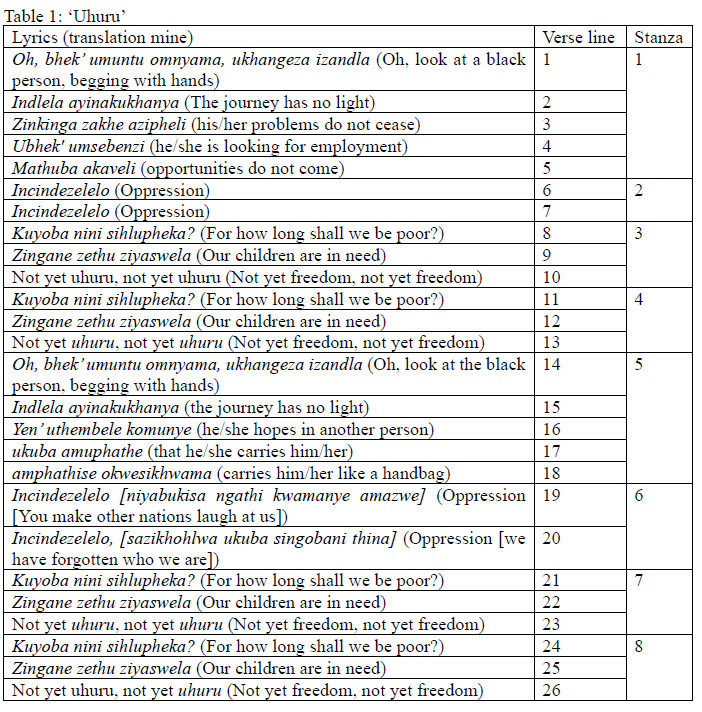
A literary, linguistic and thematic navigation and reading of the song are in order. In line 1, the songwriter employs the exclamation "Oh" to express an emotion of "disappointment," which reacts to the sight and/as observation of the situation of many a black person residing at the township of Alexander and South Africa.59Lines 1 and 2 also include a chiasmic poetic formation:
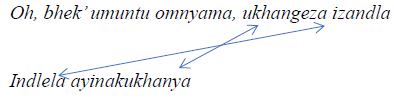
The words omnyama in line 1 and ayinakukhanya in line 2 allude to black (person) and darkness (the absence of light), respectively. Here, the song explicitly employs the term "black" people rather than "Africa-South Africans," as Masenya mostly prefers and Mtshiselwa notes with some reservations. The sound of nyama and khanya as well as (i)zandla and (i)ndlela constitutes a relative sound. Thus, there is a hearable rhyme which in terms of the placement of the lines form a chiasm. The chiasm in this instance likely functions as a stylistic tool to compare black people with the situation caricatured by darkness. The position and function of the hand (izandla) in relation to the journey (road) are characterised by darkness. Moreover, the word ayinakukhanya forms part of the figurative language employed by the songwriter that reveals the manner in which the imagery is used to represent indlela ("the journey or road").
On a lexical level, imagery draws the emotions that could be detected in the lyrics. It is easy to doubt that black people with a "begging hand" would escape the poverty cycle. The song also contains lyrics with compounding. Compounding is a stylistic process of joining lexical elements to form new stems and words.60 The word, "ayinakukhanya'' ("has no light") is made of two words, namely "ayinako" ("has no") and "ukukhanya" ("the light"). The words are compounded to form a single word, "ayinakukhanya'' The characterisation and association of the journey (indlela) as the situation of the poor black people with "darkness" (ayinakukhanya) fit within the conceptualisation of a "darkest place" in the psychiatric disorder of depression. The depictions of a weeping woman carrying a child on her back and of a single pot burning ("with no food visibly cooked inside of it") on a paraffin stove in the music video of "Uhuru" adds weight to the presupposition of a distressful situation ("a darkest place in a human's life") and poverty. In addition, the statement, Indlela ayinakukhanya ("the journey has no light") in line 2 and repeated in line 15 is a metaphor. Osubo and Kebaya define metaphor as a creative device employed by a songwriter to describe "one thing by referring to another which has the qualities that one wants to express."61 The metaphor(s), "Indlela ayinakukhanya' ("the journey has no light") is used to illuminate the human condition of poverty in the song, "Uhuru." The presupposed "darkness" (that is, the absence of light) on "the road or journey and/as situation" likely presupposes the lived experiences of black people in poverty.
Even though an allusion is made to a handbag, which in a patriarchal world literally, is "carried" by women, the invisibility of women in the lyrics of the song, "Uhuru," is glaring and problematic within the theoretical framework of Bosadi and African liberationist paradigm. However, the visibility of women in the official video of the song is welcomed. Indeed, women are the poorest and most unemployed in the patriarchal community of Alexander and in South Africa. According to Statistic South Africa, "the trends in labour force participation and absorption rates for men and women from 2014 to 2024 indicate that fewer women have been participating in the labour market as compared to men."62 It is reported that, "over the 10-year span from Q2:2014 to Q2:2024, gender disparity in unemployment rates has persisted across all education levels in South Africa."63 Furthermore, "women, irrespective of their educational background-whether they have less than a matric certificate, a matric certificate, other tertiary qualifications, or a graduate degree- consistently face higher unemployment rates compared to men."64 Thus:
Women's Day serves as a powerful reminder of the ongoing struggle for gender equality and the urgent need to address gender disparities in various spheres, particularly in the labour market. Despite significant advancements in women's rights, many still face challenges such as higher unemployment rates, underemployment and barriers to career progression compared to men. These disparities not only affect women's economic independence but also limit overall economic growth."65
Verse lines 3-5 highlight the problem of unemployment and lack of economic opportunities as the contributing factor to the poverty of black people in South Africa. The words azipheli in line 3, umsebenzi in line 4 and akaveli in line 5 constitute imvano siphelo (an assonance). The words have a similar vowel of i at the end of all three words to draw the listener of the song to the lines. The statement, Zinkinga zakhe azipheli (line 3) alludes to the persistent plight of the poor, which is caricatured by plural word, zinkinga (problems or struggles). The problems do not cease (azipheli) and thus are persistent. The statement is followed by the two statements, ubhek'msebenzi ("he/she is looking for employment") in line 4 and mathuba akaveli ("opportunities do not come") in line 5. The plurality in the statements suggests that many a black child tries to search for a means of livelihood and income but employment opportunities are inaccessible and not forthcoming. In the first quarter of 2023, the South African unemployment rate recorded at 32,9 %.66 Line 4 presents lack of employment opportunities as a contributory factor to poverty in the country. The statement, Zingane zethu ziyaswela ("Our children are in need"), which follows the question in these lines supports the view that poverty is persistent. Stats SA reports that "More than six out of ten children (62,1%) are identified as multidimensionally poor."67
Thus, the lines contain a rhetoric question, a device employed by the songwriter to draw to light the poverty of the people and its impact on children. In addition, there is assonance in lines 8 and 9, which links the lines where a vowel sound is repeated in two different words that do not end the same, namely, sihlupheka and ziyaswela. The vowel sounds of "i," "e" and "a" are repeated in these words, thus creating a rhyme. Furthermore, the verb ziyaswela in line 9 is different from the verb ziswele, which alludes to a state that has already occurred. The word ziyaswela may best be understood as alluding to a continuous occurrence and experience. The idea of persistent poverty is juxtaposed with the situation of children to suggest that poverty is detrimental to children. This presupposition is supported by the depiction of a child on the back of a poor mother in the music video. It is hard to argue conclusively that children from a poverty-stricken context find it easy to escape the poverty cycle compared to their counterparts from wealthier families.
The technique of contractions is found in line 17. The use of contractions, such as "because," "cause" and "that" in the writing of popular music causes lyrics to sound conversational because the words are often employed in casual speeches among members of the society.68 The songwriter therefore employs the technique to connect with the audience. The word ukuba ("that") in line 17 constitutes a contraction in line 17. Since line 17, ukuba amuphathe ("that he/she carries him/her") follows line 16, Yen' uthembele komunye ("he/she hopes in another person") functions as the continuation of a statement. When read interrelatedly, both the lines present the hopeful dependence of a poor person on another person (ubuntu) who is in a privileged position and is able to fulfil the statement of line 18, amphathise okwesikhwama ("carries him/her like a handbag"). The concept of ubuntu, which is about humanness and means "A person being a person through other persons," is foregrounded in line 16 and is linked to lines 14 and 15 that form part of stanza 5.
Furthermore, in line 18, analogy is employed in the word okwesikhwama ("like a handbag"). The word okwesikhwama also is symbolic. Osubo and Kebaya define symbolism as the use of an object or word to represent an abstract idea. Isikhwama ("a handbag") is an item used as a symbol drawn from an ordinary and common space of interaction of both the artist and the audience.69A handbag is a material possession that keeps the valuables of a person, which is important and always closely and safely guarded. The symbol is employed in the song "Uhuru" to foreground the idea of ubuntu, where one person is entrusted to and depends on another person for care and economic security. Stanzas 2 and 6 are related by the reference to Incindezelelo ("Oppression") and lines 19 and 20 of stanza 6 stress the repeated mention of oppression.
An African liberationist paradigm that is partly enthused by Bosadi highlights the oppression of the black people of South Africa and declares it as a scourge. Surely, the existence of the oppressed people presupposes the presence of the oppressors but the issue of their identity is beyond the scope of the present essay, as the categories vary in terms of race and gender. The songwriter uses the first-person plural pronouns ngathi (about [us]) in line 19 and thina ("we") in line 20. "We" is a subject pronoun, which means it is used as the subject of sentences (the people perform an action (sazikhohlwa is an action that is being performed) in the sentence. "Us" is an object pronoun that is used as an object in sentences. The people are thus affected by an action niyabukisa. It is likely that "inequities impede access to the resources necessary for optimal health and welfare."70 Periphrasis is evident in line 20. This device is "a type of semantic deviation in which a longer phrasing is utilised as an alternative for a shorter statement."71 The added phrase or word does not change the meaning of the statement but rather conveys the same meaning and interpretation.
The statement, Sazikhohlwa ukuba singobani thina ("We have forgotten who we are") bears the same meaning without the pronoun, thina because the word, singobani means "who we are." The addition of the phrase and pronoun thina serves to emphasise the point that the songwriter identifies him or herself with the audience. As Mosala, West, Masenya and Mtshiselwa would argue,72identifying with the audience is cardinal, as one would be able to approach both indigenous texts, such as songs and proverbs as well as ancient texts with the lived experiences of black people which are central to the discourses. The songwriter adds the issue of identity to the song. Could it be that the issue of identity is partly pivotal to the debate on poverty? The song teases out the identity of blackness, of a people grounded in ubuntu, the poor people who are undignified in terms of race, class, gender and most importantly people who are far from being "free" and "liberated," as it is not yet "Uhuru."
D GRAMMATICAL AND STYLISTIC FEATURES OF PS 72 AND POVERTY
1 Composition and Structure of Ps 72
The analysis of Psalm 72 is not new in discourses about poverty in ancient biblical texts. The psalm alludes to poverty, oppression, socio-economic and political presuppositions. In agreement with Hossfeld and Zenger,73 Human identifies an analogous pattern in verses 2-4 (social justice -A). The verses address the issue of poverty and justice for the poor. He further considers verses 5-7 (cosmos/fertility in nature -B) to be related.74 The verses present the subject of the reign of the king and fertility and verses 12-14 (social justice -A) deal with the issue of poverty as well as justice and deliverance for the poor. Again, verses 1517 (cosmos/fertility in nature -B) are concerned about the reign of the king and fertility.75 Most importantly, the issue of poverty (among other issues such as leadership) in the navigated historical context(s) of Ps 72 has enjoyed the attention of the scholars of psalms.
Literary and textual observations on Ps 72 suggest that the psalm is a product of different compositional and redactional stages and therefore possibly falls under different historical contexts. The relations and inconsistencies between the heading (v. 1a), doxologies (vv. 18-19) and colophon (v. 20) and the so-called Grundschicht and/as Primärfassung (the core of the psalm: vv. 1b-7; 12-14; 16-17ab), as well as vv. 8-11; 15; 17c, presuppose various handwritings. Verse 1a, הֹמלֹ ְׁשל ("For Solomon") and v. 20, כָׁלּוּ תְׁפִּלּוֹת דָׁוִּד בֶּן־יִּשָׁי ("are the prayers of David") indicate that Ps 72 was written by neither Solomon nor David because it merely mentions them. Therefore, Human opines that the psalm is initially a product of a "court poet or cultic prophet for an official royal court event."76However, the point that the psalm would make sense without the heading and the colophon lends credence to the idea that vv. 1a and 20 were likely added to Ps 72 at a later stage to associate the psalm with both the Davidic and Solomonic kingship ideologies.77
There are noticeable relations between vv. 5 and 15. The Qal imperfect verb that is prefixed by a conjunctive waw ו ("and") to form וִּיחִּי ("and he shall live") in v. 15 picks up on the idea raised in v.5 יִּירָׁאוּךָ עִּם־שָׁמֶּ ש ("They shall fear you as long as the sun"). The statement is also fittingly translated as "May he live long before the sun."78 It is unnecessary that v. 15 would make a point already made in v. 5 unless a different hand later decided to add the reference to the gold of Sheba and prayers that would be continually given to the king as homage. Although the gesture of paying homage may be viewed as an act strengthening geo-political relations, it does from an African liberationist perspective point to imperialism, likely Assyrian imperialism. In a context of geopolitical imperialism, submission and domination of one empire by another cannot be deemed as "Uhuru."
Up to v. 17b, שְׁמוֹ יִּנּוֹן יָׁנִּין לִּפְׁנֵי־שֶּמֶּש ("as long as the sun will continue his name"), the focus in the psalm has been on the king. The king will live long and be blessed. A change is noticeable in v. 17c where the poet asserts that besides the king, other people will be blessed through him and that nations will call the king blessed. Verse 17c of P 72 reads, וְׁיִּתְׁבָׁרְׁכוּ בוֹ כָׁל־גּוֹיִּם יְׁאַשְׁרוּהוּ ("and men will be blessed in him, all nations will call him blessed"). Not only does the change presuppose that a different handwriting is likely at work in v. 17c at a stage later than the composition of v. 17b but it also reveals a contestation of the blessing of a single human being, representing the empire, whilst the masses are poor. The psalm could have ended in v. 17b and it still would have made sense. However, unlike in the rest of the psalm, a blessing in the doxologies (vv. 18-19) is directed at a deity, thus, suggesting a different handwriting.
Worthy of note also is the introductory statement of the doxologies in v. 18: בָׁרוּךְ יְׁהוָׁה אֱלֹהִּים ("Blessed be Yahweh Elohim"). The statement pairs יְׁהוָׁ ("Yahweh") and אֱלֹהִּים ("Elohim"), whilst v.1b only mentions Elohim. This noticeable inconsistency also suggests a different handwriting. It is therefore likely that the doxologies (vv. 18-19) were later inserted to further theologise the poem of Ps 72 and subsequently turn the discourse away from poverty to monotheism. From the thematic point of view, a progression from vv. 1-4 (concerns for poverty and justice for the poor) to vv. 5-7 (description of the reign of the king and
fertility) and to vv. 12-14 (future emphatic nuance on the issue of poverty as well as justice and deliverance [liberation] of the poor) is noticeable. However, it was perhaps necessary for a later writer to interject the flow of the psalm by including the political nuances of vv. 7-11 to the socio-economic discourse on poverty and injustice of the psalm. The later placement of vv. 8-11 at the centre of the analogous pattern (A-B-A'-B') to form a concentric pattern (A-B-C [vv.8-11]-A'-B') makes sense.79 An African liberationist reader who is conscientised about Bosadi would be sympathetic to the latter redaction as the (unethical) behaviour of political leaders who often perpetuate socio-economic injustices and poverty.
2 Grammatic and Stylistic Features
Psalm 72 reflects stylistic features such as repetition as in mišpat (vv. 1, 2, 4), am (vv. 2, 3, 4),80 erets (vv. 6, 8, 19) and semes (v. 5, 17); ellipsis (vv. 2, 3, 6, 7); contrast (v. 4); pars pro toto or synecdoche (v. 3); chiasm (w. 9, 11, 15b); rhyme (vv. 9-11); merismus (vv. 9-10); hyperbole (v. 5); comparison (v. 16) and others.81 Strophe 1 (vv. 1-4) addresses the problem of justice and poverty of the poor. The nouns "justice" and "righteousness" in v. 1 that are repeated in v. 2, with "righteousness" further repeated in v. 3, render the verse as an introduction to vv. 1-4. The repetition of words serves as a stylistic feature to emphasise the themes of justice, peace and righteousness (or integrity)82 in the psalm, which in my view are cardinal to the discourse of poverty and liberation. Verse 2 reads: יָׁדִּין עַמְׁךָ בְׁצֶּדֶּק וַעֲנִּיֶּיךָ בְׁמִּשְׁפָׁט ("He will judge your people with righteousness and your poor with justice"). The preposition ב that is attached to a masculine singular noun to form בְׁצֶּדֶּק and may be translated as "with righteousness" can also be rendered as "with equity." In cases of poverty, particularly within the Bosadi theoretical framework and African liberationist paradigm, equity caricatures socio-economic justice. The point that עַמְׁךָ ("your people") will be "judged" with righteousness presupposes a situation characterised by unrighteousness at the time that the statement יָׁדִּין עַמְׁךָ בְׁצֶּדֶּק ("He will judge your people with righteousness") was composed. The conjunctive ו ("and") that is attached to the construct plural adjective with a suffix ךָ ("your") to form וַעֲנִּיֶּיךָ ("and your poor")83 makes the statement וַעֲנִּיֶּיךָ בְׁמִּשְׁפָׁט ("and your poor with justice") dependent on the preceding statement (יָׁדִּין עַמְׁךָ בְׁצֶּדֶּק). The poor are likely those who were materially poor and in need of socio-economic justice.84
Verse 2 also presupposes a situation where at the time of the composition and redaction of the core of Ps 72 (vv. 1-17) the poor existed and experienced injustice. Verse 3 states, יִּשְׁאוּ הָׁרִּים שָׁלוֹם לָׁעָׁם וּגְׁבָׁעוֹת בִּצְׁדָׁקָׁה ("May the mountains bring peace to the people and the hills [bring] righteousness"). As Masenya argues, at the advent of peace, righteousness (integrity and ethical behaviour) "Mother-Earth" produces fertility and economic prosperity.85 The psalms imagine that both peace and righteousness will be ushered to the people (לָׁעָׁ). The allusion to the people connects v. 3 to v. 4. Not only does the v. 4 present a prayer for the liberation of the poor and to end their oppression, but it also desires that justice be served to salvage the cause of the poor. Interestingly, the text (v. 4) reads: יִּשְׁפֹט עֲנִּיֵי־עָׁם יוֹשִּיעַ לִּבְׁנֵי אֶּבְׁיוֹן וִּידַכֵא עוֹשֵק ("May he86 judge [do justice to or defend the cause of] the poor of the people, (and) save the children of the needy and may he crush the oppressor"). The word incindezelelo ("oppression") that is alluded to in stanzas 2 and 6 of the song, "Uhuru," is noticeable in the psalm and explains the persistence of poverty.
The question Kuyoba nini sihlupheka? ("For how long shall we be poor?") in "Uhuru" is therefore warranted regarding Ps 72. Not only does the phrase עֲנִּיֵי־עָׁם ("poor of the people") suggest the existentiality of the poor and poverty among the people, but it also presupposes different categories and classes of people in the society stricken by poverty. The Hifil imperfect verb יוֹשִּי ע ("may he save") that is in a third person masculine singular state may also be rendered as "may he free" and/as "may he liberate" (see v. 4). The reference to the "children of the needy" presumes a generational state of neediness and poverty. The pairing of the allusion to the "oppressor" to the reference to the "poor of the people" and "children of the needy" as well as to the verbs "judge or defend or do justice to," "save" and "crush" in a single verse (v. 4) presupposes that oppression caused the injustice and generational poverty that existed in the society by non-poor people. The poet contrasts the Hifil verb עישוֹי ("may he save") with Piel וִּידַכֵא ("and may he crush") to point out the centrality of the oppressed people and the oppressors in the discourse of poverty as well as the need to dismantle oppression. Unlike the official video of the song, "Uhuru," which presents both women and children in the protest against oppression and poverty, Ps 72 merely mentions children and renders women invisible. From a Bosadi and African liberationist paradigm, the text becomes problematic to the readers who are interested in the liberation of all humans. The patriarchal nature of the Hebrew Bible reflected in this psalm renders the Christian Bible problematic in the holistic struggle against poverty. The above view presents the so-called "word of God" (the Christian Bible) as not entirely innocent, but as gender biased and unhelpful to women in situations of poverty.
Since the God of Ps 72 dislikes violence (cf. v. 14) one may hesitate to accept וִּידַכֵא in its literal sense, but rather see it as figurative. Stanza 2 (vv. 5-7) is concerned about the reign of the king and fertility. The stanza describes the "blessed consequences of social justice" in cosmic terms.87 Just rule by the king in v. 5 bears the prospect of long life (cf. vv. 7, 15, 17; Ps 61:7-8).88 Verse 6 reads: יֵרֵד כְׁמָׁטָׁר עַל־גֵּז כִּרְׁבִּיבִּים זַרְׁזִּיף אָׁרֶּץ ("May he be like rain that falls on a mown field, like showers watering the earth"). The rain and the showers that nourish the גֵּז ("mown grass") and water the earth point to the nourishment of the grazing and pasturage lands as well as agricultural land.
The pairing of the words "righteousness" and "peace" is repeated in v. 7 (cf. v. 3). As noted by Kselman,89 the poet employs "semantic-sonant chiasmus in vs. 7":
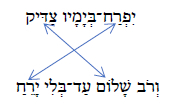
As the chiasmus above shows, the verse consists of the assonant pair יִּפְׁרַח and יָׁרֵ ח as well as the pair of synonyms, צַדִּיק and שָׁלוֹם, to highlight that both peace and righteousness (or justice) will eternally ("till moon is no more") flourish (or extraordinarily exist) when a just king rules.90 The just actions of the king in the political sphere are expected to produce peace and righteousness (vv. 5-7).91 The peace, prosperity and righteousness that characterise the reign of the king are likened to "the rain that falls on a mown field" (v. 6) and are "not an unexpected metaphor in a Davidic or messianic context, for it has already been used of the refreshing effects of the reign of a Davidic king in 2 Sam 23:3b-4 (cf. Hos. 6:3; Mic. 5:7)."92 A just political leadership that considers the plight of women, ecological crisis and the scourge of socio-economic inequality calls for prosperity from "Mother-earth" and ultimately dignifies all of humanity.
As aforementioned, v. 8 introduces stanza 3 (vv. 8-11). The stanza alludes to the political influence of the king in power, which emanates from a just reign that bears socio-economic benefits. The statement דריו ("He will rule") is a construction of the conjunctive waw attached to the Qal verb, which is connected to a conjunctive imperfect Jussive in a third person masculine singular form and may also be translated as "he will subjugate" or "he will have dominion." The Qal imperfect verb, יִּכְׁרְׁעוּ (will bow), in v. 9 insinuates political submission. The inhabitants in the desert will be submissive to the king. The submission to the king is emphasised by the feature of parallelism and the style of rhyme in vv. 811. The verbs, יִּכְׁרְׁעוּ ("will bow") and וְׁיִּשְׁתַחֲווּ ("will bow down"), form a parallelism in vv. 9 and 11. In addition, the rhyme of יָׁשִּיבוּ (will bring) and יַקְׁרִּיבוּ (will offer) in v. 10 creates a parallelism in vv. 10a and 10b.93 The Piel imperfect verb, יְׁלַחֵכוּ ("will lick"), suggests a state of being conquered or defeated. Verse 10 demonstrates the political influence and power of the kings by asserting that other kings "will bring" (שִּיבוּ) "tributes" (מִּנְׁחָׁ) and "gifts" (אֶּשְׁכָׁ). Verse 11 further alludes to the universal political influence of the king. One can imagine that the political relations with other nations would bring prosperity to the king, which would address the problem of poverty alluded to in vv. 1-4. It is likely that trade between nations is imagined in stanza 8-11. Regarding the rule of the king, Kaiser94 remarks:
The reign of this righteous king would extend as we have seen thus far: (1) geographically from sea to sea, which is to say around the world; and (2) militarily over all enemies opposing his reign; but add to this also that this reign would extend (3) economically, as tribute and gifts were brought from all over the world (v. 10); and (4) politically, as all potentates will come under this righteous king's rule and serve him (v. 11).
Although vv. 8-11 may be viewed as presenting the political influence of a king, an African liberationist reader of the text observes imperialism in the act of submission to the political leader. If the suggestion of imperialism remains uncontested, then, the biblical texts easily remain a document that is not conclusively liberating to all of humanity. Healthy relationship with mutual respect in the space of geo-politics is preferred to the rule over others and the submission of other rulers to a single ruler. Suffice to say, when imperialism persists, as depicted in the biblical texts and in modern communities, the verse line, "Not yet uhuru, not yet uhuru" (Not yet freedom, not yet freedom), is merited.
Like Stanza 1 (w.1-4), Stanza 4 (vv. 12-14) addresses the issue of poverty and social justice by shedding light on the plight of the poor. The Hifil imperfect verb, יַצִּיל, translated as "he will deliver" (v. 12), may reasonably be rendered as "he will free" or "he will liberate." Furthermore, the Piel verb, מְׁשַוֵּ ע (who cries out), presupposes that the poor are in distress. Regarding the cry of homage, as Davage95 has observed, v. 12 points "to enthronement rituals as possible backgrounds for this cry" (see 1 Sam 10:24; 2 Sam 16:16; 1 Kgs 1:25, 31, 34, 39, featuring יהי without ו.96 The negative statement וְׁעָׁנִּי וְׁאֵין־עֹזֵר ("and the poor who have no helper - the helpless") in v. 12 points out that the poor were likely disliked and that they also had no "aid," "economic assistance" or "economic security." The singular construct adjective דַל ("the weak") in v. 13 may also allude to the physical and mental as well as the socio-economical state of lowliness and helplessness.97 Furthermore, the noun אֶּבְׁיוֹנִּים ("of the oppressed") that is often translated as "of the needy" associates the situation of poverty and the state of weakness with "oppression" (v. 13).98
Thus, the paired nouns, "oppression" (מִּתוֹךְ) and "violence" (מֵחָׁמָׁס) describe the situation and plight of the poor. Based on vv. 12-14, it is reasonable to presuppose that there was likely socio-economic injustice which was accompanied by violent acts against the poor at the time of the production of the psalm. The poor lived alongside the rich persons and the plight of the poor is highlighted in stanza 4. The point that the care for the life of the poor (vv. 2-4, 12-14) constitutes "the basis for the king's dominion," renders the concerns for poverty in the socio-economic and political spheres key in Ps 72.99 The poet imagines a period where the reign of the king will be characterised by political stability, peace and economic prosperity.100
Verses 15-17 form stanza 5. The conjunctive waw ְׁ ו (and) that is attached to the Hitpael verb וְׁיִּתְׁפַלֵּל ("and may pray") shows a religious act, which accompanies the "justness" of the king, that brings economic blessings in the form of gold from Sheba (cf. 1 Kgs 10:14-15, 22).101 שְׁבָׁא ("Sheba"), a territory in southwest Arabia, mentioned in v. 10 (a verse that reveals political international relations), is repeated in v. 15 with a specific reference to an economic resource, namely gold. It is however unclear whether v. 15 presupposes trade of precious metals between the nations or the gold forms part of tribute and gifts brought to the king, as mentioned in v.10. The issue of the recipient of the gold is also contested. Hossfeld and Zenger102 argue that the poor are the recipients of the gold of Sheba. Against the argument, Davage103 notes that since the king is the recipient of gifts earlier in the psalm (v. 10), he is likely the recipient of the gold in v. 15.104 The Piel imperfect verb יְׁבָׁרֲכֶּנְׁה ("and may they bless him") in v. 15 alludes to a spiritual act of invoking the economic blessings of Elohim on the king.
An African liberationist reader inspired by Bosadi questions the idea of masculinity and patriarchy in vv. 10b and 15 a. While a consensus view in Old Testament scholarship about the Queen of Sheba sending gold to Israel is valid,105 it is strange that v. 10b alludes to a "king" and even v.15a shies away from mentioning a "queen." The preceding may be explained by the patriarchal nature of the Hebrew Bible because it is not convincingly imaginable that other male political leaders from Sheba sent gold to ancient Israel at the time the Queen of Sheba was not in political power. The mention of Solomon in Ps 72 points to the Queen of Sheba. Indeed, interpretations that ignores the patriarchal problem of vv. 10b and 15a suggests that it is "Not yet uhuru."
The point that the masculine plural noun הָׁרִּים translated as "mountains" (v. 16) may also be rendered as "hills" or "hill countries," suggesting that the psalmist is alluding to fertility and economic prosperity in the hill countries of
Southern Levant. The references to ןוֹנבלּכ ("like Lebanon") - a wooded mountain range on the northern border of Israel in v. 16 and the mention of "grain in the land," "fruits" as well as "grass of the land" allude to fertility and/as agricultural productivity.106 Verse 16 includes the "people in the cities" in the fertility that is to be experienced in the Southern Levant during the reign of a just king. The cosmic language employed in vv. 15-17 "depicts the fertility in nature, while the everlasting royal name advocates wealth and happiness."107 The fertility metaphors are used to describe the king's rule (especially vv. 5-7), which result in actual fertility (v. 16).108 As Kaiser109 notes, "It is important to note how frequently the concepts of 'rain,' 'growth' and 'fertility' are linked with concepts of 'right,' 'righteousness,' and 'justice' in the Scriptures." Psalm 72:17 presupposes healthy international relations, where גּוֹיִּם ("the foreign nations") will be blessed,110 as they pronounce happiness upon the king. Worthy of note is the point that the passive meaning of the Hithpael barak ("will be blessed") is often read reflexively as all the nations "will bless themselves."111
E CONCLUDING REMARKS
The present essay posed the question: Could an interpretation of Ps 72 enthused by the Bosadi theoretical framework and the African liberationist paradigm in conversation with the song, "Uhuru," address the issue of poverty and socioeconomic justice in Africa? The focus is on Bosadi's conception of justice and the African liberationist's notion of socio-economic justice as a theoretical framework for probing the issue of poverty and justice in (South)Africa based on a reading of Ps 72 and of the song "Uhuru."
The present study reiterated that an African liberationist reading of the Bible is a necessary approach to addressing poverty in African contexts. It was argued that Ps 72, which speaks of a king who would judge the people with justice and deliver the needy from oppression, is a call for the kind of leadership and governance that African societies need today. Although Ps 72 is often interpreted as a coronation hymn that addresses issues of leadership or as a text that addresses geo-political relations, the text importantly addresses the issue of poverty. The main question posed by the article is: If viewed as part of the biblical "protest literature" and read with an African liberationist lens that is foregrounded in the Bosadi theoretical framework, could Ps 72 offer liberating possibilities for the poor in its worlds of production and literary development as well as the South African context?
The song "Uhuru" was interpreted as a modern outcry for liberation from systemic economic oppression, resonating with the biblical plea for justice and righteousness. The research, further enthused by the Bosadi approach that focuses on the liberation of black African women, among other issues and, in this context, the psalm would likely be interpreted as a liberating text that challenged the societal structures that perpetuate poverty and marginalisation. It was established that Jesus, through His interactions with the poor, women and marginalised groups, inspire and embody the ideals of Bosadi by promoting social and economic justice. The conversation also serves as a call for African theologians, clergy and political leaders to take up the challenge of translating the vision of Ps 72 and the song "Uhuru" into real, tangible actions that address the root causes of poverty in Africa.
However, from a Bosadi and an African liberationist perspective, one needs to be cautious about the features of Ps 72 that are patriarchal nature and problematic when it comes to a holistic struggle against poverty, which is conscious of the Bible and gender issues. It is reckoned that African societies need more than just prayers and religious rituals; they need people and leaders who, like the ideal king in Ps 72, are committed to policies and actions that bring freedom (Uhuru) to the oppressed. In sum, the proposal for an integration of Christianity with African culture/s is insinuated in the essay. The study highlights the importance of integrating African cultural expressions, such as the song "Uhuru," with Christian theology, humanities and human sciences. This integration could make Christianity more relevant to African realities, particularly towards reducing poverty as well as promoting justice and liberation.
Whilst celebrating the life and scholarship of Madipoane Masenya (ngwan'a Mphahlele), the present contribution submits that uhuru (freedom) is far from being conclusively and entirely realised and/or declared in biblical scholarship in discourses of poverty. Thus, readings, such as the African liberationist one, which are enthused by the Bosadi approach, are necessary for the pursuit of uhuru (freedom).
For future research, Ps 72 may be related to Ps 109 as issues of poverty and justice for the poor may be teased out. However, such a concern is reserved for future research. Further research is also necessary for Ps 127:3-5, a text that Masenya explored in the navigation of the Bosadi interpretation of biblical texts.
BIBLIOGRAPHY
Adamo, David T. "Psalms." Pages 151-162 in Global Bible Commentary. Edited by Daniel Patte. Nashville: Abingdon, 2004. [ Links ]
Adamo, David T. and Erivwierho, Eghubare F. "The African Queen: Queen of Sheba." Journal for Semitics 19/2 (2010): 402-420. [ Links ]
Anderson, Arnold A. Psalms 1-72. London: Oliphants, 1972. [ Links ]
Arneth, Martin. Sonne der Gerechtigkeit: Studien zur Solarisierung der Jahwe-Religion im Lichte von Psalm 72. Beihefte zur Zeitschrift für Altorientalische und Biblische Rechtsgeschichte Vol. 1. Wiesbaden: Otto Harrassowitz Verlag, 2000. [ Links ]
Auffret, Pierre. "Toutes les nations le diront bienheureux," Studie Epigrafici e Linguistici 13 (1996): 41-58. [ Links ]
Barbiero, Gianni. "The Risks of a Fragmented Reading of the Psalms." Zeitschrift für die Alttestamentliche Wissenschaft 119/1 (2007): 67-91. [ Links ]
Becker, Uwe. "Psalm 72 und der Alte Orient: Grenzen und Chancen eines Vergleichs." Pages 123-140 in Mensch und König. Edited by Angelika Berlejung and Raik Heckl. Freiburg: Herder, 2008. [ Links ]
Brueggemann, Walter. Praying the Psalms. Winona: Saint Mary's Press, 1986. [ Links ]
Dahood, Mitchell. Psalms II (51-100): A New Translation with Introduction and Commentary. AB Series 17. New York: Doubleday, 1968. [ Links ]
Davage, David. "Paratextual Framings of Psalm 72 and the Shaping of Interpretive Possibilities." Acta Theologica 32/Supplement (2021): 357-379. [ Links ]
Dietrich, Jan. "Psalm 72 in Its Ancient Syrian Context." Pages 144-160 in Mediating between Heaven and Earth: Communication with the Divine in the Ancient Near East. Edited by Carly L. Crouch, Jonathan Stökl, and Anna Elise Zernecke. London: Bloomsbury, 2012. [ Links ]
Diller, Carmen. "'Er soll leben, solange die Sonne bleibt' (Ps 72,5)." Pages 1-26 in Studien zu Psalmen und Propheten. Edited by Carmen Diller (Hrsg). Freiburg: Herder, 2010. [ Links ]
Fajardo, Dan Fereth, Michaela Marie Basilan, Rosa Mae Bibonia, Glaidel Marie Braga, Jenny Rose Cabal, Ana Ocampo, Kyla Purca, and Rizcel, Sentillas. "A Stylistic Study of Liwanag's Most Liked English Songs of Ben and Ben." Journal of English Education and Linguistics 4/2 (2023): 74-89. [ Links ]
Gerstenberger, Erhard S. Psalms. FOTL 15. Grand Rapids: Wm B. Eerdmans, 2001. [ Links ]
Goldingay, John. Psalms: Volume 2 (Baker Commentary on the Old Testament Wisdom and Psalms): Psalms 42-89. Grand Rapids: Baker Books, 2007. [ Links ]
Gonzaga, Waldecir and Furghestti, Jane M. "Exegese do Salmo 72 à luz da Análise Retórica Bíblica Semítica. Um rei que espelha o coração de Deus." Revista de Cultura Teológica 99 (2021): 315-346. [ Links ]
Gunkel, Hermann. Einleitung in die Psalmen. Göttingen: Vandenhoeck & Ruprecht, 1933. [ Links ]
Hallo, William W. and Younger, Lawson K. (eds.). The Context of Scripture. Volume I. Canonical Compositions from the Biblical World. Leiden: Brill, 1997. [ Links ]
Heim, Knut M. and Satterthwaite, Philip E. "The Perfect King of Psalm 72: An 'Intertextual' Inquiry." Pages 223-248 in The Lord's Anointed: Interpretation of Old Testament Messianic Texts. Edited by Philip E. Satterthwaite, Richard S. Hess and Gordon J. Wenham; Carlisle: Paternoster Press, 1995. [ Links ]
Hobson, Fred, "Freedom as Moral Agency: Wiathi and Mau Mau in Colonial Kenya." Journal of Eastern African Studies 2/3 (2008): 456-470. [ Links ]
Hossfeld, Frank-Lothar and Zenger, Erich. Die Psalmen II (NEB Reihe). Würzburg: Echter, 2002. [ Links ]
_________. Psalms 2. Translated by Linda M. Maloney. Minneapolis: Fortress, 2005. [ Links ]
Houston, Walter. "The King's Preferential Option for the Poor: Rhetoric, Ideology and Ethics in Psalm 72." Biblical Interpretation 7/4 (1999): 341-367. [ Links ]
Human, Dirk J. "An Ideal for Leadership - Psalm 72: The (Wise) King - Royal Mediation of God's Universal Reign." Verbum et Ecclesia 23/3 (2002): 658677. [ Links ]
Idowu, Emanuel B. Towards an Indigenous Church. London: Oxford University Press, 1965. [ Links ]
Janowski, Bernd. "Die Frucht der Gerechtigkeit. Psalm 72 und die Judaische Königsideologie." Pages 94-134 in Mein Sohn bist du' (Ps 2, 7). Edited by Eckart Otto and Erich Zenger (Hrsg). Stuttgart: Verlag Katholisches Bibelwerk GmbH, 2002. [ Links ]
Kaiser, Walter. "Psalm 72: An Historical and Messianic Current Example of Antiochene Hermeneutical Theoria." Journal of the Evangelical Theological Society 52/2 (2009): 257-270. [ Links ]
_________. The Promise-Plan of God: A Biblical Theology of the Old and New Testaments. Grand Rapids: Zondervan, 2009. [ Links ]
Kraus, Hans J. Theologie der Psalmen. Neukircken: Neukirchener Verlag, 1979. [ Links ]
Kselman, John S. "Psalm 72: Some Observations on Structure." Bulletin of the American Schools of Oriental Research 220/1 (1975): 77-81. [ Links ]
Loretz, Oswald. "Der Anthologische Psalm 72." Pages 171-213 in Psalmstudien. Edited by Oswald Loretz BZAW 309. Berlin: De Gruyter, 2002. [ Links ]
Lyell, Ellena. "Giving Gold, Spices and Stones: A Closer Look at the Queen of Sheba's Gift to Solomon in 1 Kings 10." Hebrew Studies 63 (2022): 13-35. [ Links ]
Masenya, Madipoane. "Biblical Authority and the Authority of Women Experiences: Whither Way?" Scriptura: Journal for Biblical, Theological and Contextual Hermeneutics 70 (1999): 229-240. [ Links ]
_________. "Struggling with Poverty/Emptiness: Rereading the Naomi-Ruth Story in African-South Africa." Journal of Theology for Southern Africa 120/1 (2004): 46-59. [ Links ]
_________. "All from the Same Source? Deconstructing a (Male) Anthropocentric Reading of Job (3) through an Eco-Bosadi Lens." Journal of Theology for Southern Africa 137 (2010): 46-60. [ Links ]
_________. "Eating the Louse and Its Larva! The Indignity of Poverty as Embedded within Selected African and Old Testament Proverbs." Scriptura 111/3 (2012): 452459. [ Links ]
_________. "Amidst Tongues Tearing Apart and Lying Lips, God of and for the Oppressed: Casting an African Gaze at Psalm 12." Stellenbosch Theological Journal 2/2 (2016): 365-380. [ Links ]
_________. "Politically Freed Yet Mentally Enslaved! Reflecting on Psalm 8 in View of Steve Biko's Notion of Black Beauty." Pages 145-157 in Religion, Culture and Spirituality in Africa and the African Diaspora. Edited by William Ackah, Jualynne E. Dodson and R. Drew Smith. New York: Taylor and Francis, 2018. [ Links ]
_________. "Tamed Identities? Glimpsing Her Identity in Proverbs 10:1-22:16 and Selected African Proverbs." HTS Teologiese Studies/Theological Studies 74/1 (2018): 1-7. [ Links ]
_________. "Making Sense of Psalm 127: 3-5 in African/South African Contexts." Old Testament Essays 32/2 (2019): 412-425. [ Links ]
Mosala, Itumeleng J. Biblical Hermeneutics and Black Theology in South Africa. Grand Rapids: Eerdmans, 1989. [ Links ]
Mowinckel, Sigmund. Psalmenstudien II: Buch III - Kultprophetie und prophetische Psalmen. Amsterdam: Schippers, 1962. [ Links ]
Mtshiselwa, Ndikho V.N. "A Post-Apartheid Nation in Chains? Relevance of Lucky Dube's Mickey Mouse Freedom in Reconfiguring Forms of Oppression in South Africa Today." Studia Historiae Ecclesiasticae 40/1 (2014): 57-76. [ Links ]
_________. "Violence and the Liberated Woman: Brenda Fassie's Song "Nakupenda" as a Hermeneutical Lens for Reading the Song of Songs." Journal for Semitics 25/1 (2016): 409-424. [ Links ]
_________. To Whom Belongs the Land? Leviticus 25 in an African Liberationist Reading. New York: Peter Lang, 2018. [ Links ]
Mtshiselwa, Ndikhokele V.N. and Masenya (ngwan'a Mphahlele), Madipoane. "South African Female Presidential Leadership and the Inevitability of a Donga as Final Designation? Reading the Deteuronomistic Athaliah the Bosadi Way." Verbum et Ecclesia 37/2 (2016): 1-8. [ Links ]
Nyairo, Joyce and Ogude, James. "Popular Music, Popular Politics: Unbwogable and the Idioms of Freedom in Kenyan Popular Music." African Affairs 104/415 (2003): 225-249. [ Links ]
Osubo, Joel A. and Kebaya, Charles. "An Analysis of Stylistic Features in Ronald Ontiri Onchuru's Popular Music." Nairobi Journal of Humanities and Social Sciences 7/1 (2023): 13-24. [ Links ]
Perowne, Stewart J.J. The Book of Psalms (2 vols). Grand Rapids: Zondervan, 1966. [ Links ]
Plein, David J. "Poverty in the Social World of the Wise." Journal for the Study of the Old Testament 12/37 (1987): 61-78. [ Links ]
Rakoma, Joseph RD. Marema-ka-Dika tša Sesotho sa Leboa. Pretoria: Van Schaik, 1971. [ Links ]
Ringgren, Helmer. The Messiah in the Old Testament. Chicago: Alec R. Allenson, INC, 1965. [ Links ]
Salo, Reettakaisa S. Die Judäische Königsideologie im Kontext der Nachbarkulturen. Tübingen: Mohr Siebeck, 2017. [ Links ]
Saur, Markus. Die Königspsalmen. BZAW 340. Berlin: De Gruyter, 2004. [ Links ]
Scheffler, Eben H. "The Poor in the Psalms: A Variety of Views." Verbum et Ecclesia 36/1 (2015): 1-9. [ Links ]
Stats SA, "South African Women Struggle with Unemployment and Workforce Inequality." (Cited 4 September 2024). Online: https://www.statssa.gov.za/?p=17501 [ Links ]
Sun-EL Musician Feat. Azana, "Uhuru (Official Music Video)." (Cited 11 August 2025), Online: https://www.youtube.com/watch?v=09AAsYxpiJk [ Links ]
Tate, Marvin E. Psalms 51-100. Dallas: Word Books, 1990. [ Links ]
Tempies, Frederick C. "A Study of Poverty and Prosperity in the Book of Proverbs." PhD diss., Dallas Theological Seminary, 1980. [ Links ]
West, Gerald. The Stolen Bible: From Tool of Imperialism to African Icon. Leiden: Brill, 2016. [ Links ]
VanGemeren, Willem A. The Expositor's Bible Commentary: Psalms. Grand Rapids: Zondervan, 2008. [ Links ]
Zenger, Erich. "Es Sollen sich Niederwerfen vor ihm alle Könige (Psa. 72,11)." Pages 66-93 in Mein Sohn bist du' (Psa. 2, 7). Edited by Eckart Otto and Erich Zenger (Hrsg). Stuttgart: Verlag Katholisches Bibelwerk GmbH, 2002. [ Links ]
Submitted: 11/09/2024
Peer-reviewed: 14/07/2025
Accepted: 16/07/2025
* Ndikho Mtshiselwa, Department of Biblical and Ancient Studies, University of South Africa, Pretoria. E-mail: mtshivnn@unisa.ac.za, ORCID: https://orcid.org/0000-0002-2111-4563
1 The article honours and celebrates the life and scholarship of Madipoane Masenya (ngwan'a Mphahlele), the pioneer of the Bosadi reading of the Old Testament, which I dare say is worthy of being considered a theory. Bosadi evolved from being a mere hermeneutical tool to becoming a niche area at the University of South Africa. In my view, Bosadi may be considered a timely theoretical framework in the same way as the other scientific frameworks in the world of literature. Thus, the Bosadi theory provides unique knowledge for many generations to come. In this discourse, I do not intend to problematise a historical or biblical Jesus.
2 Davage, "Paratextual," 359; see also Mitchell Dahood, Psalms II (51-100): A New Translation with Introduction and Commentary (AB Series 17; New York: Doubleday, 1968), 179; Arnold A. Anderson, Psalms 1-72 (NCBC; London: Oliphants, 1972), 518; Knut M. Heim and Philip E. Satterthwaite, "The Perfect King of Psalm 72: An 'Intertextual' Inquiry," in The Lord's Anointed: Interpretation of Old Testament Messianic Texts (eds. Philip E. Satterthwaite, Richard S. Hess and Gordon J. Wenham; Carlisle: Paternoster Press, 1995), 235; Bernd Janowski, "Die Frucht der Gerechtigkeit. Psalm 72 und die judaische Königsideologie," in Mein Sohn bist du' (Ps 2, 7) (eds. Eckart Otto and Erich Zenger Hrsg; Stuttgart: Verlag Katholisches Bibelwerk GmbH, 2002), 102; Erich Zenger, "Es Sollen sich Niederwerfen vor ihm alle Könige (Ps 72,11)," in Mein Sohn bist du' (Ps 2, 7) (eds. Eckart Otto and Erich Zenger (Hrsg); Stuttgart: Verlag Katholisches Bibelwerk GmbH, 2002), 66; Markus Saur, Die Königspsalmen (BZAW 340; Berlin: De Gruyter, 2004), 135; John Goldingay, Psalms: Volume 2 Baker Commentary on the Old Testament Wisdom and Psalms: Psalms 4289 (Grand Rapids: Baker Books, 2007), 381; Walter Kaiser, "Psalm 72: An Historical and Messianic Current Example of Antiochene Hermeneutical Theoria," Journal of the Evangelical Theological Society 52/2 (2009): 263; Reettakaisa S. Salo, Die judaische Königsideologie im Kontext der Nachbarkulturen (Tubingen: Mohr Siebeck, 2017), 215-218.
3 See for example, Erhard S. Gerstenberger, Psalms (FOTL 15; Grand Rapids: Wm B. Eerdmans, 2001), 67-68; also see Diller, "Sonne bleibt," 21-22.
4 Human, "An Ideal for Leadership," 669.
5 For a much-detailed criticism, see Uwe Becker, "Psalm 72 und der Alte Orient: Grenzen und Chancen eines Vergleichs," in Mensch und König (ed. Angelika Berlejung and Raik Heckl; Freiburg: Herder, 2008), 133-134; Oswald Loretz, "Der anthologische Psalm 72," in Psalmstudien (BZAW 309; ed. Oswald Loretz; Berlin: De Gruyter, 2002), 196-197; Janowski, "Gerechtigkeit," 109-114.
6 Davage, "Paratextual," 359.
7 Hossfeld and Zenger, Die Psalmen, 413.
8 See also Hermann Gunkel, Einleitung in die Psalmen (Göttingen: Vandenhoeck & Ruprecht, 1933), 160-164.
9 Eben H. Scheffler, "The Poor in the Psalms: A Variety of Views," Verbum et Ecclesia 36/1 (2015): 5.
10 Cf. Walter Houston, "The King's Preferential Option for the Poor: Rhetoric, Ideology and Ethics in Psalm 72," Biblical Interpretation 7/4 (1999): 342-364; Hossfeld and Zenger, Die Psalmen, 416.
11 Human, "An Ideal for Leadership," 660.
12 Ibid., 670.
13 For an English translation of the hymn, see William W. Hallo and Lawson K. Younger (eds), The Context of Scripture. Volume I. Canonical Compositions from the Biblical World (Leiden: Brill, 1997), 473-474; Human, "An Ideal for Leadership," 671.
14 Human, "An Ideal for Leadership," 672; cf. Martin Arneth, Sonne der Gerechtigkeit: Studien zur Solarisierung der Jahwe-Religion im Lichte von Psalm 72 (Beihefte zur Zeitschrift für Altorientalische und Biblische Rechtsgeschichte Vol. 1; Wiesbaden: Otto Harrassowitz Verlag, 2000), 204.
15 Arneth, Gerechtigkeit, 204.
16 Human, "An Ideal for Leadership," 670.
17 Ibid., 672; cf. Gunkel, Psalmen, 305; Marvin E. Tate, Psalms 51-100 (Dallas: Word Books, 1990), 222.
18 Human, "An Ideal for Leadership," 672; cf. Sigmund Mowinckel, Psalmenstudien II: Buch III - Kultprophetie und prophetische Psalmen (Amsterdam: Schippers, 1962), 93, 96; Anderson, Psalms, 518; Hans J. Kraus, Theologie der Psalmen (Neukircken: Neukirchener Verlag, 1979), 658. Cf. Isa 9:1-6 and Jer 22:15-17.
19 Arneth, Gerechtigkeit, 204.
20 Human, "An Ideal for Leadership," 672.
21 Scheffler, "The Poor," 3.
22 Ibid., 3.
23 Arneth Gerechtigkeit, 201-208.
24 Human, "An Ideal for Leadership," 670.
25 Cf. Arneth, Gerechtigkeit, 201-208; Hossfeld and Zenger, Die Psalmen, 413-416; Human, "An Ideal for Leadership," 673.
26 The concept (South)Africa refers to the African context with a particular focus on South Africa.
27 Madipoane Masenya (ngwan'a Mphahlele), "Eating the Louse and Its Larva! The Indignity of Poverty as Embedded within Selected African and Old Testament Proverbs," Scriptura 111/3 (2012): 452-459; cf. Madipoane Masenya (ngwan'a Mphahlele), "Biblical Authority and the Authority of Women Experiences: Whither Way?" Scriptura: Journal for Biblical, Theological and Contextual Hermeneutics 70 (1999): 229-240.
28 See Masenya (ngwan'a Mphahlele), "Eating the Louse," 458; Itumeleng J. Mosala, Biblical Hermeneutics and Black Theology in South Africa (Grand Rapids: Eerdmans, 1989), 21.
29 Masenya (ngwan'a Mphahlele), "Eating the Louse," 457.
30 Madipoane Masenya, "Tamed Identities? Glimpsing Her Identity in Proverbs 10:122:16 and Selected African Proverbs," HTS 74/1 (2018): 1-7.
31 Ndikho Mtshiselwa, To Whom Belongs the Land? Leviticus 25 in an African Liberationist Reading (New York; Peter Lang, 2018).
32 Madipoane Masenya (ngwan'a Mphahlele), "Struggling with Poverty/Emptiness: Rereading the Naomi-Ruth Story in African-South Africa," JTSA 120/1 (2004): 47.
33 Masenya (ngwan'a Mphahlele), "Poverty/Emptiness," 47.
34 Ibid., 48.
35 Madipoane Masenya (ngwan'a Mphahlele), "Amidst Tongues Tearing Apart and Lying Lips, God of and for the Oppressed: Casting an African Gaze at Psalm 12," STJ 2/2 (2016): 367. For other works by Masenya on how to read the Psalms in African contexts within the Bosadi theoretical framework, see Madipoane Masenya (ngwan'a Mphahlele), "Making Sense of Psalm 127: 3-5 in African/South African Contexts," OTE 32/2 (2019): 412-425.
36 Walter Brueggemann, Praying the Psalms (Winona: Saint Mary's Press, 1986), 20.
37 Masenya, "Psalm 12," 367; cf. David T. Adamo, "Psalms," in Global Bible Commentary (ed. Daniel Patte; Nashville: Abingdon, 2004), 151.
38 Masenya, "Psalm 12," 368-369
39 Ibid., 370-377.
40 For a detailed reading of Ps 12, see Masenya, "Psalm 12," 365-380.
41 See Masenya, "Psalm 12," 371. As she argues, though not explicitly, the psalm reflects the "abuse of power by those who care less about the plight of the poor and needy."
42 Madipoane Masenya (ngwan'a Mphahlele), "Politically Freed Yet Mentally Enslaved! Reflecting on Psalm 8 in View of Steve Biko's Notion of Black Beauty," in Religion, Culture and Spirituality in Africa and the African Diaspora (eds. William Ackah, Jualynne E. Dodson and R. Drew Smith; New York: Taylor and Francis, 2018), 145-157.
43 Masenya (ngwan'a Mphahlele), "Politically Freed Yet Mentally Enslaved," 145157.
44 Masenya (ngwan'a Mphahlele), "Steve Biko," 145-157.
45 Ndikhokele N. Mtshiselwa and Madipoane Masenya (ngwan'a Mphahlele), "South African Female Presidential Leadership and the Inevitability of a Donga as Final Designation? Reading the Deuteronomistic Athaliah the Bosadi Way," Verbum et Ecclesia 37/2 (2016): 1.
46 Madipoane Masenya (ngwan'a Mphahlele), "All from the Same Source? Deconstructing a (Male) Anthropocentric Reading of Job (3) through an Eco-Bosadi Lens," JTSA137 (2010): 46-60.
47 Masenya (ngwan'a Mphahlele), "Eco-Bosadi," 55-57.
48 Ibid., 49.
49 See Gerald West, The Stolen Bible: From Tool of Imperialism to African Icon (Leiden: Brill, 2016). For the details of the African liberationist paradigm, see Mtshiselwa, Leviticus, 7-26.
50 See Ndikho Mtshiselwa, "A Post-Apartheid Nation in Chains? Relevance of Lucky Dube's Mickey Mouse Freedom in Reconfiguring Forms of Oppression in South Africa Today," Studia Historiae Ecclesiasticae 40/1 (2014): 57-76; "Violence and the Liberated Woman: Brenda Fassie's Song "Nakupenda" as a Hermeneutical Lens for Reading the Song of Songs," JSem 25/1 (2016): 409-424.
51 Fred Hobson, "Freedom as Moral Agency: Wiathi and Mau Mau in Colonial Kenya," JEAS 2/3 (2008): 457.
52 Hobson, "Freedom as Moral Agency," 460.
53 Joel A. Osubo and Charles Kebaya, "An Analysis of Stylistic Features in Ronald Ontiri Onchuru's Popular Music," Nairobi Journal of Humanities and Social Sciences 7/1 (2023): 13.
54 Joyce Nyairo and James Ogude, "Popular Music, Popular Politics: Unbwogable and the Idioms of Freedom in Kenyan Popular Music," African Affairs 104/415 (2003): 225-249.
55 Masenya, "Psalm 12," 368-369.
56 Sun-EL Musician Feat, Azana, "Uhuru (Official Music Video)," (Cited 11 August 2025), Online: https://www.youtube.com/watch?v=09AAsYxpiJk.
57 Sanele Tresure Sithole (born 28 March 1988), known professionally as Sun-El Musician, is a South African disc jockey, music producer and songwriter who was born and raised in Mooi River.
58 Makhosazana Masongo (born 13 September 2000) is a singer and songwriter best known as Azana.
59 As the song is presented and appreciated by many South Africans, it relates to many citizens in the country.
60 Dan Fereth Fajardo, Michaela Marie Basilan, Rosa Mae Bibonia, Glaidel Marie Braga, Jenny Rose Cabal, Ana Ocampo, Kyla Purca, and Rizcel Sentillas, "A Stylistic Study of Liwanag's Most Liked English Songs of Ben and Ben," Journal of English Education and Linguistics 4/2 (2023): 78.
61 Osubo and Kebaya, "Popular Music," 13-24; cf. Walter C. Kaiser, Jr., The Promise-Plan of God: A Biblical Theology of the Old and New Testaments (Grand Rapids: Zondervan, 2009), 17.
62 Stats SA, "South African Women Struggle with Unemployment and Workforce Inequality," (Cited 4 September 2024), Online: https://www.statssa.gov.za/?p=17501
63 Stats SA, "Women Struggle," n.p.
64 Ibid.
65 Ibid.
66 Stats SA, "Beyond Unemployment - Time-Related Underemployment in the SA Labour Market," (Cited on 11 February 2024), Online: https://www.statssa.gov.za/?p=16312.
67 Stats SA, "More Than 60% of South African Children Are Poor" (Cited on 4 September 2024), Online: https://www.statssa.gov.za/?p=13438#:~:text=More%20than%20six%20out%20of
68 Fajardo, "A Stylistic Study of Liwanag's Most Liked English Songs of Ben and Ben," 5.
69 Osubo and Kebaya, "Popular Music," 18.
70 Lott, "Poor," 100.
71 Fajardo et el., "Ben and Ben," 8.
72 Mosala, Biblical Hermeneutics, 21; Masenya (ngwan'a Mphahlele), "Eating the Louse," 458; West, The Stolen Bible, Mtshiselwa, Leviticus, 7-26.
73 Frank-Lothar Hossfeld and Erich Zenger, Die Psalmen II (NEB Reihe; Würzburg: Echter, 2002), 412.
74 Dirk J. Human, "An Ideal for Leadership-Psalm 72: The (Wise) King - Royal Mediation of God's Universal Reign," Verbum et Ecclesia 23/3 (2002): 667. See also David Davage, "Paratextual Framings of Psalm 72 and the Shaping of Interpretive Possibilities," Acta Theologica 32/Sup (2021): 359.
75 Human, "An Ideal for Leadership," 667. See also Davage, "Paratextual," 359.
76 Ibid., 659.
77 Davage, "Paratextual," 364.
78 Human, "An Ideal for Leadership," 663.
79 Cf. Human, "An Ideal for Leadership," 667; Davage, "Paratextual," 359.
80 My insertion.
81 Human, "An Ideal for Leadership," 665.
82 My insertion.
83 The noun is often translated as "your afflicted one." However, its translation as "your poor" is fitting. For the preference of the translation of the noun as "your poor," see Davage, "Paratextual," 360; Scheffler, "The Poor," 3. Goldingay designates the people and the poor in v. 2 as God's and not the king's (cf. Goldingay, Psalms, 384; Davage, "Paratextual," 361.
84 Kraus, Psalmen, 188-193; Scheffler, "The Poor," 4.
85 Masenya (ngwan'a Mphahlele), "Eco-Bosadi," 49.
86 Taking a cue from Perowne, who rejects the rendition of verbs in Ps 72 as future tenses in favour of the view that vv. 8, 15, 16 and 17 employ the apocopated, or jussive forms, which would indicate optatives rather than future forms, VanGemeren argues that the modal form, "may he," is the best rendering throughout the psalm. See J. J. Stewart Perowne, The Book of Psalms (2 vols) (Grand Rapids: Zondervan: Grand Rapids, 1966), 567; Willem A. VanGemeren, The Expositor's Bible Commentary: Psalms (Grand Rapids: Zondervan, 2008), 550.
87 Human, "An Ideal for Leadership," 666.
88 Jan Dietrich, "Psalm 72 in Its Ancient Syrian Context," in Mediating Between Heaven and Earth: Communication with the Divine in the Ancient Near East (eds. Carly L. Crouch, Jonathan Stökl and Anna Elise Zernecke; London: Bloomsbury, 2012), 144160; Salo, "Königsideologie," 261-268.
89 John S. Kselman, "Psalm 72: Some Observations on Structure," BASOR 220/1 (1975): 79.
90 Kselman, "Psalm 72," 79.
91 Tate, Psalms, 223; Janowski, "Gerechtigkeit," 116; cf. Davage, "Paratextual," 362.
92 Kaiser, "Antiochene," 265.
93 Kselman, "Psalm 72," 79.
94 Kaiser, "Antiochene," 266.
95 Davage, "Paratextual," 362.
96 Frank-Lothar Hossfeld and Erich Zenger, Psalms 2 (Translated by Linda M. Maloney; Minneapolis: Fortress, 2005), 216-217.
97 See the translation of the Hebrew term by Scheffler, "The Poor," 3.
98 See Human, "An Ideal for Leadership," 664; Scheffler, "The Poor," 3.
99 Tate, "Psalms," 224; also see Loretz, "Der anthologische," 171; Barbiero, "Fragmented Reading," 74; Davage, "Paratextual," 361.
100 Waldecir Gonzaga and Jane Maria Furghestti, "Exegese do Salmo 72 à luz da Análise Retórica Bíblica Semítica. Um rei que espelha o coração de Deus," RCT 99 (2021): 316.
101 Kaiser, "Antiochene," 266.
102 Hossfeld and Zenger, "Psalms 2," 203-204.
103 Davage, "Paratextual," 362.
104 Kraus, Psalmen, 80; Tate, "Psalms," 224; Goldingay, Psalms, 391.
105 David T. Adamo and Erivwierho F. Eghubare, "The African Queen: Queen of Sheba," JSem 19/2 (2010): 402-420; Ellena Lyell, "Giving Gold, Spices and Stones: A Closer Look at the Queen of Sheba's Gift to Solomon in 1 Kings 10," HS 63 (2022): 13-35.
106 Kaiser, "Antiochene," 264.
107 Human, "An Ideal for Leadership," 667.
108 Cf. Davage, "Paratextual," 362.
109 Kaiser, "Antiochene," 265; cf. Helmer Ringgren, The Messiah in the Old Testament (Chicago: Alec R. Allenson, 1965), 17.
110 Davage, "Paratextual," 362; cf. Gen 12:1-3; 18:18; 22:18; 26:3-4; 28:14; Kaiser, "Antiochene," 17-67.
111 Ibid., 267.
