




Services on Demand
Journal

Article
 English (pdf)
 Article in xml format
 Article references
 Automatic translation
 Send this article by e-mail
Indicators
Related links
-
 Cited by Google
 -
 Similars in Google
Share

 Permalink
HTS Theological Studies
On-line version ISSN 2072-8050Print version ISSN 0259-9422
Herv. teol. stud. vol.81 n.1 Pretoria 2025
https://doi.org/10.4102/hts.v81i1.10432
ORIGINAL RESEARCH
Mofokeng's contribution to black Christology and theological education in South Africa
Tsholofelo J. Kukuni
Department of Biblical and Ancient Studies, New Testament and Early Christianity, College of Human Sciences, University of South Africa, Pretoria, South Africa
ABSTRACT
This article examines Takatso Mofokeng's influential contributions to South African theological scholarship. It underscores the importance of his praxis-oriented approach to Christology and his dedication to socio-political justice, which enhance the relevance of contemporary theological movements addressing current challenges. Despite recognition within existing literature, there is a notable lacuna and dearth of widespread acknowledgement of Mofokeng's scholarship across the theological spectrum. This gap can be attributed to factors such as the absence of an official biography or Festschrift in his honour. Through an integrative qualitative literature review, aimed at developing new theoretical frameworks and perspectives, this article examines Mofokeng's theology to explore the depth of his liberation, praxis and identity theology. The findings reveal that Mofokeng's theology offers a comprehensive framework, integrating personal, social and political dimensions of faith. His work engages with individuals' lived experiences in their socio-political contexts, emphasising social justice and liberation for oppressed communities. Consequently, Mofokeng's Black Christology provides a nuanced understanding of individual identity and collective struggle within South African Black Theology.
CONTRIBUTION: This article highlights Takatso Mofokeng's intellectual legacy, underscoring its lasting relevance in addressing contemporary theological, social justice and liberation issues. It illustrates how Mofokeng's Black Christology, situated within the Reformed tradition, has profoundly shaped South African theological scholarship, offering new perspectives on identity, social justice and collective struggle. Consequently, Mofokeng's Christological framework offers a nuanced articulation of individual identity and collective struggle, positioning his theology as a critical resource within South African theological discourse and broader movements for liberation, particularly for future scholars committed to advancing Black African scholarship and contributing to the ongoing African liberation movement
Keywords: Takatso Mofokeng; Black Christology; liberation theology; praxis; social identity; socio-political justice.
Introduction
Numerous authors have examined the life, theology, thought and activism of Takatso Mofokeng, establishing his recognition as a founder of Black Theology in South Africa since the early 1970s (Forrest 1987:3). As Nel and Makofane (2014:232) note, Mofokeng's steadfast commitment to advancing African and Black Theology extends beyond mere contributions, profoundly influencing the broader development of theological scholarship.1
This article argues that Mofokeng's contributions to theological scholarship and discourse, coupled with his involvement in transformative movements (Botha 2015:70), were pivotal in making quality education accessible to all, particularly the historically excluded Black majority in South Africa. Botha (2015:69-70) examines the work of four Black Doctor of Philosophy (PhD) holders from the Belydende Kring [Confessing Circuit] who, in the 1980s, studied in the Netherlands, obtained doctoral degrees and became influential scholars in South Africa. Among them was Mofokeng, who, ahead of his time, advocated for inclusive, high-quality education, offering marginalised individuals opportunities for lifelong learning. His impact aligns with United Nations Sustainable Development Goal 4 (2015) of the 2030 Agenda, which aims to ensure inclusive, equitable and quality education for all.2
Situating Mofokeng's theology within broader theological scholarship
Thus, this article situates Mofokeng's work within broader theological scholarship, deliberately refraining from restricting it to the confines of Black Theology and Black Christology. His contributions surpass these frameworks, and a comprehensive analysis of his impact reveals the exploration of previously unaddressed themes.
Botha (2015:73) critiques the prevailing notion that Mofokeng's work is confined to Black Christology, Liberation Theology and Black Theological interpretive paradigms. He contends that Mofokeng's work is best approached from multifaceted perspectives. Botha challenges the assertion that Mofokeng's engagement with Swiss Reformed theologian Karl Barth (1962) and Jon Sobrino (1978) as primary interlocutors accurately represents his theological stance. Despite Mofokeng's rationale for engaging Barth, Botha argues that Mofokeng's Christology surpasses Barth's framework, a critique equally applicable to Sobrino's influence.
According to Botha, the authentic lens through which Mofokeng's work must be understood is not through Barth and Sobrino, but through the black farm worker referenced in Mofokeng's (1983:ix) thesis, as well as the children, and the suffering and oppressed. This underscores the necessity of approaching Mofokeng's theology from diverse theological perspectives, recognising its profound and wide-reaching impact on the discipline. Regrettably, this critical viewpoint is often absent in scholarly discourse. Botha (2015:73-76) asserts that Mofokeng's interlocutors extend beyond those with whom he aligns or those within liberation theology, and further examination of his work reveals that incorporating additional interpretative frameworks enhances the understanding of Mofokeng's theological contributions, which exceed even his own expectations.
Although Mofokeng has not directly published on his contributions to South African theological discourse, existing scholarship and commentary provide compelling evidence of the enduring nature of his legacy, both for the current generation and future ones. It is regrettable that South African theology often fails to recognise or honour scholars who have made significant contributions to theological development and educational liberation for the Black majority, in stark contrast to their non-African counterparts. As Hombana (2024:1) similarly reflects on the legacy of Professor Welile Mazamisa, he laments that Mazamisa's work has neither received adequate acknowledgement nor the recognition it truly merits.
Brief overview of literature review used as methodology
All existing knowledge is derived from pre-existing knowledge; even the foundation of original knowledge is built upon what already exists. In this study, a literature review is employed as the methodological approach to achieve the article's objectives. The guidelines adhered to for the literature review are those outlined by Snyder (2019:333). According to Snyder (2019:335), a literature review can be utilised in an integrative manner by critiquing existing literature to aid research in developing new perspectives and frameworks. This integrative approach transcends the mere review or summarisation of literature; through its description and study, conceptual theories and frameworks emerge. This article endeavours to add depth and rigour, presenting the research conducted as replicable. For the literature review as a methodology to be replicable, external readers must comprehend what the author aims to communicate. If the reader perceives the same insights or finds the conclusion plausible, then the author has succeeded in presenting a quality literature review that surpasses the pitfall of merely describing the literature engaged with (Snyder 2019:339).
Sparked interest in Professor Takatso Mofokeng's contribution to theological education
On 09 August 2024 - 10 August 2024, the Department of Biblical and Ancient Studies; the Ukholo Nenqiqo Research Institute and the Department of Philosophy, Practical, and Systematic Theology at the University of South Africa hosted the 3rd Annual Welile Mazamisa Symposium on Hermeneutics. This special event provided an important opportunity to honour Professor Madipoane Masenya Ngwan'a Mphahlele and Professor Takatso Mofokeng.3
The task of locating and reading a biography of Mofokeng was entrusted to the researcher. Excitement soon turned to disappointment upon discovering the absence of a dedicated biography in the scholarly literature. To broaden the search, inquiries were made with scholars who had written about Mofokeng, hoping one might possess a biography. Unfortunately, none could provide one. Even those who attended the symposium in Mofokeng's honour did not have access to his biography. Upon Mofokeng's arrival, an attempt was made to obtain a biography directly from him. In his humility, he provided the following written account:
Mofokeng recounted his birth in Orlando on 18 May 1942. He attended Uitkyk Primary School and Geldenhuys Secondary School in Warmbath. His post-matriculation studies commenced at the University of the North and later culminated in further education in the Netherlands. In a demonstration of humility, Mofokeng briefly shared that his career included serving as a pastor at the Nederduitse Gereformeerde Kerk (NGK) in Africa, lecturing in Botswana and teaching at the University of South Africa, as well as being a visiting scholar at Union Seminary, Cambridge University and Princeton Theological Seminary. He also supervised postgraduate students and published several works, although he chose not to elaborate on his achievements. In fact, he appeared unenthusiastic about being honoured at a prestigious event, recalling how he had forgotten about the occasion until reminded a few hours before it began. When contacted that day, concerned that he might have forgotten, he was preoccupied with tending to his cattle and working on his farm.
It has become increasingly evident that further efforts are required to ensure Mofokeng's legacy is widely recognised. While Mofokeng does not explicitly write about his contributions to theological education, a careful reading of his work reveals that drawing out this implication is not only possible but necessary. This process of interpreting the impact of scholarship is a core aspect of scholarly endeavour. Mofokeng's dispersed body of writings warrants a thorough collection and in-depth examination - an endeavour that would significantly benefit those inspired by the pathway he forged for the advancement of theological education. Mofokeng envisioned the freedom we continue to strive for today, along with ongoing renewal in theological education, constantly reaffirming its vital role in addressing societal ills.
Building on this, this article contributes to the growing body of scholarship by analysing key publications by Mofokeng, highlighting the often-overlooked contributions they make to theological education. It calls for greater recognition of how his work can influence contemporary scholarship across various theological fields in South Africa. In doing so, this article posits that Mofokeng's theology is frequently framed within the context of Black Christology, a form of incarnational theology, a characterisation with which this article concurs. Furthermore, it suggests that understanding his contributions through the lenses of embedded and deliberative theology is crucial, as it demonstrates that his impact transcends the confines of Black Theology. A brief overview of these concepts is provided and synthesised to illustrate a continuous thread of contribution to theological education that permeates through them.
Incarnational theology
The doctrine of incarnation in theology asserts that Jesus Christ, as the second Person of the Trinity, voluntarily took on flesh, being born fully man and fully God (Grenz, Guretzki & Nordling 2010:65). John 1:1 describes Jesus as the 'Word of God' [θεὸς ἦν ὁ λόγος], indicating that this Word, which was 'from the beginning' [Ἐν ἀρχῇ], in John 1:14 'became flesh and dwelt among us' [ὁ λόγος σὰρξ ἐγένετο καὶ ἐσκήνωσεν ἐν ἡμῖν]. In his incarnation, Paul asserts in Philippians 2:7 that Jesus 'emptied himself' [ἑαυτὸν ἐκένωσεν], choosing to limit certain divine prerogatives while embracing the miraculous hypostatic union, where his divine and human natures coexist in one Person. Thus, Jesus is understood as both fully God and fully man.
Since it is evident that, in the incarnation through the Virgin Birth, Jesus did not relinquish his full divinity despite choosing the path of humiliation - encompassing suffering, death and resurrection - and taking on human form to fulfil God's incarnational purpose Enns (1989:638-639), one might question how the term 'hypostatic union', which denotes the union of divine and human natures without alteration or blending of either, and which remains inseparable, can be applied to humans understood solely as the Imago Dei, as in the case of Mofokeng.
Magezi and Magezi (2016:170) argue that the Adamic incarnational Christological model should be recognised not only as relevant to African Christians but also as a significant framework within Christian theology more broadly. Its ecumenical application arises from the fact that Christ, as the New Adam, identifies with all Christians. Consequently, this model provides a crucial reference point for both Christian thinkers and laypeople, enabling them to contextualise Christ within diverse discourses. This requires recognising the relevance of Christ to people of all races, cultures, tribes and nations. Thus, it seems neither inappropriate nor theologically problematic to attribute incarnational theology to individuals who, like Jesus, immerse themselves in the lives of those they serve. By embodying their theology, as Jesus did, such individuals engage fully in the human experience of those they seek to serve.
In February 2020, Mofokeng participated in the University of the Free State's 40th anniversary celebration. Among the coverage provided by the University of the Free State (UFS), two images from the event stand out not only for their captivating nature but also for their vivid portrayal of Mofokeng's theology. The photographs show young children in the audience, appearing focused and reflective, which is fitting given the event's serious and solemn nature. The demeanour of the children, particularly one who clasped their hands and listened intently, takes on greater significance when considering Mofokeng's remarks to the gathered parishioners. Quoted by Seegers (2020), Mofokeng stated that his ministry has always been for the oppressed, emphasising the need to empathise with human suffering and uplift the downtrodden. He urged the congregation to follow Christ's example, drawing all into God's family as a community of love.
It is evident that these children recognised the presence of someone who had brought Christ to them - the hope of liberation - and demonstrated both his care and how theology is fundamentally concerned with the people it should serve. One pitfall of scholarly endeavours is the tendency to focus primarily on academic interlocutors, neglecting the common people for whom the Bible - the source of our theology - was originally written. Darko (2020:2-3) argues that the success of any academic study lies in its impact and applicability to non-academics, who may not always engage with scholarly dialogues.
While searching for Mofokeng's work and struggling to find recognition of his contributions to theological education, this researcher encountered scattered references to his writings across various scholarly works. In that moment of discouragement, it became clear that Mofokeng did not live to promote himself; rather, he emptied himself and embraced an incarnational ministry, becoming a humble servant to all. Young people, emerging researchers and established scholars alike cite Mofokeng's work, demonstrating that his legacy endures, embodied even within scholarly discourse.
Lingenfelter and Mayers (2016:10) caution that when using the metaphor of incarnational ministry, it is crucial to recognise Christ as the only true incarnation. While the incarnation is unique to Christ, no human can fully replicate the example he set; it is impossible to serve all of humanity across diverse cultures perfectly. Human beings are understood differently within specific cultural contexts, leading to variations in lifestyle and conduct. Therefore, no individual can achieve incarnational ministry flawlessly; Mofokeng never claimed nor suggested that his empathy with suffering humanity was perfect. As previously noted, he seemed unaware of the extent of his work's impact on others. He did not intend for his work to influence this confessional-reformed Baptist minister, a Greek New Testament scholar, rhetorician and Pauline scholar. Nevertheless, his black liberation theology - incarnate in hermeneutical construction - has significantly contributed to the liberation of poor and suffering black individuals in South Africa. Mofokeng's scholarship should compel imperial powers within institutionalised theologies to recognise that black African scholarship warrants serious consideration.
Embedded theology
The doctrine of embedded theology is based on the presupposition that all human beings possess certain beliefs that require nothing more than faith for acceptance. These beliefs are often inherited from well-meaning parents, guardians or influential figures who impart basic theological truths. Embedded theology is substantiated in scripture, particularly in Psalm 19:1-6 and Romans 1:19-20, which express the concept of general revelation - where God reveals himself to all humans through nature. This revelation provides foundational knowledge of God, though it lacks specific details about his attributes. Through the works and actions evident in nature, God discloses aspects of his character to all individuals (Sproul 2014:14-16) (see Table 1).
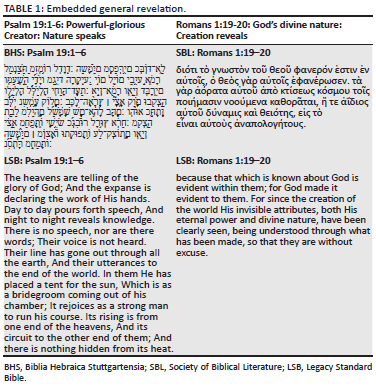
This understanding aligns with Stone and Duke's (2023:8) explanation of embedded theology as something that comes naturally to us. When participating in worship or engaging in Christian practices alongside others, individuals often feel legitimised by association, leading them to perceive their theology as valid. This theology is implicitly lived out daily by Christians who view themselves as fulfilling the mission of faithfully proclaiming the gospel of Jesus and executing God's will in the world (Stone & Duke 2003:4). However, embedded theology does not prioritise the essential task of ensuring that the Christian message is accurately understood through 'teaching correctly the message of the truth' [ὀρθοτομοῦντα τὸν λόγον τῆς ἀληθείας, Tm 2 2:15]. Louw and Nida (eds. 1996:399, 414) define correct teaching as expounding the singular and exclusive message of truth. BDAG (2000:36) asserts more emphatically that 'truth' [ἀληθεία] denotes truth consistent with uprightness of thought and deed - only arising from an accurate interpretation of scripture.
In light of this understanding, it becomes evident that all Christians are inherently engaged in theological reflection. Stone and Duke (2023:xvi) assert that a fundamental aspect of being Christian is to be a theologian. They further argue that Christians are inescapably theologians who always think theologically, regardless of whether they engage with theological concepts deliberatively or have formally studied them. For Christians, theological reflection is not an exclusive domain reserved for academics or philosophers. Sproul (2014:12) reinforces this notion by contending that everyone is a theologian engaged in theology; the distinction lies in whether one engages in biblical theology or unbiblical theology and whether they reflect critically on reality or not.
Mofokeng (1983:ix) outlines how his lived experiences shaped his path towards deliberative theology. He reflects on his struggle with the plight of black farm workers and the sight of young black children playing football with a plastic ball in tattered clothes, which provoked profound theological questions. He also recounts driving through the impoverished township of Mamelodi, witnessing the harsh realities of apartheid, where black people were confined to townships, and others faced unlawful detention, torture and death. These experiences prompted Mofokeng to engage in challenging theological reflection, leading him to ask how faith in Jesus Christ could empower black people in their fight for liberation. This introspection led him to pursue theological studies at Kampen, where he gained the knowledge to begin offering answers to the questions of those yearning for liberation (Mofokeng 1983:x).
Deliberative theology
Deliberative theology provides a critical examination of the propositional truths inherent in embedded theology. By stripping away presuppositions, it creates a conducive environment for understanding through rigorous reasoning, thereby linking scientific and logical frameworks to held beliefs (Stone & Duke 2023:8). This approach does not dismiss embedded theology or cast doubt upon it; rather, it affirms its validity by engaging in a reflective process that enhances and solidifies existing beliefs. Furthermore, if deliberative theological thinking reveals that previously accepted truths lack scriptural accuracy, it allows for the possibility of overturning these notions in favour of developing or embracing a more refined deliberative theology. This new understanding emerges from deep contemplation that formulates meaning within faith and clarifies what is believed (Stone & Duke 2023:9-10).
Mofokeng (1989:38) appears to be influenced by embedded theology, advocating for 'epistemological raptures in the hermeneutic circle'. According to Afrika (2024:1), Mofokeng wrote this during a period when South Africans were subjected to the imperial apartheid regime, which has been widely condemned as a crime against humanity. In his thesis, while engaging with deliberative theology, Mofokeng aimed to find solutions and emancipation for Black people by drawing on incarnational theology. He posed the critical question of how faith in Jesus Christ can empower Black individuals who are engaged in both embedded theology and activism for liberation and social justice (Mofokeng 1989:x). For Mofokeng, these elements serve as valid vehicles to address the humanitarian and theological challenges confronting South Africa.
Thread permeating from the above theologies as they pertain to Mofokeng's life
The opening of this article examines the first two theologies that Mofokeng gravitated towards early in his life, while the final theology highlights his turn towards deliberative theology. By achieving the highest theological qualifications and assuming the definition of deliberative theology presented above is accurate, it suggests Mofokeng's deep engagement with this discipline. However, in discussing embedded theology, this article does not limit it to informal theological acquisition; instead, it offers a nuanced understanding of the term 'embedded', extending it to include its presence within the upper echelons of sophisticated theological scholarship.
This perspective necessitates understanding Mofokeng as a complex figure who successfully integrates these ostensibly distinct theologies. This article argues that he did not abandon incarnational theology or his embedded theology; rather, he utilised his deliberative theology to enhance both aspects of his theological identity. As a Black theologian within the Reformed tradition, he transcended the limitations of theologies that can be restrictive and often fail to accommodate a nuanced approach to embracing elements of theology that resonate personally. While he identifies as a Black theologian within this tradition, his contributions extend beyond the confines of Black-Reformed theology. For example, the author of this article, who does not come from a Black Theology perspective, has nonetheless discovered valuable insights for his own theological development in Mofokeng's multifaceted approach and in the emancipation of Black scholars.
Mofokeng: A brief contribution of his work to theological education as theologised by other scholars
In an effort that seeks to understand the historical contributions to theological education and scholarship in South Africa by Mofokeng, through integrative reading, it critically examined landmark publications by Mofokeng and several scholars to draw theological insights from his work. Mofokeng's publications will be analysed to highlight his holistic contributions to theological education, while the other publications will demonstrate how his work has enriched theological education across various fields in South Africa. Ultimately, this article aims to encourage a much-needed widespread celebration of Mofokeng's legacy, fostering enduring theological education for future generations.
Mofokeng's 1983 doctoral thesis: The crucified among the cross bearers: towards a black Christology
Mofokeng's intellectual journey was deeply shaped by the experiences he encountered during his first parish, which left a lasting impression on him. Mofokeng (1983) recounts an incident involving a farmworker and a farmer:
The farmworker laboured tirelessly throughout the season, anticipating that, at harvest time, there would be abundant rewards for his efforts. However, to his deep disappointment, the farmer reaped all the benefits, leaving the Black farmworker with little to show for his toil - nothing to present to his wife and children as the fruit of his labour. (p. ix)
This experience of injustice prompted Mofokeng to seek a theological understanding of such inequity. At the time, however, his theological formation did not equip him to address the profound injustices he witnessed. This realisation set him on a journey to explore how faith in Christ might speak to the issues of Black liberation. His doctoral thesis became a provisional answer to this question, offering a theoretical framework for Christological reflection on the pressing issues of colonialism and apartheid that deeply affected Black South Africans. In doing so, he developed Black Christology to address the anthropological question: 'Who does Jesus Christ say that we are, and how shall we become our liberated selves?' (Mofokeng 1983:228).
Mofokeng's 1987a: The prosperity message and black theology
In this work, Mofokeng responds to Anderson's (1987) controversial paper that critiques the doctrine of the prosperity gospel. The prosperity gospel, which Anderson (1987:75, 78-80) critiques, promotes the belief that it is always God's will for individuals to be materially wealthy and healthy, thereby dismissing any notion of monetary or physical suffering. This doctrine, also known as the wealth and health gospel, tends to overlook Jesus' teachings against riches and eisegetically asserts that Jesus's substitutionary atonement on the cross serves as payment to free those with faith from sickness (Anderson 1987:79). From Anderson's (1987) paper, Mofokeng (1987a:84) seeks to highlight that eschatological utopia is not promised to people on earth. Simultaneously, he acknowledges the pressing humanitarian need for those living in poverty and suffering from illness in our country.
Mofokeng criticises Anderson for his focus on identifying the problems with the prosperity gospel, arguing that Anderson falls short in addressing the challenges of oppression faced by Black people and their resultant poverty, which stem from White imperial powers that have rendered them impoverished. To address this lacuna, Mofokeng (1987a:85) suggests that Black theology should fill this lacuna by advocating for a shift from a passive position of being elevated by God to actively participating in God's liberating efforts to elevate Black people to prosperity. While Black theology does not promote a prosperity gospel, it laments the failure to address historical issues that have created a divide between Whites and Blacks. Furthermore, it highlights the problematic nature of encouraging Whites to share their wealth or contribute to the prosperity of Black individuals, which inadvertently perpetuates another layer of issues: White domination and Black dependence (Mofokeng 1987a:85-86).
Mofokeng (1987a:86) acknowledges the problems of sin in the world and attributes the blame for the effects of the fall to Satan. However, he does not concede that he is solely responsible for these issues. He points to the anti-prosperity gospel as part of the problem, which promotes an all-inclusive view of prosperity that neglects the communal and familial quests for alleviating poverty within a capitalistic framework. Furthermore, Mofokeng critiques evangelicals who focus on good works and social concerns as a means to soothe their consciences regarding the socially constructed divide between the affluent and the poor. He advocates for Black theology's role in solidarity with the poor and oppressed, promoting the concept of 'integrated salvation', which recognises that the poor are not always to blame for their circumstances. Mofokeng highlights a historical legacy that identifies contributing factors to poverty, asserting that the process of liberating the poor represents a different kind of 'not yet' in contrast to an over-realised eschatology that promotes an 'already' utopia dominated by Whites (Mofokeng 1987a:86).
Mofokeng's 1987b: A Black Christology: A new beginning
Mofokeng's work makes a clarion call to the community of young Black theologians, encouraging them to be empowered by the Spirit of God to imitate Jesus by applying his liberation praxis to their salvific practices in order to transform the lives of their fellow human beings (Mofokeng 1987b:2). Mofokeng (1987b) invites fellow Black theologian-scholars to heed this call, reminding them that:
Jesus chose the side of the poor and the afflicted. He enters their world, not like a tourist or observer who remains safely outside while peering inside and never reaching the bottom of the pit. No. He descends deep into it and makes it his own in such a way and to such an extent that even death could not remove him. Instead, it found him in it and came because of it. (p. 16)
Having become man and taking on flesh, Jesus descended into the world of suffering, becoming a friend to sinners and the downtrodden of society. Despite his immaculate conception, Jesus gained knowledge and understanding of human suffering. The author of Hebrews recounts that:
[I]t was fitting for him, for whom are all things, and through whom are all things, in bringing many sons to glory, to perfect the author of their salvation through suffering [Ἔπρεπεν γὰρ αὐτῷ, διʼ ὃν τὰ πάντα καὶ διʼ οὗ τὰ πάντα, πολλοὺς υἱοὺς εἰς δόξαν ἀγαγόντα τὸν ἀρχηγὸν τῆς σωτηρίας αὐτῶν διὰ παθηµάτων τελειῶσαι] (Hb 2:10 [Author's own translation]).
[F]or we do not have a high priest who cannot sympathise with our weaknesses, but one who has been tempted in all things like we are, yet without sin. [οὐ γὰρ ἔχοµεν ἀρχιερέα µὴ δυνάµενον συµπαθῆσαι ταῖς ἀσθενείαις ἡµῶν, ἀπεπειρασµένον δὲ κατὰ πάντα καθ' ὁµοιότητα χωρὶς ἁµαρτίας] (Hb 4:15 [Author's own translation]).
This passage underscores the significance of Jesus's suffering as a means to relate to humanity and provide a model of empathy and compassion in the face of human suffering.
In alignment with Mofokeng's (1987b:16) assertion, Jesus inherited and deeply immersed himself in the world as a place of victims. Peeler (2024:92) comments on the use of the word 'world' [οἰκουμένην] by the writer of Hebrews, describing it as the present world that specifically affects the people who dwell within it. This world is created by the incarnate God himself, who understands the fears of those who inhabit it. Peeler (2024:105) argues that Christ entered this world without fear, unafraid of death - something he could not succumb to because of his sinlessness - knowing he possessed the power to deliver those living as if there were no hope for liberation. Furthermore, Peeler recounts how Hebrews 2:15 and the theme of deliverance played a pivotal and tangible role in the life of John Lea, a formerly enslaved African who converted to Christianity. The message of deliverance in this 'world' [οἰκουμένην], as well as in the world to come, provided him with assurance against despair over the devil's grip on God's people in this life.
He has done it by bringing his people to glory, and he is still going to 'make it happen' [τελειῶσαι]. Koester (2001:227) remarks that the infinitive aorist verb [τελειῶσαι] indicates that the action of bringing sons and daughters to glory is an ingressive action which God is still embarking on, with certainty that he will. Therefore, Mofokeng's call to be involved in the liberating work of Jesus is still applicable today and needs to be heeded. This is because of the fact that Hebrews 4:15 guarantees us that Jesus does not just show compassion and empathy with the afflicted, but Schreiner (2015:153) explains that Jesus guarantees to help those who are afflicted. Moreover, when we take the afflictions of various kinds to him, they will be received by one who has the 'sympathy' [συμπαθῆσαι], and he will not only sympathise but will help because he is not marked by any inability to help (Witherington 2007:229).
Mofokeng's 1987c: Following the trail of suffering: Black theological perspectives, past and present
In this work, Mofokeng (1987c:22-24) highlights the struggle for defining and identifying what exactly constitutes Black theology. The reason why there was a focus and a need to define and identify what constitutes Black theology is twofold. Firstly, Black theology needed to epistemologically be independent of White theology and not suffer from not having a real meaning and need for existence. Secondly, not having a unique definition and what constitutes it meant that it did not have constituency and could not definitively identify who its interlocutors are. Mofokeng (1987c:22-23) relays that it is when Black theology identified its interlocutors as the black working class, that it began to take shape towards charting the way forward in the struggle for the liberation of black people. Black theology gained strides by identifying black people as those who have been dispossessed of their land, reduced to labour that left them powerless as the subsistence, means of and source of power were taken from them by panicking and misinformed Whites who misconstrued the liberation struggle of black people. By defining Black theology and identifying the interlocutors, it became clear that it is about the fundamental right innate to every human being, namely human rights, enhancing the struggle from exclusively being against racism to include national revolution (Mofokeng 1987c:24).
Mofokeng (1987c:33-34) concludes by reflecting on how Black theology demonstrated that the struggles of black people extend beyond the confines of racism and capitalist oppression. The 1976 Soweto uprising, in particular, highlighted the profound suffering of black communities, and narratives such as the Exodus became emblematic of the liberation longed for by Black people. The shedding of innocent blood, the commission of heinous crimes and the experience of untold suffering made the suffering of Christ on the cross resonate deeply with Black people. They were drawn to Christology with the conviction that the death of Jesus offers profound insights into God's stance against injustice (Mofokeng 1987c:33). In this context, the resurrection power of Christ is seen as a promise for future generations, who must recognise that God severed the unbiblical umbilical cord of oppression.
Mofokeng's 1988: Black Christians, the Bible and liberation
In this presentation, Mofokeng engages with one of the most hotly debated historical issues in South Africa: the arrival of the Bible on its shores. This historical dilemma, as Mofokeng (1988:34) describes it, explores the complex relationship between Black Christians and the partnership between colonial missionaries and the Bible. The harsh reality that must be confronted is the undeniable fact that some missionaries exploited the Bible as a tool to introduce Western and European cultural norms, economic systems and attitudes, which they presented as the legitimate expression of biblical Christianity (Mofokeng 1988:35). This necessitated a response to colonisation, which, in its guise as mission work, propagated a form of Christianity that was deeply infused with colonial values, and which, Mofokeng argues, cannot be considered authentic biblical Christianity.
The emergence of missions in South Africa coincided with the expansion of the colonial empire, which systematically oppressed impoverished communities. Resane (2024:70) outlines the various historical periods when missionaries arrived on South African shores, highlighting the long-standing collaboration between missionaries and colonialists, who often worked together as allies in the colonial project. According to Resane (2024), the tragic history of this collaboration can be summarised as follows:
Corruption and moral decay permeated the socio-political landscape, manifesting through oppressive systems such as slavery, racism and land dispossession, among others. Of particular concern is the way in which the insidious forces of white supremacy and racism took root in South African society. During this time, many evangelicals chose a path of docility and silence, retreating from their prophetic role into the shadows of invisibility. Over the course of many years, socio-cultural injustices deepened, persisting until the formal end of the apartheid regime. However, even in the post-apartheid era, South Africa transitioned into a democratic dispensation that increasingly marginalised the role of God through the rise of secularism. (p. 70)
As a result, the problem is propounded by the fact that a colonial language is not the effective tool through which theological education is disseminated in South Africa. Wendland (2024:6-22) contends that the endeavour of contextualising English literature - initially conceived for Western contexts - poses a significant challenge for Western missionaries operating in rural Africa. The theological resources employed by Western theologians in their educational formation frequently lack the linguistic subtleties vital for the effective conveyance of the gospel message to indigenous African populations. Consequently, the imperative to present the gospel in a manner that is both comprehensible and culturally pertinent in rural Africa is more urgent now than it has ever been. This increased urgency is attributed to the persistent influence of colonial legacies, which continue to impede native English speakers from fully appreciating the intrinsic complexities involved in translating English theological texts into indigenous African languages. Mofokeng had a point and raised the struggle in 1988, which is still being fought 37 years later.
Mofokeng's 1989: The cross in the search for true humanity: Theological challenges facing South Africa today
The challenges confronting South Africa today, as identified by Mofokeng in 1989, remain disappointingly unchanged. It seems that the passage of time has entrenched the painful legacies of the past so deeply within the hearts of South Africans that revisiting these historical issues, which continue to shape present-day struggles, is often perceived as dwelling on past wrongs. In his historical analysis, Mofokeng (1989:38) outlines a theology of colonialism that distorted the covenant theology, presenting White Afrikaners as the chosen people of God. This theology justified the conquest and colonisation of African populations, the establishment of churches in lands violently seized from Black people, the reconfiguration of geographical boundaries and the sanitisation of wars that subjugated Black communities. Furthermore, this theological framework permeated the language of faith adopted by Africans, embedding it within the colonial-Christian paradigm that underpinned the colonial project.
Mofokeng (1989:47) warns, however, that efforts to reflect critically on the historical legacies of colonisation may provoke hostile reactions, particularly from those who benefitted from it. These projects are often perceived by beneficiaries as attempts to sow fear and resentment. Yet, these initiatives are essential for addressing the continuing suffering caused by colonialism, especially for Black people. They call us to direct our focus to the cross of Christ, to identify with his suffering, and to reflect on how innocent people endure such affliction. This recognition of innocent suffering must, in turn, provoke righteous indignation within us. As Maimela (1987:119) eloquently asserts, such indignation compels us to understand that, through Jesus' resurrection, God not only liberated him from suffering but also triumphed over it. This triumph ignited the movement for African liberation by affirming that God is intolerant of sin - particularly the sin of colonialism. Mofokeng (1989:50) expresses his disillusionment with this process, lamenting that the denial of justice may endure, partly because of a paralysed theology that fails to radically reorient Christian thought to confront the social forces still afflicting the nation.
Africa's 2024 signal for relevance
Mofokeng's work has consistently engaged with and responded to the call he made in his earlier writings. A central theme in his contributions to theological education, particularly Black theology, is his profound sense of disillusionment. He expressed deep concern over the failure of both the oppressed and theological scholars to embrace the liberation offered by God and to take tangible steps to realise it. This frustration is also evident in the relative paucity of his publications in the years preceding his retirement. At the symposium in his honour, the author of this article took the opportunity to reassure Mofokeng that, despite the limited number of written works, his legacy endures in the lives of the people, and his contributions are far from forgotten.
Recently, Africa (2024), drawing inspiration from Mofokeng, completed a thesis titled 'Crossbearers as the Messianic Generation: Towards a Black Radical Christology' at the University of South Africa. In this concise work, Africa (2024:iv) extends Mofokeng's exploration of the faith in Christ that empowers Black people engaged in the struggle for liberation. He argues that, despite the passage of decades since Mofokeng's engagement in the liberation struggle, South Africa continues to face a crisis, particularly in how theology can be applied to the practical challenges of achieving liberation. In his thesis, Africa (2024:1) introduces the concept of Fallism,4 which, on 09 March 2015, helped to expose the myth of the 'rainbow nation', drawing attention to the enduring social and political divisions in South Africa.
Mofokeng's contribution to education, scholarship and a quest for relevance henceforward
As this article draws to a close, it resonates with another powerful clarion call from Botha (2015:80-81), who observes that, living in a complex society like South Africa - where struggles are multifaceted - it is unlikely that we will ever find perfectly opportune moments to address our issues from within our respective scholarly disciplines. More crucially, Botha (2015:80-81) highlights theology as a field capable of engaging with diverse and intricate ideas, offering critical theological analysis. The enduring legacy of Mofokeng and his contemporaries must not be overlooked; contemporary theological and biblical scholars must remain vigilant to ensure that their work does not fall prey to the influence of imperial forces.
Conclusion
This article seeks to rekindle interest in the life of Takatso Mofokeng, a figure whose existence continues to resonate deeply with those engaged in theological study. Despite publishing relatively little, Mofokeng's contributions to both formal and informal theology remain profound, serving as an enduring source of inspiration. Much like Jesus, who wrote nowhere except for the textual variant in John 8:6, Mofokeng's life and the teachings he imparted offer timeless truths that transcend generations. His theological insights speak to individuals from all walks of life, reaching a wide spectrum of interlocutors - from laypeople to scholars in a variety of academic fields.
Mofokeng's contributions to Black Theology, paired with his activism for human liberation - especially for oppressed Black individuals - extend far beyond abstract philosophical discourse on Black consciousness. His work stands in direct alignment with the liberating message of Jesus, calling for the freedom of all humanity. His name proudly belongs to the pantheon of Black theologians who have shaped South African contextual theological education. Today, biblical scholars, including the author of this article, benefit from Mofokeng's legacy, particularly in the areas of Pauline and Greek New Testament scholarship's contribution to liberation through liberationist texts. As a result, scholars continue to build upon his groundwork, advancing towards a vision of total liberation.
Looking ahead, future research should explore the implications of Mofokeng's theology for post-apartheid justice and liberation theology, particularly within diverse academic contexts. His profound impact has yet to be fully realised, and there remains much to discover in applying his ideas to contemporary struggles for justice and freedom. In this way, Mofokeng's legacy offers a rich and ever-expanding terrain for theological exploration - one that promises to inspire and challenge future generations.
Acknowledgements
Competing interests
The author declares that they have no financial or personal relationships that may have inappropriately influenced them in writing this article.
Author's contribution
T.J.K. is the sole author of this research article.
Ethical considerations
This article followed all ethical standards for research without direct contact with humans or animal subjects.
Funding information
This research received no specific grant from any funding agency in the public, commercial or not-for-profit sectors.
Data availability
Data sharing is not applicable to this article as no new data were created or analysed in this study.
Disclaimer
The views and opinions expressed in this article are those of the author and are the product of professional research. It does not necessarily reflect the official policy or position of any affiliated institution, funder, agency or that of the publisher. The author is responsible for this article's results, findings and content.
References
Africa, O., 2024, 'Crossbearers as the messianic generation: Towards a black radical Christology', MTh-Thesis, University of South Africa. [ Links ]
Anderson, A., 1987, 'The prosperity message in the eschatology of some new charismatic churches', Missionalia: Southern African Journal of Mission Studies 15(2), 72-83. [ Links ]
Arndt, W., Danker, F.W. & Bauer, W., 2000, A Greek-English lexicon of the New Testament and other early Christian literature, BDAG, 3rd edn., University of Chicago Press, Chicago, IL. [ Links ]
Barth, K., 1962, Church dogmatics, 1st edn., T&T Clark, Edinburgh. [ Links ]
Botha, N., 2015, 'An encounter between black theology and reformed theology: The involvement of govender, Mazamisa, Mofokeng and Ntoane', Studia Historiae Ecclesiasticae 41(2), 69-81. https://doi.org/10.25159/2412-4265/347 [ Links ]
Darko, D.K., 2020, Against principalities and powers: Spiritual beings in relation to communal identity and the moral discourse of Ephesians, Langham Publishing, Carlisle. [ Links ]
Enns, P.P., 1989, The moody handbook of theology, Moody Press, Chicago, IL. [ Links ]
Forrest, M.R., 1987, 'Christology from below: And examination of the Black theology of Takatso Mofokeng in the context of the development of Black Theology in South Africa and in critical relation to the Christological ethic of Dietrich Bonhoeffer', PhD-Thesis, University of Cape Town. [ Links ]
Grenz, S.J., Guretzki, D. & Nordling, C.F., 2010, Pocket dictionary of theological terms, InterVarsity Press, Downers Grove, IL. [ Links ]
Hombana, M., 2024, 'Dialectica reconciliae: Mazamisa's contribution to the historical development of New Testament interpretation in South Africa', Verbum et Ecclesia 45(1), 1-8. https://doi.org/10.4102/ve.v45i1.3000 [ Links ]
Koester, C.F., 2001, Arguments in Hebrews: A new translation with introduction and commantary, The Anchor Yale Bible, London, New Haven, CT. [ Links ]
Lingenfelter, S.G. & Mayers, M.K., 2016, Ministering cross-culturally: A model for effective personal relationships, Baker Academic, Grand Rapids, MI. [ Links ]
Louw, J.P. & Nida, E.A. (eds.), 1996, Greek-English lexicon of the New Testament based on semantic domains, v.1: Introduction & domains, 2nd edn., United Bible Societies, New York, NY. [ Links ]
Magezi, V. & Magezi, C., 2016, 'An Adamic incarnational Christological framework as a theological approach for African contextual ministry', Missionalia 44(2), 152-174. https://doi.org/10.7832/44-2-111 [ Links ]
Maimela, S., 1987, Proclaim freedom to my people: Essays on religion and politics, Skotaville, Johhanesburg. [ Links ]
Mofokeng, T., 1983, The crucified among the crossbearers: Towards a black christology, Uitgeversaamtchappij J. H. Kok, Kampen. [ Links ]
Mofokeng, T., 1987a, 'The prosperity message and black theology: A response to Allan Anderson', Missionalia: Southern African Journal of Mission Studies 15(2), 84-86. [ Links ]
Mofokeng, T., 1987b, 'A black christology: A new beginning', Journal of Black Theology in South Africa 1(1), 1-17. [ Links ]
Mofokeng, T., 1987c, 'Following the trail of suffering: Black theological perspectives, past and present', Journal of Black Theology in South Africa 1(2), 21-34. [ Links ]
Mofokeng, T., 1988, 'Black Christians, the bible and liberation', Journal of Black Theology in South Africa 1(1), 34-42. [ Links ]
Mofokeng, T., 1989, 'The cross in the search for ture humanity: Theological challenges facing South Africa today', Journal of Black Theology in South Africa 3(2), 38-51. [ Links ]
Nel, R.W. & Makofane, M.K., 2014, 'Re-imagining African reformed praxis in theological education: A missiological dialogue with the Northern Theological Seminary', Studia Historiae Ecclesiasticae 40, 231-248. [ Links ]
Peeler, A., 2024, Hebrews, William B. Eerdmans Publishing Company, Chicago, IL. [ Links ]
Resane, K.T., 2024, 'Maintaining and evangelical faith in the face of a decadent culture of democracy', Conspectus 37(1), 69-83. https://doi.org/10.54725/conspectus.2024.1.5 [ Links ]
Schreiner, T.R., 2015, Commentary on Hebrews, B&H Publishing, Nashville, TN. [ Links ]
Seegers, E., 2020, Strong transformational focus at faculty opening, celebrating 40 years, University of the Free State, Bloemfontein. [ Links ]
Snyder, H., 2019, 'Literature review as a research methodology: An overview and guidelines', Journal of Business Research 104, 333-339. https://doi.org/10.1016/j.jbusres.2019.07.039 [ Links ]
Sobrino, J., 1978, Christology at the crossroads, Orbis Books, Maryknoll, New York, NY. [ Links ]
Sproul, R.C., 2014, Everyone's a theologian: An introduction to systematic theology, Reformation Trust Publishing, Sanford, FL. [ Links ]
Stone, H. & Duke, J.O., 2023, How to think theologically, 4th edn, Media, Minneapolis, MN. [ Links ]
United Nations, 2015, Transforming our world: The 2030 agenda for sustainable development, UN, New York, NY. [ Links ]
Wendland, E., 2024, 'The use of translational English in theological compositions for more effective communication: Some basic considerations', Conspectus 37, 6-22. https://doi.org/10.54725/conspectus.2024.1.1 [ Links ]
Witherington, B., 2007, Letters and homilies for Jewish Christians: A socio-rhetorical commentary on Hebrews, James, and Jude, InterVarsity Press, Westmont, IL. [ Links ]
 Correspondence:
Tsholofelo Kukuni
kukuntj@unisa.ac.za
Received: 11 Dec. 2024
Accepted: 28 Mar. 2025
Published: 11 June 2025
1. This article uses 'scholarship' and 'education' interchangeably, with 'education' encompassing all levels of learning and 'scholarship' broadly referring to academic work and intellectual discourse.
2. While this aspect does not constitute a fundamental component of the manuscript's central argument, it is afforded concise consideration towards the conclusion of the article to illustrate how Mofokeng advocates for an education that empowers marginalised communities.
3. Hereinafter referred to as Mofokeng.
4. Referred to as an umbrella term for movements such as #RhodesMustFall and #FeesMustFall.
