




Services on Demand
Journal

Article
 English (pdf)
 Article in xml format
 Article references
 Automatic translation
 Send this article by e-mail
Indicators
Related links
-
 Cited by Google
 -
 Similars in Google
Share

 Permalink
South African Journal of Education
On-line version ISSN 2076-3433Print version ISSN 0256-0100
S. Afr. j. educ. vol.45 suppl.1 Pretoria Oct. 2025
https://doi.org/10.15700/saje.v45ns1a2676
ARTICLES
Technology-supported cooperative learning to promote deeper self-directed learning in computer science education
Sukie van Zyl; Roxanne Bailey
Research Unit Self-Directed Learning, North-West University, Potchefstroom, South Africa. sukie.vanzyl@nwu.ac.za
ABSTRACT
The world is characterised by volatility, uncertainty, complexity and ambiguity. Disruptive online technology is impacting education. Students in higher education should be adaptive, resilient, deeper self-directed learners who take ownership of their learning and transfer knowledge and skills to solve problems in new contexts. The challenge is to apply cooperative learning (CL) and to promote deeper self-directed learning (DSDL) in online environments. With this research we aimed to determine how technology-supported cooperative learning (TSCL) could be implemented to enhance DSDL. A sequential explanatory mixed methods research design was applied. The self-rating scale of self-directed learning (SRSSDL) and the cooperative learning perception questionnaire (CLPQ) were administered before and after a TSCL intervention. Reflective journals were used as a qualitative data-collection instrument. The population consisted of 31 second-year computer science education pre-service teacher students enrolled in a course on computer networks. The quantitative data indicate an improvement in self-directed learning with a medium effect. The qualitative data support the quantitative results and suggested that the TSCL intervention contributed to fostering DSDL. Guidelines covering group composition, cooperative learning structure, class preparation, reflection, and task design are proposed, although their transferability to other populations requires further research.
Keywords: computer science education; connectivism; cooperative learning; deeper learning; deeper self-directed learning; knowledge transfer; online learning; self-directed learning; technology-supported cooperative learning
Introduction and Background
The emergence of new technology requires an advanced level of digital literacy and skills to thrive in a connected global world (Zhao, Llorente & Gómez, 2021:10). Online facilitation of classes has subsequently become an increasingly preferred mode of delivery (Zhao et al., 2021:2). Students, as digital natives, require teaching and learning approaches that involve technology (Szymkowiak, Melovic, Dabic, Jeganathan & Kundi, 2021:8). Educators need to compile teaching and learning environments that intrinsically motivate and challenge students to be prepared for a world where uncertainty and rapid change have become the new normal (Szymkowiak et al., 2021:2). Educational practices can thus either be adapted to empower students to face the challenges of a future world, or "miss the opportunity to influence significantly the great minds of our next great generation" (Seemiller & Grace, 2017:25).
Knowles (1975:15) advocates for self-directed learning (SDL) by stating that "we are entering into a strange new world in which rapid change will be the only stable characteristic." Currently, SDL is increasingly accepted as a requirement for successful learning in online environments (Doo & Zhu, 2024:1). In a world characterised by volatility and uncertainty in which complex problems must be solved, it is argued that SDL on its own is no longer sufficient (Van Zyl & Mentz, 2019:67). Especially in the context of computer science, students should also be deeper learners who can transfer their knowledge and skills and apply higher-order thinking to solve problems in new contexts (Qian, Chen & Chen, 2024:28-29). Deeper self-directed learning (DSDL) is, therefore, viewed as an essential competency where students take initiative, are proactive in their learning (Knowles, 1975:14), and can transfer their knowledge and skills to solve novel problems (Van Zyl & Mentz, 2019:101). This is especially relevant for pre-service teacher students in computer science education who must keep up with the rapidly changing digital landscape (Van Zyl, 2024:66). In addition, they also need to transfer their knowledge and skills to apply technology in innovative teaching and learning methods in online environments in their future classrooms (Zhao et al., 2021:2).
Cooperative learning (CL) involves incorporating five specific elements to result in students cooperating to accomplish a shared goal (Johnson & Johnson, 2019:46). The impact of CL has been well-documented, which includes several social and academic benefits and the fostering of SDL (Johnson & Johnson, 2019:39; Low & Van Ryzin, 2024:672). With technology-supported CL (TSCL), technology is used to strengthen the incorporation of the five essential CL elements (Low & Van Ryzin, 2024:672). It is, however, not evident how TSCL should be implemented in online learning environments to best enhance DSDL. The aim with this research, therefore, was to determine how TSCL may be implemented in computer science education to enhance DSDL.
Literature Review
According to Knowles (1975:19), SDL is based on the science of helping "maturing human beings" learn. SDL has since been acknowledged as a fundamental and meta-competence for responding to the challenges of a volatile, uncertain, complex, and ambiguous (VUCA) world, with lifelong learning, adaptability, courage, and resilience (Morris, 2024:236-237; Panthalookaran, 2022:241-242). Consequently, in a rapidly changing educational environment where online learning has become prevalent, the necessity of SDL and the importance of learning motivation and self-monitoring capabilities are increasingly noted (Doo & Zhu, 2024:12).
Self-directed students are intrinsically motivated to learn by their desire to achieve, their urge to grow, their satisfaction with accomplishment, their need to know, and their curiosity (Knowles, 1975:21). Although many SDL characteristics and skills are described in literature, a paucity of research exists on knowledge transfer and SDL (Mariano & Batchelor, 2021:141; Van Zyl & Mentz, 2019:68).
Knowledge transfer - the ability to apply knowledge and skills to solve novel problems - is regarded as a fundamental goal of higher education (LoGiudice, Norman, Manzoor & Monteiro, 2023:47, 50). Students should acquire transferable core skills that may be applied beyond the classroom to foster lifelong learning (Transue, 2013:188). Deeper learning (DL) involves acquiring knowledge and skills that enable far transfer and the application of 21st-century competencies (Pellegrino & Hilton, 2012:8). DL also emphasises making meaningful connections and employing higher-order thinking, which is particularly relevant in the rapidly evolving field of computer science education (Qian et al., 2024:29). Consequently, students in computer science need to become deeper self-directed learners who take ownership of their learning process, cultivate deep knowledge, develop a broad range of 21st-century skills, and apply their knowledge and skills to address problem scenarios in diverse and unfamiliar contexts (Van Zyl, 2024:70-71).
Interpersonal skills such as collaboration, teamwork and effective communication are considered an essential VUCA skill set in a digital society (Aboderin & Havenga, 2024:29; Panthalookaran, 2022:245). Utecht and Keller (2019:107) recommend that connectivism as a learning theory can provide guidance on using technology in a connected and collaborative learning environment. Active, student-centred teaching and learning strategies in a social context such as CL are thus recommended (Aboderin & Havenga, 2024:29; Low & Van Ryzin, 2024:673).
Research indicates that CL supports the development of SDL (Johnson & Johnson, 2019) and under specific conditions, also facilitates the development of DSDL (Van Zyl, 2024:80).
Moreover, Johnson and Johnson (2014:1) envision that technology could revolutionise CL by enhancing communication and enabling online platforms for collaborative projects. However, they do not address how the five essential elements of CL could be effectively integrated into a synchronous online environment.
Conceptual Framework
Three interconnected concepts, namely computer science education, DSDL and TSCL formed the foundation of this research (see Figure 1). These concepts are explicated followed by a discussion on why connectivism was deemed appropriate as interlinking framework to connect all three concepts.
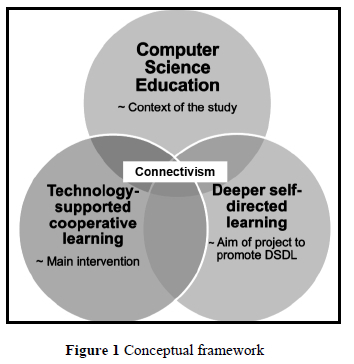
Computer science education
Computer science is an interdisciplinary field and comprises all principles of human activity within information and communication technology to find and implement solutions to real-world problems (Almurotovich & Mansurjonovich, 2021:223-224; Van Zyl, 2024:68). Computer science education, in addition, incorporates the pedagogical knowledge to develop such knowledge and skills. Computer science educators should be lifelong learners in this dynamic field and should also be able to select and apply appropriate teaching and learning strategies to facilitate the various topics (Almurotovich & Mansurjonovich, 2021:224). These topics range from having a more theoretical focus, such as computer networks, to topics with a more practical focus, such as application software, and coding and robotics (Van Zyl, 2024:68).
Because computer science is characterised by rapid changes, teaching methods should empower students to be lifelong learners and adapt to change. Fostering SDL in computer science education is thus a necessity (Mthembu & Gachie, 2024:113). However, SDL is not sufficient when considering the complexity of the challenges posed by the Fifth Industrial Revolution. The competence to transfer knowledge to solve problems in unknown contexts should also be fostered. It is thus recommended that the focus of computer science education should be on promoting DSDL (Van Zyl, 2024:67).
Deeper self-directed learning
Self-directed learning is viewed as a survival skill and a prerequisite for navigating in a modern world (Knowles, 1975:17). The SDL process is driven by a learning need that involves six key actions: diagnosing learning needs, formulating learning goals, identifying human and material resources, selecting and implementing appropriate learning strategies, and evaluating learning outcomes (Knowles, 1975:18). Although the student initiates these actions, collaboration plays a key role in fostering SDL where students share resources and view themselves as "mutually helpful human beings" (Knowles, 1975:72).
Hattie and Donoghue (2016:11) argue that learning is the outcome of processes that move through different levels - from surface, to deep, to transfer. Transfer is thus viewed as the ultimate goal of learning, where deep knowledge is applied to make connections to other ideas and "being able to know what to do when one does not know what to do" (Hattie & Donoghue, 2016:11). Accordingly, Pellegrino and Hilton (2012:141) argue that an integral aspect of learning is the ability to integrate and apply transferable knowledge and skills across disciplines. They conclude that DL is a process grounded in social relationships, which results in the application of transferable knowledge and skills in the cognitive, intrapersonal and interpersonal domains (Pellegrino & Hilton, 2012:79). Learning for transfer, thus not only includes cognitive perspectives on learning, but also intrapersonal and interpersonal skills.
Considering the complexities of a rapidly changing world, it is thus argued that education should focus on fostering DSDL, which incorporates both SDL and DL (Van Zyl & Mentz, 2019:98). DSDL is subsequently defined as a process, where the individual intentionally takes charge of the learning process, resulting in transferable competencies in the cognitive, intrapersonal and interpersonal domains. In the cognitive domain, a deep approach to learning is followed to make connections and transfer knowledge. In the intrapersonal domain, students become intrinsically motivated and apply metacognitive skills to regulate and monitor their learning, to evaluate whether learning goals have been met. The interpersonal domain becomes crucial to support and strengthen learning and foster transfer. Broader perspectives on solutions to problems are obtained while communicating and collaborating with others. Critical thinking is improved when knowledge is shared and ideas and solutions are discussed and debated with peers. Moreover, effective collaboration builds confidence, fosters intrinsic motivation, and enhances SDL (Van Zyl & Mentz, 2019:100-101).
The aim of the DSDL process is thus to prepare students to face the challenges of a VUCA world by applying SDL strategies for the transfer of knowledge and skills to solve novel problems and continuously developing and growing as deeper self-directed learners (Van Zyl & Mentz, 2019:101).
Technology-supported cooperative learning
Placing students in groups and requiring them to work together will not necessarily develop social skills and promote learning (Johnson & Johnson, 2019:46). CL differs from traditional group work by incorporating five essential elements to ensure that each group member contributes to the group's goal. Subsequently, each member is held accountable for the entire task. The five elements are positive interdependence, individual accountability, social skills, face-to-face promotive interaction, and group processing (Johnson & Johnson, 2019:46-49).
Although designing and implementing effective CL environments is challenging, technology offers valuable opportunities to address these challenges (Low & Van Ryzin, 2024:672). When integrating technology, especially in the context of online learning, normal classroom methods should be transformed and cannot merely be transferred to an online environment (Siemens, 2006:iv; Siemens, Rudolph & Tan, 2020:114). The aim of TSCL, therefore, is to leverage technology to incorporate the five elements of CL in an online environment to enhance social learning.
A higher level of autonomy is required from students in online learning environments compared to physical classrooms (Park & Yun, 2018:43). It is, therefore, recommended that facilitators build in scaffolding and apply active teaching and learning strategies to support and encourage students to engage in online environments (Park & Yun, 2018:43; Turnquest, Fan, Rangel, Dyer & Master, 2024:17). CL, when applied in a structured way, thus becomes a scaffold for online learning and encourages students to persist in their learning (Johnson & Johnson, 2019:55; Kirschner, Sweller, Kirschner & Zambrano, 2018:220; Turnquest et al., 2024:3).
Connectivism
Connectivism describes learning as the process of "combinatorial creativity" where new ideas are created by forming connections between existing ideas and concepts (Siemens et al., 2020:110). The ability to see connections between ideas and concepts is subsequently regarded as a core skill of connectivism (Transue, 2013:186). Learning is, however, not merely a function of accessing a network of experts but also involves developing a skills set to critically evaluate information, navigate and process contradicting opinions, self-regulate learning and develop a goal-oriented mindset (Siemens et al., 2020:111-112). This skills set is strongly connected to the characteristics of self-directed learners and the SDL process (Knowles, 1975:18). Connectivism thus emphasises the importance of lifelong learning in a social context in a complex digital landscape and the responsibility of the individual as a self-directed learner to set learning goals and manage learning (Mukhlis, Haenilah, Maulina, Nursafitri, Nurfaizal & Noerhasmalina, 2024:812).
Connectivism can be viewed as an extension of learning theories related to social constructivism (Bell, 2011:101), thus positioning CL as a teaching and learning strategy in the context of connectivism. In addition, technology plays an important role in enhancing collaboration and connecting the collective knowledge of individuals to discover knowledge and find solutions to problems (Utecht & Keller, 2019:107). Co-creation is viewed as the first phase of the knowledge construction process (Siemens, 2006:6). Thereafter, knowledge is disseminated, key ideas are communicated, knowledge is personalised, and in the final stage, knowledge is implemented, which recursively feeds into the first stage of co-creating knowledge. On the highest knowledge level, deeper levels of knowledge transform existing knowledge which results in innovation (Siemens, 2006:10). This view on knowledge and knowledge construction aligns with DSDL where knowledge and skills are transferred to new contexts.
It is thus concluded that promoting DSDL aligns with the core foundations of connectivism in which a skills set needs to be cultivated to manage learning in digital environments to continuously move from co-creation of knowledge to implementing knowledge in a socially connected technology environment (Transue, 2013:188; Utecht & Keller, 2019:107). Siemens (2006:10) calls for the urgency to embed pedagogical practices to develop the "people of tomorrow" and argues that keeping to traditional pedagogical approaches will prepare "students and employees for a future that will not exist."
Methodology
This research was informed by the pragmatic paradigm and an explanatory sequential mixed-methods design (Creswell & Plano Clark, 2018:91) was applied. The population (N = 31) consisted of second-year computer science education pre-service teacher students from two different campuses of a South African university enrolled in a computer network course. A non-random convenience sampling approach was used, and all students were invited to participate in the study. One of the researchers also served as the course lecturer. To minimise potential power dynamics and prevent students' responses from being influenced by this dual role, delayed informed consent was obtained after the completion of the course. Delayed informed consent was obtained and 11 (n = 11) students gave voluntary informed consent to participate in the research. Ethical clearance for the study was obtained from the relevant ethics committee of the university and gatekeeper permission was also obtained. All procedures adhered to institutional ethical guidelines.
Data Collection Instruments and Methods
The self-rating scale of self-directed learning ([SRSSDL], Williamson, 2007:68) was used as a quantitative data collection instrument to determine participants' perceived level of SDL readiness. The SRSSDL questionnaire was used as a pre- and post-test, before and after the respective TSCL intervention which was applied for 7 weeks. The perceptions of students on TSCL were measured with an adapted cooperative learning perception questionnaire (CLPQ) (developed by the Research Unit Self-Directed Learning at the North-West University). Reflective journals (in the form of an online blog) were used as a qualitative data-collection method. These journals were analysed to obtain a rich perspective on students' inclination towards SDL, knowledge transfer and the incorporation of the elements of CL in the TSCL environment.
Intervention
The TSCL intervention was part of the teaching-learning strategy of the module and all students participated in the intervention. The TSCL intervention focused on the three domains (cognitive domain, interpersonal domain and intrapersonal domain) as required for DSDL. Microsoft Teams (MS Teams) was used as an online facilitation platform. Students were unfamiliar with MS Teams, and as future teachers, they could experience how MS Teams could be used to facilitate classes (both in an online setting and a hybrid and/or flipped classroom setting).
Students were randomly divided into teams or base groups of four students. Their first task was to name their teams by creatively referring to network terminology. During online facilitation, they would work in novel randomised CL groups, randomly assigned using the MS Teams function. After class the students were required to work on other assignments in their base groups. We structured the course content to follow a holistic approach, and thus first provided an overview of the terminology and then focused on a deeper level on the various aspects of the module content.
Several authentic scenarios were provided where students had to follow a problem-first approach. Students participated in regular Kahoot (an online game-based learning platform) challenges that served as formative assessment. Students could participate in Kahoot challenges as many times as they wanted as we aimed to provide a fun environment to assist students in identifying their learning needs and to foster individual accountability.
We provided PowerPoint presentations and weekly electronic guides (e-guides) as scaffolding on the institution's learning management system (LMS). Instead of providing subject content, the focus of using these resources was on guiding students. We intentionally incorporated metacognitive questioning and knowledge surveys, as suggested by Wirth, Nuhfer, Watson, Fleisher and Bailey (2021:132). Students had to keep weekly reflection journals by using the blog tool of the LMS. In a fully online course where the lecturer and the students are distanced from each other, the blogs provided a means for reflection, but also a means for asynchronous individual communication and getting to know each other.
We had never met these students face-to-face. Some of the students were studying at other campuses and were not acquainted with us as lecturers. The students reflected on their learning and provided feedback on their experience in the module. We also ensured that we regularly responded to their blog entries. We thus got real-time feedback on the intervention, were informed of challenges that they experienced, could encourage students continuously and were able to identify at-risk students.
Data Analyses
For the data analyses, we used paired-sample t-tests to analyse the quantitative results from the SRSSDL questionnaire and the CLPQ. We also applied structural coding and thematic analysis, guided by Saldaña (2013:267), to analyse the qualitative results.
Results
Figures 2 and 3 illustrate the results obtained from the research. When looking at the individual categories of the SRSSDL (see Figure 2), the paired sample statistics indicate that awareness increased with medium effect (d = 0.7). Participants thus showed improved understanding of the factors that contribute to SDL (see Williamson, 2007:70). An increase in evaluation (d = 0.38) and interpersonal skills (d = 0.39) was observed, both reflecting small effects. The decrease in learning strategies and learning activities reflected little to minimal change, as reflected in the effect sizes. Van der Walt (2014:7) states that participants initially often overestimate their SDL readiness. The improved awareness may, therefore, suggest that participants had become more conscious of their learning strategies and activities and had realised that they had previously overestimated their SDL readiness in these categories.
We analysed the CLPQ according to constructs related to the five elements of CL and SDL. The reliability of the questionnaire was confirmed with statistical analyses. The results indicate a statistically significant large effect (d = 0.83) for the individual accountability construct. The CLPQ also confirmed an increase in SDL with a medium effect (d = 0.65). The increase in both individual accountability and SDL provide confirmation of the other, suggesting consistency across the measures.
It is interesting that by applying an intervention with focus on CL, participants' individual accountability had improved. However, almost no improvement was noted in the social skills construct. We speculate that this is a result of how the CLPQ was compiled, with not many questions specifically focusing on the construct of social skills.
Table 1 summarises the categories and themes that emerged from the qualitative data (gathered from the students' reflective journal blogs).
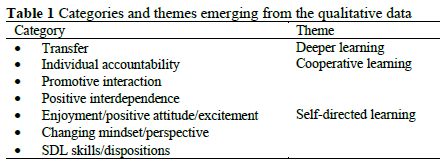
As indicated in Table 1, participants illustrated several aspects relating to the three main constructs of the intervention (DL, CL, and SDL) when referring to their blog entries. Only 10 of the participants submitted blog entries and as we kept the submission of the questionnaires anonymous, we could not map the participants' quantitative data to that of their qualitative results. The three main themes that emerged are discussed below.
Deeper Learning
DL, with the focus on "transfer" was observed in statements such as: "I have learned so much throughout this module and it was a weird but fun experience doing it online and where we had to think of different alternative ways where we could make the class work fun and interesting" (P2).
This was reiterated by Participant 4 who noted: "We can also always link the CAT [Computer Applications Technology] topics to their prior knowledge through having them connecting to things that have happened to them in the past" (P4).
Participant 7 also made specific reference to how they could see that what they had learnt in the module would benefit or be transferred in future
contexts: "For a future CAT teacher, I am definitely learning new and interesting ways to present theoretical content in my classroom in an exciting and non-boring way'" (P7).
The reference to DL being stimulated through the intervention reflected positively on the impact of the TSCL intervention. It was obvious that the blog entries would frequently point to collaboration as the main component of the intervention was focused on CL.
Cooperative Learning
We used the five basic principles of CL, as described by Johnson and Johnson (2019:47-49), to guide the categories emanating from the blog entries relating to CL.
Participants' specific comments point to the notion that the students' individual accountability was stimulated during the TSCL intervention: "We all carried our weight this week. I am proud to be part of The Ethernet Squad" (P2). Participant 4 stated as follows: "I have done my own research on the different topologies in order to understand the work better" (P4). This gives a clear indication that they felt responsible for their own learning (an aspect of SDL). Another noteworthy comment was that of Participant 6, who mentioned that they had ensured that their work was up to date - an aspect that is not always common among students.
Apart from individual accountability being stimulated through the TSCL intervention, participants illustrated a heightened sense of promotive interaction.
"I almost forgot about the week 8 Kahoot test but luckily a friend reminded me" (P3). Participant 3 indicating promotive interaction throughout the TSCL intervention. This notion was also mentioned by P5: "[a]nd I learned so much about it today with my group. I couldn't have asked for a more fun and productive way than this" (P5).
Participant 6 noted how their group intentionally used technology to support each other: " We also decided on when to Zoom to get together and on the same page to make sure we know what to do and how to support each other" (P6).
Considering the isolation often experienced during pure online learning experiences, this was especially positive.
The driving force behind CL, which also distinctively sets it apart from collaborative learning, is the principle of positive interdependence: "All the group members worked together as one, even though we are still busy finishing up the final few questions, we are working like the moon and the tides" (P2) - evidently showing synergy and a sense of interdependency in the group.
Participant 6 also indicated that they engaged collaboratively within their group to establish a common understanding: "I started to discuss our micro lesson and we exchanged ideas, decided who does what and what topic and grade we are choosing" (P6).
It was evident that group members worked well to establish positive interdependence: "Everyone respected each other and teamwork was visible since first the day. I could not have asked for any other team members" (P8).
Participant 10 stated that they were convinced that all group members were invested in the group task: "There wasn't a day that I wondered if someone was going to do their part" (P10).
The findings thus indicate that the TSCL intervention stimulated the principles of CL and it is possible that these also resulted in enhancing SDL (also see Johnson & Johnson, 2019:39).
Self-directed Learning
Participant 2 noted: "I can't wait to learn more about networks." Although it seemed as though Participant 4 was despondent, it is noteworthy that they took the initiative to further their research on the topic they felt uncomfortable with: "When the work was explained after the test I was completely lost ...I needed to go do my own research and work with super little background" (P4).
Participant 6 stated that the class expanded their knowledge greatly and pushed them to equip themselves: "I learned a lot of new things I did not know anything about or even knew it existed. I like learning new things and equipping myself with new knowledge" (P6)
One specific aspect relating to SDL is the confidence to expand one's knowledge and make changes where needed. This was evident from Participant 8's comment: "I think the fear of change should stop and new principles should be implemented in the school systems, to change the traditional behaviour of what learners are trained to be" (P8).
Most importantly, it became evident that most of the participants had experienced the learning process positively and were thus open to expanding their learning: "This 2 weeks' work was very interesting for me because it is the most I ever learned and it' s also one of my favourite themes in CAT" (PIG).
From the results extrapolated from the three datasets (SRSSDL questionnaire, CLPQ and the blog reflections), it became evident that participants' DSDL was stimulated. In the following section we provide a brief discussion of the main findings in relation to our research question. Using triangulation, the results of the empirical data as well as the most prominent aspects from the literature review, position our research findings within the broader body of scholarship.
Discussion
The results of this research indicate that TSCL can promote DSDL in an online course in computer science education. In the body of scholarship, it is indicated that CL holds many advantages for the development of SDL (Johnson & Johnson, 2019:39). However, we determined that including a technology component to incorporate the elements of CL, to enhance intrinsic motivation and social interaction, and incorporating connectivism (Utecht & Keller, 2019:107), elevated participants' experience of the intervention and also enhanced aspects relating to DSDL. Participants specifically mentioned using technology to support each other. As Johnson and Johnson (2014:1) note that technology could revolutionise CL, and in the case of our research, it did. Not only did technology alleviate the isolation of a fully online course, but also encouraged participants to skilfully use technology to enhance the online CL experience.
As is evident from the quantitative results, individual accountability (CL construct) and awareness (SDL construct) both increased with practical significance, indicating a positive change in the participants' approach to learning.
If we refer to the five basic elements of CL: positive interdependence, promotive interaction, individual accountability, social skills, and group processing, it is not surprising that the TSCL intervention had a positive effect on participants' SDL and CL scores. Furthermore, the intervention also seemed to have had a perceived positive impact on participants' DSDL.
The TSCL intervention addressed SDL constructs as follows.
The blog reflections addressed the evaluation construct of SDL. Group processing (the CL element where participants reflected on what worked well and how they could improve in future) also focused on the evaluation construct. The interpersonal construct was stimulated directly by applying CL, as students' positive interdependence and their subsequent mutual reliance on each other were fostered. As indicated by several participants, individual accountability was successfully stimulated throughout the TSCL intervention which probably caused the increase in the SDL construct of awareness.
Several participants specifically mentioned the fact that they applied the knowledge and the skills that they had learned in this intervention in other contexts. This would not have been possible had it not been for the use of technology, which bridged the geographical gap between participants and thus enhanced collaboration. Furthermore, we surmise that several guidelines became evident when implementing TSCL in a fully online course to promote DSDL.
Guidelines for Implementing Technology-supported Cooperative Learning to Promote Deeper Self-directed Learning
When implementing TSCL to promote DSDL, several guidelines should be considered. These guidelines are discussed below.
Group composition
Assigning base groups provides continuous peer support beyond scheduled classes. In online environments, group sizes should be larger to compensate for potential inactivity due to poor connectivity or other challenges. To ensure stability and engagement, two members can be assigned to each role.
Structuring cooperative learning
The five basic elements of CL should be explicitly incorporated. Clear instructions and the allocation of roles to all group members enhance individual accountability and encourage promotive interaction, as students draw on one another as resources.
Class preparation
Students should prepare before class to strengthen individual accountability and enable meaningful contributions to group tasks within the limited time available online. Individual pre-class activities can be particularly effective in this regard.
Reflection and transfer
Reflection plays a critical role in promoting transfer across contexts and in developing DSDL. Reflection tools such as knowledge surveys and blogs can foster intrapersonal competencies, metacognition, and evaluation (as DSDL constructs), while also serving as group processing mechanisms (a key element of CL).
Task design and assessment
Group tasks and assignments should target higher-order cognitive competencies, such as critical thinking and creativity (as DSDL constructs). Moreover, assessments and collaborative activities should be grounded in authentic, challenging problem scenarios, thereby reinforcing promotive interaction and positive interdependence among group members.
Conclusion
From the results obtained in this research, we conclude that DSDL could be promoted in a fully online course when teaching and learning methods are structured to incorporate certain conditions. Connections between students should be well established and active teaching and learning strategies, such as CL, should be applied. In addition, reflection tools should be incorporated, and group tasks and individual activities should be authentic and challenging, and focus on promoting metacognition, critical thinking and creativity. In the socially connected technological environment, participants evolved from individual knowledge construction to co-creating knowledge and transferring their knowledge and skills. We therefore argue that the ultimate goal of learning should be to promote DSDL where students as self-directed learners are able to transfer knowledge and skills across contexts, thereby achieving a higher level of transfer than argued by Hattie and Donaghue (2016:11).
Although the findings are promising, certain limitations should be acknowledged. The study was conducted with a small population, and the dual role of one researcher as both lecturer and researcher could have influenced participants' responses. While the proposed guidelines are generic and applicable across contexts, further research is required to examine the transferability of the findings to other populations.
Authors' Contributions
SvZ collected the data (questionnaires and conducted interviews). Both authors were involved in statistical analyses, qualitative data analysis, and in conceptualising and compiling the manuscript.
Notes
i. Published under a Creative Commons Attribution Licence.
References
Aboderin O & Havenga M 2024. Essential skills and strategies in higher education for the Fourth Industrial Revolution: A systematic literature review. South African Journal of Higher Education, 38(2):24-43. https://doi.org/10.20853/38-2-5430 [ Links ]
Almurotovich QO & Mansurjonovich JM 2021. Description of the methodological basis for ensuring interdisciplinary continuity of the subject "Computer Science and Information Technology" in vocational education. JournalNX, 7(10):223-225. https://doi.org/10.17605/OSF.IO/MK6WN [ Links ]
Bell F 2011. Connectivism: Its place in theory-informed research and innovation in technology-enabled learning. International Review of Research in Open and Distance Learning, 12(3):98-118. https://doi.org/10.19173/irrodl.v12i3.902 [ Links ]
Creswell JW & Plano Clark VL 2018. Designing and conducting mixed methods research (3rd ed). Thousand Oaks, CA: Sage. [ Links ]
Doo MY & Zhu M 2024. A meta-analysis of effects of self-directed learning in online learning environments. Journal of Computer Assisted Learning, 40(1):1-20. https://doi.org/10.1111/jcal.12865 [ Links ]
Hattie JAC & Donoghue GM 2016. Learning strategies: A synthesis and conceptual model. npj Science of Learning, 1(1):16013. https://doi.org/10.1038/npjscileam.2016.13 [ Links ]
Johnson DW & Johnson RT 2014. Using technology to revolutionize cooperative learning: An opinion. Frontiers in Psychology, 5:1156. https://doi.org/10.3389/fpsyg.2014.01156 [ Links ]
Johnson DW & Johnson RT 2019. The impact of cooperative learning on self-directed learning. In E Mentz, J de Beer & R Bailey (eds). Self-directed learning for the 21st century: Implications for higher education (NWU Self-Directed Learning Series Vol. 1). Cape Town, South Africa: AOSIS. https://doi.org/10.4102/aosis.2019.bk134.02 [ Links ]
Kirschner PA, Sweller J, Kirschner F & Zambrano RJ 2018. From cognitive load theory to collaborative cognitive load theory. International Journal of Computer-Supported Collaborative Learning, 13:213-233. https://doi.org/10.1007/s11412-018-9277-y [ Links ]
Knowles MS 1975. Self-directed learning: A guide for learners and teachers. Chicago, IL: Association Press. [ Links ]
LoGiudice AB, Norman GR, Manzoor S & Monteiro S 2023. Does a deep learning inventory predict knowledge transfer? Linking student perceptions to transfer outcomes. Advances in Health Sciences Education, 28(1):47-63. https://doi.org/10.1007/s10459-022-10141-7 [ Links ]
Low S & Van Ryzin MJ 2024. Student-centered instruction can build social-emotional skills and peer relations: Findings from a cluster-randomized trial of technology-supported cooperative learning. School Psychology, 39(6):672-681. https://doi.org/10.1037/spq0000589 [ Links ]
Mariano GJ & Batchelor K 2021. The role of metacognition and knowledge transfer in self-directed learning. In M Khosrow-Pour, S Clarke, ME Jennex & AV Anttiroiko (eds). Research anthology on developing critical thinking skills in students. Hershey, PA: IGI Global. [ Links ]
Morris TH 2024. Four dimensions of self-directed learning: A fundamental meta-competence in a changing world. Adult Education Quarterly, 74(3):236-254. https://doi.org/10.1177/07417136231217453 [ Links ]
Mthembu N & Gachie W 2024. Teaching approaches of high school teachers in the 21st century: Fostering the cultivation of self-directed learning for computer science education. In C Bosch, L Goosen & J Chetty (eds). Navigating computer science education in the 21st century. Hershey, PA: IGI Global. https://doi.org/10.4018/979-8-3693-1066-3.ch006 [ Links ]
Mukhlis H, Haenilah EY, Maulina D, Nursafitri L, Nurfaizal & Noerhasmalina 2024. Connectivism and digital age education: Insights, challenges, and future directions. Kasetsart Journal of Social Sciences, 45(3):803-814. https://doi.org/10.34044/j.kjss.2024.45.3.11 [ Links ]
Panthalookaran V 2022. Education in a VUCA-driven world: Salient features of an entrepreneurial pedagogy. Higher Education for the Future, 9(2):234-249. https://doi.org/10.1177/23476311221108808 [ Links ]
Park S & Yun H 2018. The influence of motivational regulation strategies on online students' behavioral, emotional, and cognitive engagement. American Journal of Distance Education, 32(1):43-56. https://doi.org/10.1080/08923647.2018.1412738 [ Links ]
Pellegrino JW & Hilton ML (eds.) 2012. Education for life and work: Developing transferable knowledge and skills in the 21st century. Washington, DC: National Academies Press. Available at https://www.fsba.org/wp-content/uploads/2014/04/Education-for-life-and-work.pdf. Accessed 21 October 2025. [ Links ]
Qian L, Chen F & Chen N 2024. On deeper learning evaluation model for college students based on SOLO taxonomy. In HM Briel (ed). Proceedings of the 2024 SSEME Workshop on Social Sciences and Education (SSEME-SSE 2024) (Vol. 864). Paris, France: Atlantis Press. https://doi.org/10.2991/978-2-38476-289-7 [ Links ]
Saldaña J 2013. The coding manual for qualitative researchers (2nd ed). London, England: Sage. [ Links ]
Seemiller C & Grace M 2017. Generation Z: Educating and engaging the next generation of students. About Campus, 22(3):21-26. https://doi.org/10.1002/abc.21293 [ Links ]
Siemens G 2006. Knowing knowledge. Available at https://www.knowingknowledge.com/2006/10/knowing_knowledge_pdf_files.php. Accessed 30 November 2024. [ Links ]
Siemens G, Rudolph J & Tan S 2020. "As human beings, we cannot not learn". An interview with Professor George Siemens on connectivism, MOOCs and learning analytics. Journal of Applied Learning & Teaching, 3(1):108-119. https://doi.org/10.37074/jalt.2020.3.1.15 [ Links ]
Szymkowiak A, Melovic B, Dabic M, Jeganathan K & Kundi GS 2021. Information technology and Gen Z: The role of teachers, the internet, and technology in the education of young people. Technology in Society, 65:101565. https://doi.org/10.1016/j.techsoc.2021.101565 [ Links ]
Transue BM 2013. Connectivism and information literacy: Moving from learning theory to pedagogical practice. Public Services Quarterly, 9(3):185-195. https://doi.org/10.1080/15228959.2013.815501 [ Links ]
Turnquest KN, Fan W, Rangel VS, Dyer N & Master A 2024. Student engagement, school involvement, and transfer student success. Contemporary Educational Psychology, 79:102322. https://doi.org/10.1016/j.cedpsych.2024.102322 [ Links ]
Utecht J & Keller D 2019. Becoming relevant again: Applying connectivism learning theory to today's classrooms. Critical Questions in Education, 10(2):107-119. Available at https://files.eric.ed.gov/fulltext/EJ1219672.pdf. Accessed 17 October 2025. [ Links ]
Van der Walt MS 2014. Metakognitiewe bewustheid, selfgerigtheid in leer en een leerprestasie van voornemende wiskundeonderwysers vir die intermediare en senior fase. Suid-Afrikaanse Tydskrif vir Natuurwetenskap en Tegnologie, 33(1):Art. #1169, 9 pages. https://doi.org/10.4102/satnt.v33i1.1169 [ Links ]
Van Zyl S 2024. A framework for developing deeper self-directed learning in computer science education. In C Bosch, L Goosen & J Chetty (eds). Navigating computer science education in the 21st century. Hershey, PA: IGI Global. https://doi.org/10.4018/979-8-3693-1066-3.ch004 [ Links ]
Van Zyl S & Mentz E 2019. Moving to deeper self-directed learning as an essential competency for the 21st century. In E Mentz, J de Beer & R Bailey (eds). Self-directed learning for the 21st century: Implications for higher education (NWU Self-Directed Learning Series Vol. 1). Cape Town, South Africa: AOSIS. https://doi.org/10.4102/aosis.2019.bk134.03 [ Links ]
Williamson SN 2007. Development of a self-rating scale of self-directed learning. Nurse Researcher, 14(2):66-83. https://doi.org/10.7748/nr2007.01.14.2.66.c6022 [ Links ]
Wirth KR, Nuhfer EB, Watson R, Fleisher SC & Bailey R 2021. Knowledge surveys: Supporting students along pathways to self-directed learning with self-assessment. In E Mentz, D Laubscher & J Olivier (eds). Self-directed learning: An imperative for education in a complex society (NWU Self-Directed Learning Series Vol. 6). Cape Town, South Africa: AOSIS Books. https://doi.org/10.4102/aosis.2021.bk279.06 [ Links ]
Zhao Y, Llorente AMP & Gómez MCS 2021. Digital competence in higher education research: A systematic literature review. Computers & Education, 168:104212. https://doi.org/10.1016/j.compedu.2021.104212 [ Links ]
Received: 30 December 2024
Revised: 2 September 2025
Accepted: 26 September 2025
Published: 24 November 2025


