A South African central hospital's experience with malignant colorectal obstruction
Abstract
BACKGROUND: The spectrum and outcome of colorectal cancer (CRC) presenting with obstruction is not well studied in low- to middle-income countries (LMIC) and could have implications for health policy. This study aimed to address this deficit in an LMIC setting METHODS: A retrospective analysis was conducted of patients with large bowel obstruction, during the period 2000-2019 from the prospective Inkosi Albert Luthuli Central Hospital (IALCH) CRC registry data. Data analysed included the site of CRC, tumour differentiation, management of patients with obstructive CRC, resection margins post resection, oncological management and reasons for failure to receive oncological therapy. Patient follow-up and recurrence were recorded RESULTS: Malignant obstruction from CRC occurred in 510 patients (20% of the CRC registry). Median age at presentation was 57 years (IQR 48-67). One hundred and seventy-six (34.5%) and 135 (26.5%) had stage III and IV disease respectively. Moderately differentiated cancer was seen in 335 (65.6%). Management was resection (370; 72.5%), diverting colostomy (123; 24.1%) and stent insertion (55; 10.8%). Twenty-one patients (5.7%) had positive resection margins. Recurrence occurred in 34 patients (6.7%), all of whom had initially undergone resection, giving a recurrence rate of 9.8% in those receiving surgery. Median disease-free interval for patients developing recurrence was 21 months (IQR 12-32 CONCLUSION: One in five patients with CRC presented with obstruction. These patients were younger than in high income-country (HIC) series. Over 70% underwent resection. Stomas were used twice as frequently as stents to relieve the obstruction, a finding that is the reverse of that in HICs
obstructive colorectal cancer; malignant bowel obstruction; obstruction; colon cancer
Introduction
Colorectal cancer (CRC) is the third most common type of cancer worldwide. It is estimated that around 1.4 million new cases occur each year.1211334
Large bowel obstruction (LBO) can present acutely, with colic-like abdominal pain, abdominal bloating and absence of bowel movement and flatus, while vomiting is less frequent than in small bowel obstruction, or sub-acutely, with gradual development of symptoms, changes in bowel habits and recurrent left lower quadrant abdominal pain.5553
Methods
The study was carried out at Inkosi Albert Luthuli Central Hospital (IALCH), a tertiary referral hospital in Durban. This study was a retrospective descriptive analysis of prospectively collected data, over the period 2000-2019, from the colorectal unit CRC registry. Patients with obstructing CRCs who survived to be assessed and further treated at IALCH were analysed. IALCH drains the eastern seaboard of the KwaZulu-Natal (KZN) province of South Africa, which covers a population of over 11 million. Patients with colonic cancers initially managed surgically at Addington and Greys hospitals are referred to the multidisciplinary clinic at IALCH after resection, unless they presented with complicated disease that requires management in a central hospital. The multidisciplinary team (MDT) comprising colorectal surgeons, oncologists and radiologists discuss their management and formulate a treatment plan. Patients who present with acute large bowel obstruction as assessed on clinical grounds and plain abdominal radiographs underwent emergency laparotomy at the referring hospital. If the obstruction was adjudged partial, the patient is referred to the colorectal unit for further assessment and management.
The surgeons in our unit adopted and employed the principles of total mesocolon/mesorectal excision.6
Results
Two thousand five hundred and four patients (2504) with CRC were accrued into the database between 2000 and 2019. The cohort with obstructing CRC numbered 510, of whom 287 (56.3%) were male, with a male-to-female ratio of 1.3:1. The median age at presentation was 57 years (IQR 48-67).
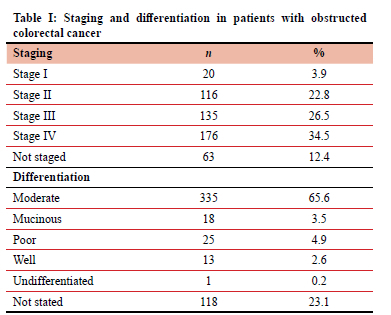
Table I shows staging and tumour differentiation in patients with obstructed CRC. Stage III and IV disease accounted for 61% and stage I only 4%. Moderately differentiated tumours were present in two-thirds of the patients with mucinous differentiation being observed in 18 (3.5%).
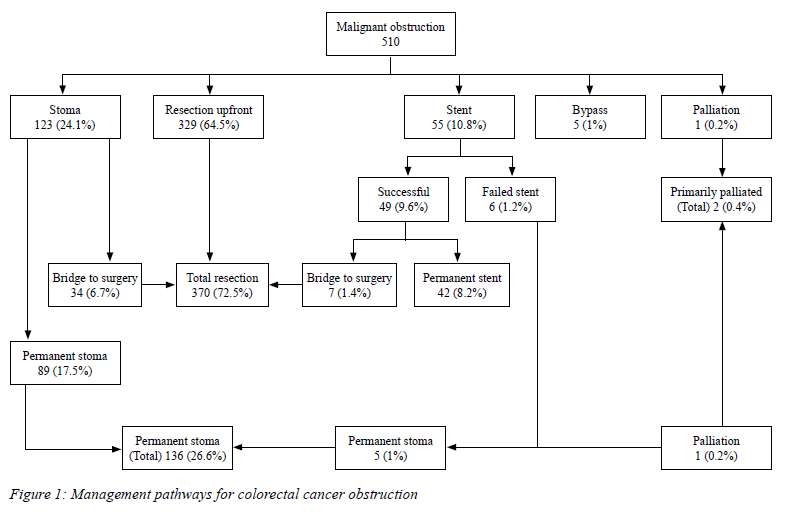
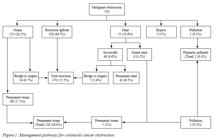
Figure 1 shows management pathways of the patients with CRC obstruction. Three hundred and sixty-seven patients (72%) underwent resection. The primary management of an obstruction was resection, followed by the insertion of a stent and the diversion of the colostomy. Out of the 370 patients who had resection, almost 70% were primarily resected, while 55 had a SEMS insertion. One hundred and thirty-six (26.6%) patients required permanent stoma from the total cohort of 510, of these, 89 (17.5%) were patients initially planned for primary resection. Eleven patients underwent trial for resection but were deemed irresectable.
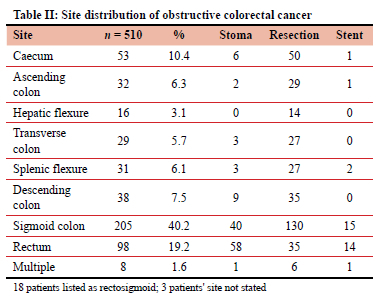
The obstructing cancer site distribution is shown in Table II. The most common site was the rectosigmoid colon (59.4%).
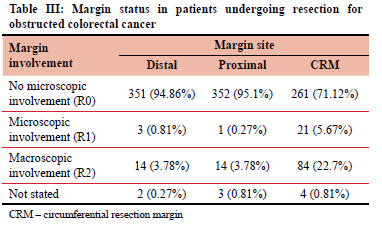
Table III illustrates the margin status of the 370 patients who underwent resection. An R0 resection was achieved in 260 patients (70.3%). The positive margin rate was 29%.
Twenty-one and three patients had R1 and R2 resections respectively.
Forty-three patients (8.4%) received neoadjuvant therapy of whom 16 underwent resection. One hundred and ninety-seven were offered adjuvant therapy; only 72 (19.5%) received adjuvant therapy. One hundred and fifty-six patients (30.6%) received palliative therapy and 114 (21.7%) received no chemotherapy or radiation.
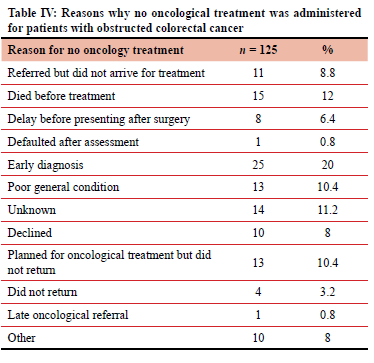
Table IV shows reasons for failure to receive oncological therapy. Forty-five patients were lost to follow-up after discharge from the hospital. The remaining 465 (91.2%) patients were followed up for a median of 11 months (IQR 4-26). The longest period a patient was followed up was 106 months. Recurrence occurred in 34 (6.7%) patients.
All recurrences occurred in patients who underwent upfront resection (recurrence rate 9.8%) and none from those who received neoadjuvant therapy prior to definitive surgery. Median disease-free interval for patients developing recurrence was 21 months (IQR 12-32). There were 242 (47.5%) patients who are known to have died, of whom 22 (4.3%) died in hospital. The date of death was only recorded in 59 (11.6%).
Discussion
The study sought to establish the clinicopathological spectrum and management of obstructed CRC in KZN.
A number of observations have been made which are in keeping with observations in the international literature. CRC presents as an emergency in a wide range of patients, but the vast majority of reports present a figure of around 30%.75,8,9 The proportion of patients with obstructed CRC from our database of CRC patients was 20.4%, which falls in the mid-range of the 10-30% reported in international reports.5,8,9 It is unclear in the setting of this cohort who generally have a poor socioeconomic status, how health-seeking behaviours or the pathway of care influences the rate of misdiagnosis and late complicated presentation with LBO.8
Moolla and Madiba found that the mean age in South African black patients with obstructing CRC was 50 years, nearly a full two decades earlier than patients from HICs and a decade earlier than other racial groups in South Africa.10
Tumour staging is seen as an important prognostic predictor of clinical outcome for patients with CRC.1111121313
In this series, 70% were obstructed in the rectosigmoid region with over two-thirds having stage III and IV disease. These findings are comparable to those from a HIC country study that reported 70.5% had obstructing cancers at a site distal to the splenic flexure and 53.4% had T4 tumours.14
Over 70% of patients with obstruction were managed with resection in this study. This is in keeping with international trends typified by the report of Lee et al. that recommends that a single-stage procedure should be the objective for the treatment of patients with obstructing colorectal cancers, except hemodynamically unstable patients during surgery or when the condition of the bowel is not optimal for primary anastomosis.15
Ten per cent of our patients had SEMS. This is in sharp contrast to a Japanese multicentre systematic review that showed 47% patients had SEMS, a rate four times higher than in our study. Diverting stoma was performed twice as often as SEMS in our study, whereas in their study, it was performed with equal frequency. Their study showed that the major complication rate was 16% in the SEMS group, which was half of those who had a stoma. In our study, technical success was achieved in 90%. The vast majority were palliative with only seven of the 49 successful SEMS enabling a bridge to surgery. Stenting has been reported to have an adverse effect on survival, though a current meta-analysis suggests that SEMS placement might not negatively influence oncological long-term outcomes, but will decrease the number of permanent stomas when compared to emergency surgery.161717
The aim of oncological surgery is to achieve negative circumferential and longitudinal resection margin, which is considered the hallmark of a successful oncologic resection with several studies demonstrating that CRC margin involvement is able to predict local recurrence and poor prognosis.1814
Improving oncological outcomes also requires neoadjuvant or adjuvant chemo- or chemoradiation therapy.
The poor follow-up in this series makes it difficult to assess efficacy, though the 16 patients who received neoadjuvant therapy had no recurrence of disease post resection.
The yearly incidence of recurrent disease after curative resection is about 9.9% at 1 year, 26.2% at 3 years, and 31.5% at 5 years.19
The limitations of this study include the poor follow-up of patients who did not return for surveillance including colonoscopy during the study period, which precludes an accurate analysis of long-term oncological outcomes.
Conclusion
LBO diagnosed clinically and by plain radiographs is a common clinical presentation of CRC in this South African cohort. The R0 resection rate is below that found in HICs. Better delineation of partial from complete obstruction may reduce the need for urgent surgery and a more planned oncological approach in those with partial obstruction. In those with complete obstruction, improved timely access to colorectal SEMS could reduce the need for diverting stomas with their attendant morbidity. Barriers to long-term routine follow-up with postoperative surveillance need to be identified and addressed to optimise oncological outcomes.
Acknowledgements
I would like to thank my supervisors Prof. TE Madiba and Dr S Cheddie, whose lives we lost during the completion of this study, for their dedicated support, guidance and continuously providing encouragement.
Conflict of interest
The authors declare no conflict of interest.
Ethical approval
Permission to conduct the study was granted from the Biomedical Research Ethics Committee of the University of KwaZulu-Natal (BREC no: BREC/00001235/2020).
ORCID
N Ndlovu https://orcid.org/0000-0002-0259-0345
S Kader https://orcid.org/0000-0002-6216-5703
Y Moodley https://orcid.org/0000-0002-4119-1734
S Cheddie https://orcid.org/0000-0002-1844-5759
TE Madiba https://orcid.org/0000-0002-0155-9143
REFERENCES
-
1. Graham A, Adeloye D, Grant L, Theodoratou E, Campbell H. Estimating the incidence of colorectal cancer in Sub-Saharan Africa: A systematic analysis. J Glob Health. 2012;2(2):020404. https://doi.org/10.7189/jogh.02.020404.
» https://doi.org/10.7189/jogh.02.020404 -
2. Brand M, Gaylard P, Ramos J. Colorectal cancer in South Africa: An assessment of disease presentation, treatment pathways and 5-year survival. S Afr Med J. 2018;108(2):11822. https://doi.org/10.7196/SAMJ.2018.v108i2.12338.
» https://doi.org/10.7196/SAMJ.2018.v108i2.12338 -
3. Phillips R, Hittinger R, Fry J, Fielding L. Malignant large bowel obstruction. Br J Surg. 1985;72(4):296-302. https://doi.org/10.1002/bjs.1800720417.
» https://doi.org/10.1002/bjs.1800720417 -
4. Decker KM, Lambert P, Nugent Z, et al. Time trends in the diagnosis of colorectal cancer with obstruction, perforation, and emergency admission after the introduction of population-based organized screening. JAMA Network Open. 2020;3(5):e205741-e. https://doi.org/10.1001/jamanetworkopen.2020.5741.
» https://doi.org/10.1001/jamanetworkopen.2020.5741 -
5. Pisano M, Zorcolo L, Merli C, et al. 2017 WSES guidelines on colon and rectal cancer emergencies: obstruction and perforation. World J Emerg Surg. 2018;13(1):1-27. https://doi.org/10.1186/s13017-018-0192-3.
» https://doi.org/10.1186/s13017-018-0192-3 -
6. Heald R, Husband E, Ryall R. The mesorectum in rectal cancer surgery - the clue to pelvic recurrence? Br J Surg. 1982;69(10):613-6. https://doi.org/10.1002/bjs.1800691019.
» https://doi.org/10.1002/bjs.1800691019 -
7. Lee-Kong S, Lisle D. Surgical management of complicated colon cancer. Clin Colon Rectal Surg. 2015;28(04):228-33. https://doi.org/10.1055/s-0035-1564621.
» https://doi.org/10.1055/s-0035-1564621 -
8. Ramos RF, Dos-Reis LCS, Teixeira BEB, et al. Colon cancer surgery in patients operated on an emergency basis. Rev Col Bras Cir. 2017;44:465-70. https://doi.org/10.1590/0100-69912017005007.
» https://doi.org/10.1590/0100-69912017005007 -
9. Shwaartz C, Fields AC, Prigoff JG, Aalberg JJ, Divino CM. Should patients with obstructing colorectal cancer have proximal diversion? Am J Surg. 2017;213(4):742-7. https://doi.org/10.1016/j.amjsurg.2016.08.005.
» https://doi.org/10.1016/j.amjsurg.2016.08.005 -
10. Moolla Z, Madiba TE. Trends in demographics and management of obstructing colorectal cancer. World J Surg. 2014;38(9):2466-70. https://doi.org/10.1007/s00268-014-2595-y.
» https://doi.org/10.1007/s00268-014-2595-y - 11. Fleming M, Ravula S, Tatishchev SF, Wang HL. Colorectal carcinoma: pathologic aspects. J Gastrointest Oncol. 2012;3(3):153.
-
12. Ho Y-H, Siu SK, Buttner P, et al. The effect of obstruction and perforation on colorectal cancer disease-free survival. World J Surg. 2010;34(5):1091-101. https://doi.org/10.1007/s00268-010-0443-2.
» https://doi.org/10.1007/s00268-010-0443-2 -
13. Nozawa H, Morikawa T, Kawai K, et al. Obstruction is associated with perineural invasion in T3/T4 colon cancer. Colorectal Disease. 2019;21(8):917-24. https://doi.org/10.1111/codi.14655
» https://doi.org/10.1111/codi.14655 -
14. Atsushi I, Mitsuyoshi O, Kazuya Y, et al. Long-term outcomes and prognostic factors of patients with obstructive colorectal cancer: a multicenter retrospective cohort study. World J Gastroenterol. 2016;22(22):5237. https://doi.org/10.3748/wjg.v22.i22.5237.
» https://doi.org/10.3748/wjg.v22.i22.5237 -
15. Lee YM, Law WL, Chu KW, Poon RT. Emergency surgery for obstructing colorectal cancers: A comparison between right-sided and left-sided lesions. J Am Coll Surg. 2001;192(6):719-25. https://doi.org/10.1016/S1072-7515(01)00833-X.
» https://doi.org/10.1016/S1072-7515(01)00833-X -
16. Amelung FJ, Burghgraef TA, Tanis PJ, et al. Critical appraisal of oncological safety of stent as bridge to surgery in left-sided obstructing colon cancer: a systematic review and meta-analysis. Crit Rev Oncol Hematol. 2018;131:66-75. https://doi.org/10.1016/j.critrevonc.2018.08.003.
» https://doi.org/10.1016/j.critrevonc.2018.08.003 -
17. Van Hooft JE, Veld JV, Arnold D, et al. Self-expandable metal stents for obstructing colonic and extracolonic cancer: European Society of Gastrointestinal Endoscopy (ESGE) Guideline-Update 2020. Endoscopy. 2020;52(05):389-407. https://doi.org/10.1055/a-1140-3017.
» https://doi.org/10.1055/a-1140-3017 -
18. Balbaa MA, Elkady N, Abdelrahman EM. Predictive factors of positive circumferential and longitudinal margins in early T3 colorectal cancer resection. Int J Surg Oncol. 2020;2020:6789709. https://doi.org/10.1155/2020/6789709.
» https://doi.org/10.1155/2020/6789709 -
19. Guraya SY. Pattern, stage, and time of recurrent colorectal cancer after curative surgery. Clin Colorectal Cancer. 2019;18(2):e223-e8. https://doi.org/10.1016/jxlcc.2019.01.003.
» https://doi.org/10.1016/jxlcc.2019.01.003