Balinsky's Darwinian roots
Abstract
Boris Ivan Balinsky (1905-1997) was Professor and Head of the Department of Zoology at the University of the Witwatersrand (Wits), Johannesburg, South Africa. He came to Wits in 1949 (via Munich and Edinburgh) from Kiev, where he was Professor of Embryology. As an acclaimed experimental embryologist he was especially famous for inducing a supernumerary limb in a newt when he was a 19-year-old student in Ivan Schmalhausen's laboratory in Kiev 1924. In Johannesburg he wrote his famous textbook of embryology, which influenced generations of students around the world. In addition to pioneering the application of electron microscopy to the study of early development, he tackled a variety of projects of general zoological interest. Lesser known is his latter day work, carried out during his retirement, on variation and hereditability (especially of wing colouration) in the butterfly Acraea horta, on which he published five papers from 1974 to 1986. His butterfly work showing the loose connection between the genotype and phenotype, with the genotype expressing itself in a variable way in the face of a constant physical environment, is of special interest in the current era of evolutionary and ecological developmental biology. His exposure to the stimulating evolutionary ideas of Schmalhausen during his early Kiev years no doubt provided a context for his butterfly work. Some ideas about how the 'loose connection between the genotype and phenotype' may be achieved through behavioral modification or positional information during development are addressed in this paper in the light of recent work. In his eighties Balinsky worked on the classification of microlepidoptera on which he published several papers. He died in September 1997, just short of his 92nd birthday.
Balinsky; butterfly; Acraea; wing-phenotype; hereditability; Schmalhausen
Background
Boris Balinsky was born in Kiev, Ukraine, in 1905—the year of the first Russian revolution. He was a student at the University of Kiev in the 1920s. His teacher, and later his mentor, was the luminary Ivan Schmalhausen (1884–1963). Schmalhausen was a vital force in the Russian development of the 'modern synthesis' in evolutionary biology1 Factors of Evolution: The Theory of Stabilizing Selection.2 3,4 and especially by his remarkable experiment3 5 3 3 An Introduction to Embryology,6 6 3
Balinsky's evolutionary roots in the Kiev years
In 1968, Balinsky, as Professor of Zoology at the University of the Witwatersrand, wrote an article on Darwin for the Wits science students journal, Probe.7 5 8 3,8 as later set out in Factors of Evolution.2 8 9 Factors of Evolution was 'nothing less than an attempt to integrate evolutionary morphology, population genetics, experimental embryology, and ecology into a coherent framework to provide a causal theory for evolution'. Rather accordingly, the field of interest of Schmalhausen's teacher Severtsov,8 9–11 When Schmalhausen accepted the directorship of the Moscow Institute of Evolutionary Morphology following Severtsov's death in 1935, he negotiated to maintain his Directorship in the Ukrainian Academy on a part-time basis and Balinsky, who in the meantime had been appointed as Professor of Embryology at Kiev University in 1933 at the age of 28, was appointed Deputy-Director of the Biological Institute in the Ukrainian Academy of Science.3,8
While Balinsky wrote about Schmalhausen's Factors of Evolution in his later years,8 3 8 Factors of Evolution2Factors was published in 1949, the year Balinsky sailed for South Africa. Against this dire background, a further disaster came with Lysenko's tirade in August 1948, in Leningrad, against the many supporters of Mendelian-based genetics, which resulted in their instant dismissal. Schmalhausen lost his position as Director of the Institute of Evolutionary Morphology and was expelled from Moscow University.8 8 3
As a student in Kiev in 1925, Balinsky attended Schmalhausen's lectures on evolution. Rather presciently for Balinsky's later career in South Africa (1949–1997), Schmalhausen stressed the importance of Raymond Dart's work in recognising the hominid character of Australopithecus—at the time that the idea still met with considerable scepticism.8 12 13 The Organism as a Whole in Individual and Historical Development. In 1936, Balinsky, who had a fair command of German, was asked by Schmalhausen to translate Anton Dohrn's famous book,14 The Origin of Vertebrates and the Principle of Succession (i.e., Change) of Functions, from the original German into Russian. Dohrn was a strong advocate of Darwin's 'Theory of Evolution by Natural Selection'. Balinsky recalls that 'translating the book gave me great pleasure and also insight into some problems of evolution.' The translated book, with an introduction by Schmalhausen, was published in 1937.3,8
In his Probe article of 1968,7 Probe article or even earlier, thinking about how he would address the problem. In a way it was inevitable that he chose to tackle the subject using butterflies. As an 11-year-old boy in the Ukraine, he was stimulated by Akasov's book on collecting butterflies as well as by Berge's Small Atlas of Butterflies and Moths during his summer visits to his grandfather's parish in the countryside and he became an avid collector and classifier for about ten years.3 The Orthoptera and Pseudoneuroptera of the Russian Empire by Jacobson and Bianki, he was attracted to the orders which had aquatic larvae and he initially started working on mayflies from 1924. Then, for logistical reasons, he switched to stoneflies, especially on his summer trips to the Caucasus where they are abundant.3,15 Subsequently, in South Africa, he focused on dragonflies. All this was undertaken in parallel with his embryological career and other broad zoological interests.
Variation and hereditability in butterflies
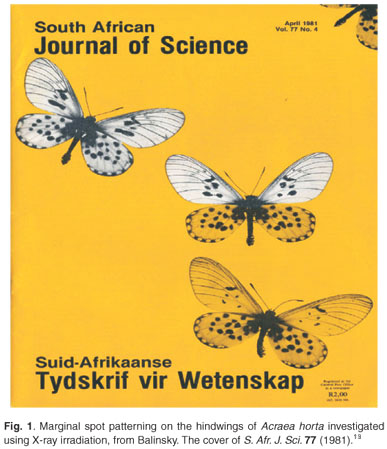
In anticipation of his formal retirement as Professor and Head of Department at Wits at the end of 1973, Balinsky prepared the way for his new line of research on variation and hereditability in South African lepidoptera. In searching for a suitable species, he chose the African garden butterfly Acraea horta, which had the advantage of the caterpillars feeding on leaves of the tree Kiggelaria Africana, which he was able to grow in his garden. He also built himself a butterfly breeding shed and his study become a research laboratory. The whole operation was a going concern prior to his formal retirement. In his new role as an Honorary Professorial Research Fellow, and working from home, he was able to rear Acraea horta, starting with single pairs, through ten generations under conditions of inbreeding, mostly brother–sister matings.16 17–20 (see Fig. 1).
Of special interest is his paper on the inheritance of wing colouration in females.17
The results showed that the genotype does not strictly determine the phenotype of the individual female, i.e. with the same genotype the colour could vary within a wide range from pale yellow to bright red. Thus, yellow females could give rise to orange and brick-red females, red females to yellow and orange ones, and orange females to yellow and red ones. As he put it, with the expression of the genotype in individual females being highly variable, the selection differential of individual females has hardly any selection response. In a letter written to me on the 24 February 1977, he summarised the progress of his work as follows: 'What I think is really the main general result of the work I have done so far, is the loose connection in my butterflies between genotype and phenotype: the genotype expressing itself in a variable way… which of course is nothing new, known in Drosophila, but then Drosophila is only one species, and I am not sure that it can be considered as a 'typical' case of a wild animal'. While his findings showed that any particular female could give rise to progeny across the colour range of the inbred brood, a most intriguing aspect of the paper was that the averages of the colour classes of the parental generations were highly heritable in terms of filial generation averages.
Balinsky's finding that the genotype expressed itself in a variable way in his butterflies, is very much in line with Schmalhausen's 'reaction norm',2 112
While the influence of the environmental factors of temperature and light on butterfly wing colour has been well documented (see Gilbert and Epel1111,21 in which sensory information from the environment is transferred via the neuroendocrine system to the tissues where it is able to regulate gene expression. As summarised by Gilbert and Epel,11 1111
The involvement of the neuroendocrine pathway in wing colouration has been well documented11 Araschnia levan, where the wing colouration at the time of eclosing from the pupal case is usually bright orange in spring and black in summer. The change of colouration, from spring to summer morphs, was found to be regulated by changes in day length and temperature during the larval period,11,22,23 which suggested that a neuroendocrine signalling pathway is involved. It was further found that these environmental signals modulated the phenotype by regulating the amount of the hormone ecdysone during the larval stage of development. Larvae that develop in spring do not experience a pulse of ecdysone, whereas summer larvae do. An injection of ecdysone converted the colouration of the spring form into the summer form. Most pertinently for the present discussion, the injection of intermediate amounts of ecdysone produced intermediate phenotypes not found in natural conditions.11,21 As applied to Balinsky's butterflies, these findings suggest that the range of wing colouration in a brood could be underwritten by a range of ecdysone concentrations across the individuals of the brood. However, this still leaves open the question of how a range of ecdysone concentrations is established in a seemingly homogenous batch kept under the same physical conditions, and how the range repeats in each generation.
'Each genome encodes a continuous range of potential phenotypes … and the environment each encounters determines its phenotype'
What type of mechanism could generate the range of wing-colour morphs in the brood from a single female in Balinsky's butterflies reared under the same physical conditions? As wing-colour pattern is determined in the late larval wing bud and the early pupal wing—in time for the synthesis of pigments shortly before the emergence of the adults2425,26 Hence the succession of scale development may determine the final wing colouration and is thus open to time-based modulation. This raises the question of the extent to which the level of ecdysone can influence the rate of developmental succession in the synthesis of wing pigments in the specialised wing scale cells. Does heterochronic modulation control wing colouration?
There is, however, another possible way in which a graded bias could be applied to developing embryos. It is based on the embryological principle27 Acraea butterflies, the eggs are laid in batches of typically 100–150 and are not scattered singly, as in most Rhopalocera. This opens up the possibility of establishing an inside–outside positional effect or gradient across the egg-batch. Eggs would take on a bias as a result of their position in the batch. Along the same general line of reasoning, a developmental bias could be imposed on eggs at an even earlier stage as a result of the spatial distribution of ovarioles in the ovary and the ensuing order of egg laying. In the contemporary context, such positional biasing could be effected by epigenetic changes in the DNA, such as in the level of cytosine methylation, chromatin packaging via histone variants, or in the binding of short antisense RNAs. A relevant aspect of the epigenetic circuitry is its regulatory effect on transcription, thereby positioning epigenetic reactions as possible regulatory switches acting on specific genes early on in development, even from the time of oogenesis. In this way, epigenetic changes in the egg could, for example, affect specific genes that are later transcribed in the pathway of wing colouration, or which affect the rate of development of the neuroendocrine pathway and its secretory activity (a heterochronic effect).
It would be intriguing to assay epigenetic changes that occur in eggs from early developmental stages, especially with respect to Balinsky's findings—are there epigenetic differences between inside and outside eggs within a batch? A simple first experiment to address the above considerations, behavioural or positional, would be to follow the development of single eggs or embryos in isolation, with respect to the development of wing colouration.
A concealed pool of genetic variability?
In his paper on the 'Variation and Inheritance of Wing Spotting in Acraea',18
In order to increase the amount of heritable variability in the study, Balinsky irradiated the pupae with X-rays and subsequently with UV. In one spotting variation following X-ray irradiation, there was a spectacular change in the shape of the wing marginal spots which were converted into longitudinal streaks.19,20 However, although he experimented with different doses of radiation, the initial aim of the experiment—to obtain new mutant breeding strains for subsequent genetic study—was not achieved. He suggested this was possibly due to the limited scale of the operation, which was not large enough to produce recessive mutations.
While it is recognised that widespread genetic variation exists that may be unexpressed, it is only beginning to be appreciated that some of this cryptic variance may be important in maintaining phenotypic stability28 22,29,*.
Understanding the nature and role of concealed variation has attracted a lot of interest in recent years. As Gibson and Dworkin32 11,33—a year after he died— of a molecular mechanism which unmasks cryptic genetic variation through stress. This was achieved by mutating the heat shock gene Hsp83, thereby inactivating its protein Hsp90, which produced a range of 'concealed' phenotypes. The mechanism hinges on the functioning of Hsp as a molecular chaperone that keeps many proteins in their functional 3D conformation.11,33 Rutherford and Lindquist's inspirational conclusion was that Hsp90 functions as a capacitor for morphological evolution.
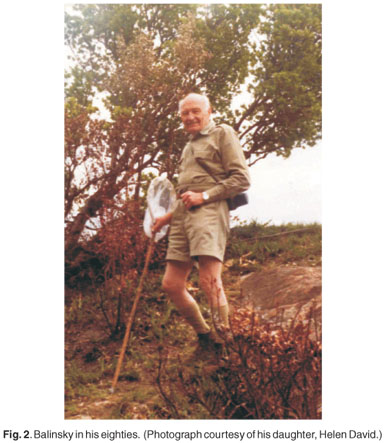
Balinsky published five papers on his butterfly breeding experiments, working from home during the first twelve years of his retirement (1974–1986) from the age of 69 until 81. It was as if he had waited for his retirement days to address this central biological problem (Fig. 2).
Taxonomic studies
After the butterfly work, Balinsky, now in his eighties (Fig. 2), returned to his evergreen interest in taxonomy and chose to work on the identification of moths (microlepidoptera) from a vast collection housed in the Transvaal Museum. He published five articles on this work from 1987 to 1994,34–38 by which time he was 89. As is well known, an important tool in the classification of the lepidoptera is the structure of the intricate parts making up the genitalia. It is held that 'male and female genital compatibility serves to isolate different species reproductively', and hence the notion of a lock-and-key hypothesis of genital evolution.39
On a visit to Balinsky's home in about 1990, he eagerly showed me the technique he used to prepare the specimens and we viewed the dissected genitalia under the microscope. When I naively suggested, knowing abysmally little about the field at the time, that the work informed on the emerging evo-devo approach—given that the intricate structures were at the crossroad of embryonic development, variation and selection—he was somewhat amused. Having spent a lifetime identifying insects, he had no doubt reflected on the changes and implications of these mating structures during evolutionary time. But more to the point, the immediate problem before him, now in his 80s, was the identification of microlepidoptera specimens in the museum collection—a feasible and remarkable, well-chosen project for his time of life. And then there was the exciting possibility of identifying some new species. But no doubt his benignly amused response also stemmed from his years of experience which allowed him to view all this new 'evo-devo' talk as being rather 'old hat' – just a reawakening of the earlier Severtsov-Schmalhausen milieu at a molecular level. As he liked to remind one, fashions in research come and go, but are profitably reinvestigated with the tools of the time, as with his own swift application of the then new technique of electron microscopy to the study of early development. As succinctly expressed by Weaver and Hogan,40
I appreciate a grant from the Faculty of Science (FRC), University of the Witwatersrand towards the writing and publication of this paper.
References
- 1. Levit G.S., Hossfeld U. and Olsson L. (2006). From the 'modern synthesis' to cybernetics: Ivan Ivanovich Schmalhausen (1884–1963) and his research program for a synthesis of evolutionary and developmental biology. J. Exp. Zool. 306B, 89–106.
- 2. Schmalhausen I.I. (1949). Factors of Evolution: The Theory of Stabilizing Selection. Blakiston, Philadelphia.
- 3. Balinsky B.I. (1988). The Boris Balinsky Memoir. The Archive of the University of Illinois in Urbana-Campaign, Urbana, IL.
- 4. Mangold O. (1923). Transplantationsversuche zur Frage der Spezifität und der Bildung derKeimblätter beiTriton. Arch. Micr. Anat. u. Entw. Mech. 100, 198–301.
- 5. Balinsky B.I. (1925). Transplantation des Ohrbläschens bei Triton. Roux' Archiv. Microscop. Anat. Entwicklungsmech. Org. 105, 718–731.
- 6. Balinsky B.I. (1960). An Introduction to Embryology. W.B. Saunders Company, Philadelphia.
- 7. Balinsky B.I. (1980). Darwin's Day. Probe – The Journal of the Science Students Council. University of the Witwatersrand, Johannesburg.
- 8. Balinsky B.I. (1980). Scientists remember: B.I. Balinsky on Ivan I. Schmalhausen. S. Afr. J. Sci. 76, 498–499.
- 9. Gilbert S.F. (2003). The morphogenesis of evolutionary developmental biology. Int. J. Dev. Biol. 47, 467–477.
- 10. Adams M.B. (1980). Severtsov and Schmalhausen: Russian morphology and the evolutionary synthesis. In The Evolutionary Synthesis: Perspectives on the Unification of Biology, eds E. Mayr and W.B. Provine, pp. 193–228. Harvard University Press, Cambridge, MA.
- 11. Gilbert S.F. and Epel D. (2009). Ecological Developmental Biology: Integrating Epigenetics, Medicine, and Evolution. Sinauer Associates Inc., Sunderland, MA.
- 12. Smuts J.C. (1926). Holism and Evolution. Macmillan, London.
- 13. Schmalhausen I.I. (1938). The Organism as a Whole in Individual and Historical Development (in Russian). Akad. Nauk SSSR, Moscow.
- 14. Dohrn A. (1875). Der Ursprung der Wirbelthiere und das Princip des Functionswechsels: Genealogische Skizzen. Engelmann, Leipzig.
- 15. Balinsky B.I. (1950). On the Placoptera of the Caucasus. Trans. R. Ent. Soc. London 101, 59–87.
- 16. Balinsky B.I. (1974). Ten generations inbreeding of Acraea horta (L) (Lepidoptera). J. Ent. Soc. Sth. Afr. 37, 9–86.
- 17. Balinsky B.I. (1977). Inheritance of wing colour in females of the butterfly Acraea horta L. J. Ent. Soc. Sth. Afr. 40, 1–11.
- 18. Balinsky B.I. (1979). Variation and inheritance of wing spotting in the butterfly Acraea horta (L). Rev. Zool. Afr. 93, 810–879.
- 19. Balinsky B.I. (1981). Immediate and delayed effects of radiation on the genetic endowment of the butterfly, Acraea horta L. S. Afr. J. Sci. 77, 162–167.
- 20. Balinsky B.I. (1986). Early differentiation in the egg of the butterfly, Acraea horta under normal conditions and after ultraviolet irradiation. Acta Embryol. Morph. Exp. 6, 103–141.
- 21. Nijhout H.F. (2003). Development and evolution of adaptive polyphenisms. Evol. Dev. 5, 9–18.
- 22. Koch P.B. and Bückmann D. (1987). Hormonal control of seasonal morphs by the timing of ecdysteroid release in Arachnia levana L. (Nymphalidae: Lepidoptera). J. Insect Physiol. 33, 823–929.
- 23. Nijhout H.F. (1991). The Development and Evolution of Butterfly Wing Patterns. Smithsonian Institution Press, Washington D.C.
- 24. Nijhout H.F. (1980). Pattern formation on lepidopteran wings: determination of an eye spot. Dev. Biol. 80, 267–274.
- 25. NijhoutH.F. (1980). Ontogeny of the color pattern on the wings of Precis coenia (Lepidoptera: Nymphalidae). Dev. Biol. 80, 275–288.
- 26. Koch P.B., Lorenz U., Brakefield P.M. and ffrench-Constant R.H. (2000). Butterfly wing pattern mutants: developmental heterochrony and coordinately regulated phenotypes. Dev. Genes Evol. 210, 536–544.
- 27. Richardson M.K. (2009). Diffusible gradients are out – an interview with Lewis Wolpert. Int. J. Dev. Biol. 53, 659–662.
- 28. Carroll S.B., Grenier J.K. and Weatherbee S.D. (2001). From DNA to Diversity: Molecular Genetics and the Evolution of Animal Design. Blackwell Scientific, Malden, MA.
- 29. Wake D.B. Foreword. In Schmalhausen I.I. (1986). Factors of Evolution: The Theory of Stabilizing Selection. University of Chicago Press, Chicago, IL.
- 30. Waddington C.H. (1957). Strategy of the Genes: A Discussion of Some Aspects of Theoretical Biology. Allen and Unwin, London.
- 31. Waddington C.H. (1975). The Evolution of an Evolutionist. Cornell University Press, Ithaca, NY.
- 32. Gibson G. and Dworkin I. (2004). Uncovering cryptic genetic variation. Nat. Rev. Genet. 5, 681–690.
- 33. Rutherford S.L. and Lindquist S. (1998). Hsp90 as a capacitor for morphological evolution. Nature 396, 336–342.
- 34. Balinsky B.I. (1987). Ancylosis (Heterographis) subpyrethrella (Ragonot, 1888) and five related new species from southern Africa (Lepidoptera: Phycitinae). Ann. Trans. Mus. 34(14), 303–317.
- 35. Balinsky B.I. (1989). Ancylosis/Heterographis/Staudingeria group of Phycitinae (Lepidoptera: Pyralidae) in southern Africa. Ann. Trans. Mus. 35(5), 75–107.
- 36. Balinsky B.I. (1991). On genitalia of some southern African Phycitinae (Lepidoptera, Phycitinae). S. Afr. J. Zool. 26(1), 11–35.
- 37. Balinsky B.I. (1991). New and inadequately described genera and species of Phycitinae (Pyralidae, Lepidoptera) from southern Africa. S. Afr. J. Zool. 26(3), 93–114.
- 38. Balinsky B.I. (1994). A Study of African Phycitinae in Transvaal Museum. Privately published, Johannesburg.
- 39. Gilligan T.M. and Wenzel J.W. (2008). Extreme intraspecific variation in Hystrichophora (Lepidoptera: Tortricidae) genitalia — questioning the lock-and-key hypothesis. Ann. Zool. Fennici 45, 465–477.
- 40. Weaver M. and Hogan B. (2001). Powerful ideas driven by simple tools: lessons from experimental embryology. Nat. Cell Biol. 3, E165–E167.
Accepted 19 November 2009.