Management of Dental Caries in an HIV-infected Child: A Case Report
Abstract
BACKGROUND: HIV/AIDS remains prevalent in Sub-Saharan Africa with South Africa maintaining the highest number of daily infections and the largest population of individuals living with HIV. Dental caries as an oral disease itself, is highly prevalent in the same epidemiological region. Contemporary literature documents an increased prevalence and severity of dental caries in association with HIV- infection. This case report describes the clinical presentation of dental caries in an HIV-infected child whilst outlining the management undertaken. CASE REPORT: A 5-year-old male patient was diagnosed with Human Immunodeficiency Virus (HIV) infection shortly after birth. The patient was initiated on Highly Active Antiretroviral Therapy (HAART) in 2017. HIV was acquired in this case because of vertical transmission from mother-to-child. Clinical examination showed dental caries on all primary molars as well as the interproximal surfaces of the anterior teeth. DISCUSSION: Oral disease is a common manifestation of HIV within the paediatric patient group. The oral manifestations of HIV need to be documented to underscore the significance of these in Paediatric Dentistry. The detailed management of dental disease should be highlighted to compare treatment with that undertaken in HIV-negative patients. CONCLUSION: Increased research related to HIV-status and caries risk is essential for understanding the management principles required in treating these patients. Furthermore, the synergistic relationship between dental caries and lowered immunity should be highlighted.
HAART; HIV; ART; oral manifestations; dental caries; Paediatric Dentistry
Introduction
The World Health Organisation (WHO) defines HIV as a viral infection which targets the immune system, weakening its defence against other forms of infectious disease. The virus destroys the function of immune cells which is measured by the CD4 T-cell count. In 2020, the WHO documented that an estimated 680 000 (480 000 to 1.0 million) people died because of HIV-associated disease with an estimated 1.5 million (1 to 2 million) newly acquired HIV- infections. Furthermore, it was estimated that by the end of 2020, there were 37.7 million (30.2 to 45.1 million) people living with HIV and over two thirds of these (25.4 million) reside in WHO African regions.1
The elimination of mother-to-child (vertical) transmission is a global public health goal and priority. Studies have shown that antiretroviral intervention can assist to reduce the risk of vertical transmission with a documented 15 to 30% risk reduction during pregnancy and labour, less than 2% risk reduction with non-breast feeding and less than 5% risk reduction with breastfeeding.1, 2
Although HIV-infection is associated with well-known pathologies, the need remains for comprehensive comparative studies to determine the association between HIV and early childhood caries. Contemporary studies from several African countries as well as Thailand, have shown a distinct increase in both the prevalence and severity of dental caries in both children and adult patients living with HIV-infection.3-8 HIV-infection is characterised by impairment of functional immunity thereby facilitating the development of opportunistic infections particularly in the oral cavity. About 30 to 80% of HIV- infected individuals present with one or more oral disease/manifestations. In spite of the initiation of HAART which has reduced the incidence of oral manifestations, an Increase in dental caries has been reported within the HIV-positive population.2910107
Case Report
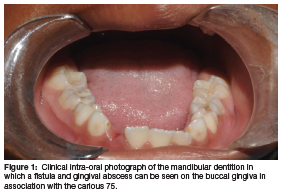
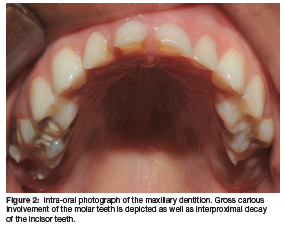
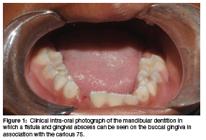
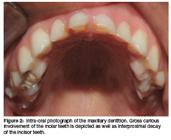
A 5-year-old male patient accompanied by his mother, presented for a dental consultation at the Paedodontics Clinic of the Oral and Dental Hospital at Sefako Makgatho Health Sciences University. The main complaint of the patient was "painful, rotten teeth". The patient's mother explained that several black spots were initially observed on the teeth when the patient was about 4-years old, although these did not prompt any form of intervention as the affected teeth were going to be shed. The mother confirmed that the child had been diagnosed with HIV in his first year of life at which time antiretroviral therapy was initiated. The mother expressed great discomfort to mention the term "HIV" and stated that this information has never been disclosed to the son. Clinical extra-oral examination showed bilateral submandibular lymphadenopathy with pain on the left. In addition, eczema was noted on the facial skin and the patient's lips were markedly cracked whilst he displayed short stature for his age. Intra-oral examination showed a draining fistula in association with tooth 75 (Figure 1). There was carious involvement of teeth 51, 52, 53, 61, 63, 65, 74, 84 and 85 (Figure 2).
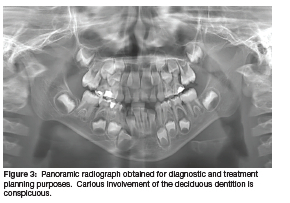
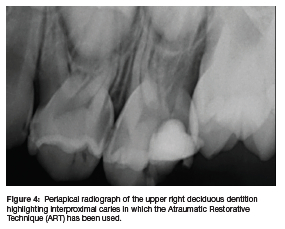
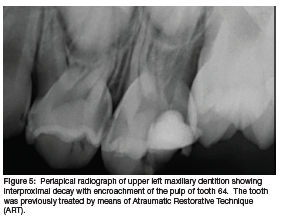
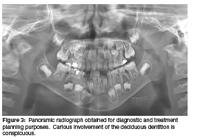
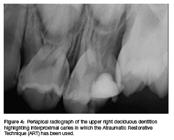
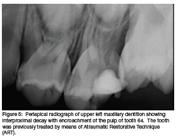
Informed consent was obtained from the mother to continue with treatment. The child was noted to be both negative and withdrawn and was slightly uncooperative. Periapical and panoramic radiographs were taken to assess the extent of carious defects and to assist with treatment planning (Figures 3 to 5).
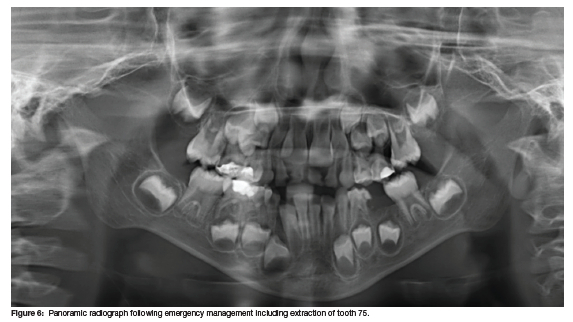
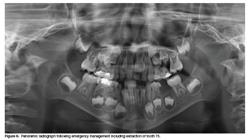
After discussing the treatment plan options, it was agreed that an emergency extraction of tooth 75 be performed (Figure 6). The preventive phase was subsequently commenced and comprised of a scaling and polishing, demonstration of oral hygiene maintenance, placement of fissure sealants on teeth 16, 26, 36 and 46 using 3MTM Clinpro TM sealant as well as a diet review. The corrective phase included pulpotomies on tooth 55 and tooth 85 using Ultradent AstringedentTM -15.5% Ferric Sulfate to stop bleeding followed by the application of pure Dentsply Kalzinol- Zinc Oxide Eugenol Cement Powder and normal saline as a medicament. Restorations using 3MTM KetacTM Universal Glass Ionomer were done on teeth 55, 84 and 85.
Unfortunately, the patient's mother, who is the primary caregiver, was unavailable for subsequent visits where the placement of stainless-steel crowns and space maintainers were planned. This was to be followed by the maintenance phase to be conducted at 3-monthly and then 6-monthly intervals.
DISCUSSION:
The number of paediatric patients affected by HIV remains high in developing countries with vertical transmission from mother-to-child being the major contributor .112, 6
The prevalence of dental caries is much higher in HIV-infected children than in those who are HIV-negative.3-8 It is thus imperative that oral health education be prioritised together with regular screening and prevention.111213141515,16,17 . In our South African context, a study conducted by Mohamed and others in 2020 stated that children as the vulnerable group continue to suffer the impact of the HIV/AIDS pandemic and they may have an increased caries experience compared with their healthy peers.7
It has been shown that HIV-infected children and adults have a significantly higher caries experience with involvement of both the deciduous and permanent dentitions. Furthermore, the presence of caries in HIV-positive children is often associated with hypoplasia of the deciduous dentition, gingival inflammation and lower CD4 T-cell counts.377
The impact of dental caries on the quality of life and daily functioning in both children with HIV and their accompanying caregivers is of great public concern. Caries affects mastication, growth and development. Furthermore, the pain and frequent dental visits which are required, may affect those who are of school going age and work attendance by the accompanying parents /guardian/ caregivers. A carious dentition may have a long-term psychological effect on patients which may be compounded by the stigma associated with HIV-status. The increasing prevalence of dental caries in developing countries is largely because of increased consumption of sugary foods, poor oral hygiene, xerostomia, as well as an altered oral microbiome in conjunction with low levels of awareness of the problem in health care workers.5,7,18
A Ugandan study conducted in patients attending an HIV Care Clinic, revealed general xerostomia within in all HIV-positive patients. This was shown to be because of HIV infiltration of the lymphoid rich salivary glands where it infects the follicular dendritic cells during apparent dormancy whilst it replicates and may result in increased numbers of CD8 lymphocytes. This is what results in generalised lymphadenopathy throughout the body. Many of these patients develop cystic lymphoid hyperplasia of the salivary glands characterised by lymphoepithelial cyst formation. Involvement of the salivary parenchyma results in decreased salivary flow which increases the risk for caries development. The same study showed that female gender and longer duration of antiretroviral treatment are independent risk factors for caries development. Chronic antiretroviral therapy may cause alterations in the normal microbial flora of the oral cavity thus facilitating opportunistic infections which is exacerbated by xerostomia. Moreover, HIV-positive patients are at risk for malnutrition which is worsened by dental caries especially in children and the elderly.5
The oral status of HIV-infected children who attended a Paediatric Infectious Diseases Clinic in Cape Town, South Africa was investigated.7777
CONCLUSION:
It is thus apparent that additional research into the association between HIV-infection and dental caries is required. The literary findings sugg est a relationship exists between HIV-infection and dental caries which requires an understanding of how lowered immunity may synergistically affect multiple factors predisposing to the development of dental caries. There is a need for effective oral health interventions in HIV-positive patients. Thus, the awareness of the high prevalence of dental caries in association with HIV emphasizes the need for strategic public oral health care policies which highlight preventative care and include comprehensive care programmes to holistically meet the needs of these patients.
REFERENCES
-
1. Organization WH. HIV and AIDS. Available at: https://www.who.int/news-room/fact-sheets/detail/hiv-aids. Accessed 17 October 2024.
» https://www.who.int/news-room/fact-sheets/detail/hiv-aids - 2. Coker M, El-Kamary SS, Enwonwu C, et al. Perinatal HIV Infection and Exposure and Their Association With Dental Caries in Nigerian Children. Pediatr Infect Dis J. Jan 2018;37(1):59-65.
- 3. Akhigbe P, Chukwumah NM, Folayan MO, et al. Age-specific associations with dental caries in HIV-infected, exposed but uninfected and HIV-unexposed uninfected children in Nigeria. BMC Oral Health. Sep 27 2022;22(1):429.
- 4. Murererehe J, Malele-Kolisa Y Niragire F, Yengopal V. Prevalence of dental caries and associated risk factors among People Living with HIV/AIDS and HIV uninfected adults at an HIV clinic in Kigali, Rwanda. PLoS One. 2023;18(4):e0276245.
- 5. Kalanzi D, Mayanja-Kizza H, Nakanjako D, Mwesigwa CL, Ssenyonga R, Amaechi BT Prevalence and factors associated with dental caries in patients attending an HIV care clinic in Uganda: a cross sectional study. BMC Oral Health. Jul 19 2019;19(1):159.
- 6. Coker MO, Akhigbe P, Osagie E, et al. Dental caries and its association with the oral microbiomes and HIV in young children-Nigeria (DOMHaIN): a cohort study. BMC Oral Health. Dec 4 2021;21(1):620.
- 7. Mohamed N, Mathiba OP, Mulder R. Oral status of HIV-infected children aged 12 years or younger who attended a Paediatric Infectious Diseases Clinic in Cape Town. Clin Exp Dent Res. Feb 2020;6(1):75-81.
- 8. Kikuchi K, Yasuoka J, Tuot S, et al. Dental caries in association with viral load in children living with HIV in Phnom Penh, Cambodia: a cross-sectional study. BMC Oral Health. Mar 25 2021;21(1):159.
- 9. isser MJ, Neufeld S, de Villiers A, Makin JD, Forsyth BW. To tell or not to tell: South African women's disclosure of HIV status during pregnancy. AIDS Care. Oct 2008;20(9):1138-1145.
- 10. Delva W, Abdool Karim Q. The HIV epidemic in Southern Africa - Is an AIDS-free generation possible? Curr HIV/AIDS Rep. Jun 2014;11(2):99-108.
- 11. Lauritano D, Moreo G, Oberti L, et al. Oral Manifestations in HIV-Positive Children: A Systematic Review. Pathogens. Jan 31 2020;9(2).
- 12. Howell RB, Jandinski J, Palumbo P, Shey Z, Houpt M. Dental caries in HIV-infected children. Pediatr Dent Nov-Dec 1992;14(6):370-371.
- 13. Madigan A, Murray PA, Houpt M, Catalanotto F, Feuerman M. Caries experience and cariogenic markers in HIV-positive children and their siblings. Pediatr Dent. Mar-Apr 1996;18(2):129-136.
- 14. Rwenyonyi CM, Kutesa A, Muwazi L, Okullo I, Kasangaki A, Kekitinwa A. Oral Manifestations in HIV/AIDS-Infected Children. Eur J Dent Jul 2011;5(3):291-298.
- 15. Castro GF, Souza IP, Lopes S, Stashenko P, Teles RP. Salivary IgA to cariogenic bacteria in HIV-positive children and its correlation with caries prevalence and levels of cariogenic microorganisms. Oral Microbiol Immunol. Oct 2004;19(5):281-288.
- 16. Nabbanja, J. , Gitta, S. , Peterson, S. , & Rwenyonyi, C. M. (2013). Orofacial manifestations in HIV positive children attending Mildmay Clinic in Uganda. Odontology, 100, 116-120.
- 17. Yengopal, V. , Kolisa, Y. , Thekiso, M. D. , & Molefe, M. P. (2016). The child and adolescent with HIV in resource poor countries. Oral Diseases, 22, 25-34.
- 18. Teshome A, Muche A, Girma B. Prevalence of Dental Caries and Associated Factors in East Africa, 2000-2020: Systematic Review and Meta-Analysis. Front Public Health. 2021;9:645091.
Name: BK Bunn
Address: Department of Operative Dentistry, School of Oral Health Sciences, Sefako Makgatho Health Sciences University, South Africa.
Email:
Cell: 082-708 5868

Author contributions
P Gwengu - conceptualisation, writing and editing
BK Bunn - writing, editing and submission
S Mudau - clinician who retrieved case, writing and editing