




Servicios Personalizados
Revista

Articulo
 Inglés (pdf)
 Articulo en XML
 Referencias del artículo
 Traducción automática
 Enviar articulo por email
Indicadores
Links relacionados
-
 Citado por Google
 -
 Similares en Google
Compartir

 Permalink
Clean Air Journal
versión On-line ISSN 2410-972Xversión impresa ISSN 1017-1703
Clean Air J. vol.29 no.1 Pretoria 2019
https://doi.org/10.17159/2410-972x/2019/v29n1a8
RESEARCH BRIEF
South African Highveld concentrations of outdoor Total Gaseous Mercury
Belelie MDI; Piketh SJI; Burger RPI; Naidoo MII
INorth-West University Potchefstroom Campus, Unit for Environmental Sciences and Management, Private Bag X6001, Potchefstroom, 2520, South Africa
IICSIR, Natural Resources and the Environment, Climate Studies, Modelling and Environmental Health, Private Bag 395, Pretoria, 0001, South Africa
It is well-known that the Highveld is one of the country's poorest air quality regions. This is due to the abundance of anthropogenic activities such as coal-fired power plants, mining, and cement production among others. The formerly mentioned source is regarded globally and has been extensively studied as the leading source of ambient mercury. Mercury is recurrently oxidized and reduced between its environmental forms. Methyl-mercury poses adverse effects on humans if inhaled/consumed in excessive amounts. In this research, the authors conducted a first-ever characterization of total gaseous mercury (TGM) concentrations over the Highveld region.
We evaluated concentrations of the pollutant at three characteristically different sites (Balfour, Middelburg, and Standerton). Datasets spanning 2009-2013 for each site were obtained from the Mpumalanga Department of Agriculture, Rural Development, and Land and Environmental Affairs. For data investigation and manipulation purposes, we only considered data pertaining to 2009.
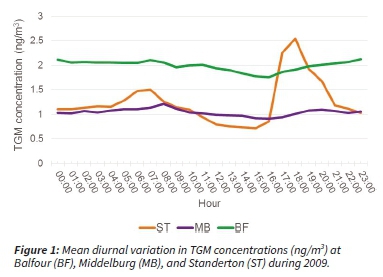
In general, measured concentrations were within the Northern Hemisphere range of 1.5-1.7 ng/m3 and 1.2-1.4 ng/m3 observed at Cape Point, South Africa. The seasonal variation between sites suggests that meteorology had a profound influence on TGM concentrations. Diurnally, no profound variations were observed at Balfour and Middelburg and this may be ascribed to sparse regional sources. At Standerton, however, the observed diurnal variation suggests a significant influence from local domestic coal combustion.
Coal-fired power plants, the foremost source of TGM, appeared to have little to no effect on measured concentrations. This does not imply that it should be discarded as the leading source of the pollutant in the country, but rather highlights the importance of meteorology in regulating spatial and temporal change in concentrations. Additional studies in the immediate vicinity of coal-fired power plants are needed in order to quantify the specific contribution from this source. This study aims to serve as a baseline from which future changes can be measured.
References
Belelie MD, Piketh SJ, Burger RP and Naidoo M. Characterisation of ambient Total Gaseous Mercury concentration over the South African Highveld. Atmospheric Pollution Research 2019;10:12-23. [ Links ]
* Author for correspondence E-mail:monraybelelie@gmail.com
