




Servicios Personalizados
Revista

Articulo
 Inglés (pdf)
 Articulo en XML
 Referencias del artículo
 Traducción automática
 Enviar articulo por email
Indicadores
Links relacionados
-
 Citado por Google
 -
 Similares en Google
Compartir

 Permalink
SAMJ: South African Medical Journal
versión On-line ISSN 2078-5135versión impresa ISSN 0256-9574
SAMJ, S. Afr. med. j. vol.103 no.11 Pretoria ene. 2013
BOOK REVIEW
The Hungry Season: Feeding Southern Africa's Cities
Bridget Farham
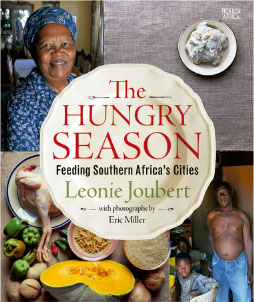
By Leonie Joubert, with photographs by Eric Miller. Johannesburg: Picador Africa, 2012. EAN: 9781770102293.
Leonie Joubert has done it again. She has taken a subject that people think is cut and dried - all you need to do is plant vegetable gardens, right? - and shown that there is a lot more to food security than a few veggies at the bottom of the garden.
As in Boiling Point: People in a Changing Climate, she has told the story of food security, or its lack, through the voices of people. She and Eric Miller took the lives of eight people in eight southern African places to look at the complexity of food security in urban areas. This in itself is an unusual approach - most studies of food security concentrate on rural areas. Urban areas are assumed to be secure -after all, there are shops down the road.
But, as anyone who has looked into food security in any depth will know, this is a complex subject that is not simply about access to food. As Joubert so eloquently states, food has been a major driver of our technological development over the past 12 000 years. We are now largely free of the uncertainties of whether or not there will be enough food tomorrow. There are massive surpluses of food produced, and we can store food for longer and ship it further. Much of what we today recognise as food, would be unrecognisable to our grandparents.
It is food availability that has allowed our cities to grow so big, and ironically, what has now produced a lack of food security for many living in those cities. And it is not just about lack of food security. Within this apparent abundance of food there is childhood stunting and malnutrition and the illnesses associated with a modern, Westernised diet.
The book tackles the most important question - why, when southern Africa produces enough calories and nutrients to feed the region, are so many people living with hunger or the fear of hunger?
This journey through eight people's lives in eight different regions is an enlightening one. Perhaps if the right people read it, we may start to go some way towards addressing this fundamental question.
A delightful animation of The Hungry Season, commissioned by Leonie Joubert and funded by the University of Cape Town's Criminology Department and the Embassy of Finland, is available online at http://www.youtube.com/watch?v=iX77NZttLKo.
